Paper commentary
ProbFaS: Probabilistic Video Frame Selection for MLLMs via Multi-Fidelity Calibration
ProbFaS picks video frames by calibrating cheap alignment scores with MLLM judgments
- Problem Image-text alignment scores rank video frames poorly for answering questions, since their rankings correlate weakly with downstream accuracy. Frame selectors built on them often pick frames the MLLM gains little from.
- Method ProbFaS calibrates cheap alignment scores using sparse yes/no judgments from the MLLM itself. Instead of trusting the scores alone, it fits a co-kriging Gaussian process to map them onto the judgments, then picks frames with a temporal determinantal point process.
- Results ProbFaS is the most accurate of fourteen training-free selectors and uniform sampling in 13 of 15 settings from 8 to 128 frames. Its margin over the strongest baseline reaches 3.1 percentage points.
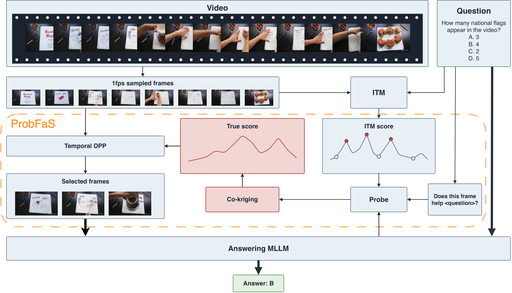
Figure 4 . ProbFaS pipeline. An image–text alignment model first scores every frame of a one-frame-per-second candidate grid against the question, and then the answering MLLM judges m of these frames with a label-free yes/no question. Co-kriging calibrates the low-fidelity alignment scores to these judgments on every frame, and a temporal DPP selects the k frames that the MLLM answers from.
Original paper · CC BY 4.0 · Tianru Zhang, Mayank Nautiyal, Hugo Eidmann, Prashant Singh, Ekta Vats · ProbFaS: Probabilistic Video Frame Selection for MLLMs via Multi-Fidelity Calibration · Original paper figure · Converted the paper's own image file from its arXiv HTML version to PNG.Why alignment scores pick the wrong frames
Training-free frame selectors usually score each frame with an image–text model such as CLIP, SigLIP or BLIP, then pick frames by that score. They assume that a frame the scoring model ranks highly is also more useful to the downstream MLLM. The study checks that assumption frame by frame, asking how much each single frame helps the MLLM answer.
The check uses Qwen3-VL-8B as the answering model on Video-MME.
The assumption fails in the measured sense: the median within-question rank correlation with frame usefulness is at most 0.08 on Video-MME. Over 40% of questions show a negative correlation, so for many questions the ranking points the wrong way. Table 1 puts the three alignment scores close together, with median correlations of 0.06 to 0.08 and top-frame accuracy from 50.9% to 54.4%, against 42.4% with no image.
A stronger alignment model barely helps, so the gap is not simply a matter of model size.
The answering MLLM's own yes/no judgment does better on the same check. Its median correlation is 0.17, and answering from its top frame alone gives 60.1% accuracy. It correlates only 0.43 with BLIP-2 and 0.50 with SigLIP, so it carries information those scores lack. Running the MLLM on every frame of a long video is too costly, which is the bottleneck frame selection is meant to avoid.
Treating the two signals as different fidelities
The key idea is to treat the alignment score as a cheap, biased measurement of relevance, and the MLLM's yes/no judgment as an accurate but costly one. ProbFaS combines the two with co-kriging, a multi-fidelity Gaussian process, so that it learns how the alignment score maps onto the judgment for each question. The authors expect the bias to be measured on a few frames and carried along the timeline, because denoising, refitting or resampling the same score cannot add what the score lacks.
The probe asks whether a frame helps, and its log-odds are \( y(t)=\ell_{Yes}(t)-\ell_{No}(t) \), so that \( \sigma(y(t)) \) is the probability that the frame helps. Co-kriging relates the two in log-odds as \( y(t)=\rho\,\mathrm{logit}\,s(t)+b+\delta(t) \), where \( s(t) \) is the alignment score of frame \( t \). The scale \( \rho \) and offset \( b \) calibrate the score to the answering model, and \( \delta(t) \) is a smooth discrepancy over time, modelled as a Gaussian process with a Matérn kernel.
Since \( \rho \) is free in sign, a high alignment score can count as evidence against a frame.
Only the discrepancy is smoothed, and the posterior mean of the discrepancy is added back to the scaled score. This gives \( g(t)=\rho\,\mathrm{logit}\,s(t)+b+\hat\delta(t) \), and the relevance is \( \hat r(t)=\sigma(g(t)) \). Smoothing the score itself would blur short events, which questions often ask about, so the peaks of the score are kept sharp.
One video, step by step
The video is first sampled as one candidate frame per second. An image–text matching model scores every candidate against the question, giving the alignment score \( s(t) \). The answering MLLM then judges m = 64 probe frames with the label-free yes/no question, in single-frame forward passes with no generation.
The probe residuals are then used to fit the Matérn kernel and noise level by marginal likelihood, after \( \rho \) and \( b \) are fitted by least squares. The calibrated relevance \( \hat r(t) \) is then computed on every grid frame. Frame selection uses a temporal DPP whose quality term is this calibrated relevance and whose similarity is an RBF kernel in time.
Greedy MAP inference adds, at each step, the frame with the largest gain \( \hat r(t_i)^2(1-C_{iI}C_I^{-1}C_{Ii}) \), which is relevance times temporal novelty. The length scale is \( \ell=\max(n/(2k),1) \), half the spacing of k evenly spaced frames.
Does ProbFaS beat the selectors across budgets
The same frozen Qwen3-VL-8B answers every method, at budgets of 8, 16, 32, 64 and 128 frames. Two methods on the same questions are compared with a paired McNemar statistic, where an absolute value above 1.96 means p is below 0.05.
ProbFaS is the most accurate method in 13 of 15 settings across Video-MME, MLVU and LongVideoBench, at budgets of 8 to 128 frames. Its margin over the strongest baseline reaches 3.1 percentage points at most. The authors read this as better-chosen frames being worth more than extra frames, though the budget comparison is shown only for these two benchmarks.
With other answering models, the margins over the runner-up shrink, with |z| at most 1.7. Margins over uniform sampling stay large, with |z| at least 2.8, so frames chosen from one model's judgments still help models that were never probed.
Which parts carry the gain
The ablations all run at k = 32, and each row changes one component of ProbFaS. Using the alignment score alone with the same temporal DPP already beats uniform sampling. Adding probes with co-kriging adds 0.9, 4.6 and 4.0 points on Video-MME, MLVU and LongVideoBench, over the alignment-score variant.
The GP extrapolation matters because relevant frames often fall between probes. Probing 64 evenly spaced frames instead of the mixed probe set loses on all three benchmarks. Replacing BLIP-2 with SigLIP 2 costs 0.7 to 0.9 points, but the method still beats every baseline on MLVU and LongVideoBench.
It is significantly better in 9 of those comparisons. Coverage rules spread frames into stretches that the relevance rates as irrelevant, and the worst of them loses up to 7.0 points on MLVU.
Using 32 probes instead of 64 drops accuracy by 0.9 to 1.8 points at budgets of 32 frames or fewer. Probing every frame costs 16 times as much and adds only 0.2 to 0.4 points, so 64 probes recover most of what single-frame judgments offer.
Does the calibrated curve track dense probing?
To test the extrapolation, the authors probed every one-frame-per-second grid frame for all 2,700 Video-MME questions. The raw alignment score scores 0.40 on the same frames.
Selecting from the dense judgments instead gives only 0.3 points more at k = 32, which is not significant (z = 0.4). The two selections share 22% of frames exactly, and 88% of frames chosen from the calibrated curve lie within one DPP length of a dense-judgment frame.
The default Matérn 5/2 kernel is matched by the squared exponential, within 0.2 points on every benchmark. Removing the GP and keeping only calibration loses 1.7 to 2.8 points.
What the selection costs per question
Selection takes 11.5 seconds per question on average, measured on one GH200 GPU over 90 Video-MME questions with model loading excluded.
Most of the time goes to the BLIP-2 grid on long videos, which takes 19.5 of 23.7 seconds. The 64 probes take about 3.5 seconds whatever the video length, and co-kriging with the DPP takes under 0.15 seconds. The BLIP-2 grid reuses each frame's encoding across questions, and without that reuse it costs 16.9 seconds per question.
WFS-SB scores the same grid, and ProbFaS takes 3.5 seconds more while being 1.7, 2.2 and 2.3 points more accurate at k = 32.
Limitations
The probe judges each frame alone, so it can't capture dependencies between frames. Gains are therefore smaller on tasks such as Video-MME counting and global synopses, and the advantage shrinks on Video-MME at higher frame budgets.
Probe quality depends on the judge model: performance degrades with weaker judges such as LLaVA-Video-7B or Qwen3-VL-2B. With the 2B probe, the method falls back to the BLIP-2-only level, although it ranks frames much like the 8B model. With LLaVA-Video-7B as the probe, accuracy loses 0.9 to 2.9 points, but it still stays above uniform sampling.
Paper info
- Authors
- Tianru Zhang, Mayank Nautiyal, Hugo Eidmann, Prashant Singh, Ekta Vats
- Venue
- arXiv · Preprint
- First published
- 2026-11-25
- Added
- 2026-11-27
- Updated
- 2026-11-25
- Version
- v1
- arXiv
- 2611.34903
- Category
- cs.CV
- Original paper terms
- CC BY 4.0
- What we show
- Paper info, commentary and permitted figures from the original paper
AI commentary is a separate explanation from the original paper and may contain errors. The original paper and figures follow each source's terms of use and any rights noted separately.
Abstract
Processing long videos with multimodal large language models (MLLMs) is prohibitively expensive, making informative frame selection essential for accurate video understanding. The default uniform sampling often misses task-relevant keyframes, while recent training-free selectors instead pick frames by how well each one matches the question under an image-text alignment (ITA) score. However, we show that ITA signals correspond poorly with the MLLM's true needs: their rankings correlate weakly with downstream accuracy and are even negatively correlated on over 40% of questions, whereas the MLLM's internal yes/no judgment yields a much stronger signal. We present ProbFaS, a training- and label-free probabilistic pipeline that fuses both signals for key frame selection. ProbFaS treats dense ITA scores as cheap, biased measurements and sparse MLLM judgments as accurate, costly ones, unifying them via co-kriging, a multi-fidelity Gaussian process, to calibrate relevance across all frames. A temporal determinantal point process then selects frames capturing relevance peaks while preserving temporal coverage. Across Video-MME, MLVU and LongVideoBench, ProbFaS is the most accurate among fourteen state-of-the-art training-free selectors and uniform sampling in 13 of 15 settings (8-128 frames), outperforming the strongest baseline by up to 3.1 percentage points. On MLVU and LongVideoBench, 32 ProbFaS frames match or surpass the top baseline at 128 frames and uniform sampling with up to 768 frames.
Quote from the paper
Tianru Zhang, Mayank Nautiyal, Hugo Eidmann, Prashant Singh, Ekta Vats (2026). ProbFaS: Probabilistic Video Frame Selection for MLLMs via Multi-Fidelity Calibration. arXiv:2611.34903v1. https://arxiv.org/abs/2611.34903v1
BibTeX
@misc{zhang2026probfas,
  title = {{ProbFaS: Probabilistic Video Frame Selection for MLLMs via Multi-Fidelity Calibration}},
  author = {Tianru Zhang and Mayank Nautiyal and Hugo Eidmann and Prashant Singh and Ekta Vats},
  year = {2026},
  eprint = {2611.34903},
  archivePrefix = {arXiv},
  url = {https://arxiv.org/abs/2611.34903v1}
}