Paper commentary
Cairn: Object-Centric 3D Trajectory Priors for Steering Frozen VLAs
Cairn steers frozen robot models along learned 3D routes for moved objects
- Problem Frozen vision-language-action models fail when objects are moved or obstacles block the way, because they tie object placement to the layouts seen in training. Fine-tuning for new layouts needs robot data for each scene and erodes existing skills.
- Method Cairn adds a learned 3D route prior that plans the held object instead of the gripper. Unlike fine-tuning, it keeps the VLA frozen and pulls its predicted actions toward the next waypoint of a sampled route.
- Results On 1,941 held-out LIBERO scenes with displaced objects and obstacles, success rose from 24.5% to 95.1% for a frozen π0.5. That is above a π0.5 fine-tuned on the training layouts.
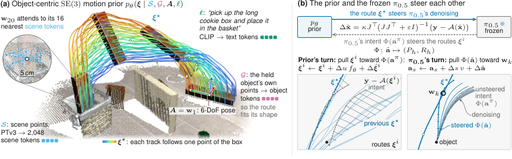
Figure 2 .Overview. (a)From scene points S, object points G at grasp pose A and instruction ℓ, the prior samples routes of SE(3) waypoints attending to nearby scene tokens (Sec. 3.1). Each track of the plan ξ⋆ follows one object point.(b)The prior and frozen π0.5 steer each other (Sec. 3.3): π0.5’s unsteered intent Φ(aπ) pulls the routes ξi and moves ξ⋆ to its group, and at each denoising step Φ(ˆa) is pulled toward wk.
Original paper · CC BY 4.0 · Agelos Kratimenos, Kostas Daniilidis, Evangelos Chatzipantazis · Cairn: Object-Centric 3D Trajectory Priors for Steering Frozen VLAs · Original paper figure · Converted the paper's own image file from its arXiv HTML version to PNG.Why a frozen VLA stalls when the scene changes
A VLA largely decides where an object belongs from the layouts it saw in training, so moving the object can collapse its success. Obstacles cause a different failure: the model drives the held object into them, because the detour has to be chosen before the obstacle is reached. Both the detour and any turn a long object needs depend on the scene's 3D geometry and the object's shape, which a model that works mostly from 2D images sees only indirectly.
Fine-tuning can teach a VLA new layouts, but it needs robot demonstrations for every new scene. It can also make the model forget skills it already had, so fine-tuning trades new layouts for old competence. Guidance avoids weight changes by nudging each denoising step along the gradient of an objective, and recent work applies this to frozen flow-matching VLAs.
The open question is therefore where the route should go, not only how to push a frozen VLA. It must also reach the VLA without retraining it. The hardest requirement is agreement, because a route picked without the VLA's own preferred motion has to be forced on it.
Planning the held object and letting both levels correct each other
The key idea is to plan the held object instead of the gripper. A learned prior proposes SE(3) routes of the object, from grasp to release, and the frozen VLA is steered along the chosen route. The name fits the design: the route marks the way for the held object, while the VLA does the moving.
The authors expected this to work because a distribution of routes can couple with the VLA at test time, rather than being imposed on it. Feedback runs both ways: the VLA's intended motion chooses and reshapes the sampled routes, and the chosen route pulls the VLA's denoising toward its next waypoint. The VLA's weights are never changed, and the prior is trained without any robot actions.
Because the training signal is the object's own motion, the prior can describe turns and detours that a gripper-level target would not express.
How the motion prior builds a route
The prior takes RGB point clouds of the scene and of the held object, the object's pose at the grasp, and the instruction. It samples a route of K waypoints, written as \(\xi=(w_1,\dots,w_K)\sim p_\theta(\cdot\mid c)\) with \(c=(S,G,A,\ell)\), where each waypoint is an SE(3) pose and the first waypoint equals the grasp pose \(A\). The last waypoint is the placement, so the goal comes out of the route rather than being given as an input.
Each waypoint stores its position relative to the grasp position and a continuous 6D rotation, giving nine values per waypoint. Orientation is kept because it decides whether the object fits a gap, such as a box turning upright past a pillar.
The prior builds on the 3DFA policy network but treats the held object separately: its cloud is encoded by a point MLP and posed at the grasp.
Training uses rectified flow: for a training route Y, the waypoints after the first are interpolated as \(Y_u=(1-u)\epsilon+uY\), and the first waypoint stays at the start pose. The network learns the velocity \(Y-\epsilon\) on these waypoints, and a geodesic term on the rotations is added near the end of the flow, where the clean-route estimate is more reliable.
At test time, M routes are drawn by integrating from Gaussian noise with a few Euler steps, and the first waypoint is reset after each step.
The sampled routes turn, lift and tilt the object as the receptacle requires, and they pass an obstacle on either side.
Generating routes beyond LIBERO's single layout
LIBERO's human demonstrations share one layout with no obstacles, and their routes differ by only 2 to 4 cm on average. The prior can't learn goal-following or obstacle-aware routes from data like that, so the authors generated new demonstrations. Generated routes differ by 23 to 31 cm within a task, which gives the prior a real spread of options.
Figure 3 shows this loop, from re-anchoring to a detour and a kept execution.
From LIBERO's 4,605 human demonstrations, the generator produces 16,049 demonstrations, plus 79,470 alternative routes. The records are split by layout into training and validation, so the variants of one layout stay in the same split.
How the prior and the VLA correct each other
Figure 2 summarises the two directions: the prior's routes are reweighted by the VLA's unsteered intent, and the chosen route pulls the VLA's denoising at each step. The two models form a joint model in which each is guided by the other's output, held fixed.
At the grasp, the VLA draws an unguided intent sample from its own distribution, and this sample is used for planning but not executed. Because the matching uses arc length rather than time, the agreement leaves the execution pace to the VLA.
A second VLA solve then follows the chosen route, and at each flow step the clean estimate gives predicted object poses for the next waypoint. The position residual r is corrected by a damped Gauss–Newton step, \(\mathrm{vec}(\Delta^{pos}_s)=-\kappa J^\top(JJ^\top+\varepsilon I_3)^{-1}r\), which cancels a controlled fraction κ of the residual with one 3×3 solve.
The guided update is \(X_{s'}=X_s+(s'-s)v_\phi(X_s,s,o)+\Delta_s\), where the correction is applied directly to the flow state. The Jacobian through the VLA's clean estimate is approximated by the identity, which avoids a backward pass through the VLA at every flow step.
The LIBERO-Shift test set and run settings
The scenes cover 27 tasks from the four LIBERO suites that π0.5 was trained on, and about half of them contain an obstacle. Each scene runs with three seeds, giving 5,823 episodes, while the ablations use one seed per scene.
The prior has 4.35M parameters and draws 16 routes of 20 waypoints in 10 Euler steps. Steering corrects each action chunk of 10 steps, of which 5 are executed.
Are the sampled routes clear and do they reach the goal?
Among the prior's ingredients, the data matters most, as the authors conclude from these comparisons.
RRT-Connect, given the same goal and selection, finds a clear route in 88.4% of episodes, but it takes 45.5 s per grasp on a CPU core. The prior takes 0.37 s per grasp on a GPU, so the speed comparison also mixes hardware. The released 3D HAMSTER planner reaches the receptacle in 37.7% of episodes, with a clear path in 37.5%.
When the same network is trained on LIBERO's demonstrations alone, it reaches the receptacle in only 16.3% of episodes. Training without alternative routes raises the goal rate to 98.6%, but it proposes a single route, with none clear in 1.4% of cases.
Steering the frozen π0.5 on LIBERO-Shift
Table 2 compares steering methods that differ in what the frozen π0.5 is steered toward, or in whether its weights change. Alone, π0.5 solves 96.5% of standard LIBERO but succeeds in only 24.5% of LIBERO-Shift. Cairn raises overall success to 95.1%, and in turn scenes it moves from 13.4% to 88.8%.
Local fields leave the route as it was, so OmniGuide's repeller reaches only 24.8% overall. Adding an attractor to the receptacle's true centre lifts it to 50.9%, because a straight pull stalls behind obstacles.
Fine-tuning π0.5 on the prior's training scenes reaches 91.3% on LIBERO-Shift, but standard LIBERO success falls from 96.5% to 70.5%. Cairn keeps 97.0% on standard LIBERO, and steering the fine-tuned model along Cairn's route gives the highest LIBERO-Shift success, at 96.1%. The authors read this as weight changes and routes composing, with the route supplying the part that transfers to new layouts.
Carrying over to LIBERO-PRO and a real arm
Steering starts after the grasp, so episodes where π0.5 picks the wrong object stay failures. Thirteen of the 40 tasks are not single carries, so they run unsteered.
This shows the ceiling on the gain: the steering can only change what happens after the grasp.
On a Franka FR3 DROID setup, the released π0.5-DROID stays frozen while the prior is trained only on generated simulation data. Each of three tasks runs 10 trials with and without Cairn, and with a free path both reach 10/10 in the bowl task.
Which parts of the coupling carry weight
Where π0.5's intent changes the route, the hand moves with 12% less jerk and the early corrections are 16% smaller.
Placing targets densely along the route costs the most on both benchmarks, at 10.5 points on LIBERO-PRO and 19.3 points on LIBERO-Shift. Sparse waypoints leave the pace to π0.5, which is why the high-level route works better.
Removing the rotation term costs 13.8 points on LIBERO-Shift, because rotation matters where the object turns. Dropping the gripper term lowers success by 2.0 and 3.4 points, because π0.5 lets go early. A fixed-strength step instead of the normalised step costs 2.1 and 2.0 points, and the carried object then touches obstacles 38 times compared to 10.
Real-time chunking, applied to the fixed route, pulls the correction through π0.5's network and loses 15.7 points on LIBERO-Shift. It is also 35% slower than Cairn, so the time steps impose the route's pace on π0.5.
Limits of the evidence
On LIBERO-Shift, success has little room to change, so the ablation gaps there are small. On LIBERO-PRO the steering reaches only the episodes that grasp correctly and use single-carry tasks.
The real-robot evidence covers three tasks with 10 trials each, on one replica of the lab with a single frozen π0.5-DROID. The prior's training data came only from generated demonstrations in simulation, so the real-robot results rest on that transfer alone.
Cairn costs more per chunk than π0.5 alone, at 190 ms compared to 128 ms on one B200 GPU. The authors leave open whether the prior could learn from videos of people moving objects.
Paper info
- Authors
- Agelos Kratimenos, Kostas Daniilidis, Evangelos Chatzipantazis
- Venue
- arXiv · Preprint
- First published
- 2026-11-25
- Added
- 2026-11-27
- Updated
- 2026-11-25
- Version
- v1
- arXiv
- 2611.34914
- Category
- cs.RO · cs.CV
- Original paper terms
- CC BY 4.0
- What we show
- Paper info, commentary and permitted figures from the original paper
AI commentary is a separate explanation from the original paper and may contain errors. The original paper and figures follow each source's terms of use and any rights noted separately.
Abstract
Vision-language-action models (VLAs) are capable low-level controllers, but they tie where objects go to the layouts they were trained on: when objects are moved or obstacles block the way, they carry them to the wrong place or into collisions. Fine-tuning on new layouts needs robot data for each one and erodes skills the model already has. We introduce Cairn, which keeps the VLA frozen and steers it at test time along learned 3D trajectories of the object in its gripper. A small prior reads point clouds of the scene and the held object, along with its pose when grasped and the instruction, and samples SE(3) trajectories up to its release that lead it around obstacles and turn it to fit through gaps. The prior and the VLA form the two levels of a hierarchical planner in which feedback runs both ways: the VLA's intended motion chooses and reshapes the trajectories, and the chosen one guides the VLA's denoising. Its predicted actions, mapped to the held object's poses through the grasp, are pulled toward the next waypoint, while the VLA's weights stay untouched. Across 1,941 held-out LIBERO scenes with displaced objects and obstacles, Cairn raises the success rate of a frozen π0.5 from 24.5% to 95.1%, above that of a π0.5 fine-tuned on our training layouts, without hurting standard LIBERO. On the third-party LIBERO-PRO benchmark, it raises success from 27.3% to 38.0%, and from 54.4% to 81.1% on the episodes it steers. On a real Franka, with a prior trained purely in simulation, it guides the frozen DROID π0.5 around an obstacle and to a placement at the limit of the arm's reach, where it otherwise fails. All code, models and data will be made public.
Quote from the paper
Agelos Kratimenos, Kostas Daniilidis, Evangelos Chatzipantazis (2026). Cairn: Object-Centric 3D Trajectory Priors for Steering Frozen VLAs. arXiv:2611.34914v1. https://arxiv.org/abs/2611.34914v1
BibTeX
@misc{kratimenos2026cairn,
  title = {{Cairn: Object-Centric 3D Trajectory Priors for Steering Frozen VLAs}},
  author = {Agelos Kratimenos and Kostas Daniilidis and Evangelos Chatzipantazis},
  year = {2026},
  eprint = {2611.34914},
  archivePrefix = {arXiv},
  url = {https://arxiv.org/abs/2611.34914v1}
}