Paper commentary
Guidance as Variance Matching
Guidance scales can be set by matching the variance of the data
- Problem Diffusion guidance works well in practice, but no explanation predicts the scales people pick, such as 7.5 for Stable Diffusion 1.5. Guidance also makes the posterior mean prediction worse while samples improve.
- Method Variance-matched guidance picks the guidance scale in closed form so the guided prediction's variance matches the data's. Unlike hand-tuned scales, it needs no sampling or tuning.
- Results Without tuning, the rule gives 7.44 for Stable Diffusion 1.5, close to the published 7.5, and recovers scales for eleven widely used models.
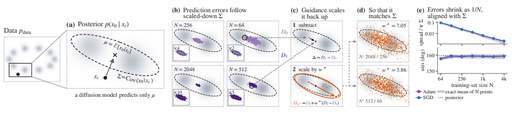
Figure 2 . Guidance as variance matching, on a two-dimensional example with real trained models. Left: the data, a mixture of ten Gaussians, and one noisy input xt at σ=0.4. (a) The posterior p(x0|xt) has mean µ (×) and covariance Σ (dashed); a diffusion model is trained to predict only µ. (b) Predictions of 1,024 models per training-set size N, each retrained with a new seed and training set for 40,000 steps, distributed as scaled-down Σ. (c) For a sampled pair of models, one weak (N=64) and one strong (N=512), guidance steps from D0 past D1. (d) Over all pairs, the guided predictions take the total spread of Σ. (e) The spread falls as 1/N and keeps the posterior’s axis (dotted), for Adam, SGD and the exact posterior mean ofNpoints (gray). More details and the setup are in Appendix B.2.
Original paper · CC BY 4.0 · Ali Backour, Artem Lukoianov, Frank Permenter, Tommi Jaakkola, Justin Solomon, Vincent Sitzmann · Guidance as Variance Matching · Original paper figure · Extracted the figure area from page 2 of the original PDF.Why guidance needs a new explanation
A scale of 1 simply returns the stronger prediction, yet practitioners choose much larger scales, such as 7.5 for Stable Diffusion 1.5. The authors note that no model they know of explains why guidance works or predicts the effective scale.
The sharpened-distribution account of classifier-free guidance doesn't seem to hold in practice, so it can't serve as the explanation. Autoguidance has no condition to sharpen, which undercuts that account from another side. Karras et al. argue that guidance corrects errors made by the strong model, but the authors find that the scales used in practice increase the denoising error.
The key idea: posterior-mean predictions are too narrow
A denoiser trained to predict the posterior mean returns predictions that are less spread out than the data they model. Guidance can restore that spread, so the authors set the scale so the guided prediction has the variance of the data. Because the rule works on variance rather than on error, it doesn't require a metric to pick the scale.
No sampling is needed to compute it. For SD 1.5 the resulting constant is 7.44, close to the published 7.5.
How the scale is computed
The guided prediction starts from the weaker prediction D0 and adds w times the difference D1 minus D0. Under that assumption the guided prediction still has the posterior mean in expectation, so guidance changes only the covariance.
The covariance of the guided prediction is a scalar factor times the posterior covariance, with the factor (1 minus w) squared over m0 plus w squared over m1. Setting that factor to one gives a quadratic in w, so the matched scale is a root of that quadratic. Because m0 is at least 1 and m1 is above 1, the discriminant is positive and two real roots always exist.
For large m0 and m1 the roots are approximately plus or minus one over the square root of 1/m0 plus 1/m1. The positive root extrapolates past D1 away from D0, as usual guidance does. The negative root extrapolates past D0 away from D1, which the authors use to explain guidance in both directions.
Why retrained models scatter in the posterior's shape
In their simple model the spread falls as 1 over N, where N is the training-set size, and it keeps the posterior's axis. The covariance of the prediction is proportional to the posterior covariance, with the factor 1 over m(x_t). So a strong model and a weak model differ only in how much spread they carry, and a linear combination can scale that difference up to the full posterior covariance.
Do the predicted scales match practice?
Constants tuned to a single metric each win on that metric but often lose on the others, so the best scale depends on the metric. The published scale matches no metric's optimum, so the authors suspect it was picked by human judgment. EDM2 chose its published scales by grid search, and those scales are smaller than the variance-matched constant.
In a blind study with 1,458 votes from 41 people, raters compared SD 3.5 Medium samples at different settings. This is a preference result from an informal poll, not a measured quality gain.
On CogVideoX-2B and AudioLDM 2 it trades distribution distance for alignment.
Guidance in both directions and checkpoint scales
The two roots often have opposite signs, so the theory predicts that guidance can work with negative scales. With SD 1.5 and CommonCanvas, both directions improve FID and FDDINOv2, while every scale between 0 and 1 is worse than either model.
The same pattern holds for SD 2.1 with SD 1.5 and with CommonCanvas, across scales from minus 4 to 5. Averaging the two models, at w equal to 0.5, never beats the better one. Not every pair shows this, and what separates the pairs that do is left to future work.
When the weak model is an earlier checkpoint, the two share training targets, so their difference has less variance than for an independent pair. A checkpoint's matched scale is therefore larger than an independent model's. On EDM2-XS the measured ratio stays at 1.0 up to r equal to 1/4 and reaches 1.6 for FID and 2.2 for FDDINOv2 at r equal to 3/4.
The theory's ratio is larger than this at each r, and the authors attribute the gap to a finite averaging length in the training. An early checkpoint shares little with the strong model's averaging window, so the two behave almost like independent models.
Limitations
An LLM was also run as a rater, and its 2,500 votes are kept apart from the people's.
The diversity effect of correlated error fields was measured only in a synthetic setting with isotropic Gaussians as a multimodal distribution.
Paper info
- Authors
- Ali Backour, Artem Lukoianov, Frank Permenter, Tommi Jaakkola, Justin Solomon, Vincent Sitzmann
- Venue
- arXiv · Preprint
- First published
- 2026-11-25
- Added
- 2026-11-27
- Updated
- 2026-11-25
- Version
- v1
- arXiv
- 2611.34801
- Category
- cs.CV · cs.LG
- Original paper terms
- CC BY 4.0
- What we show
- Paper info, commentary and permitted figures from the original paper
AI commentary is a separate explanation from the original paper and may contain errors. The original paper and figures follow each source's terms of use and any rights noted separately.
Abstract
Guidance repels the prediction of a diffusion model away from a weaker reference prediction. It substantially improves sample quality, but its mechanism remains poorly understood. We first find that, at the scales used in practice, guidance does not improve the prediction of the posterior mean (the model's training target); it makes the prediction worse, while samples improve. Second, posterior-mean predictions have less variance than the data, and we find that guidance restores it. We introduce variance-matched guidance: a closed-form rule that picks the guidance scale by matching the variance of the guided predictions to that of the data. Without tuning, it recovers the hand-picked scales of eleven widely used models across image, video, audio, motion, and world generation; to our knowledge, no previous explanation of guidance predicts them. Applied per noise level, it yields a schedule without tuned hyperparameters that users prefer to hand-crafted ones on SD 3.5 Medium. Third, we offer an interpretation of the mechanism behind guidance: each model makes a random error in predicting the posterior mean, and guidance rescales the difference of these errors into a sample with the posterior's covariance, which improves sampling. This view also suggests two new hypotheses that our experiments support: guidance can work with negative scales, and guiding a model with its own checkpoint needs a larger scale than guiding it with an independently trained model.
Quote from the paper
Ali Backour, Artem Lukoianov, Frank Permenter, Tommi Jaakkola, Justin Solomon, Vincent Sitzmann (2026). Guidance as Variance Matching. arXiv:2611.34801v1. https://arxiv.org/abs/2611.34801v1
BibTeX
@misc{backour2026guidance,
  title = {{Guidance as Variance Matching}},
  author = {Ali Backour and Artem Lukoianov and Frank Permenter and Tommi Jaakkola and Justin Solomon and Vincent Sitzmann},
  year = {2026},
  eprint = {2611.34801},
  archivePrefix = {arXiv},
  url = {https://arxiv.org/abs/2611.34801v1}
}