Paper commentary
Token Pruning Needs a Protected Sink Token: Coherent Spatial Aggregation in Vision Transformers
MCTP maps how pruning at each depth changes a ViT's predictions
- Problem Earlier comparisons study token reduction algorithms, not how a pretrained ViT responds when it loses tokens. That leaves open which tokens the model depends on.
- Method Monte Carlo Token Pruning (MCTP) removes random patch-token sets inside a ViT at chosen depths. It scores each token by how much keeping it raises the top-class probability.
- Results Protecting five tokens cuts SigLIP 2's off-box token impact by up to 62%.
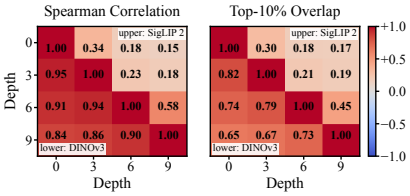
Figure 3 .Cross-depth consistency.Signed Spearman correlation (left) and top-10% overlap (right) of token impacts∆ i between pruning depths, for DINOv3 (lower triangle) and SigLIP 2 (upper triangle), averaged over the ImageNet-1k validation set.
Original paper · CC BY 4.0 · Wyatt, Julian, Willoughby, James, Clement, Allison, Voiculescu, Irina · Token Pruning Needs a Protected Sink Token: Coherent Spatial Aggregation in Vision Transformers · Original paper figure · Extracted the figure area from page 4 of the original PDF.Why per-depth token pruning needs its own analysis
Self-attention in a ViT grows quadratically with the number of image tokens, which is why so much work tries to shrink that count. Token pruning drops tokens from the sequence, token merging combines similar ones, and adaptive patch sizing gives different image regions different budgets. These families differ in their selection criteria and in the depths where they make their decisions.
Earlier comparisons study the reduction algorithms themselves, varying keep rates, backbone size and dataset. They pay much less attention to how a given pretrained model reacts when it loses tokens. That leaves open which tokens such a model depends on, and whether that dependence stays steady through its layers.
The authors treat this as a question about each pretrained model's response, not about the reduction algorithm. For this they introduce Monte Carlo Token Pruning (MCTP), which prunes random token subsets at several depths and measures how the prediction moves.
How MCTP measures token impact
A ViT turns each image into patch tokens and prepends prefix tokens such as [CLS] and registers. The classification readout concatenates the [CLS] token with the average of the patch tokens, written as GAP, so the readout is \(z_{out}=\mathrm{cat}(z_{cls},\mathrm{pool}(z_{patch}))\). SigLIP 2 has no [CLS] token, so its multi-head attention pooling output takes that slot.
A linear probe is trained on ImageNet-1k without pruning, and the best probe from the sweep is used for every later measurement.
MCTP keeps a small random subset of patch tokens at the start of a chosen block l, and the blocks after l run only on the prefix tokens plus that subset. Each draw gives a stability value of 1 when the top prediction matches the unpruned prediction, written as \(\hat{s}(x,\tau)=\mathbb{1}[\arg\max p(x,\tau,l)=\hat{y}]\). The readout pools only over the tokens that survive the draw.
Over M independent draws, the method compares the mean probability of the unpruned top class when a token is kept with the mean when it is removed. That gap is the token impact, \(\Delta_i=\mathbb{E}[p_{\hat{y}}(x,\tau,l)\mid i\in\tau]-\mathbb{E}[p_{\hat{y}}(x,\tau,l)\mid i\notin\tau]\), and a positive value means the probability is higher when the token is kept.
Unlike RISE, which masks the input, MCTP removes tokens inside the network at block l, and at l=0 it resembles the attention masking used by ViT-Shapley. The kept-versus-removed comparison follows Data Banzhaf, which the authors cite as more robust to noise in the model's output than Shapley values.
The sampler keeps square blocks of the patch grid, because uniformly sampled tokens change the prediction too little. The main runs keep 10% of the 441 patch tokens, which is 44 tokens nominally, and use 1,000 draws. Caching the blocks before l means a 1,000-draw run at l=6 costs about 47 full forward passes, compared to 1,000 for input masking.
A single draw at l=6 costs 1.9 GFLOPs, compared to 41.8 GFLOPs for a full DINOv3 B/16 forward pass at 336×336.
Does token impact keep its order across depths?
Coherence is measured per image as the Spearman rank correlation between two impact maps taken at different depths, and the value is then averaged over the validation set. The mean over all depth pairs gives the coherence value ρ used throughout the paper. Figure 3 shows both measures for each depth pair, with DINOv3 in the lower triangle and SigLIP 2 in the upper.
Across the linear-probed B/16 models on ImageNet-1k, DINOv3 scored a mean cross-depth Spearman of 0.90, and SigLIP 2 scored 0.28. The comparison reuses the same random draws at every depth, which the authors describe as a best-case estimate.
Prediction agreement tests the same idea from the output side. The authors compare this with a uniform random selection of the same size.
A multi-seed check shows SigLIP 2's inter-seed Spearman at the same depth lies between 0.56 and 0.88. The authors read this as evidence that SigLIP 2's low cross-depth coherence isn't caused by Monte Carlo noise.
Where class evidence sits on the object
Effective support summarises how widely the positive impact is spread across patch tokens. The positive part of each impact is normalised as \(q_i^+=\frac{\max(\Delta_i,0)}{\sum_j \max(\Delta_j,0)}\), and its entropy is \(H^+=-\sum_i q_i^+\log q_i^+\). The effective support is \(\phi^+=e^{H^+}/N\), so a high value means the positive impact is shared across many tokens and a low value means it is concentrated.
Prediction stability is averaged over the draws and over the images of each class, and it compares against the unpruned prediction rather than the true label.
Off-box mass checks whether the positive impact lies on the object, using the ImageNet validation bounding boxes. It is \(m=\frac{\sum_{i\notin G} q_i^+}{(N-|G|)/N}\), where G is the set of tokens inside the box, so dividing by the outside fraction normalises for box size. Uniform positive impact gives m equal to 1, and lower values mean the impact sits on the object.
The authors use only images whose prediction is correct, and they prefer off-box mass because boxes only estimate the object's location.
For DINOv3 B/16 the off-box mass is 0.31 at l=0 and 0.31 at l=9. The authors conclude that the coherent models keep their evidence near m of 0.3, while SigLIP 2's sits near 0.94.
Junco and other birds sit among the classes furthest below the trend, so they keep their prediction more often than their support suggests.
Why removing sink tokens breaks SigLIP 2
Darcet et al. found high-norm outlier tokens on redundant background patches, and the authors build on that finding. SigLIP 2 has no prefix tokens, so the authors hypothesise that high-norm sinks form on patch tokens that pruning doesn't protect. TIPSv2 also trains on image-text pairs but stays coherent, with ρ of 0.82, so the pretraining objective alone doesn't explain SigLIP 2.
Its maps still stay mostly on the object at l=6 and l=9, with off-box mass of 0.41 and 0.29.
The abstract reports that protecting five tokens cuts SigLIP 2's off-box token impact by up to 62%. An empty register, added without moving those activations, leaves the off-box mass and stability at the level of unmodified SigLIP 2.
Protecting five random tokens changes the off-box mass very little, so the gain doesn't come from the sampling scheme alone.
The five highest-norm tokens at block 3 contain only 3.1% of the final block's top five, against a chance level of 1.1%. At block 6 the overlap reaches 80%, so the protected tokens at l=3 are not the eventual sinks of the unpruned model. At l=3 a high-norm sink forms in only 12 to 16% of draws, and when one forms at block 6 under the top-five protection, a protected token is the sink 92% of the time.
Random protected tokens are the sink only 14% of the time in the same setting.
Pruning the high-norm sink tokens collapses the prediction, and the authors say coherence collapses with it.
Limitations
MCTP is too costly to make pruning decisions at inference, so the authors present it as a post-hoc analysis tool. The paper doesn't evaluate existing token pruning methods, and it doesn't propose a new pruning method.
Only SigLIP 2 shows low coherence among the eight models, so the sink interventions cover a single prefix-free model. The authors note that SigLIP encoders are widely used in VLMs, but this study tests only one prefix-free model.
Dense predictions and other reduction approaches, such as token merging and adaptive patch sizing, are left to future work. Protecting tokens can't help at l=0, because the model hasn't yet embedded image context into any patch token.
Paper info
- Authors
- Wyatt, Julian, Willoughby, James, Clement, Allison, Voiculescu, Irina
- Venue
- arXiv · Preprint
- First published
- 2026-11-23
- Added
- 2026-11-25
- Updated
- 2026-11-23
- Version
- v1
- arXiv
- 2611.31025
- Category
- cs.CV
- Original paper terms
- CC BY 4.0
- What we show
- Paper info, commentary and permitted figures from the original paper
AI commentary is a separate explanation from the original paper and may contain errors. The original paper and figures follow each source's terms of use and any rights noted separately.
Abstract
Vision Transformers (ViTs) are a predominant architecture for computer vision, with token reduction emerging as a popular paradigm to improve their efficiency. Prior work compares reduction algorithms, but not how models respond to them, nor how their response changes with model depth. We propose Monte Carlo Token Pruning (MCTP), which estimates each token's impact on the prediction when tokens are explicitly removed during the forward pass. Applying MCTP to recent pretrained models, we observe that most, such as DINOv3, maintain a similar ranking of token importance at every depth (high Coherent Aggregation), while SigLIP 2 does not. This coherence requires predictions to survive pruning, which depends on keeping high-norm "sink" tokens: prefix tokens are kept by design, while prefix-free SigLIP 2 forms them on patch tokens, which pruning may remove. We show that in removing DINOv3's prefix tokens, its predictions and coherence collapse, while protecting only 5 tokens for SigLIP 2 cuts the token impact outside the object's bounding box by up to 62%. Beyond this, MCTP offers a post-hoc method to evaluate how a pretrained ViT responds to pruning, and suggests that token reduction methods should keep "sinks".
Quote from the paper
Wyatt, Julian, Willoughby, James, Clement, Allison, Voiculescu, Irina (2026). Token Pruning Needs a Protected Sink Token: Coherent Spatial Aggregation in Vision Transformers. arXiv:2611.31025v1. https://arxiv.org/abs/2611.31025v1
BibTeX
@misc{julian2026token,
  title = {{Token Pruning Needs a Protected Sink Token: Coherent Spatial Aggregation in Vision Transformers}},
  author = {Wyatt, Julian and Willoughby, James and Clement, Allison and Voiculescu, Irina},
  year = {2026},
  eprint = {2611.31025},
  archivePrefix = {arXiv},
  url = {https://arxiv.org/abs/2611.31025v1}
}