Paper commentary
Text Is Just Another Shot in Vision-Language Models: Simple Probes on Frozen Encoders Do It
Simple convex probes on frozen encoders match elaborate few-shot CLIP adaptation methods
- Problem Few-shot CLIP methods keep the zero-shot text classifier as the anchor, labeled images only correcting it. That design was tuned to CLIP's weak visual features, so it may not hold with stronger encoders.
- Method TASP is a convex logistic regression on frozen features. It treats each class name as weighted training examples and as a regularization prior, instead of as a fixed anchor.
- Results With frozen PE-Core-L features, TASP reaches 87.1% accuracy at 1 shot and 91.4% at 16 shots. That beats prior few-shot adaptation methods by 4.6 to 11.0 points.
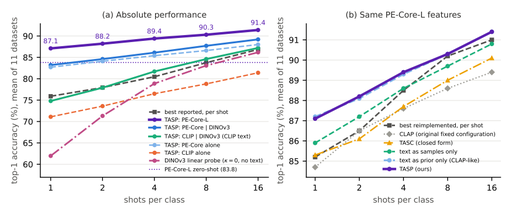
Figure 1 .Strong features explain the absolute gains; the probe remains competitive under controlled features.(a) Mean accuracy over the 11 datasets of the few-shot benchmark. Black dashed: the best reported value at each shot count among the 86 method and baseline curves reporting all 11 datasets with CLIP ViT-B/16, including arXiv preprints and methods using LLM-generated text. Coloured: TASP, a single logistic regression on frozen features in which each class name is one more training sample, with one hyper-parameter configuration per feature set for all datasets and shot counts, selected without ImageNet; pink dash-dot: DINOv3 linear probe without text (κ= 0); dotted purple: zero-shot classifier of PE-Core-L. (b) Controlled comparison on identical frozen PE-Core-L features, splits and model-selection protocol (11 datasets; ImageNet excluded from model selection): TASP, its samples-only, prior-only and closed-form variants, CLAP with its originally reported configuration, and the best reimplemented prior method at each shot count. We use the same splits, seeds and shots as the literature. ImageNet is included in evaluation but never used for hyperparameter selection (Sec. 4). Full controlled results: Tab. 2.
Original paper · CC BY 4.0 · Reda Bensaid, Ismail Ben Ayed, François Leduc-Primeau, Vincent Gripon · Text Is Just Another Shot in Vision-Language Models: Simple Probes on Frozen Encoders Do It · Original paper figure · Extracted the figure area from page 2 of the original PDF.Why the text anchor stalls
Most few-shot methods for CLIP keep the zero-shot text classifier as the anchor and treat labeled images as a correction to it. Prompt learners, adapters, caches and text-regularised probes all follow this pattern, even though their parameterisations differ. The reason is that CLIP's zero-shot classifier matched a 4-shot linear probe on the same features.
That observation describes one encoder, though, and CLIP's image features miss fine-grained and spatial detail.
So the question becomes how much weight the class name should keep once the visual features are better.
Counting a class name in shots
The authors model each class as a Gaussian, where images scatter around a class mean with spread σ² and the class-name embedding is a noisy, misaligned reading of that mean with spread τ². This is written as \( x \mid c \sim \mathcal{N}(m_c, \sigma^2 I) \) for the images and \( t_c \sim \mathcal{N}(m_c, \tau^2 I) \) for the class name. With a flat prior on the class mean, the posterior mean combines the support shots and the class name as a weighted average.
\[ \hat m_c = \frac{n\,\bar x_c + \kappa\, t_c}{n+\kappa}, \qquad \kappa = \frac{\sigma^2}{\tau^2} \] Here \(\bar x_c\) is the average of the n support images of class c, and the class name enters with weight κ.
This gives two ends of one estimator: at n=0 it is the zero-shot classifier, and as n grows well past κ it becomes a purely visual estimate. For CLIP the paper puts κ near 4, which explains why the literature anchors on the text.
The derivation assumes isotropic Gaussian noise and a flat prior, and the modality gap can inflate the estimated τ², which biases κ downwards. The proof is the standard conjugate update, given in the appendix.
Training the probe on class names and shots
Both feature sets are then ℓ2-normalised. The loss averages each image's augmented views, then adds each class name as w extra samples on top of the n images of its class.
\[ \mathcal{L}(W,b)=\frac{\sum_{c}\big(\sum_{j}\ell^{img}_{cj}+w\,\ell^{txt}_{c}\big)}{C(n+w)}+\frac{\lambda_0}{2n}\lVert W-W_0\rVert_F^2 \] The second term pulls the weights toward W0, the zero-shot weights built from the class-name embeddings, and its strength falls as the number of shots rises.
The objective is convex when λ0 is positive, and it is solved to numerical optimality with full-batch L-BFGS, with no learning-rate schedule and no early stopping. Only w and λ0 are tuned, and both stay fixed across datasets and shot counts. For PE-Core-L the selected pair is (w, λ0) = (1, 10⁻³), chosen on the 10 datasets other than ImageNet.
Setting w=0 and λ0=0 recovers a standard linear probe, w=n with λ0=0 gives cross-modal adaptation, and w=0 with a nonzero λ0 gives a CLAP-like probe. A least-squares variant, TASC, swaps the cross-entropy for a squared loss on one-hot targets, keeps the same text weight and prior, and solves a single linear system.
For two encoders, each image is the concatenation of both feature blocks, while each class name fills only the vision-language block. Training takes 0.1 s on average per dataset on pre-extracted PE-Core-L features, and 4.5 s on ImageNet at 16 shots.
Results on the 11-dataset benchmark
Each support image gets 10 augmented views, and on PE-Core-L features with one configuration, TASP reaches 87.1% at 1 shot and 91.4% at 16 shots.
Much of this comes from the encoder: zero-shot PE-Core-L alone reaches 83.8%, which is level with the best reported few-shot methods up to 8 shots. On top of that, the probe adds 3.3 points at 1 shot and 7.6 points at 16. So the probe's contribution is real, but it sits on a stronger encoder than CLIP ViT-B/16. At the ViT-B scale, PE-Core still scores 82.7% at 1 shot and 88.0% at 16, above the envelope at every shot count.
A DINOv3 linear probe with no text head reaches 83.1% at 8 shots and 86.2% at 16 shots. At 1 shot it scores only 62.0%, which shows how much the class-name prior matters when labels are scarce.
Controlled comparisons on matched features
The authors re-implement prior methods on exactly the same frozen PE-Core-L features, with the same selection rule. With its originally reported configuration, CLAP scores 84.7% at 1 shot and 89.4% at 16, between 1.7 and 2.4 points below TASP.
Cache and residual designs that anchor on the zero-shot logits fall furthest behind as shots accumulate. The closed-form TASC trails TASP by 1.8 points at 1 shot and 1.3 at 16.
Fine-tuning changes the comparison: CLIP-LoRA keeps a 0.7–2.0 point edge on CLIP alone. Adding frozen DINOv3 reverses that, and TASP with DINOv3 is 1.7 to 4.6 points better than CLIP-LoRA on CLIP. The cost gap is large, since CLIP-LoRA back-propagates through both encoders while TASP runs on cached features in seconds.
Adding a self-supervised partner and shifting the data
A self-supervised partner helps most when the vision-language model is weakest: at 16 shots DINOv3 adds 6.5 points to CLIP and 0.6 points to PE-Core-L. The authors attribute the smaller gain for PE-Core to its partly redundant visual features, which overlap with DINOv3's. The union also costs inference time, running at about half the throughput of one ViT-B.
The shift test trains the 16-shot probe on ImageNet and evaluates it unchanged on ImageNet-V2, -Sketch, -A and -R. Averaged over the four shifted sets, TASP on PE-Core-L reaches 82.8%, compared to 61.6% for the best reported CLIP method. Adding DINOv3 lowers PE-Core-L to 81.8% on this average, so under large shifts the vision-language features hold up better.
What κ measures in practice
The authors estimate κ with the Proposition 1 classifier on single encoders that have a text head. The validation-optimal κ is 4 for CLIP and 4 for SigLIP, and 8 for PE-Core-L. For DINOv2-L with the ShareLock head, κ is 1, so the text is worth about one image.
Text as samples and text as prior behave as two parametrisations of one estimator, not as two methods. On PE-Core-L, validation accuracy stays within 0.2 points along the ridge that trades the sample weight w against the prior strength λ0. Cross-modal adaptation ties w to n, which under-weights the text at 1 to 2 shots.
An additional frequency check keeps only image content with magnitude at least 32. Under that filter DINOv3 keeps 65% of its clean accuracy, compared to 49% for CLIP. The authors offer this as one possible reason for DINOv3's gains on visually detailed datasets such as FGVC-Aircraft and EuroSAT.
Limits of the claims
TASP solves an iterative convex problem, so it is not strictly training-free, though it finishes in seconds. It also needs no manually chosen learning rate or epoch schedule.
In base-to-novel tests, TASP trains only on base-class images and falls back to the zero-shot classifier for novel classes. With PE-Core-L it reaches a harmonic mean of 90.8%, but most of that margin is PE-Core-L's zero-shot accuracy on novel classes. On PE-Core, PromptSRC edges TASP in harmonic mean, 88.2% compared to 87.8%. The authors conclude that adapting the text head pays when test classes are unseen, and TASP does not adapt it.
PromptSRC training was unstable on PE-Core, and in 20 of its runs the loss returned to ln C, the chance level. Runs that collapsed were re-run once with the same seed, and the 14 that collapsed again are excluded from the means. The authors note that this rule favours PromptSRC.
The authors note that using those numbers as reported generally favours those methods.
Paper info
- Authors
- Reda Bensaid, Ismail Ben Ayed, François Leduc-Primeau, Vincent Gripon
- Venue
- arXiv · Preprint
- First published
- 2026-11-24
- Added
- 2026-11-25
- Updated
- 2026-11-24
- Version
- v1
- arXiv
- 2611.32672
- Category
- cs.CV
- Original paper terms
- CC BY 4.0
- What we show
- Paper info, commentary and permitted figures from the original paper
AI commentary is a separate explanation from the original paper and may contain errors. The original paper and figures follow each source's terms of use and any rights noted separately.
Abstract
Few-shot adaptation of vision-language models has produced increasingly elaborate methods built on CLIP and on one shared principle: the zero-shot text classifier is the anchor, and labeled images only correct it. We argue that this principle reflects CLIP's visual features rather than a property of the task. We provide a simple Bayesian interpretation, in which a class name is worth exactly kappa = sigma^2 / tau^2 labeled images, the ratio between the visual spread of a class and the misalignment of its name. The Bayes classifier of this model counts text as kappa more samples. With modern frozen encoders, few-shot adaptation then reduces to a well-regularised convex probe. Specifically, we introduce TASP, a simple convex logistic regression on frozen features that incorporates class-name embeddings as weighted training examples and as a regularization prior. On the standard 11-dataset benchmark, TASP with frozen PE-Core-L features achieves 87.1% accuracy at 1 shot and 91.4% at 16 shots, outperforming state-of-the-art few-shot vision-language adaptation methods by 4.6 to 11.0 percentage points. While stronger representations explain much of this improvement, controlled comparisons on matched features show that existing frozen-encoder adaptation methods do not materially improve on this probe. We further find that the weight assigned to text matters more than how it is incorporated, and that combining self-supervised visual features with vision-language representations is most beneficial for weaker visual encoders. Together, these findings suggest that progress in few-shot vision-language adaptation depends more on representation quality and the appropriate use of text supervision than on increasingly complex adaptation mechanisms.
Quote from the paper
Reda Bensaid, Ismail Ben Ayed, François Leduc-Primeau, Vincent Gripon (2026). Text Is Just Another Shot in Vision-Language Models: Simple Probes on Frozen Encoders Do It. arXiv:2611.32672v1. https://arxiv.org/abs/2611.32672v1
BibTeX
@misc{bensaid2026text,
  title = {{Text Is Just Another Shot in Vision-Language Models: Simple Probes on Frozen Encoders Do It}},
  author = {Reda Bensaid and Ismail Ben Ayed and François Leduc-Primeau and Vincent Gripon},
  year = {2026},
  eprint = {2611.32672},
  archivePrefix = {arXiv},
  url = {https://arxiv.org/abs/2611.32672v1}
}