Paper commentary
Benchmarking Protein Structure Tokenizers as Generation Targets for Language Models
Writability, not reconstruction, decides how well a language model generates protein structure tokens
- Problem Structure tokenizers are picked by reconstruction fidelity, which says nothing about whether a language model can write their tokens. Published systems change the tokenizer, base model and data together, so its own effect was never isolated.
- Method The authors hold the base model, data and recipe fixed and swap only the tokenizer. They train the same 9B model on eight tokenizers and measure the TM score of the structures it writes.
- Results At 2B tokens, DPLM-2 reached TM 0.6623 on FoldBench334, while VanillaVQ reached 0.3781 under identical conditions. Codebook size and reconstruction ceiling do not explain the spread.
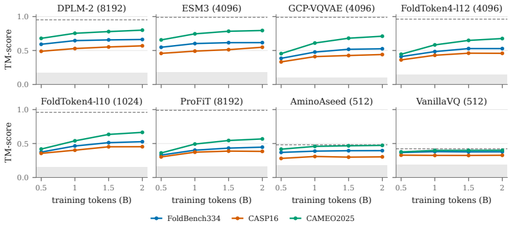
Figure 1 . Writability under identical conditions. Each panel is one tokenizer (codebook size in parentheses); the three curves are the three evaluation sets. The shaded band is that tokenizer’s random-token floor 𝑆4 and the dashed line is its reconstruction ceiling 𝑆1, both measured through the same decoder and scorer; panels share axes. Identity is carried by panel title rather than colour, since eight categorical hues cannot be separated reliably under colour-vision deficiency.
Original paper · CC BY 4.0 · Yong Liu, Zhanpeng Shi, Peicong Lin, Zhenyi Zhong, Yizhou Dang, Wendi Wu, Haoling Li, Jiayu Gu, Duo An, Shuangjia Zheng · Benchmarking Protein Structure Tokenizers as Generation Targets for Language Models · Original paper figure · Extracted the figure area from page 5 of the original PDF.Why reconstruction scores miss the generation problem
A language model gets access to protein structure when each residue is turned into one of K codewords by a structure tokenizer. Tokenizers are usually picked by reconstruction, meaning how much structure survives an encode and decode round trip. The authors call the second property writability, and earlier comparisons never measured it.
Once the model has to generate the codes, the tokenizer stops being a perception module and becomes a generation target. Published systems that emit structure tokens change the tokenizer, base model, data and compute together, so the tokenizer's own effect was never isolated. The study sets out to close that gap by holding everything except the tokenizer fixed.
Holding everything but the tokenizer fixed
The key idea is to swap only the tokenizer and see what the model can write under identical training. All arms share one mixture and one cosine schedule over 2B tokens, with exports at 0.5, 1, 1.5 and 2B tokens. Given the sequence and a task instruction, the model emits one token per residue by greedy decoding, and the string passes through that tokenizer's own decoder before TM-score.
A raw TM score can't be compared across tokenizers, because each decoder adds a different amount of structure by itself. The authors therefore bracket each score with a floor from uniformly random tokens and a ceiling from encoding and decoding the ground truth once. The redemption rate is \( RR = \frac{TM_{model} - S_4}{S_1 - S_4} \), which gives the share of the interval the model captured.
A narrow interval inflates that share, so two tokenizers with ceilings of 0.48 and 0.42 are read as counterexamples rather than successes.
A cross-tokenizer difference only means something if it clears the run-to-run noise. The authors repeated ESM3 end to end and found paired differences with standard deviation 0.0067 TM and a largest magnitude of 0.0123 TM. They treat differences with |ΔTM| below 0.013 as indistinguishable. That threshold is a lower bound, since it comes from a single repeated arm.
How far writability spreads across tokenizers
At 2B tokens on FoldBench334, final TM runs from 0.6623 for DPLM-2 down to 0.3781 for VanillaVQ. The three evaluation sets order the arms the same way. The authors report absolute TM rather than ratios, since random tokens already score 0.103 to 0.185 through the same decoders.
Codebook size doesn't order the arms, because DPLM-2 and ProFiT both use 8192 codewords and sit at the top and the bottom. Reconstruction doesn't order them either, since six of the eight tokenizers reconstruct above 0.95 TM and still span almost the full writability range. ProFiT has the highest ceiling at 0.9902, yet its redemption rate is the lowest among the non-degenerate arms at 33.9%.
A good codec can therefore still be a poor vehicle for a language model.
Whether nearby codewords mean nearby structures
The hypothesis is that a tokenizer is writable when close codewords denote close structures. For binary codes, closeness can be measured as Hamming distance, the number of differing bits. DPLM-2 uses 13-bit codewords, and FoldToken4 uses binary codes of ℓ bits at each level.
The first test encodes ground-truth backbones, perturbs 30% of positions and decodes the result. For DPLM-2, a one-bit flip costs 0.019 TM, moving from 0.946 to 0.927, while a random codeword costs 0.347. For FoldToken4-l12 the two perturbations cost nearly the same, 0.627 versus 0.572 at 30%, so its bits don't carry similarity.
The second test asks whether the trained model actually uses this locality, by looking at its own wrong tokens. At 2B tokens, DPLM-2's errors sit 3.29 of 13 bits from the correct codeword, a ratio of 0.506 to the random expectation. FoldToken4-l12 stays at 0.985, which is effectively the cost of a random wrong codeword.
Where the gap to ESMFold comes from
ESMFold reads the same ESM2-3B features but emits coordinates directly, so the gap reflects the token interface rather than a weaker input. The paired difference is +0.209, with a bootstrap interval of +0.194 to +0.227, and ESMFold wins on 96.3% of targets.
The authors split contacts by sequence separation and score each band between a floor and a ceiling. DPLM-2 captures 63.2% of long-range contacts, compared to 72.3% of short-range ones. Long-range capture spans 63.2% down to 20.3% across arms and tracks final TM at +0.976. ESM2-3B's own contact head reaches 0.813 on these targets, while the model emits 0.633.
Closing that transfer gap would account for about 0.091 TM, which is 44% of the 0.209 gap.
The remaining part is attributed to discretisation, since extrapolating to the representation's own ceiling predicts TM 0.840. The authors note that this second term is an extrapolation beyond the observed range. Decoding is a small lever: the oracle best of 32 samples is +0.0515 TM over greedy, while the medoid recovers +0.0095.
Beyond 500 residues, DPLM-2's TM falls to 0.549, and long-range contact capture drops to 40.1%.
Two interventions that moved nothing
The authors pre-registered two ways of supervising bits on DPLM-2 tokens. D2H's primary comparison on FoldBench334 at 2B tokens gives −0.0001 TM, with a paired interval of −0.0078 to +0.0075.
The pre-registered plan discarded a null unless the intervention changed the error geometry. D2H didn't change it, with the error ratio at 0.507 against 0.506 for the baseline. The authors explain both results by saturation: the targeted quantity stops improving at 1.5B tokens.
D2B at 0.5B has a higher token error rate than the baseline, 95.1% versus 93.9%, with the same TM. This shows that token accuracy is a poor proxy for structural quality.
Limitations
The bit-locality account is correlational and isn't established causally. The noise floor rests on one repeated arm and nine paired cells. Three to five repetitions per arm would be the proper estimate.
The base model scores 0.7743 on a 350-item MMLU-Pro subset, and extending the vocabulary without training leaves that score unchanged. Raw TM and accuracy drop correlate at +0.825, but no pairwise comparison is significant. The authors don't claim that more writable arms keep more general capability. The ESM3 over GCP-VQVAE gap falls from 0.163 to 0.091 with compute, so that comparison holds only up to 2B tokens.
Sampling and best-of-n were out of scope.
Paper info
- Authors
- Yong Liu, Zhanpeng Shi, Peicong Lin, Zhenyi Zhong, Yizhou Dang, Wendi Wu, Haoling Li, Jiayu Gu, Duo An, Shuangjia Zheng
- Venue
- arXiv · Preprint
- First published
- 2026-11-24
- Added
- 2026-11-25
- Updated
- 2026-11-24
- Version
- v1
- arXiv
- 2611.32168
- Category
- q-bio.QM · cs.AI
- Original paper terms
- CC BY 4.0
- What we show
- Paper info, commentary and permitted figures from the original paper
AI commentary is a separate explanation from the original paper and may contain errors. The original paper and figures follow each source's terms of use and any rights noted separately.
Abstract
Discrete structure tokenizers are the standard way to give a language model access to protein three-dimensional structure, yet they are selected on how accurately they can be read, their reconstruction fidelity, while the property that governs generation is how well a model can write them. We measure this property, writability, directly: holding the base model, data, recipe and compute fixed, we swap only the tokenizer and train the same 9B model to emit structure tokens residue by residue, over eight tokenizers, four compute budgets and three evaluation sets (96 cells). At 2B tokens final writability runs from TM 0.662 down to 0.378 under identical conditions, with five of the eight arms clearing the TM 0.5 mark at which a fold is usually called correct and three falling short of it. Neither codebook size nor reconstruction ceiling explains where an arm lands; the best and worst both use 8192 codewords. What does explain the spread is local structure preservation of the code space. In DPLM-2 a one-bit codeword error costs 0.019 TM where a random codeword costs 0.347, and the trained model's own errors are correspondingly local, at 0.51 of the random Hamming expectation; FoldToken4 fails both tests at the same codebook size and is 0.13 TM less writable. Three controls discipline how such a benchmark may be read. A same-recipe rerun puts the noise floor at $σ=0.0067$ TM, which collapses an apparent six-way ranking into four tiers. A reference-free geometry panel turns out to be nearly orthogonal to TM (Pearson $-0.58$), with the worst arm by TM producing the most physically valid backbones. And two pre-registered interventions are null for a reason the mechanism measurements reveal: the quantity they target saturates at 1.5B tokens while TM is still rising. All 131 evaluation cells, including raw generated token streams, are released.
Quote from the paper
Yong Liu, Zhanpeng Shi, Peicong Lin, Zhenyi Zhong, Yizhou Dang, Wendi Wu, Haoling Li, Jiayu Gu, Duo An, Shuangjia Zheng (2026). Benchmarking Protein Structure Tokenizers as Generation Targets for Language Models. arXiv:2611.32168v1. https://arxiv.org/abs/2611.32168v1
BibTeX
@misc{liu2026benchmarking,
  title = {{Benchmarking Protein Structure Tokenizers as Generation Targets for Language Models}},
  author = {Yong Liu and Zhanpeng Shi and Peicong Lin and Zhenyi Zhong and Yizhou Dang and Wendi Wu and Haoling Li and Jiayu Gu and Duo An and Shuangjia Zheng},
  year = {2026},
  eprint = {2611.32168},
  archivePrefix = {arXiv},
  url = {https://arxiv.org/abs/2611.32168v1}
}