Paper commentary
CO-GRAFT: Attributing Reinforcement Learning Gains in Search Agents via Role-Level Policy Grafting
CO-GRAFT attributes search agent RL gains to individual agent roles
- Problem Overall exact-match gains from RL do not show which functional role of a search agent improved. Outcome-only supervision cannot separate reasoning, search decisions, query writing, and answer extraction, and single-role ablations miss roles that must change together.
- Method CO-GRAFT lets a trained agent and its pre-RL initialization take turns writing four roles within one trajectory. Each role goes to one policy while live retrieval runs, and Shapley values split the total gain across roles.
- Results Query generation takes at most 15% of the total gain on NQ and HotpotQA. Gains instead depend on answer validity, search retention, and model scale.
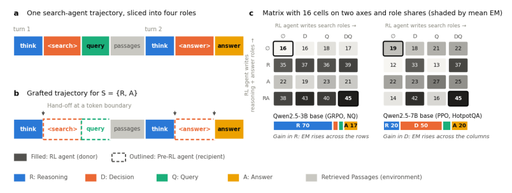
Figure 1 : Overview of the CO-GRAFT framework for attributing RL performance gains. (a) A search-agent trajectory partitioned into four roles: reasoningR, decisionD, queryQ, and answerA; gray passages are returned by the environment. (b) A grafted trajectory for S={R,A} : the RL agent (filled) generatesRandA, while its pre-RL model (outlined) generatesDandQduring live retrieval. (c) The 4×4 grid of all 16 role combinations, indexed by the roles owned by the RL agent (row∪column ) while the pre-RL model generates the remaining roles: columns add search roles (D,Q) and rows add reasoning and answer roles (R,A), progressing from ∅ (top left, pre-RL model alone) to {R,D,Q,A} (bottom right, RL agent alone). Each cell reports the mean EM (%) of the grafted policy on the same 1,000 evaluation questions (darker shading indicates higher EM), alongside each role’s Shapley percentage share of total gainv(N)−v(∅)for Qwen2.5-3B base (GRPO, NQ) and Qwen2.5-7B base (PPO, HotpotQA).
Original paper · CC BY 4.0 · Ramraj Chandradevan, Sayontan Ghosh, Vinoth Selvendran · CO-GRAFT: Attributing Reinforcement Learning Gains in Search Agents via Role-Level Policy Grafting · Original paper figure · Extracted the figure area from page 3 of the original PDF.Why overall EM gains hide the mechanism
RL post-training lifts search agents by up to 32 EM points over prompted pre-RL agents in the authors' evaluation. That total says little about what changed inside the agent, though. Each turn of a search agent has four jobs: reasoning, choosing between search and answer, writing a query, and extracting the final answer. An EM increase could come from any of these four, and outcome-only supervision doesn't say which one moved.
Behavioural statistics such as response length, search frequency and query overlap track training progress. But they don't show that a change in one role actually raised end-to-end accuracy. Single-role ablations miss cases where two roles must change together, and offline interventions on static prefixes skip live retrieval. So the field needed a way to probe a trained checkpoint in closed-loop execution.
Letting two policies share one trajectory
The key idea is to let the trained agent and its pre-RL starting point write different roles of the same trajectory. Each role goes to exactly one of the two policies, so the ownership pattern can change while live retrieval keeps running. The authors call the trained model the donor and its exact initialization the recipient, and both share a tokenizer and prompt template.
Every model-generated token falls into one of four roles: R for reasoning before the next action tag, D for the action choice, Q for the search query string, and A for the answer text. Passages returned by the retriever belong to neither policy, so they stay outside all role counts. For a grafted policy S, the donor writes the roles in S and the recipient writes the rest, and the S equal to empty set gives pure recipient behaviour.
Three harness rules keep hand-offs clean: the reasoning owner's action tag is dropped, hand-offs happen at whole-token boundaries, and an action counts only when both tags close.
From 16 measurements to Shapley and Möbius values
Each grafted policy S gets a score v(S), its mean EM on a fixed evaluation set. The recipient's score v(∅) and the donor's score v(N) set the two ends of the gain. The Shapley value of a role averages its marginal gain over all subsets of the other roles, weighted by how often each subset comes before it in a random order. Because the four shares add up to v(N) minus v(∅), the attribution accounts for the full gain.
The authors report each share as a percentage of that total gain. They report shares only when the gain reaches at least four EM points, since percentages become unstable near zero. Möbius terms split the same measurements differently, looking at what a role set gains only when it is owned together. For a set T of two or more roles, the term is \(m(T)=\sum_{S\subseteq T}(-1)^{|T|-|S|}v(S)\), which is zero when roles act independently, positive under synergy and negative when roles overlap.
Checking the harness against Search-R1
The authors ran the pure recipient and pure donor cases in both the original Search-R1 code and the CO-GRAFT harness on identical evaluation sets. Across 32 comparisons covering 8 model pairs, two datasets and two policy behaviours, 28 matched within single-point EM noise. The other four differed by at most 2.3 points, so the harness shows no sign of adding its own artifacts at that tolerance.
Ruling out format, budget and retrieval explanations
The authors read this as format compliance driving the answer gain in Qwen2.5, and content improvement in Llama-3.2.
The authors replace the decision role with a fixed search budget from 0 to 4 while keeping the rest of the RL agent. This points to a learned task-level search depth rather than per-question stopping.
Freezing the retrieved passages cuts the query attribution by 60–100%, which is 0.6–2.5 EM points. Giving the pre-RL model the RL agent's passages adds at most 3 EM points, while giving the RL agent control of R yields 11–22 EM points. So the query gains come from retrieval rather than from conditioning on the query text, on the Qwen2.5-3B and Qwen2.5-7B PPO pairs.
Where the gain lands across models
Across seven models that clear the reporting threshold, the query share stays at 15% or below on both datasets. Reasoning is higher on HotpotQA for six of the seven models, and Answer is higher on NQ for six of the seven. So question complexity mostly moves credit between reasoning and answer extraction, rather than changing the query share.
In three families, larger models put 17 to 40 percentage points more credit on Answer and Query combined in five of six comparisons. The clearest case is Qwen2.5 base, where the 3B model gets 70% from Reasoning on NQ, compared to 40% for the 7B model. The 7B model's share moves toward Answer, and larger models also start with higher valid-answer rates.
Instruction tuning acts mainly through the valid-answer rate and search retention, not through instruction tuning alone. Llama-3.2-1B instruct gains 6.1 to 11.2 points more than its base variant because it keeps searching. Llama-3.2-3B instruct stops searching entirely and gains only +1.3 to +3.2 points, against the +22.4 to +31.6 of its base variant.
Standalone roles versus joint effects
Shapley shares can hide coupling, so the authors read the Möbius terms beside them. In Llama-3.2-3B base on NQ, the standalone reasoning term is +0.1 while the reasoning-decision pairwise term is +8.8. Decision alone is −2.5 on that model, so the two roles need each other to lift EM. On HotpotQA the same reasoning-decision term is +5.4.
Qwen2.5-3B instruct on NQ has positive single-role terms of +11.0 for R, +6.2 for D and +13.8 for A. Yet its R×A term is −8.9 and D×A is −7.3, so the authors read these roles as redundant rather than synergistic. Higher-order terms need care, because a positive three- or four-way term can offset negative pairs. On Qwen2.5-3B base on NQ, R×D×A is +5.2 while R×A is −2.2 and D×A is −2.9, so the positive term mostly offsets the negatives.
Does the RL optimizer change the picture?
The authors compared public GRPO and PPO checkpoints on four model pairs. The leading role stayed the same for three architectures, for example Reasoning led Qwen2.5-3B base at 70% under GRPO and 83% under PPO on NQ. That held even though PPO raised Qwen2.5-3B search calls, from 1.1 to 2.1 on NQ.
The exception is Qwen2.5-7B base on NQ, where PPO saturates the four-search turn limit. There the Decision share reaches 77%, and Reasoning turns negative at −27%. GRPO, by contrast, averages 1.1 searches and splits credit between Reasoning at 40% and Answer at 38%. So the starting model sets the role distribution, and the optimizer disrupts it only when search reaches the turn boundary.
Limitations
Attribution measures the difference between a policy pair, so it doesn't score a standalone checkpoint. Shapley shares don't capture joint dependencies when interactions are large, as in the Qwen2.5-7B PPO pair, so the Möbius terms must be read alongside them.
Roles are cut by structural action tags, so internal planning, passage synthesis and formatting all stay inside R.
Paper info
- Authors
- Ramraj Chandradevan, Sayontan Ghosh, Vinoth Selvendran
- Venue
- arXiv · Preprint
- First published
- 2026-11-23
- Added
- 2026-11-25
- Updated
- 2026-11-23
- Version
- v1
- arXiv
- 2611.31185
- Category
- cs.IR · cs.AI · cs.CL
- Original paper terms
- CC BY 4.0
- What we show
- Paper info, commentary and permitted figures from the original paper
AI commentary is a separate explanation from the original paper and may contain errors. The original paper and figures follow each source's terms of use and any rights noted separately.
Abstract
Reinforcement learning (RL) improves large language model search agents by up to 32 exact-match (EM) points over their pre-RL initializations, yet overall accuracy gains do not identify which underlying functional capabilities improve or interact during training. We introduce CO-GRAFT, a reward-agnostic interventional attribution framework in which an RL-trained agent and its pre-RL initialization jointly generate a single trajectory under closed-loop execution with live retrieval. Each policy controls a mutually exclusive subset of four functional roles: intermediate reasoning, search-or-answer decision, search query generation, and final answer extraction. Evaluating all 2^4=16 role assignments without modifying weights or retraining defines a cooperative game whose Shapley values decompose the total RL gain across roles, while M"obius interaction terms distinguish standalone role improvements from multi-role coupling. Applying CO-GRAFT to Search-R1 agents across Qwen2.5 and Llama-3.2 models (spanning two sizes, base and instruction-tuned initializations, GRPO and PPO optimizers, and NQ and HotpotQA datasets), we show that query generation never exceeds 15% of the total gain; instead, gains are governed by pre-RL answer validity, search retention, model scale, and fixed task-level search budgets, shifting credit from reasoning toward answer extraction in larger or well-formatted answer response checkpoints while smaller base models rely on reasoning--decision coupling.
Quote from the paper
Ramraj Chandradevan, Sayontan Ghosh, Vinoth Selvendran (2026). CO-GRAFT: Attributing Reinforcement Learning Gains in Search Agents via Role-Level Policy Grafting. arXiv:2611.31185v1. https://arxiv.org/abs/2611.31185v1
BibTeX
@misc{chandradevan2026graft,
  title = {{CO-GRAFT: Attributing Reinforcement Learning Gains in Search Agents via Role-Level Policy Grafting}},
  author = {Ramraj Chandradevan and Sayontan Ghosh and Vinoth Selvendran},
  year = {2026},
  eprint = {2611.31185},
  archivePrefix = {arXiv},
  url = {https://arxiv.org/abs/2611.31185v1}
}