Paper commentary
KMed-31B Technical Report
Per-category specialists merged into a medical model
- Problem Post-training one model on exam questions and clinical chats often improves one while lowering the other. Medical QA has reference answers, but clinical inquiry needs rubrics, so the tasks interfere when trained together.
- Method KMed-31B trains one specialist per task category, each with a reward that fits its feedback. It then distills them into one student through MOPD2, which scores each specialist's token-level contribution on the student's own rollouts.
- Results On HealthBench Hard, KMed-31B scored 41.87 in non-thinking mode, up from 22.95 for its base model. Its scores on four multiple-choice benchmarks held or slightly improved.
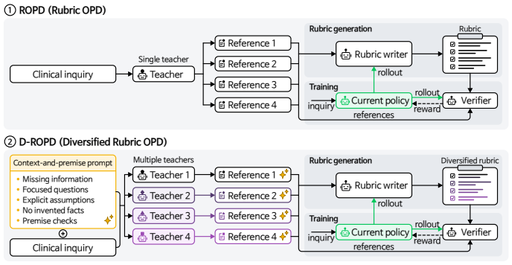
Figure 5 : Comparison of ROPD and D-ROPD in the final training stage of the clinical inquiry specialist. ROPD samples several reference responses from one teacher model, whereas D-ROPD takes one reference response from each of four distinct teacher models, generated with the context- and-premise prompt.
Original paper · CC BY 4.0 · KMed Team · KMed-31B Technical Report · Original paper figure · Extracted the figure area from page 9 of the original PDF.Why one training run struggles across medical tasks
Small open-weight medical models must answer knowledge-intensive questions, reason about cases and hold consultations on local hardware. Recent open-weight models near 30B parameters look competitive on single benchmarks, but they split their strength between exam questions and health conversations. Gemma-4-31B-IT scored 53.86 on MedXpertQA Text in non-thinking mode, yet only 22.95 on HealthBench Hard.
Post-training makes the imbalance worse because a gain on one kind of task can come at the expense of another. ConRub-Med's rubric-based RL on Qwen3-32B is one such case, where HealthBench Hard rose from 9.46 to 33.17 while MedXpertQA Text fell from 22.41 to 17.55. The authors read this pattern as a property of how the tasks are posed and supervised, not of one model or one training method.
Medical question answering has reference answers to check against, whereas clinical inquiry needs rubrics that score accuracy, completeness and fit to the user. Because the two differ in expected output and in feedback, they behave like distinct domains that interfere when trained together.
A split by output type and feedback
The core move is to give each kind of medical task its own specialist, trained with a reward that matches the feedback that task can provide. Open-ended QA, multiple-choice QA and diagnosis prediction have reference answers, so their specialists learn from answer-matching rewards. Clinical inquiry has no single correct answer, so its specialist learns from rubric-based feedback instead.
The thinking branch drops open-ended question answering, so it trains specialists for only three categories. Earlier medical work handled interference by refining the data mixture or by merging separate specialists, whereas this recipe uses the task split to decide which specialists to train.
Building the training data for each category
For open-ended QA, the answer options are removed from MedQA-USMLE, and the text of the correct option becomes the reference answer. The conversion follows an ablation in Nemotron-CrossThink, which reported higher accuracy on GPQA Diamond and SuperGPQA in its open-ended format. An LLM-based check screens items that depend on options or on missing images, but it excludes an item only when the check judges it unsuitable.
Some MedCaseReasoning presentations already include the final diagnosis or confirmatory results, which would give away the answer. Gemini-3.1-Pro-Preview rewrote these presentations to remove such cues, and the rewritten set keeps all 13,092 cases with their original labels.
Synthetic Health Dialogue simulates consultations in which the user knows details the assistant cannot see at first, so relevant context may be missing. Patient cases draw on 48 primary-care clinical presentations and tasks, grouped into 180 families. For SFT the authors used 50,000 clinician queries, each paired with a response from Kimi-K3 with thinking on, and RL drew 5,000 lay queries and 5,000 clinician queries.
How each specialist is trained
All specialists use a leave-one-out variant of GRPO, where each response's advantage is computed against the other responses in its sampled group. The advantage is \(A_i=(R_i-\bar{R}_{-i})/\sigma_{-i}\), with the mean and standard deviation taken over the rewards other than \(R_i\). The loss is a PPO-style clipped surrogate with a KL penalty toward the run's initial checkpoint, and each category sets its own KL coefficient.
The clinical inquiry specialist goes through three stages, beginning with SFT on SHD that includes MedMCQA examples to keep multiple-choice performance. In the RaR stage, a judge reads the query, its rubric and the response, then gives one holistic rating that is rescaled to the unit interval. In D-ROPD, the rubric writer sees four reference responses from distinct teachers and the current rollouts, then writes binary criteria with positive integer weights for 2,000 prompts.
Merging the specialists with MOPD2
MOPD2 trains a single student on its own rollouts, and each specialist supplies a token-level signal at every step. Because the signal is measured against the checkpoint, it reflects what each specialist added rather than the full output distribution.
The non-thinking and thinking branches each get their own specialists and student, so the procedure runs twice. Qwen3.8-27B is trained only in the thinking branch, using all four categories.
Integration method comparison
Table 4 compares integration methods on the non-thinking Gemma-4-31B-IT branch by how much of the teacher gain each method recovers. Mix-RL recovered 89% of the teacher gain on HealthBench Hard, compared to 82% for MOPD2. On MedXpertQA Text the picture reverses: Mix-RL's recovery was −118%, compared to 89% for MOPD2. Mix-RL starts from the clinical inquiry SFT checkpoint, whereas MOPD2 starts from Gemma-4-31B-IT, so the two are not fully matched.
What the evaluation measures
HealthBench Hard is a 1,000-example subset chosen as difficult for frontier models, and HealthBench Professional has 525 conversations written by physicians testing a clinician-facing assistant. Four multiple-choice benchmarks are also used: MedXpertQA Text, JAMA Clinical Challenge, NEJM AI QA and MedQA-USMLE. HealthBench scores are averaged over three runs, and multiple-choice accuracy is averaged over ten runs.
Results against general-purpose models
In thinking mode it scored 51.48, above Claude-Opus-5 at 42.26. Both gains rest on the highest unadjusted HealthBench Hard scores in their mode, which is the comparison the authors emphasize.
On HealthBench Professional, KMed-31B stayed below GPT-5.6-sol and Claude-Opus-5, with a gap of 17.74 points to Claude-Opus-5 in non-thinking mode. Gemma-4-31B-IT had a gap of 30.02 points to the same model, so the recipe narrows that distance without closing it.
On the four multiple-choice benchmarks, non-thinking KMed-31B improved by 0.17 to 2.49 points, whereas the thinking model moved between −0.16 and +0.26 points. No multiple-choice score fell by more than 0.16 points relative to Gemma-4-31B-IT, so exam accuracy held in these tests. In thinking mode the gaps to proprietary models on JAMA Clinical Challenge were 9.85 to 11.02 points, which the authors read as similar to the base model's gaps.
Comparison with medical models from other developers
Among medical models with 27B to 32B parameters, KMed-31B scored higher on every benchmark where they have a score. Baichuan-M4 reported 49.7 on HealthBench Hard, and KMed-31B scored 51.48 in thinking mode. Several of these figures are developer-reported, with judges and run counts that differ across reports, so the comparison is looser than the protocol used for KMed-31B.
Gains from each clinical inquiry training stage
Starting from 22.95 on HealthBench Hard, SFT raised the score to 30.50, RaR to 42.97, and D-ROPD to 46.04. On HealthBench Professional the score went from 37.92 to 59.62 across the same stages. RaR gave the largest stage-to-stage gains, 12.47 on HealthBench Hard and 12.17 on HealthBench Professional. D-ROPD added 3.07 and 1.54 points, so the regenerated rubrics add a smaller increment after fixed rubrics have done most of the work.
Why implicit rather than explicit rubric aggregation
Explicit aggregation scores each rubric criterion separately and sums weighted verdicts, while implicit aggregation asks the judge for one score over the whole rubric. At step 200 explicit aggregation scored 56.19 on HealthBench Hard, compared to 50.50 for implicit aggregation. Its length-adjusted score was 3.82, compared to 31.94 for implicit aggregation, so the unadjusted gain does not hold under length adjustment.
Its rollouts met 89.6% of positive criteria, compared to 72.9% for implicit aggregation, and its answers grew to about twice the length.
The authors attribute this to explicit aggregation rewarding each remaining criterion, so responses keep growing as criteria get covered. A related study found that implicit aggregation preserved response appropriateness better than additive aggregation, so the authors use implicit aggregation in RaR.
Transfer to Qwen3.8-27B
Applied to Qwen3.8-27B in thinking mode, the same recipe raised both HealthBench scores. On GPQA Diamond the Qwen3.8-27B MOPD2 model rose from 81.26 to 89.73, and it scored higher than its base model on all six benchmarks.
Limitations
The task categories and benchmarks leave out electronic health record tasks and agentic clinical tasks with tools. No experiment ran in a clinical setting, so the results don't show how KMed-31B would perform in patient care.
Paper info
- Authors
- KMed Team
- Venue
- arXiv · Preprint
- First published
- 2026-11-21
- Added
- 2026-11-24
- Updated
- 2026-11-21
- Version
- v1
- arXiv
- 2611.28719
- Category
- cs.CL · cs.AI
- Original paper terms
- CC BY 4.0
- What we show
- Paper info, commentary and permitted figures from the original paper
AI commentary is a separate explanation from the original paper and may contain errors. The original paper and figures follow each source's terms of use and any rights noted separately.
Abstract
We present KMed-31B, a medical large language model post-trained from an open-weight model for on-premises deployment with limited hardware. Post-training a model for diverse medical tasks remains difficult, because improving one kind of task can lower performance on another. We attribute this to differences between tasks in expected output and available feedback. Medical question answering and diagnosis prediction have reference answers, whereas clinical inquiry has no single correct response and is judged with rubrics. We therefore divide medical training tasks into four categories by these two properties, train one specialist per category with a reward that its feedback supports, and integrate the specialists into a single student with Multi-teacher On-policy Delta Distillation (MOPD$^2$). For clinical inquiry, we build Synthetic Health Dialogue, a simulated corpus of consultations with lay users and clinicians whose patient cases span common clinical presentations in primary care. Relative to its base model, KMed-31B raises HealthBench Hard from 22.95 to 41.87 and HealthBench Professional from 37.92 to 50.20 in non-thinking mode, and from 23.80 to 51.48 and from 41.97 to 59.18 in thinking mode, while its scores on four multiple-choice medical benchmarks are maintained or slightly improved. KMed-31B has the highest unadjusted HealthBench Hard score among the compared models, including proprietary ones, and scores higher on HealthBench Professional than every open-weight model we compare, including models with more than ten times as many total parameters. Applied to another base model, Qwen3.8-27B, the same training recipe also raises both HealthBench scores. We describe the training recipe, data construction, and settings in detail so that institutions requiring on-premises deployment can develop medical models from open-weight foundations.
Quote from the paper
KMed Team (2026). KMed-31B Technical Report. arXiv:2611.28719v1. https://arxiv.org/abs/2611.28719v1
BibTeX
@misc{team2026kmed,
  title = {{KMed-31B Technical Report}},
  author = {KMed Team},
  year = {2026},
  eprint = {2611.28719},
  archivePrefix = {arXiv},
  url = {https://arxiv.org/abs/2611.28719v1}
}