Paper commentary
AutoPILOT: A Visual Agent Harness for Real-Time Gameplay
- Problem Not stated in the paper.
- Method AutoPILOT lets each model call start a primitive action, an open-loop macro or a model-written closed-loop Python controller, which keeps acting on the screen until a wake event returns control to the model.
- Results Reached 68.6% real-time success against 38.3% for VISTA with GPT-6.1 Sol on AFK-Bench under the same budgets.
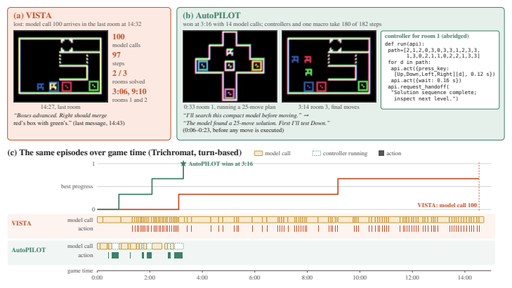
Figure 10 Case study: Trichromat, a turn-based game, with GPT-6.1 Sol in real time. (a) VISTA moves once per model call and reaches the last room with its last calls. (b) AutoPILOT searches a Python model of each room and executes the solution with controllers, shown abridged for room 1. (c) Best progress, model calls, controller runs and steps over game time. Each room adds a third to progress.
Original paper · CC BY 4.0 · Mark Zhao, Pengcheng Wang, Rui Yang, Jiarui Yao, Xirui Jiang, Yuxi Chen, Bingxuan Li, Hanyang Chen, Ke Yang, Manling Li, Tong Zhang, Huan Zhang · AutoPILOT: A Visual Agent Harness for Real-Time Gameplay · Original paper figure · Extracted the figure area from page 32 of the original PDF.The one-action-per-call bottleneck
When the game keeps running during inference, such an agent can act only as often as its model responds, and each action may be chosen from a frame that is already out of date.
On GameWorld, VISTA with GPT-6.1 Sol falls from 84.1% with the clock paused to 42.9% in real time. Better memory and inspection tools do not close this gap. In real time, VISTA reaches 38.3% against 38.9% for the plain Codex harness, and higher reasoning effort adds only 4–7 points to VISTA.
How one model call covers many steps
AutoPILOT keeps VISTA's action and read-only tools and adds a choice among three execution modes in each model call. A primitive action sends one step, an open-loop macro sends a sequence of actions written by the model, and a closed-loop controller runs a Python program that reads the screen and acts repeatedly. A primitive action also stops any macro or controller that is running.
While a macro or controller runs, the model's tool call blocks, so the model produces no tokens and the worker plays the game.
Its controller can also request a handoff, which returns control with a reason so that the model can inspect the situation.
Latency is what the design targets. For GPT-6.1 Sol at low effort the median model call takes 6.1 s, so a single action chosen on one frame is executed several seconds after that frame was read.
Returning control to the model
A call returns a fresh frame to the model on one of six wake events. Two come from the program: a handoff requested by a controller, and the return of a run at its own stopping condition or on an error, together with a macro that has sent all its actions. Four come from the harness: a decision screen, a scene change, a timeout and the restart that follows a loss.
What AFK-Bench measures
Hostile real-time environments end the attempt when the agent is idle, benign real-time environments keep changing without punishing inaction, and turn-based environments change only when the agent acts.
The main metric is the success rate, the fraction of episodes in which the official success check fires before a budget is used up, and mean progress is reported as a finer signal. Results with GPT-6.1 Sol use three episodes per task with different seeds, 360 in total, while the other models run one episode per task.
Real-time results against VISTA and Codex
With GPT-6.1 Sol in real time, AutoPILOT reaches 68.6% success against 38.3% for VISTA and 38.9% for Codex. With Claude Opus 5.5 the figures are 53.3% for AutoPILOT against 30.0% for VISTA and 32.5% for Claude Code. AutoPILOT costs $0.89 per episode with GPT-6.1 Sol, against $1.50 for VISTA with the same model.
The margin is largest in hostile real-time environments, where AutoPILOT wins 62.5% of episodes against 16.7% for VISTA with GPT-6.1 Sol. With the four further models the margin remains, from 13.3 points with Qwen4-Max to 29.2 points with Hy4-flash in real time, but all four stay below GPT-6.1 Sol and Claude Opus 5.5.
Memory and inspection tools add no overall gain in real time. VISTA's visual memory does not lift it above plain Codex, although with the clock paused the same tools add 4.4 points over Codex, from 51.7% to 56.1%. Moving from the paused clock to real time costs AutoPILOT 4.5 points and VISTA 17.8 points with GPT-6.1 Sol.
Where the gains come from
Even with the clock paused, AutoPILOT beats VISTA by 17.0 points with GPT-6.1 Sol and by 21.7 points with Claude Opus 5.5, so latency explains only part of the gap. The authors attribute the rest to executing a whole plan per model call, which makes far better use of the call budget.
VISTA's real-time failures are mostly budget failures: 208 of its 222 real-time failures end after its 100 model calls are used, after only 78 steps per episode. AutoPILOT sends 681 steps from 43 model calls, because one macro or controller carries out many steps.
Recovery from restarts
The authors explain the gap by the time each retry takes: VISTA plays every retry one action per model call, while AutoPILOT plays it at game speed inside a macro or controller.
Budget, reasoning effort, generation speed and cost
Capping spending per episode, AutoPILOT matches VISTA's final success rate at 0.2 times its total cost with both models, $37 against $180 with GPT-6.1 Sol and $75 against $369 with Claude Opus 5.5.
At high effort VISTA remains 26.1 points below AutoPILOT with GPT-6.1 Sol and 16.7 points below with Claude Opus 5.5. The authors read this as a longer call yielding a program that then acts for many steps.
Generation speed is simulated as a decoding speed in tokens per second, in which the clock stops during generation and advances by N/v seconds for N output tokens. On the 80 hostile and benign real-time tasks, AutoPILOT with GPT-6.1 Sol at low effort rises from 55.0% at 10 tokens per second to 63.8% at 200 tokens per second, while VISTA reaches 38.8% at 200 tokens per second against 57.5% with the clock paused.
The authors attribute the small sensitivity to speed to the fact that speed only delays when a working controller starts, and a controller plays at full speed once written. Claude Opus 5.5 at high effort gains the most, from 31.3% to 62.5%.
Transfer to GameWorld
GameWorld has 170 tasks in 34 browser games, none of which overlap with AFK-Bench, and it was run with the same budgets.
VISTA loses 41.2 points with GPT-6.1 Sol and 25.9 points with Claude Opus 5.5, while AutoPILOT loses 2.9 points and 4.7 points.
Limitations
A closed-loop controller can run for at most 120 s, after which a timeout wake event returns control to the model. A controller that cannot read the screen while it runs wins fewer tasks than a closed-loop one, 78 against 83.
Generation speed was varied in simulation, not measured with the models, and the GameWorld comparison covers 34 games.
Paper info
- Authors
- Mark Zhao, Pengcheng Wang, Rui Yang, Jiarui Yao, Xirui Jiang, Yuxi Chen, Bingxuan Li, Hanyang Chen, Ke Yang, Manling Li, Tong Zhang, Huan Zhang
- Venue
- arXiv · Preprint
- First published
- 2026-11-20
- Added
- 2026-11-24
- Updated
- 2026-11-20
- Version
- v1
- arXiv
- 2611.28202
- Category
- cs.AI
- Original paper terms
- CC BY 4.0
- What we show
- Paper info, commentary and permitted figures from the original paper
AI commentary is a separate explanation from the original paper and may contain errors. The original paper and figures follow each source's terms of use and any rights noted separately.
Abstract
Multimodal foundation models can play video games well when the game waits for them, but often fail when it keeps running. We find that much of this gap lies in the harness, which decides what the model sees, what it remembers, and how its outputs become actions over time. Existing harnesses such as VISTA improve the first two, yet turn each model call into at most one action, so the agent acts only as often as its model thinks. We introduce AutoPILOT, which changes the third: in each model call, the model can send a primitive action, start an open-loop macro, or write a closed-loop controller that keeps playing from the screen without further model calls until it hands control back. To evaluate agents in real-time games, we build AFK-Bench, 120 diverse browser games grouped by how they respond to inaction and playable in real time or with the clock paused. With GPT-6.1 Sol under the same budgets, AutoPILOT reaches 68.6% real-time success against 38.3% for VISTA, and on GameWorld it keeps 80.0% in real time while VISTA drops from 84.1% to 42.9%. Its gains hold across models, and it reaches VISTA's final success rate at a fifth of its API cost. Our results suggest that how a harness turns model outputs into actions over time is a central yet underexplored part of agent design, and we hope AutoPILOT and AFK-Bench will serve as a foundation for agents in a world that does not wait.
Quote from the paper
Mark Zhao, Pengcheng Wang, Rui Yang, Jiarui Yao, Xirui Jiang, Yuxi Chen, Bingxuan Li, Hanyang Chen, Ke Yang, Manling Li, Tong Zhang, Huan Zhang (2026). AutoPILOT: A Visual Agent Harness for Real-Time Gameplay. arXiv:2611.28202v1. https://arxiv.org/abs/2611.28202v1
BibTeX
@misc{zhao2026autopilot,
  title = {{AutoPILOT: A Visual Agent Harness for Real-Time Gameplay}},
  author = {Mark Zhao and Pengcheng Wang and Rui Yang and Jiarui Yao and Xirui Jiang and Yuxi Chen and Bingxuan Li and Hanyang Chen and Ke Yang and Manling Li and Tong Zhang and Huan Zhang},
  year = {2026},
  eprint = {2611.28202},
  archivePrefix = {arXiv},
  url = {https://arxiv.org/abs/2611.28202v1}
}