Paper commentary
Directional Bias in Quantile SGD and Score-Inversion Inference under Dependence
Dependence biases quantile SGD, and fixed-candidate tests give valid intervals
- Problem Quantile SGD moves its threshold with recent data, so serially dependent inputs push its estimate in one direction. Score covariances cannot detect this bias, and most guarantees assume independent inputs.
- Method Score inversion tests many fixed candidate quantiles instead of tracking a threshold. Candidates with small standardized scores form an accepted set, and its convex hull gives the interval.
- Results The interval has O(n^-1/2) coverage error for a fixed sufficient lag window, and the paper calls this rate sharp. An exact scan takes O(n log n) time.
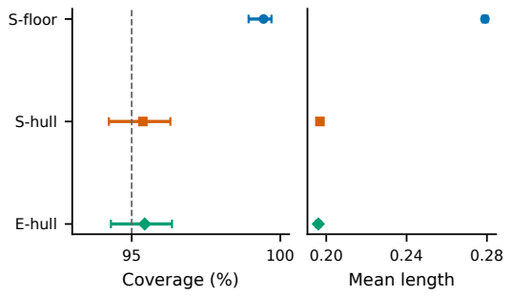
Figure 5 : Variance-floor control on 1,600 i.i.d. Cauchy streams,n = 3,000, with the power window. S-floor and S-hull differ in the floor and acceptance rule; E-hull also uses equal weights. Coverage bars are Wilson 95% Monte Carlo intervals; length bars are mean±1.96MCSE.
Original paper · CC BY 4.0 · Xiaoli Li, Qianqian Lei, Wei Biao Wu · Directional Bias in Quantile SGD and Score-Inversion Inference under Dependence · Original paper figure · Extracted the figure area from page 46 of the original PDF.Why a moving threshold picks up dependence
Quantile SGD keeps a single threshold and nudges it after each observation, which is cheap enough for long streams. Its guarantees mostly assume independent inputs, yet the inputs of conformal calibration and quantile temporal-difference learning are serially dependent. That gap matters because recent observations move the threshold and also help predict where the next input will fall.
Time reversal gives a clean test of the problem. Reversing a stationary stream keeps its marginal quantiles and every autocovariance of the scalar quantile score, so any quantity built from those covariances stays the same. The leading bias of quantile SGD still changes, from -.113 in the forward stream of the Section 4 example to -.038 in the backward one.
So the bias carries information that the score covariances don't capture.
The same issue appears in averaged SGD, whose bias is systematic rather than random.
Delaying the threshold to isolate lag interactions
The authors' central move is to delay the threshold, so the indicator uses the threshold from d steps back instead of the latest one. Under finite innovation memory, a threshold delayed by r steps no longer depends on the current observation, which cuts the direct feedback. Each additional delay removes one lag interaction while every observation and the leading second moment stay in the estimate.
The theory starts from a signed expansion of the mean error of quantile SGD. The scaled mean error converges to an interaction term minus a curvature term, and the interaction is built from sums of the lagged score times the conditional density at the target. The interaction vanishes for independent inputs, so only dependence produces the directional part of the bias.
Intuitively, the recent displacement of the threshold is of order eta_t, and that displacement shifts the conditional density of the next observation near the target. Corollary 2 sharpens the point: a stream and its time reversal can have identical covariances and different biases. The expansion needs no moments of the observations, and its density assumptions are needed only when the threshold depends on the recent past.
Inverting score tests over fixed candidates
Instead of tracking a threshold, score inversion checks many fixed candidate quantiles q. At a candidate equal to the population quantile, the indicator minus tau has mean zero, so the score stays centered. Candidates whose standardized score is small enough form the accepted set, and the closed convex hull of that set is the implemented interval.
The candidate-dependent variance is floored at 1/n, which keeps the denominator away from zero. A connected-floor variant enlarges the floor so that the accepted set is an interval for every data set, and the authors use it as a comparison. The coverage analysis transfers local-dependence normal approximations to this interval.
For a fixed sufficient window and finite memory, the coverage error is of order n to the minus one half, and the authors call this rate sharp for this interval. A Fenwick tree handles each prefix sum and point update in logarithmic time, so the full scan runs in O(n log n).
What the experiments show
The Fenwick scan was checked against the direct scan on 3,000 random configurations with 2 ≤ n < 120. The two agreed exactly on endpoints, the weighted center and the number of acceptance components in every case. At n = 3,000 and window b = 512, the Fenwick scan ran 10.89 times faster in single-thread timings, and its time barely changed with the window.
The authors compare the E-hull interval with circular block bootstrap intervals on 600 common streams per row. For MA(11) at n = 3,000, E-hull covers 94.50% and CBB4 covers 93.83%, where CBB4 uses blocks of length four times the ceiling of n to the power one third. The gap is .67 percentage point, with a paired Monte Carlo standard error of .58.
With the connectedness floor active at the target, S-floor covers 99.44% on 1,600 i.i.d. Cauchy streams at n = 3,000. S-hull covers 95.38% with intervals 29.4% shorter, so the enlarged floor buys coverage with longer intervals. Figure 5 displays the coverage and length comparison for these variants.
Limits of the theory and the tests
The expansion is derived for decreasing stepsizes and is not yet extended to constant stepsizes or to bootstrapped targets. Adaptive conformal inference and quantile temporal-difference learning are therefore not covered directly.
The finite-memory theory needs a fixed innovation memory r, and data-selected windows get only explicit bounds rather than the fixed-window rate. The AR(1) experiments show that the bias coefficients stay predictive under geometric dependence, but that setting sits outside the finite-memory assumption.
Paper info
- Authors
- Xiaoli Li, Qianqian Lei, Wei Biao Wu
- Venue
- arXiv · Preprint
- First published
- 2026-11-20
- Added
- 2026-11-24
- Updated
- 2026-11-20
- Version
- v1
- arXiv
- 2611.28367
- Category
- stat.ML · cs.LG
- Original paper terms
- CC BY 4.0
- What we show
- Paper info, commentary and permitted figures from the original paper
AI commentary is a separate explanation from the original paper and may contain errors. The original paper and figures follow each source's terms of use and any rights noted separately.
Abstract
Quantile stochastic gradient descent (SGD) tracks a quantile by comparing each observation with an adaptive threshold, and closely related updates calibrate online conformal sets and drive quantile temporal-difference learning. Their inputs are serially dependent, yet existing guarantees largely assume independence. We show that dependence creates a directional bias that score autocovariances cannot detect: reversing a stationary stream leaves every score autocovariance unchanged but can change the leading bias threefold. For finite memory and decreasing stepsizes, the bias splits into lag-specific interactions between the threshold and the current observation and a curvature term; delaying the threshold removes the interactions one lag at a time while keeping every observation and the leading variance. At stepsizes near $t^{-1/2}$, as used for online inference, the bias is comparable to the standard error and makes an SGD-based interval miss mostly on one side. Testing fixed candidates instead keeps the score centered, so calibration depends only on score autocovariances. Extending local-dependence self-normalized approximations to the implemented acceptance hull, we show that inverting these tests gives a density-free, moment-free interval for the population quantile with $O(n^{-1/2})$ coverage error for a fixed sufficient lag window, a rate that is sharp for this interval, and a guarantee for data-selected windows; an exact scan takes $O(n\log n)$ time. Experiments confirm the lag-by-lag predictions and show calibration competitive with block bootstrap at lower cost.
Quote from the paper
Xiaoli Li, Qianqian Lei, Wei Biao Wu (2026). Directional Bias in Quantile SGD and Score-Inversion Inference under Dependence. arXiv:2611.28367v1. https://arxiv.org/abs/2611.28367v1
BibTeX
@misc{li2026directional,
  title = {{Directional Bias in Quantile SGD and Score-Inversion Inference under Dependence}},
  author = {Xiaoli Li and Qianqian Lei and Wei Biao Wu},
  year = {2026},
  eprint = {2611.28367},
  archivePrefix = {arXiv},
  url = {https://arxiv.org/abs/2611.28367v1}
}