Paper commentary
Scalable Beckmann Maps Improve One-step Generation
Guidance makes one-step Beckmann maps generate higher-quality images
- Problem Beckmann maps output only a sample, not the velocity or score that classifier-free guidance combines. So the original BTM stayed far behind multistep generators, with a one-step FID of 17.6 on ImageNet.
- Method SBM applies classifier-free guidance to the map's own conditional and null predictions. It trains without a teacher, so sampling still takes one network evaluation.
- Results SBM-XL reaches a one-step FID of 1.6 on ImageNet 256x256 with no teacher or feature loss, against 1.72 for iMF-XL/2.
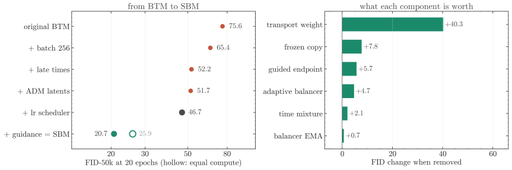
Figure 10 From BTM to SBM.One-step FID-50k after 20 epochs for DiT-B/2 maps trained from scratch in the SD-VAE latent (one seed).Left:each row adds one change to the row above, from the BTM configuration we started from to SBM. The hollow marker reads the SBM run at equal compute.Right:change in FID when one component is removed from the full recipe; a positive value means the component helps. Appendix C.1.5 defines every row and component.
Original paper · CC BY 4.0 · Ulrik Unneberg, Shiyi Wang, Lee Cheuk-Kit, Felix Berg, Boris Kozinsky, Yilun Du, Michael S. Albergo, Eric Vanden-Eijnden · Scalable Beckmann Maps Improve One-step Generation · Original paper figure · Extracted the figure area from page 15 of the original PDF.Why one-step BTM lacked guidance
Beckmann Transport Models learn a one-step map straight from data, with no teacher and no pretrained feature network. The weak point is quality: the original BTM reaches a one-step FID of 17.6 at 1280 epochs on ImageNet 256×256. Recent one-step generators reach FIDs below 2, so the gap is large. Classifier-free guidance is the usual lever for conditional generation, and it works by combining a conditional and an unconditional prediction.
A Beckmann map has no velocity or score to combine, because it only outputs the sample. So the open question is whether a Beckmann map can be guided during training while sampling still takes one network evaluation.
The autonomous denoiser behind the guidance
Since that field behaves like a denoiser, classifier-free guidance can be applied to it the way it is applied to a velocity. Written in implicit form, the guided denoiser has a correction term that uses the guided and the null denoisers.
Real denoisers are not available during training, so SBM substitutes the map's own conditional and null predictions. Both predictions come from one network, because condition dropout trains the same network on the labelled and the null case. That keeps the cost of a plain map, which is one network evaluation at sampling time, and adds no denoiser.
The substitution is not exact, and the authors characterize the bias in Appendix A.1.
How the guided training step works
Each training draw combines a noise sample, a data sample of the chosen class and a uniform time S in the linear interpolant. The guided direction is \(\dot I^\omega_S=\dot I_S+\frac{1-\omega^{-1}}{1-S}\,(T(I_S)-T^{\varnothing}(I_S))\), so the BTM direction receives a correction. The correction is the gap between conditional and null endpoint predictions, and the factor 1/(1-S) converts that gap into an interpolant velocity.
At ω = 1 the correction vanishes, and the step is ordinary conditional BTM.
The transport loss pushes the live prediction toward a target that a stop-gradient freezes along the guided direction. The boundary loss asks the map to return clean data at x1, with the same guidance correction applied to that clean target. The two terms are added with a weight λ, and Algorithm 1 gives the loop in full.
Training also varies the boundary level γ, and that level is fed to the network as an input. At sampling time the map receives pure noise and a fixed read level, so one evaluation gives the endpoint. The class label is still a run-time input, and κ can rescale the class embeddings at read time without a second call.
What the guided update guarantees
Theorem 2 links the stationary points of the guided stopped update to a guided conservation equation. The result assumes the clean boundary loss, a population objective, a guidance weight at least 1, a positive λ, and a null map equal to the identity on the data.
A stationary point alone doesn't show that trajectories reach the data, so the authors add a local existence result. This is a local result, and it does not show global arrival or convergence of training.
The two-mode example uses a standard Gaussian source in R2 and data points at e1 and −e1. The condition puts weight 0.8 on e1 and 0.2 on −e1, while the null mixture puts 0.5 on each. For each finite ω above 1, self-consistent guided maps exist that send more than 0.8 of the source mass to e1 and keep both data points fixed. The ordinary map is also a solution at that strength, so the equations don't pick out this reweighting.
ImageNet results against native BTM and baselines
The first comparison keeps the architecture, the SD-VAE latent, the data and the sampler fixed and changes only the training recipe. Each SBM update costs 1.6 BTM updates, so the compute gap shrinks by that factor.
On converged DiT-XL/2 maps, BTM's class means sit too close together, with a slope of 0.80, and its classes are too wide, with a ratio of 1.19. SBM's class means lie on the identity line, and its spread ratio is 1.00. The authors read the recipe as correcting both problems together, which fits its lower FID.
In the RAE latent, SBM-XL reaches an FID of 1.6 after 840 EFLOP. By the authors' count, iMF-XL/2 reports 1.72 at 2,700 EFLOP, which is 3.2x the training compute of SBM-XL. Drifting-L/2 reaches 1.54 at 2,200 EFLOP, but that count leaves out the 2.1B feature networks it relies on.
On FDr6, SBM-XL reads 6.2, compared to 8.4 for iMF-XL/2. The RAE latent is built on DINOv2, so the authors note it may favor one of the six encoders. Without that encoder, the mean of the other five is 6.4.
Text-to-image with a single network evaluation
SBM-B and SBM-XL were trained from scratch on the MiniT2I training data, with a frozen FLAN-T5-Large text encoder. Each image takes one map evaluation and one decoder call, and the maps act in a frozen DINOv2-S latent. SBM-XL reaches a GenEval score of 0.856, compared to 0.883 for MiniT2I-L/16 at 200 network evaluations per image.
The four-step MeanFlow distillation of MiniT2I-B/16 scores 0.842, but it needs a separate distillation stage. The baselines are pixel-space systems at 512px, so the sampling cost comparison rests on the authors' own count.
Action-conditioned world modeling without guidance
The one-step map predicts the next latent frame from four context frames and their actions. These world models use ω = 1, with no guidance and no auxiliary feature loss.
On BridgeData V2, SBM scored an SSIM of 0.869 and an FID of 4.25, compared to 0.835 and 4.86 for DriftWorld. The SBM training budget is 15.6 EFLOP, and DriftWorld's is at least 30.4 EFLOP. SBM doesn't use the DINOv3 feature encoder that DriftWorld's own ablation found essential.
The short SBM run used 5.7 EFLOP, compared to at least 16.1 for DriftWorld on RT-1. The short run reached an FID of 7.70, compared to 8.99 for DriftWorld, and an FVD of 28.3, compared to 62.8.
Inside the first chunk of eight frames both models follow the ground truth, but past it DriftWorld's arm dissolves within about ten frames. Beyond the first chunk the authors judge the SBM rollout qualitatively, so long-horizon accuracy remains untested.
Which parts of the recipe matter
Figure 10 traces a DiT-B/2 SD-VAE map from the BTM configuration, which reads FID 75.6 after 20 epochs, to the full SBM recipe. Four changes without guidance bring the FID to 46.7, and the unguided changes net to zero. Adding the guided targets and the smoothed gradient balancer then brings it to 20.7 at the same epoch budget.
Removing the per-row normalization of the transport loss leaves the map worse than native BTM. So the guided targets carry most of the gain in this ablation, which uses one seed.
At read time, the label scale κ moves the trade-off between Inception Score and FID. From κ = 1 to 2 the Inception Score rises, while FID reaches its minimum of 1.61 at κ = 1.35 before it climbs. This is an inference knob on the same network, not a second evaluation.
Limitations
The theory covers idealized population updates, with local endpoint existence under weak guidance. Guidance adds network evaluations during training, although sampling keeps one.
Image models use representation autoencoders, and text-to-image evaluation uses GenEval at 256×256 only. World-model metrics reset history every eight generated frames, and longer rollouts are judged qualitatively. Long-horizon accuracy and downstream control performance are untested.
What the authors leave open
The analysis leaves open which self-consistent map training selects, and whether the objective can steer that choice.
Paper info
- Authors
- Ulrik Unneberg, Shiyi Wang, Lee Cheuk-Kit, Felix Berg, Boris Kozinsky, Yilun Du, Michael S. Albergo, Eric Vanden-Eijnden
- Venue
- arXiv · Preprint
- First published
- 2026-11-20
- Added
- 2026-11-24
- Updated
- 2026-11-20
- Version
- v1
- arXiv
- 2611.28286
- Category
- cs.LG
- Original paper terms
- CC BY 4.0
- What we show
- Paper info, commentary and permitted figures from the original paper
AI commentary is a separate explanation from the original paper and may contain errors. The original paper and figures follow each source's terms of use and any rights noted separately.
Abstract
Beckmann Transport Models (BTM) learn one-step generative maps end-to-end from data, without a teacher, a distillation stage, or pretrained features. We introduce Scalable Beckmann Maps (SBM), which bring to BTM the two ingredients behind the quality of modern multistep generators: classifier-free guidance (CFG) and a training recipe that scales, while keeping sampling at a single network evaluation. CFG combines conditional and unconditional velocity or score predictions, which a Beckmann map does not have. Our guidance rests on one observation: the BTM current is a positive multiple of an autonomous denoising field, to which CFG applies as it does to a velocity. With exact denoisers this gives guided BTM. In practice we substitute the map's own conditional and null predictions for the denoisers, which requires no additional network and introduces a bias that we characterize. We show that the guided update is consistent with a guided conservation equation, and that guidance can move the boundaries between basins, sending more noise to the modes a condition favors. Trained from scratch in the latent of a representation autoencoder, SBM reaches a one-step FID of 1.6 on ImageNet 256x256 without a teacher or a feature loss, outperforming the Improved-MeanFlow baseline with 3.2x fewer FLOPs. In text-to-image generation it reaches a GenEval score of 0.86 with one network evaluation. As a world model, where we train without guidance, the recipe alone outperforms DriftWorld on all five metrics of two robot-manipulation benchmarks, with 1.9-2.8x less training compute and no pretrained auxiliary feature encoder.
Quote from the paper
Ulrik Unneberg, Shiyi Wang, Lee Cheuk-Kit, Felix Berg, Boris Kozinsky, Yilun Du, Michael S. Albergo, Eric Vanden-Eijnden (2026). Scalable Beckmann Maps Improve One-step Generation. arXiv:2611.28286v1. https://arxiv.org/abs/2611.28286v1
BibTeX
@misc{unneberg2026scalable,
  title = {{Scalable Beckmann Maps Improve One-step Generation}},
  author = {Ulrik Unneberg and Shiyi Wang and Lee Cheuk-Kit and Felix Berg and Boris Kozinsky and Yilun Du and Michael S. Albergo and Eric Vanden-Eijnden},
  year = {2026},
  eprint = {2611.28286},
  archivePrefix = {arXiv},
  url = {https://arxiv.org/abs/2611.28286v1}
}