Paper commentary
Same Executions, Different Gaps: Judgment Rules in Web-Agent Evaluation
Judging rules can shrink a web agent's reported lead without changing its ranking
- Problem Web-agent gains are judged by a model that predicts likely completion, so a reported lead can rest on the judge's choice of question. Rankings alone miss how much of the advantage survives a stricter rule.
- Method The authors compare two judging rules on the same saved executions. Certification asks whether the record supports completion, and paired labels then estimate the gap directly.
- Results Switching to certification cut Claude's lead over Qwen from 8.33 to 1.33 percentage points while Claude still ranked first.
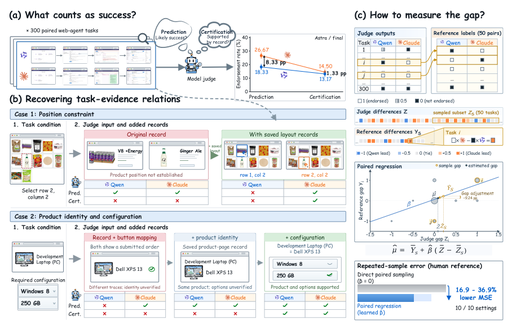
Figure 1 : Three complementary checks of an agent comparison. (a) Astra judges the same full trace and final screenshot under two success rules. (b) Archived task relations reveal a positional distinction and remove an apparent purchase advantage; browser cards illustrate record contents. Checks denote success endorsement; crosses denote non-endorsement. (c) Full-cohort judge differences and 50 paired reference labels yield a regression-adjusted estimate. A judge value of 0.5 averages two disagreeing calls. Strips show task excerpts; the scatter illustrates one sample, while the bars summarize repeated-sampling MSE across ten human-reference settings.
Original paper · CC BY 4.0 · Wang, Zelong, Li, Weiyue, Xue, Fei, Zhu, Junru · Same Executions, Different Gaps: Judgment Rules in Web-Agent Evaluation · Original paper figure · Extracted the figure area from page 2 of the original PDF.A lead that depends on the judging rule
Judge models make it cheap to score saved web-agent executions, so many improvement claims now rest on their verdicts. A plausible verdict on each run is useful, but it is only part of the evidence for saying one agent is better by a specific amount. The gap between two agents is a separate quantity from either agent's score. If a rule lowers both scores unevenly, the ranking can hold while the advantage a reader would credit to the better agent largely disappears.
The question here is what happens to Claude's lead over Qwen when the judge answers a different question about the same executions. Under Astra with the final view, the lead falls from 8.33 to 1.33 percentage points once the judge is asked whether the record supports completion. Claude's rate drops from 26.67 to 14.50, and Qwen's drops from 18.33 to 13.17.
Claude still ranks first on the point estimates, so the ordering holds while the size of the advantage changes.
Two questions asked of one record
The key idea is to hold the executions and their records fixed and change only the question the judge answers. Under prediction, the judge names the more likely outcome, so it must choose even when the record leaves completion open. Under certification, the judge asks whether the record supports completion, and a zero means not endorsed, whether the failure was observed or the evidence was simply missing.
Each execution gets two fresh calls per rule and view, and their endorsements are averaged into an endorsement rate. The final view includes the terminal screenshot, and the expanded view adds up to two earlier screenshots. The rule effect is the prediction lead minus the certification lead, so a positive value means Claude's lead shrinks.
How far the lead shrinks
The main test uses Astra with the final view on the same 300 task pairs. A reader would therefore credit Claude with much less improvement, even though the executions didn't change and Claude still ranks first.
The effect is not confined to one judge, because all five point-estimate leads in Table 1 shrink. That interval includes zero, so this judge leaves the change uncertain. The ranking alone would miss this spread across judges and views.
A fresh batch tests whether the reduction survives when unresolved cases get their own verdict. A fresh binary-certification control shows a reduction too, so the effect remains when the judge can tell insufficient evidence apart from failure.
Table 2 splits the three-state verdicts for Qwen and Claude under Astra with the final view. Claude's supported-success rate is 14.3, close to Qwen's 13.0, yet its unresolved share is 23.2, compared to 12.7 for Qwen. A small gap in supported success therefore doesn't mean the two executions have the same outcome structure.
Other systems and judges
The authors extend the rule comparison to more execution systems from the same release. Qwen, Claude and GPT-4o share 300 tasks, while adding Llama 3.3-70B leaves 206 common tasks. Llama has no VisualWebArena executions and lacks two WebArena tasks, and it uses text observations while the others use vision.
Under Astra, the leads of Qwen, Claude and GPT-4o over Llama all shrink on their common tasks. The authors take this as evidence that one uniform correction to all agent scores would miss the rule's effect.
Relations the judge has to see
The authors' second intervention asks whether a judge can check a task condition when the record shows the relevant object and observation. Two human annotators checked the annotations, and a third resolved disagreements.
Qwen clicked the second item in row 1, while Claude clicked the requested position and reached the matching product page. The original record leaves grid position, product and destination unconnected, so prediction endorses both executions and certification endorses neither. Adding the position, product and destination relation makes both rules separate the executions, with Claude endorsed and Qwen not endorsed under each rule.
Re-presenting existing observations doesn't produce this change.
The laptop task asks for a Development Laptop (PC), but the confirmation names a Dell XPS 13. Mapping the recorded click to the Order Now button makes prediction endorse only Claude. The archived product page links the two names, and adding the product identity makes prediction endorse both executions. Configuration evidence alone doesn't resolve identity, and certification endorses both executions only once identity and configuration are both supplied.
A source intervention matters when it makes the task condition checkable, whatever direction the lead moves. Supplying the relation doesn't ensure that every judge will use it correctly.
Why calibration can worsen the gap
Calibrating each agent's score separately can look like a fix, but the gap has its own error. Shrinking each error can break that cancellation and leave a worse difference.
The authors fit binary error correction for each agent on development labels and test the Astra/final certification case against the functional reference. Before calibration both rates underestimate their targets by similar amounts, and the estimated lead is +0.67 points. Each score is closer to its target, but the errors now pull the lead estimate in opposite directions.
Estimating the gap from paired labels
The estimator starts from a random sample of task pairs with both agents labeled. The sample gap can overrepresent tasks where one agent does well, so the estimator compares the sample's judge gap with the full cohort's judge gap. Let \(Y_i\) be the reference outcome difference on task i and \(Z_i\) the judge endorsement difference on that task.
The estimate is \[ \hat{\mu}=\bar{Y}_S+\hat{\beta}(\bar{Z}-\bar{Z}_S), \] where \(\bar{Z}\) is the judge difference over the full cohort. The first term is the labeled sample's gap, and the second term uses the full-cohort and sample judge differences to correct it.
Direct paired sampling fixes the weight at zero, and equal-weight correction fixes it at one. Paired regression instead learns the weight from the same 50 labeled pairs by regressing paired reference differences on paired judge differences. This avoids a separate development set, and every method uses the same paired labels. A constant offset in the judge's gap cancels in the difference between full-cohort and sample means, so the judge helps only through its variation across tasks.
Precision with the same labels
Mean squared error counts both variance and squared bias, so it captures the whole estimation error. Equal weighting does slightly better in the two Astra certification settings, so learning the weight doesn't always win.
Precision also affects a practical question: which agent leads. Its interval coverage is 94.2-94.7%, compared to 94.6% for direct sampling, so it sits slightly below the nominal level. The intervals resolve the ordering more often at the same label budget.
Kimi K2.5 has a small and uncertain rule contrast, yet its judgments still improve regression precision over direct sampling and equal weighting. The authors read this as separating how much a judge responds to the rule from how useful it is for estimation.
The additional systems extend this result: regression improves on direct paired sampling under both references, while equal weighting stays competitive in a few human-reference settings.
Limits of the evidence
The study uses fixed released executions. The source interventions establish local effects of particular evidence relations, not general rules. The estimation results measure sampling risk only within the declared cohorts and references.
Supplying a relation doesn't guarantee that every judge uses it correctly. Supplementary query and form experiments show improved use in some cases and persistent object or time confusion in others.
Interval coverage in the precision study is slightly below nominal.
Paper info
- Authors
- Wang, Zelong, Li, Weiyue, Xue, Fei, Zhu, Junru
- Venue
- arXiv · Preprint
- First published
- 2026-11-23
- Added
- 2026-11-24
- Updated
- 2026-11-23
- Version
- v1
- arXiv
- 2611.30190
- Category
- cs.AI · cs.CL
- Original paper terms
- CC BY 4.0
- What we show
- Paper info, commentary and permitted figures from the original paper
AI commentary is a separate explanation from the original paper and may contain errors. The original paper and figures follow each source's terms of use and any rights noted separately.
Abstract
Success-rate gains guide the development of web agents. Yet knowing which agent ranks first does not tell us how much confidence to place in its reported advantage. We study the comparison itself: how success is defined, what evidence supports the judgments, and how the difference between agents is estimated. On fixed web-agent executions, changing a judge from predicting likely completion to requiring recorded support can remove most of a reported lead without changing the ranking. This effect persists when unresolved completion is distinguished from supported failure. Controlled source additions explain how missing relations between task requirements, objects and observations can conceal a difference or create an apparent advantage. We also find that making both agents' score estimates more accurate can make their difference less accurate, because their original errors partly canceled. To estimate a chosen outcome difference, we combine judge predictions with reference labels for sampled task pairs. Across four released execution systems, regression fitted on the same 50 labeled pairs reduces estimation error relative to direct paired sampling. The results give agent researchers a practical basis for assessing claimed improvements: make the comparison target explicit, retain the evidence needed to check it, and use paired labels to estimate the difference directly.
Quote from the paper
Wang, Zelong, Li, Weiyue, Xue, Fei, Zhu, Junru (2026). Same Executions, Different Gaps: Judgment Rules in Web-Agent Evaluation. arXiv:2611.30190v1. https://arxiv.org/abs/2611.30190v1
BibTeX
@misc{zelong2026same,
  title = {{Same Executions, Different Gaps: Judgment Rules in Web-Agent Evaluation}},
  author = {Wang, Zelong and Li, Weiyue and Xue, Fei and Zhu, Junru},
  year = {2026},
  eprint = {2611.30190},
  archivePrefix = {arXiv},
  url = {https://arxiv.org/abs/2611.30190v1}
}