Paper commentary
$R^2$: Recognizing and Reducing Redundant Visual Tool Use
- Problem Benchmark accuracy hides whether each visual tool call helps, because correct trajectories with redundant calls receive the same reward as efficient ones.
- Method Sorts samples into five tool-utility categories, scores each crop by how strongly the following reasoning depends on it, and adds a redundancy-based efficiency advantage to GRPO among correct trajectories.
- Results Raised macro-average accuracy to 68.13% from 63.31% for the tool-enabled backbone, while mean tool calls fell from 1.17 to 0.99.
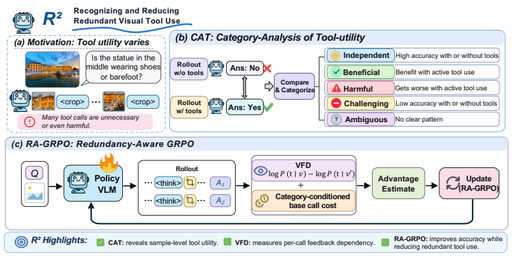
Figure 2 .Overview of R2 for recognizing and reducing redundant visual tool use.CAT compares rollouts with and without tool access to characterize sample-level tool utility and guide training-data selection. VFD measures the dependence of the same subsequent reasoning on actual versus alternative visual feedback. RA-GRPO combines VFD-based redundancy costs with a base call cost for Tool-Independent samples to assign relative efficiency advantages among correct trajectories, supplementing outcome supervision.
Original paper · CC BY 4.0 · Yilin Zhao, Jinyu Wang, Wenming Yang · $R^2$: Recognizing and Reducing Redundant Visual Tool Use · Original paper figure · Extracted the figure area from page 4 of the original PDF.Aggregate accuracy hides tool utility
Enabling tools raised the macro-average accuracy of Qwen3-VL-8B-Instruct by 6.16 percentage points. That average blends samples that are solved without tools, samples that gain from extra observations, and samples whose accuracy drops once tools are available. Figure 1 splits the samples and reports contrasting changes for the benefiting and harmed groups, so the aggregate conceals both the direction and the size of each group's change.
An outcome reward cannot separate these cases, because a correct trajectory with redundant crops and a correct trajectory with one decisive crop both receive the same reward of 1. Even a sample that benefits from tools can contain calls that return repeated or low-value observations. Tool-use supervision therefore needs two levels, one for how useful tools are to a given sample and one for how much each individual call contributes.
How the three parts connect
R2 combines three parts in a chain, and each part supplies an input to the next. CAT labels each training sample from teacher rollouts, VFD scores the tool calls inside those rollouts against a calibrated threshold, and RA-GRPO turns the flagged calls into an efficiency term for the policy update. Figure 2 draws the same chain, showing the rollouts with and without tools, the pairing of actual and alternative feedback, and the advantage that enters the update.
Sorting samples by tool utility
CAT starts from several teacher rollouts for each sample, drawn in two settings: with tool access enabled and with only the original image as visual input. In the tool-enabled setting the model may make multi-turn tool calls, while in the tool-disabled setting it sees just the image. The label depends on answer correctness and also on whether tools were actually invoked, so a sample answered correctly without any call is treated differently from one answered correctly after active use.
Tool-Independent samples succeed reliably in both settings, which suggests that direct reasoning is enough for them. Tool-Beneficial samples succeed substantially more often when tools are used actively, while Tool-Harmful samples succeed less often under the same condition. Challenging samples fail in both settings, so tool access alone does not resolve them.
Ambiguous samples show intermediate or inconclusive patterns that fit none of the other four rules.
The labels also decide which candidates enter reinforcement learning training: Tool-Independent, Tool-Beneficial and Challenging samples are kept. Qwen3-VL-8B-Instruct serves as the tool-enabled teacher for the labels, and Mini-o3-7B was tried as an alternative teacher. The authors note that category proportions can still vary with the teacher model and the inference protocol.
How tool utility is spread across benchmarks
Figure 3 gives the category shares for all seven benchmarks, with the question count of each benchmark shown alongside. Under Qwen3-VL-8B-Instruct as the teacher, Tool-Beneficial samples make up at most 12.44% of each benchmark. Tool-Independent samples account for 67.50% of HRBench-4K, 61.50% of HRBench-8K and 62.83% of V⋆Bench. So even benchmarks built around high-resolution perception contain many items that a model answers without tools.
VisualProbe and ZoomBench select small targets and difficult questions during construction, and their Challenging shares are 54.6% and 35.8%. Both still contain Tool-Independent samples, so the authors argue that difficulty-based filtering does not capture tool utility on its own.
Scoring a call by the dependence it creates
VFD looks at one tool call at a time. For call t in trajectory i, it takes the actual returned visual feedback and the full context before that feedback, then scores the reasoning window that follows, which ends before the next tool call or the final answer. Because the score is computed on rollouts that already exist, no trajectory is regenerated.
The length-normalized log-likelihood of a window is \(\ell(u\mid h,v)=\frac{1}{L}\sum_{k=1}^{L}\log\pi_{\theta_{old}}(u_k\mid h,v,u_{<k})\), where the old policy scores each token of the window given the context, the visual feedback and the earlier tokens of the window.
The VFD score is \(d_{i,t}=\ell(u_{i,t}\mid h_{i,t},v_{i,t})-\frac{1}{J}\sum_{j=1}^{J}\ell(u_{i,t}\mid h_{i,t},\tilde v^{(j)}_{i,t})\), which subtracts the average log-likelihood under J alternative observations from the log-likelihood under the actual feedback. A higher score means the same reasoning is more probable with the actual observation than with the alternatives, which indicates stronger dependence on that call.
A low score is treated as a sign of potential redundancy.
Score scales differ between data sources, so each source receives its own threshold, \(\tau_s=\mathrm{Quantile}_q\big(\{d_{i,t}: s(x)=s,\ (i,t)\in\mathcal{W}_{\mathrm{reasonwarm}}\}\big)\), taken from the warmup reasoning windows of that source. After warmup the thresholds are frozen, and a call whose score falls below \(\tau_{s(x)}\) is marked as a low-dependency call.
From call scores to trajectory costs
Scoring every call in every trajectory would add online cost, so each trajectory has one eligible call sampled uniformly. The redundancy estimate is \(\hat R_i=M_i\,z_i\), with \(M_i=|\mathcal{E}_i|\), \(t_i\sim\mathrm{Uniform}(\mathcal{E}_i)\) and \(z_i=\mathbf{1}[d_{i,t_i}<\tau_{s(x)}]\), so it scales the single draw's flag by the number of eligible calls.
When \(M_i=0\) the sampling is skipped and \(\hat R_i\) is set to 0.
The VFD estimate by itself gives zero cost both to trajectories that answer directly and to tool-using trajectories whose sampled call is not flagged. To push Tool-Independent samples toward direct answers, the category-conditioned cost adds a base charge per tool call. The full cost is \(C_i=\hat R_i+K\,\mathbf{1}[c(x)=\text{Tool-Independent}]\,N_i\), where \(N_i\) is the total number of tool calls in trajectory i, \(c(x)\) is the CAT category assigned before training, and \(K\ge 0\) is the base cost per call.
Direct answers cost nothing, and whenever K is above zero every Tool-Independent trajectory with at least one call has a positive cost. For the other categories the cost consists only of the VFD estimate.
Efficiency advantage and the policy update
Costs are compared only among the correct trajectories of a group, so a cheap failure cannot earn an efficiency reward. Let S+ be the set of rewarded trajectories and \(\bar C^+\) their mean cost; the efficiency advantage is \(A^{eff}_i=(\bar C^+-C_i)/B\) for i in S+ and 0 otherwise. B is the fixed maximum tool-call budget, so the scale does not depend on how spread out the costs happen to be in the group.
The efficiency advantages in a group are zero when no trajectory is correct or when all correct trajectories share one cost.
The outcome advantage is \(A^{out}_i=\frac{r_i-\bar r}{\sigma_r+\epsilon}\), with \(\bar r=\frac{1}{G}\sum_{j=1}^{G}r_j\), where \(\sigma_r\) is the sample standard deviation of the rewards in the group. All correct trajectories in a group receive the same outcome advantage, so this term alone cannot tell their tool use apart.
The two terms are summed as \(A_i=A^{out}_i+\beta A^{eff}_i\) with \(\beta\ge 0\), and within the correct set the efficiency advantages sum to zero. Cheaper correct trajectories therefore receive positive efficiency advantages and costlier ones receive negative advantages.
Each token has the importance ratio \(\rho_{i,m}(\theta)=\frac{\pi_\theta(o_{i,m}\mid H_{i,m})}{\pi_{\theta_{old}}(o_{i,m}\mid H_{i,m})}\), comparing the current policy with the old one. RA-GRPO maximizes \(\mathcal{J}_{\mathrm{RA\text{-}GRPO}}(\theta)=\mathbb{E}\big[\min\big(\rho_{i,m}A_i,\ \mathrm{clip}(\rho_{i,m},1-\epsilon_c,1+\epsilon_c)A_i\big)\big]\), so the combined advantage \(A_i\) drives a clipped update.
Training and evaluation setup
Training samples come from VisualProbe-Train and ZwZ-RL-VQA-10K, and after deduplication and solvability filtering about 10K candidates remain. After the category selection and the extra exploration-quality and consistency filters, approximately 3.3K training examples remain.
Vanilla GRPO starts from the same backbone, uses the same data and training configuration, and drops the efficiency terms.
Evaluation covers HRBench-4K, HRBench-8K, V⋆Bench, VisualProbe, ZoomBench, MMStar and MME-RealWorld-Lite, with the VisualProbe Easy, Medium and Hard splits aggregated. Accuracy is answer accuracy, and Calls counts the tool calls per question, including failed attempts.
Accuracy and calls against the backbone and Vanilla GRPO
Table 1 lists accuracy and mean calls for each model on the seven benchmarks, with macro averages and a difference row against the tool-enabled backbone. Compared with the tool-enabled Qwen3-VL-8B-Instruct backbone, RA-GRPO raised macro-average accuracy from 63.31% to 68.13%. Mean tool calls fell from 1.17 to 0.99, a 15.38% reduction.
Vanilla GRPO reached 67.98%, so the authors attribute most of the accuracy gain over the backbone to reinforcement learning itself rather than to the efficiency terms. Against Vanilla GRPO, RA-GRPO lowers mean calls by 12.39% at comparable benchmark accuracy.
The gain over the backbone is positive on all seven benchmarks, ranging from +1.12 on HRBench-4K to +8.44 on MME-RealWorld-Lite. The gains on the two general benchmarks are 5.14 percentage points on MMStar and 8.44 percentage points on MME-RealWorld-Lite, even though training used perception-oriented tasks.
Mean calls per question vary widely across those models, from 0.11 for Thyme-RL to 3.05 macro-average calls for Mini-o3-7B.
Where call reductions fall by category
Table 2 reports accuracy and calls for each CAT category, with Vanilla GRPO and RA-GRPO evaluated under the shared labels. The authors read this as the method removing low-value calls rather than necessary ones.
Tool-Beneficial and Tool-Harmful samples make up at most 15.28% of each benchmark, so their category gains move the benchmark average by a smaller margin. The authors note that this is why evaluation by tool utility is needed to see those gains.
Other models under the same labels
Qwen3-VL-8B-Instruct with tools is substantially more accurate than Qwen2.5-VL-7B-Instruct at the macro level. Yet it scores 36.14% on Tool-Harmful samples, the lowest of the evaluated models, so stronger aggregate accuracy can coexist with weakness on samples that tools hurt.
Mini-o3-7B averages 3.38 calls per category and improves category macro average by 2.45 percentage points over Qwen2.5-VL-7B-Instruct, so the authors suggest that more interaction does not bring a matching gain.
Pixel-Reasoner and Thyme obtain their largest category gains on Tool-Beneficial samples, a pattern that the benchmark-level averages in Table 1 do not show.
What each cost term contributes
Table 4 gives the benchmark and category macro averages for the same variants.
Replacing the VFD estimate with All-Redundant, which counts every eligible call as redundant, lowers calls in every category, to 0.54 on average.
Limits of the evidence
The RA-GRPO training reported here uses only Qwen3-VL-8B-Instruct as its backbone. Category labels depend on the teacher model and the inference protocol.
The authors leave more robust dependency estimation, additional tools and other model families to future work.
Paper info
- Authors
- Yilin Zhao, Jinyu Wang, Wenming Yang
- Venue
- arXiv · Preprint
- First published
- 2026-11-20
- Added
- 2026-11-23
- Updated
- 2026-11-20
- Version
- v1
- arXiv
- 2611.27070
- Category
- cs.CV
- Original paper terms
- CC BY 4.0
- What we show
- Paper info, commentary and permitted figures from the original paper
AI commentary is a separate explanation from the original paper and may contain errors. The original paper and figures follow each source's terms of use and any rights noted separately.
Abstract
Recent studies have shown that visual tools can improve multimodal reasoning. However, the effects of tools vary substantially across samples, and benchmark accuracy alone does not reveal whether tool interactions are beneficial or redundant. We present $R^2$, a framework that recognizes and reduces redundant visual tool use in vision-language models. We first introduce a sample-level Category Analysis of Tool Utility (CAT), which categorizes samples according to whether a model can benefit from tools. This analysis reveals that benchmark scores may obscure a model's tool-use ability. Across seven benchmarks, samples benefiting from tools account for at most 12.44% of each benchmark, while the majority gain little from tool interaction or are even harmed by it. To assess individual calls, we propose the Visual Feedback Dependency (VFD) metric, which compares the likelihood of the same subsequent reasoning under actual and alternative visual feedback without an external evaluator or trajectory regeneration. Redundancy-Aware GRPO (RA-GRPO) combines this dependency signal with a category-conditioned base call cost to assign relative efficiency advantages among correct trajectories, supplementing outcome-based supervision. Across the seven benchmarks, RA-GRPO reduces the mean number of tool calls by 12.39% relative to Vanilla GRPO at comparable benchmark accuracy. Evaluated by tool-utility category, RA-GRPO improves category macro-average accuracy over Vanilla GRPO by 3.35 percentage points.
Quote from the paper
Yilin Zhao, Jinyu Wang, Wenming Yang (2026). $R^2$: Recognizing and Reducing Redundant Visual Tool Use. arXiv:2611.27070v1. https://arxiv.org/abs/2611.27070v1
BibTeX
@misc{zhao2026recognizing,
  title = {{$R^2$: Recognizing and Reducing Redundant Visual Tool Use}},
  author = {Yilin Zhao and Jinyu Wang and Wenming Yang},
  year = {2026},
  eprint = {2611.27070},
  archivePrefix = {arXiv},
  url = {https://arxiv.org/abs/2611.27070v1}
}