Paper commentary
Lazy Agents Answer Against Their Own Beliefs: Reinforcement Learning with Verifiable Beliefs Teaches Them to Act on What They Believe
Reinforcement learning with verifiable beliefs teaches agents to commit only when evidence suffices
- Problem Agents trained only on final answers often commit before they have enough evidence. A lucky guess earns the same reward as a well-supported answer, so the outcome reward cannot teach when to commit.
- Method RLVB rewards each turn using the exact posterior that the simulator computes during training. It rewards further steps while several answers remain possible and rewards committing once the evidence is sufficient, with no judge or reward model.
- Results Across nine settings with three vision-language models, RLVB improved the base model by 17.1% on average. It beat PPO with an LLM judge by 9.3% while using 1.6 times fewer GPU-hours.
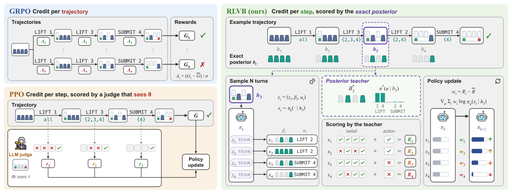
Figure 2 Three RL frameworks on the cups task.The red cylinderθis under cup 4. (a) GRPO gives every step the advantage of its trajectory, and the two shared lifts therefore get opposite credit that depends only on the final guess. (b) In PPO, a judge that seesθscores each step. It penalizes the correct beliefalland rewards the lucky guess {4}. (c)RLVBscores the action of each turn sampled ath 3 against the teacher policyπ ∗, which acts on the exact posterior, and raises the turns with a reward above the group mean. The figure also shows a variant that scores each belief line againstB ∗3. We report this variant as an ablation.
Original paper · CC BY 4.0 · Richmond Sin Jing Xuan, Peilin Feng, Wenbin Wang, Soujanya Poria · Lazy Agents Answer Against Their Own Beliefs: Reinforcement Learning with Verifiable Beliefs Teaches Them to Act on What They Believe · Original paper figure · Converted the paper's own image file from its arXiv HTML version to PNG.Why agents answer too early
Agents that work over long horizons must keep gathering evidence until it is enough to act on. Many agents quit gathering evidence too soon and guess instead, a pattern the authors call laziness. Even when they wrote that several answers remained possible, the base models committed at 3 to 68% of the turns where the evidence was insufficient.
A reward on the final answer can't separate these cases, because a lucky guess and a well-supported answer earn the same reward. Process rewards from an LLM judge try to credit single steps, but the judge sees the hidden target and can reward a lucky guess. The judge also makes training more expensive, since it is called at every step.
Premature answers are common even among models that state a belief: on HiddenGames the base models gave 64 to 97% of their answers before the evidence was sufficient. The open question is how an agent can learn to act on its own belief, rather than only be told to.
The exact posterior as a verifiable belief
The key idea is that the simulator can see the rules behind the hidden answer during training, so it can compute the exact posterior after every step. The authors treat this posterior as the belief the evidence supports, and they reward the agent for matching it without any judge or critic. Figure 2 contrasts this with GRPO, which credits whole trajectories, and with PPO, where a judge that sees the target scores each step.
Before step t the posterior is \( b_t(\theta) \propto p_0(\theta)\prod_{s<t} p(o_s\mid\theta,a_{1:s}) \), the prior times the likelihood of every earlier observation given the target and actions. Because every observation in these tasks is deterministic, the posterior is the prior restricted to the targets that agree with everything the agent has seen.
The answers the evidence still allows form the set \( B^*_t \), the answers with posterior above zero.
The agent is a vision-language model that writes a reasoning block, a belief line and an action at each turn. The belief line names the answers the agent still considers possible, and it is exact when it matches \( B^*_t \). The reward never reads this line, but the update still trains it together with the action, because the likelihood of the whole turn is raised.
The teacher uses the agent only through the measured accuracy of the agent's own answers, so unreliable answering makes it ask for more evidence.
The per-turn reward is the log probability of the agent's action under the teacher, plus a belief term that the EM variant also uses. Answering too early costs far more than one extra step, since an early answer scored −7.42 in figure 1 while an extra step costs only the time discount. So the action term mostly teaches the agent not to answer early.
Turning sampled turns into a policy update
Training runs in phases, and in each phase a frozen copy of the model plays the episodes. At every history, the authors sample N turns from that copy and score each one with the reward.
GRPO instead credits every step with the advantage of its whole episode, so the two gradients differ. The EM variant weights turns by exponentiated reward, normalized over the history, and these weights estimate the target distribution itself.
The model moves toward the target by gradient steps on a weighted log likelihood, and a phase ends when its KL divergence from the phase copy exceeds the limit ε. A turn whose action the teacher rejects, with probability below one twentieth of the best action, gets no positive weight. Training uses LoRA adapters for up to 50 updates, and each turn sees the full history of actions and observations but not the earlier reasoning.
Accuracy across nine settings
The authors test three vision-language models on HiddenGames, Pro-Worlds and RoboQuest. HiddenGames uses 756 games with seeds, maps and colors unseen in training, while Pro-Worlds and RoboQuest are never seen in training. Pro-Worlds is new in this paper: the agent sees the world through a small window and can make at most 35 moves.
RLVB(EM) gained 10.4% on average, and the authors attribute most of the gain to the reward rather than to the learner.
With the outcome reward, GRPO and PPO fall below the base model on average. GRPO (action-only) lost 1.0% and PPO (action-only) lost 5.1% on average. With the same group-relative learner as GRPO, the posterior reward beat the outcome reward by 18.1% on average.
PPO (belief + action), which uses a judged belief reward, gained 7.9% over Base on average. It also cost less, because PPO (belief + action) used 120.1 GPU-hours against 74.2 for RLVB on Qwen3.5-4B, and it made about 12,600 judge calls.
RLVB's accuracy varied by up to 4% across training runs, so gaps of a few points need careful reading.
Where the accuracy gain comes from
The authors group each answer by how much evidence the agent had when it answered.
Premature answers fell from 76 to 87% for Base to 44 to 46% for RLVB. On HiddenGames alone, 34.5 to 43.1% of RLVB answers were premature, compared to 58.9 to 94.3% for PPO (belief + action) and 64.2 to 95.1% for Base (w/ belief).
On insufficient-evidence turns whose line still names several answers, RLVB committed at only 0.1 to 2.2% of turns, while the base model with the same line committed at 3 to 68%. The authors read this as the agent acting on its own belief, since the reward never reads that line.
The belief term does not raise accuracy on any of the three models, and it makes the agent commit whenever its line names a single answer. On Qwen3-VL-4B-Thinking, the agent answers on 98% of single-answer turns where only that answer remains and on 95% where several remain. Without the belief term, RLVB answers on 66% of turns where only one answer remains and on 32% of turns where several remain.
Keeping only the belief term gave 24.6% on HiddenGames, 14.6% on Pro-Worlds and 19.7% on RoboQuest, compared to 24.5%, 18.2% and 34.0% for Base (w/ belief).
The outcome reward gives little to learn from when every episode in a group gets the same reward. After 50 updates, 18.8 to 53.1% of the GRPO groups had no winning episode and so no learning signal. For RLVB, about 2% of groups gave no signal for the two Qwen3-VL models and about 14% for Qwen3.5-4B.
Did the trained agent read evidence better or pick better steps?
The authors set three possible explanations: better reading of the evidence, more informative steps, or acting on the belief line. Over all turns, RLVB's belief line is not consistently more exact than the base model's line.
On HiddenGames the first step raised the posterior by 15.6, 14.9 and 14.8% for Base, PPO (belief + action) and RLVB.
This points to the stopping decision, not step selection, as the source of the gain.
Limitations
RLVB needs a task whose rules are known, so the simulator can compute the exact posterior.
With training, wrong answers given with enough evidence rose from 2 to 4% to 10 to 15% of episodes, mostly on the Tabletop tasks. On Pro-Worlds the trained agents reached 32.4%, compared to 100% for the posterior teacher.
The trained agent doesn't choose more informative steps, so the gain depends on the stopping decision. A harness check that rejects early answers did not raise base accuracy on HiddenGames and Pro-Worlds, because the harness can't read the observations.
RoboQuest has no exact posterior, so the posterior teacher isn't available there. The RLVB runs on Qwen3.5-4B stopped early under the step KL limit, after 20 to 35 updates.
Paper info
- Authors
- Richmond Sin Jing Xuan, Peilin Feng, Wenbin Wang, Soujanya Poria
- Venue
- arXiv · Preprint
- First published
- 2026-11-24
- Added
- 2026-11-26
- Updated
- 2026-11-24
- Version
- v1
- arXiv
- 2611.32884
- Category
- cs.AI
- Original paper terms
- CC BY 4.0
- What we show
- Paper info, commentary and permitted figures from the original paper
AI commentary is a separate explanation from the original paper and may contain errors. The original paper and figures follow each source's terms of use and any rights noted separately.
Abstract
AI agents working on long tasks often commit to an answer before they have enough evidence, a behavior called laziness. In our evaluations, they frequently commit even while their stated belief still names several possible answers. An outcome reward at the end of the episode scores only the final answer, so it cannot teach the agent when to commit, because a lucky guess receives the same reward as an answer backed by evidence. During training, however, the simulator can compute the exact posterior over the answer at every step and tell whether the evidence is already enough. We propose Reinforcement Learning with Verifiable Beliefs (RLVB), which rewards the agent for taking further steps while this posterior still allows several answers and for committing once the evidence is sufficient. The reward needs no judge, critic or reward model, and it never reads the belief line the agent writes before each action. We also introduce Pro Worlds, a benchmark of visual puzzles where the agent views a large world through a small window. We evaluate three vision-language models on three benchmarks, two of which are never seen in training. RLVB improves the base model in all nine settings, by 17.1% on average. Under the outcome reward, GRPO and PPO fall below the base model on average. RLVB also outperforms PPO with a process reward from an LLM judge by 9.3% on average while using 1.6 times fewer GPU-hours. The trained agent answers with sufficient evidence in 51%, 12% and 74% of the episodes on the three benchmarks, against 8%, 0.4% and 36% for the base model. Its accuracy gain therefore comes from answering more often at high levels of evidence. The belief line shows how the agent reaches this evidence: it acts on its own belief. It commits at only 0.1 to 2.2% of the turns at which the evidence is insufficient and its line still names several answers, against 3 to 68% for the base model.
Quote from the paper
Richmond Sin Jing Xuan, Peilin Feng, Wenbin Wang, Soujanya Poria (2026). Lazy Agents Answer Against Their Own Beliefs: Reinforcement Learning with Verifiable Beliefs Teaches Them to Act on What They Believe. arXiv:2611.32884v1. https://arxiv.org/abs/2611.32884v1
BibTeX
@misc{xuan2026lazy,
  title = {{Lazy Agents Answer Against Their Own Beliefs: Reinforcement Learning with Verifiable Beliefs Teaches Them to Act on What They Believe}},
  author = {Richmond Sin Jing Xuan and Peilin Feng and Wenbin Wang and Soujanya Poria},
  year = {2026},
  eprint = {2611.32884},
  archivePrefix = {arXiv},
  url = {https://arxiv.org/abs/2611.32884v1}
}