논문 해설
Lazy Agents Answer Against Their Own Beliefs: Reinforcement Learning with Verifiable Beliefs Teaches Them to Act on What They Believe
RLVB: 신념대로 답하도록 에이전트 학습
- 연구 문제 긴 작업의 AI 에이전트는 증거가 모이기 전에 답을 내곤 합니다. 최종 답만 채점하는 결과 보상으로는 언제 답할지 가르칠 수 없습니다.
- 연구 방법 RLVB는 시뮬레이터가 아는 정확한 사후분포로 매 턴을 채점합니다. 답이 여럿 남으면 더 살피고 증거가 충분하면 답하도록 보상합니다.
- 주요 결과 세 모델과 세 벤치마크의 아홉 설정 모두에서 기반 모델보다 높았고, 평균 17.1% 향상되었습니다.
장기 과제에서 에이전트가 너무 일찍 답하는 문제
증거가 충분해지기 전에 추측으로 답하는 에이전트의 행동을 저자들은 laziness라고 부릅니다. 컵 과제에서 에이전트는 컵을 하나씩 들어 올려 숨겨진 빨간 원기둥을 찾는데, 컵 1에서 초록 원기둥이 나오고 컵 3이 비어 있다는 것을 확인하면 빨간 원기둥은 컵 2나 컵 4에 각각 2분의 1의 확률로 있게 됩니다. 이 상태에서 다음 행동은 답을 내는 것이 아니라 다른 컵을 드는 것이어야 하지만, 기본 모델들은 신념 줄에 여러 컵이 아직 가능하다고 적고도 답을 냈습니다. 기존 결과 보상은 에피소드 끝의 최종 답만 채점하므로, 운 좋은 추측과 증거에 근거한 답이 같은 보상을 받고 어느 턴이 도움이 되었는지도 알려 주지 못합니다.
과정 보상은 턴마다 채점하려는 시도이지만, 한 단계의 가치를 추정하기가 어렵습니다. PPO의 critic은 숨겨진 정답에 따라 달라지는 결과에 맞춰 학습되고, 그림 2(b)에서 보듯 정답을 보는 LLM 판정자는 운 좋은 추측에 보상을 주고 정확하지만 아직 불확실한 신념을 벌점으로 깎을 수 있습니다. critic은 정책과 함께 학습되는 두 번째 모델이고 판정자는 매 단계 호출되므로, 학습 비용도 그만큼 커집니다. 저자들은 시뮬레이터가 숨겨진 정답과 각 행동이 드러낼 정보를 모두 안다는 점에 주목합니다. RLVB는 이 정보로 매 단계 이후의 정확한 사후분포를 계산하고, 신념이 그 분포와 얼마나 맞는지로 보상을 줍니다.
그 결과 보상은 에이전트가 지금까지 모은 증거에만 의존하며 판정자, critic, 보상 모델이 필요 없습니다. 학습 업데이트는 행동과 함께 신념 줄도 학습시키지만, 보상 계산은 신념 줄을 읽지 않습니다.
저자들은 Pro-Worlds라는 시각 퍼즐 벤치마크를 새로 만들었습니다. 에이전트는 큰 세계를 작은 창으로만 보며 창을 옮겨 증거를 모으고, 최대 35수 안에 여덟 개 후보(Jigsaw는 열 개) 가운데 답을 골라야 합니다. 정확한 사후분포를 따르는 교사는 평균 14.7수 만에 모든 게임을 풀었고, 15개 게임을 게임마다 20회씩 평가했습니다. RoboQuest의 열 가지 모바일 조작 과제는 정확한 사후분포가 없는 과제로 옮겨 가는지 확인하는 데 쓰였고, 과제마다 50개 게임을 사용했습니다. RLVB는 세 모델과 세 벤치마크의 아홉 가지 설정 모두에서 기본 모델보다 나았으며, 평균으로는 17.1% 향상되었고 기대값 최대화(EM)를 학습기로 쓰면 10.4% 향상되었습니다.
반면 결과 보상으로 학습한 GRPO와 PPO는 평균적으로 기본 모델보다 낮았습니다. LLM 판정자의 과정 보상을 쓴 PPO와 비교하면 RLVB는 평균 9.3% 높았고, GPU 시간은 1.6배 적게 들었습니다.
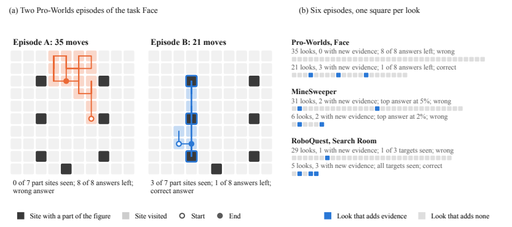
Figure 12 Example episodesof an agent trained withRLVBon Qwen3-VL-4B. (a) Two Pro-Worlds episodes of the same task, where the agent views one site at a time and only the dark sites show a part of the hidden picture. (b) Two episodes from each benchmark, with the first taking many steps and the second taking few; each square represents one step and is filled when that step adds evidence.
원문 · CC BY 4.0 · Richmond Sin Jing Xuan, Peilin Feng, Wenbin Wang, Soujanya Poria · Lazy Agents Answer Against Their Own Beliefs: Reinforcement Learning with Verifiable Beliefs Teaches Them to Act on What They Believe · 원문 그림 인용 · 원본 PDF 51쪽에서 그림 영역을 추출했습니다.정확한 사후분포를 과정 보상으로 쓰는 RLVB
RLVB가 기준으로 삼는 것은 시뮬레이터가 학습 중에만 아는 숨은 목표 θ입니다. 시뮬레이터는 θ의 사전분포 p0과 관측 우도를 곱해 각 이력에서 정확한 사후분포 bt를 계산합니다. bt는 지금까지의 행동과 관측을 조건으로 정답 후보 y가 맞을 확률을 나타냅니다. 관측이 결정적인 과제에서는 bt가 p0을 모든 관측과 맞는 목표로 좁힌 것과 같습니다. 이 사후분포에서 Bt* 집합, 곧 증거가 아직 허용하는 답들이 나오며, 이 집합이 이후 단계의 판단 기준이 됩니다.
교사 정책 π*는 bt를 입력받아 각 행동의 가치를 계산합니다. 답 y의 가치는 할인된 정답 확률에 로그를 취한 값이고, 증거 행동 a의 가치는 관측 o 이후의 사후분포 b(a,o)가 가진 가치를 기대값으로 합친 것입니다. 저자들은 이 계산을 깊이 n만큼 몇 단계 앞을 내다보는 lookahead로 되풀이합니다. 교사가 답할 확률 pans는 σ(Δ/τ)로 정해지는데, Δ는 가장 좋은 답의 가치에서 가장 좋은 증거 행동의 가치를 뺀 값입니다. 교사는 에이전트에 대해서는 정확도 ρ̂만 알며, ρ̂는 에이전트가 낸 답에서 측정합니다. 그래서 에이전트의 답이 믿을 만하지 않으면 답의 가치가 낮아지고, 교사는 더 많은 증거를 요구하게 됩니다.
보상 R(h, x)은 행동 항과 신념 항으로 나뉩니다. 행동 항은 에이전트가 쓴 행동 u를 교사 정책의 로그 확률로 채점하므로, 턴의 결정이 답하기인지 계속하기인지와 증거 행동의 선택을 함께 평가합니다. 신념 항은 신념 줄을 B 위의 균등분포 bβ와 비교하며, 정답 후보 밖의 답에는 로그 확률 −m을 줍니다. 신념 줄은 보상에 직접 들어가지 않지만, 턴 전체의 우도를 높이는 업데이트를 통해 행동과 함께 학습됩니다. 그림 1에서 컵 2와 컵 4가 아직 가능한 상황을 보면, 답을 너무 일찍 내는 행동은 −7.42를 받습니다. 반면 증거가 충분해진 뒤 한 단계를 더 가는 행동은 할인 한 단계만큼만 손해를 봅니다.
이 차이 때문에 보상은 먼저 성급한 답을 피하도록 가르칩니다.
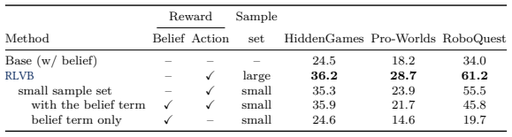
Table 3 The sample set and the two terms of the reward(Qwen3-VL-4B-Thinking). The numbers are the mean accuracy in percent over three test runs.Large: 1,200 histories are sampled in each phase and 800 of them are used for training.Small: 300 histories are sampled and 200 are used. With the belief term only, the acceptance rule is also off. Best of each column in bold.
원문 · CC BY 4.0 · Richmond Sin Jing Xuan, Peilin Feng, Wenbin Wang, Soujanya Poria · Lazy Agents Answer Against Their Own Beliefs: Reinforcement Learning with Verifiable Beliefs Teaches Them to Act on What They Believe · 원문 그림 인용 · 원본 PDF 11쪽에서 그림 영역을 추출했습니다.업데이트에서는 같은 이력에서 N개의 턴을 샘플링하고, 보상이 높은 턴의 확률을 올립니다. RLVB는 GRPO처럼 같은 그룹 안에서 보상을 비교하는 정책 기울기를 쓰고, RLVB(EM)는 보상을 지수로 바꾼 가중치로 EM을 씁니다. 한 단계의 크기는 πϕ가 πk에서 벗어난 KL 발산이 ε을 넘으면 끝나는 phase로 제한합니다. 턴마다 자기 보상만 주는 까닭은 교사의 lookahead가 이후의 결과를 이미 가치에 담기 때문입니다. 반대로 GRPO에 과정 감독을 붙인 방식은 이후 모든 단계의 보상을 현재 단계에 더합니다. 그림 2(c)의 b3에서는 컵 2와 컵 4가 절반씩 나눠 가지므로, 지금 답하면 맞을 확률이 최대 1/2입니다.
컵 하나를 들추면 한 단계 뒤에 정답을 맞힐 수 있어서, 교사는 π*(u|b3)의 거의 전부를 두 들추기 행동에 줍니다.
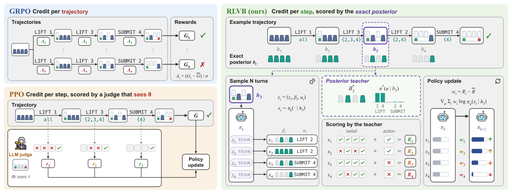
Figure 2 Three RL frameworks on the cups task.The red cylinderθis under cup 4. (a) GRPO gives every step the advantage of its trajectory, and the two shared lifts therefore get opposite credit that depends only on the final guess. (b) In PPO, a judge that seesθscores each step. It penalizes the correct beliefalland rewards the lucky guess {4}. (c)RLVBscores the action of each turn sampled ath 3 against the teacher policyπ ∗, which acts on the exact posterior, and raises the turns with a reward above the group mean. The figure also shows a variant that scores each belief line againstB ∗3. We report this variant as an ablation.
원문 · CC BY 4.0 · Richmond Sin Jing Xuan, Peilin Feng, Wenbin Wang, Soujanya Poria · Lazy Agents Answer Against Their Own Beliefs: Reinforcement Learning with Verifiable Beliefs Teaches Them to Act on What They Believe · 원문 그림 인용 · arXiv HTML판의 원본 그림 파일을 PNG로 바꿨습니다.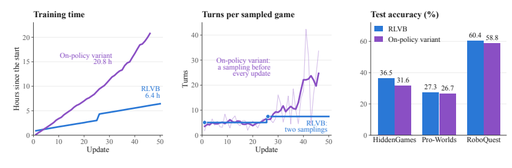
Figure 13 Sampling in phases against on-policy sampling(Qwen3-VL-4B). Left: training time, where the two jumps forRLVBcome from its two sampling passes. Middle: the number of turns in the games sampled for training, with the thin line showing each update and the thick line showing the mean of five updates. Right: accuracy on the three benchmarks.
원문 · CC BY 4.0 · Richmond Sin Jing Xuan, Peilin Feng, Wenbin Wang, Soujanya Poria · Lazy Agents Answer Against Their Own Beliefs: Reinforcement Learning with Verifiable Beliefs Teaches Them to Act on What They Believe · 원문 그림 인용 · 원본 PDF 52쪽에서 그림 영역을 추출했습니다.기반 모델과 기존 기준선 대비 결과
RLVB는 시각-언어 모델 세 개와 벤치마크 세 개로 이루어진 아홉 개 설정에서 기반 모델(Base)보다 평균 17.1% 높은 정확도를 보였습니다. 학습기를 EM으로 바꾼 RLVB(EM)도 아홉 개 설정 모두에서 기반 모델을 넘었고, 평균 향상폭은 10.4%였습니다. 두 학습기 모두 SFT, GRPO, PPO(action-only)보다 모든 설정에서 높았습니다. 학습에 쓰지 않은 Pro-Worlds와 RoboQuest에서도 향상이 이어져, 두 벤치마크에서 각각 최대 17.6%와 32.8% 높았습니다. 반면 결과 보상은 거의 도움이 되지 않았습니다. 그래서 GRPO(action-only)는 평균 1.0%, PPO(action-only)는 평균 5.1% 기반 모델보다 낮았습니다.
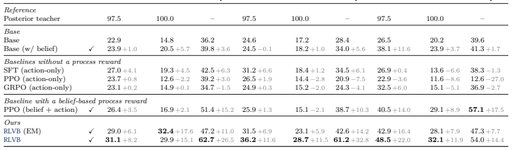
Table 1 Accuracy (%) of three vision-language models on the three benchmarks.HiddenGames tests unseen games of the training tasks. Pro-Worlds and RoboQuest are never seen in training. The rows group the methods by training signal: none, imitation or the outcome reward, a belief-based process reward from an LLM judge, and the posterior process reward ofRLVB. A check mark under Belief means that the agent states a belief before each action. Numbers are means over three sampling seeds. Grey numbers give the change against Base. Bold marks the best model in each column. The posterior teacher acts on the exact posterior, which is not available in RoboQuest.
원문 · CC BY 4.0 · Richmond Sin Jing Xuan, Peilin Feng, Wenbin Wang, Soujanya Poria · Lazy Agents Answer Against Their Own Beliefs: Reinforcement Learning with Verifiable Beliefs Teaches Them to Act on What They Believe · 원문 그림 인용 · 원본 PDF 10쪽에서 그림 영역을 추출했습니다.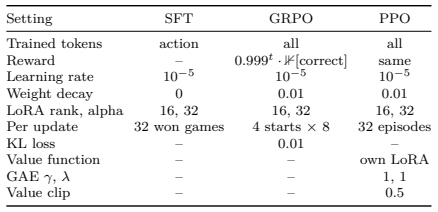
Table 20 Settings of the baselines.“All” means the reason- ing and the action.
원문 · CC BY 4.0 · Richmond Sin Jing Xuan, Peilin Feng, Wenbin Wang, Soujanya Poria · Lazy Agents Answer Against Their Own Beliefs: Reinforcement Learning with Verifiable Beliefs Teaches Them to Act on What They Believe · 원문 그림 인용 · 원본 PDF 38쪽에서 그림 영역을 추출했습니다.향상의 대부분은 사후분포 보상에서 나온다고 저자들은 봅니다. 서로 다른 두 학습기가 이 보상과 함께 모두 큰 향상을 보였기 때문입니다. RLVB와 GRPO(action-only)는 같은 학습기를 쓰는데, 이 학습기는 각 샘플을 자기 그룹과 비교해 가중합니다. 같은 학습기 안에서 사후 과정 보상은 결과 보상보다 아홉 개 설정 모두에서 높았고, 평균 차이는 18.1%였습니다. RLVB는 LLM judge의 과정 보상을 쓰는 PPO(belief + action)보다도 높았습니다. PPO(belief + action)는 기반 모델보다 평균 7.9% 높았고, RLVB는 이보다 아홉 개 중 여덟 개 설정에서 앞서 평균 9.3% 높았습니다.
예외는 Qwen3.5-4B의 RoboQuest 설정이었습니다. 비용도 달랐습니다. RLVB는 보상을 사후분포에서 계산하고 값 네트워크나 reward model이 필요 없어 더 쌌습니다. PPO(belief + action)는 정책 옆에 값 네트워크를 학습하고 모든 신념을 LLM judge에게 채점받았으며, 표 4에 따르면 GPU 시간은 RLVB가 1.6배 적게 들었습니다.
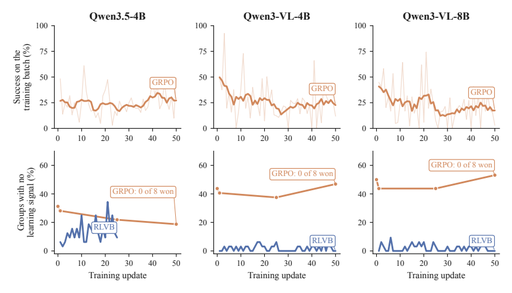
Figure 3 Learning signal during training.Top: success of GRPO on the training batch. Bottom: share of groups that give no learning signal because all their members receive the same reward. A group is a set of episodes for GRPO and the turns at one history forRLVB.
원문 · CC BY 4.0 · Richmond Sin Jing Xuan, Peilin Feng, Wenbin Wang, Soujanya Poria · Lazy Agents Answer Against Their Own Beliefs: Reinforcement Learning with Verifiable Beliefs Teaches Them to Act on What They Believe · 원문 그림 인용 · 원본 PDF 13쪽에서 그림 영역을 추출했습니다.RLVB와 RLVB(EM)는 두 학습기 모두 큰 향상을 냈지만, 평균 정확도는 RLVB가 42.7%, RLVB(EM)가 36.0%였습니다. RLVB(EM)는 표 1의 아홉 열 중 하나에서만 RLVB를 앞섰습니다. 반면 표 2에서 RLVB는 세 벤치마크 모두에서 RLVB(EM)보다 성급한 답을 적게 냈습니다. RLVB(EM)는 신념 항을 유지하므로 두 방식은 보상도 다릅니다. 같은 설정을 세 번 학습했을 때 RLVB의 정확도는 최대 4% 차이가 났습니다.
충분한 증거에서 답한 비율과 신념 줄의 역할
RLVB의 성능 향상이 어디서 왔는지 보려면 답을 낸 시점에 쌓인 증거를 따져야 합니다. 저자들은 에피소드를 답할 때의 증거 수준으로 나눠, 충분한 증거에서 답한 에피소드의 비율을 세었습니다. 그 비율은 HiddenGames에서 RLVB가 51%, Pro-Worlds에서 12%, RoboQuest에서 74%였고, 기반 모델은 각각 8%, 0.4%, 36%였습니다. 같은 자리에서 PPO(belief + action)는 20%, 3%, 57%였습니다. 충분한 증거에서 낸 답은 모든 방법에서 66에서 92%가 맞았고, 가장 낮은 증거 수준에서는 0에서 13%만 맞았습니다. 그래서 RLVB의 정확도 상승은 높은 증거 수준에서 더 자주 답한 데서 왔고, 같은 증거 수준에서 답의 정확도가 기반 모델보다 높아진 것은 아닙니다.
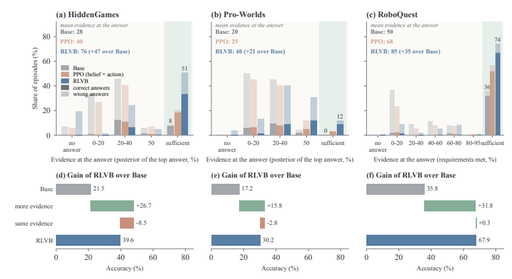
Figure 5 The evidence at the answer.We group each method’s episodes by the evidence at the answer. This evidence is the exact posterior of the top answer, or the share of requirements met on RoboQuest. (a) to (c) show the share of episodes answered at each level. The solid part of each bar marks correct answers. The shaded level shows sufficient evidence. The numbers above it report the shares for Base andRLVB. The upper left corner reports the mean evidence at the answer. (d) to (f) showRLVB’s gain over Base, split by equation (11). We pool the results across the three models.
원문 · CC BY 4.0 · Richmond Sin Jing Xuan, Peilin Feng, Wenbin Wang, Soujanya Poria · Lazy Agents Answer Against Their Own Beliefs: Reinforcement Learning with Verifiable Beliefs Teaches Them to Act on What They Believe · 원문 그림 인용 · 원본 PDF 16쪽에서 그림 영역을 추출했습니다.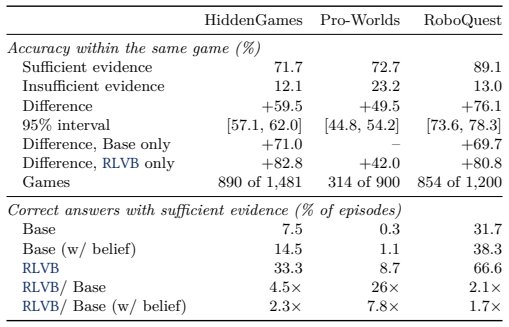
Table 22 Answers with sufficient evidence.Upper part: accuracy of answers given with sufficient evidence and with insufficient evidence within the same test game.Games: test games that have both kinds of answers across one model’s episodes from Base, PPO (belief + action),RLVB(EM), andRLVB. The 95% interval comes from a bootstrap over these games.Base onlyandRLVBonlyuse one method’s episodes. Base has both kinds of answers in only one Pro-Worlds game. Lower part: the share of all episodes (%) with a correct answer given with sufficient evidence, and RLVB’s share divided by the share for Base or Base (w/ belief). HiddenGames covers the five tasks with an answer, and RoboQuest covers the eight tasks where requirements can be counted. Results are pooled across the three models and the three test seeds.
원문 · CC BY 4.0 · Richmond Sin Jing Xuan, Peilin Feng, Wenbin Wang, Soujanya Poria · Lazy Agents Answer Against Their Own Beliefs: Reinforcement Learning with Verifiable Beliefs Teaches Them to Act on What They Believe · 원문 그림 인용 · 원본 PDF 42쪽에서 그림 영역을 추출했습니다.기반 모델은 대부분 낮은 증거 수준에서 답했습니다. 사후 확률이 40% 아래인 상태에서 답한 에피소드가 HiddenGames에서 79%, Pro-Worlds에서 96%였습니다. 이 차이는 신념 줄을 보고 행동하는 방식에서 옵니다. 증거가 부족하고 신념 줄이 여러 답을 가리키는 턴에서 RLVB는 0.1에서 2.2%의 턴에서만 답했습니다. 같은 신념 줄을 가진 기반 모델은 3에서 68%의 턴에서 답했습니다. 신념 줄이 단일 답을 가리켜 답할 때는 두 에이전트 모두 신념 줄이 가리킨 답을 그대로 냈습니다. 즉 RLVB가 더 자주 답할 수 있었던 것은 신념 줄을 만든 방식보다, 그 줄을 보고 행동을 미루거나 실행하는 방식이 달라졌기 때문입니다.
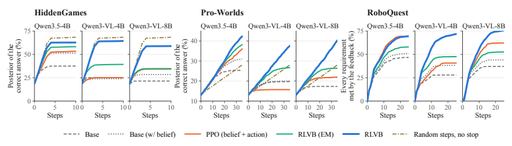
Figure 4 Evidence gathered by thek-th step.Each small panel is one model. HiddenGames and Pro-Worlds: the exact posterior of the correct answer. RoboQuest: the share of episodes where the feedback meets every requirement of the task. A finished episode keeps its final value. The right end of each curve is therefore the evidence at the end of the episodes. The dash-dot line is an agent that takes random legal steps and never stops.
원문 · CC BY 4.0 · Richmond Sin Jing Xuan, Peilin Feng, Wenbin Wang, Soujanya Poria · Lazy Agents Answer Against Their Own Beliefs: Reinforcement Learning with Verifiable Beliefs Teaches Them to Act on What They Believe · 원문 그림 인용 · 원본 PDF 14쪽에서 그림 영역을 추출했습니다.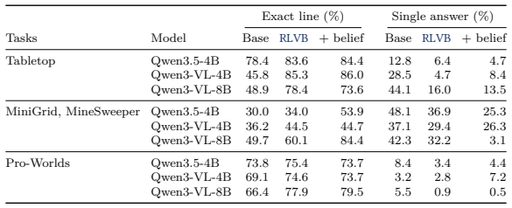
Table 8 The belief line while several answers remain, evaluated on states reached by all three agents. A state is defined by the game together with the number of answers still possible, with every state weighted equally.Exact line: share of belief lines that name exactly the answers still possible.Single answer: share of belief lines that name a single answer. Unreadable lines are excluded. Base denotes Base (w/ belief), and+ beliefdenotesRLVBtrained additionally with the belief term of equation (5), as in
원문 · CC BY 4.0 · Richmond Sin Jing Xuan, Peilin Feng, Wenbin Wang, Soujanya Poria · Lazy Agents Answer Against Their Own Beliefs: Reinforcement Learning with Verifiable Beliefs Teaches Them to Act on What They Believe · 원문 그림 인용 · 원본 PDF 18쪽에서 그림 영역을 추출했습니다.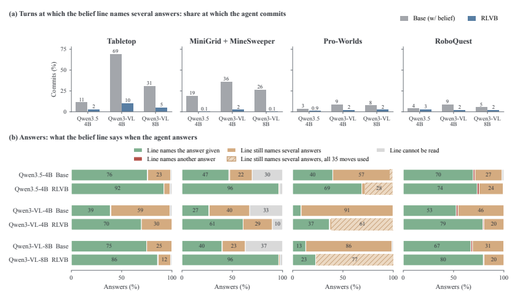
Figure 8 Acting on the belief line.(a) Among turns where the belief line names several answers, at any level of evidence, the share where the agent commits. (b) For every answer, the belief line written on that turn either names the given answer, names another answer, or still names several answers. On Pro-Worlds, answers given after all 35 moves are used are hatched because the agent can only answer then. Base means Base (w/ belief). Results are pooled across the three test seeds. On RoboQuest, language-model readers label every belief line, as section K describes.
원문 · CC BY 4.0 · Richmond Sin Jing Xuan, Peilin Feng, Wenbin Wang, Soujanya Poria · Lazy Agents Answer Against Their Own Beliefs: Reinforcement Learning with Verifiable Beliefs Teaches Them to Act on What They Believe · 원문 그림 인용 · 원본 PDF 20쪽에서 그림 영역을 추출했습니다.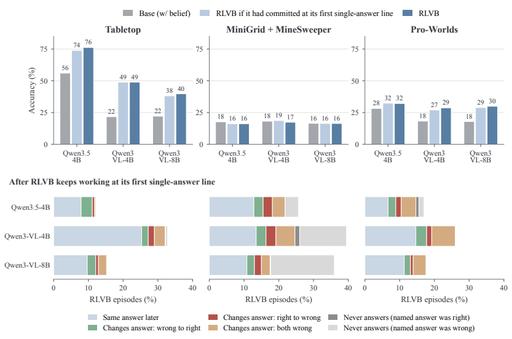
Figure 9 Committing at the first single-answer line.The upper row shows the accuracy of Base (w/ belief) and RLVB. It also shows the accuracyRLVBwould reach by committing to the answer in its first single-answer belief line. The lower row shows what follows in episodes whereRLVBkeeps working at its first single-answer line, as a share of its episodes. Results are pooled across the three test seeds.
원문 · CC BY 4.0 · Richmond Sin Jing Xuan, Peilin Feng, Wenbin Wang, Soujanya Poria · Lazy Agents Answer Against Their Own Beliefs: Reinforcement Learning with Verifiable Beliefs Teaches Them to Act on What They Believe · 원문 그림 인용 · 원본 PDF 21쪽에서 그림 영역을 추출했습니다.그렇다고 신념 줄 자체가 더 정확해진 것은 아닙니다. 전체 턴에서 RLVB의 신념 줄은 기반 모델보다 일관되게 정확하지 않았고, 단일 답을 가리킨 줄도 자주 틀렸습니다. 각 단계가 더한 증거량도 기반 모델과 비슷했습니다. 저자들은 훈련이 주로 답을 낼지 정하는 결정을 에이전트 자신의 모니터링에 잇는 방향으로 작동했다고 봅니다. 그래서 저자들은 증거를 더 잘 읽게 되면 답도 나아질 것이라고 기대합니다.
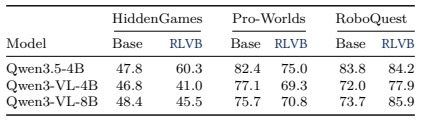
Table 7 Belief accuracy over all turns.We report the share of turns (%) where the belief line is exact. A belief line is exact when it names exactly the answers still possible under the exact posterior. We count a line that cannot be read as not exact. RoboQuest has no posterior. On RoboQuest, a line counts as exact when it names a single answer exactly when every requirement is met and does not exclude the true answer. Language-model readers judge this on every turn of the 361 instances that at least one method solves, as section K describes. Base means Base (w/ belief).
원문 · CC BY 4.0 · Richmond Sin Jing Xuan, Peilin Feng, Wenbin Wang, Soujanya Poria · Lazy Agents Answer Against Their Own Beliefs: Reinforcement Learning with Verifiable Beliefs Teaches Them to Act on What They Believe · 원문 그림 인용 · 원본 PDF 17쪽에서 그림 영역을 추출했습니다.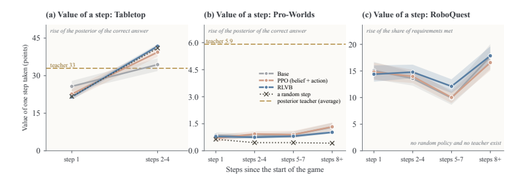
Figure 7 The value of a stepwhen every episode is followed from the start of its test game, with the steps grouped into four windows. The value is the increase in the exact posterior of the correct answer in percent, or on RoboQuest the increase in the share of requirements met, averaged over the steps taken in a window before the evidence is sufficient. The dotted line indicates a random step and the dashed line indicates the average step of the posterior teacher. RoboQuest has neither line. The bands represent 95% intervals.
원문 · CC BY 4.0 · Richmond Sin Jing Xuan, Peilin Feng, Wenbin Wang, Soujanya Poria · Lazy Agents Answer Against Their Own Beliefs: Reinforcement Learning with Verifiable Beliefs Teaches Them to Act on What They Believe · 원문 그림 인용 · 원본 PDF 19쪽에서 그림 영역을 추출했습니다.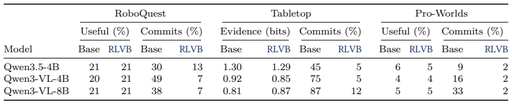
Table 9 Base andRLVBat the same state.A state is defined by the task together with the evidence gathered so far, and we compare the two models across states reached by both.Useful: share of actions that add evidence. Evidence: evidence added by one action, in bits.Commits: share of cases in which the agent commits to an answer although its evidence is not sufficient.
원문 · CC BY 4.0 · Richmond Sin Jing Xuan, Peilin Feng, Wenbin Wang, Soujanya Poria · Lazy Agents Answer Against Their Own Beliefs: Reinforcement Learning with Verifiable Beliefs Teaches Them to Act on What They Believe · 원문 그림 인용 · 원본 PDF 19쪽에서 그림 영역을 추출했습니다.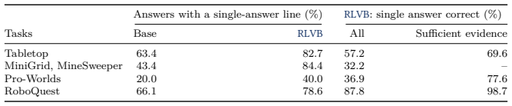
Table 10 The belief line at the answer.The last turn’s belief line for every episode that ends with an answer. Answers with a single-answer lineis the share of these episodes where the belief line names a single answer.Single answer correctis the share of these single answers that are the true answer. We report it over all such episodes and over those with sufficient evidence at the answer. – means fewer than 20 episodes. On RoboQuest, the belief lines are read as in
원문 · CC BY 4.0 · Richmond Sin Jing Xuan, Peilin Feng, Wenbin Wang, Soujanya Poria · Lazy Agents Answer Against Their Own Beliefs: Reinforcement Learning with Verifiable Beliefs Teaches Them to Act on What They Believe · 원문 그림 인용 · 원본 PDF 21쪽에서 그림 영역을 추출했습니다.적용 범위와 남은 한계
RLVB는 시뮬레이터가 사전분포와 관측 우도를 알아 정확한 사후분포를 계산할 수 있는 과제에 적용됩니다. 사후분포를 알 수 없는 과제에는 이 보상을 직접 적용할 수 없으며, 본 논문은 RoboQuest에서 사후분포 없이 요구 충족 비율로 평가했습니다. 또한 행동이 많은 과제에서는 lookahead 비용이 커지고, 신념 줄은 답 집합을 표현하므로 더 세밀한 확신도는 나타내지 못합니다. 저자들은 학습된 에이전트가 MineSweeper 등에서 추가 단계가 증거를 더하지 않을 때 답을 잘 내지 않는다는 점과, 충분한 증거에서도 관찰을 잘못 읽어 오답을 내는 사례가 남아 있다는 점을 밝힙니다.
논문 정보
- 저자
- Richmond Sin Jing Xuan, Peilin Feng, Wenbin Wang, Soujanya Poria
- 학회·저널
- arXiv · 프리프린트
- 최초 공개일
- 2026년 11월 24일
- 등록일
- 2026년 11월 26일
- 수정일
- 2026년 11월 24일
- 버전
- v1
- arXiv
- 2611.32884
- 분류
- cs.AI
- 원문 이용 조건
- CC BY 4.0
- 제공 범위
- 논문 정보, 해설, 허용된 원문 그림
AI 해설은 논문 원문과 별개의 설명이며 오류가 있을 수 있습니다. 원문과 그림은 각 출처의 이용 조건과 따로 표시된 권리를 따릅니다.
초록
AI agents working on long tasks often commit to an answer before they have enough evidence, a behavior called laziness. In our evaluations, they frequently commit even while their stated belief still names several possible answers. An outcome reward at the end of the episode scores only the final answer, so it cannot teach the agent when to commit, because a lucky guess receives the same reward as an answer backed by evidence. During training, however, the simulator can compute the exact posterior over the answer at every step and tell whether the evidence is already enough. We propose Reinforcement Learning with Verifiable Beliefs (RLVB), which rewards the agent for taking further steps while this posterior still allows several answers and for committing once the evidence is sufficient. The reward needs no judge, critic or reward model, and it never reads the belief line the agent writes before each action. We also introduce Pro Worlds, a benchmark of visual puzzles where the agent views a large world through a small window. We evaluate three vision-language models on three benchmarks, two of which are never seen in training. RLVB improves the base model in all nine settings, by 17.1% on average. Under the outcome reward, GRPO and PPO fall below the base model on average. RLVB also outperforms PPO with a process reward from an LLM judge by 9.3% on average while using 1.6 times fewer GPU-hours. The trained agent answers with sufficient evidence in 51%, 12% and 74% of the episodes on the three benchmarks, against 8%, 0.4% and 36% for the base model. Its accuracy gain therefore comes from answering more often at high levels of evidence. The belief line shows how the agent reaches this evidence: it acts on its own belief. It commits at only 0.1 to 2.2% of the turns at which the evidence is insufficient and its line still names several answers, against 3 to 68% for the base model.
원문 인용
Richmond Sin Jing Xuan, Peilin Feng, Wenbin Wang, Soujanya Poria (2026). Lazy Agents Answer Against Their Own Beliefs: Reinforcement Learning with Verifiable Beliefs Teaches Them to Act on What They Believe. arXiv:2611.32884v1. https://arxiv.org/abs/2611.32884v1
BibTeX
@misc{xuan2026lazy,
  title = {{Lazy Agents Answer Against Their Own Beliefs: Reinforcement Learning with Verifiable Beliefs Teaches Them to Act on What They Believe}},
  author = {Richmond Sin Jing Xuan and Peilin Feng and Wenbin Wang and Soujanya Poria},
  year = {2026},
  eprint = {2611.32884},
  archivePrefix = {arXiv},
  url = {https://arxiv.org/abs/2611.32884v1}
}