Paper commentary
CoT-Proxy: Cross-Format Transfer for Distilling Long-Horizon Policies
Student models learn long-horizon agent policies from teacher actions alone
- Problem Distilling a long-horizon agent usually copies the teacher's chain-of-thought, which closed teachers hide behind an API. Students cannot learn from that trace in this setting.
- Method CoT-Proxy trains the student on teacher actions with the think block left empty. A KL penalty on the student's own generations keeps it close to its initial model.
- Results On AppWorld, action-only training raised Qwen3-4B task success from 7.3% to 17.9%. Adding CoT-proxies raised it to 35.1%.
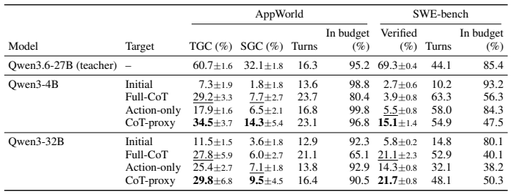
Table 1 : Task success of students distilled from the open teacher with each training target, on the AppWorld test-normal split (168 tasks, 56 scenarios) and on SWE-bench Verified (500 tasks). Every number is the mean over three seeds, with the standard deviation provided for the scores. Turns is the mean number of model responses per task. In budget is the share of trajectories that end before exhausting the token budget of the accumulated context.
Original paper · CC BY 4.0 · Dawid J. Kopiczko, Tijmen Blankevoort, Yuki M. Asano · CoT-Proxy: Cross-Format Transfer for Distilling Long-Horizon Policies · Original paper figure · Extracted the figure area from page 4 of the original PDF.Why copying the teacher's reasoning gets stuck
The students here are post-trained reasoning models that handle single-turn problems well but fall short on long-horizon tasks such as AppWorld and SWE-bench Verified. The usual supervised recipe imitates the whole trajectory, including the chain-of-thought, and that route stops working for the strongest teachers.
Dropping the reasoning from the training target
The key idea is to render each teacher turn with its think block left empty and the action placed directly after it. The same rendering is applied to earlier assistant turns, so the teacher's reasoning never reaches the student through the history.
If that holds, the actions are what needs teaching, and the student's own reasoning, already good on single turns, can stay as it is. At inference the student runs with thinking enabled, and it still carries out the learned policy through its own reasoning. The authors call this transfer from a training format without reasoning to inference with reasoning cross-format transfer.
A related safety result found that narrow fine-tuning with the chain-of-thought disabled produced broad misalignment that persisted once the chain-of-thought was re-enabled. The authors use this kind of transfer on purpose, to teach a useful long-horizon policy rather than a harmful behaviour.
Giving the student a summary of the teacher's reasoning
A CoT-proxy keeps the empty think block and inserts a short summary, wrapped in a summary tag, between that block and the action. Because the student still never trains on the reasoning text, the summary gives a signal without the cost of reasoning tokens.
For the open teacher, the authors ask the teacher to condense each turn's own reasoning into at most two sentences, without seeing the action or later observations. For GPT-5.6 Luna they use the reasoning summaries its API returns, with no further processing. The summaries average 26 tokens on AppWorld, against a 124-token reasoning trace they condense.
How the replay term enters the loss
The loss has two parts, a cross-entropy term over the teacher positions and a KL term over the replay positions, as follows. \[ L(\theta) = -\frac{1}{N_t}\sum_{i\in T}\log p_\theta(y_i \mid h_i) + \frac{1}{N_r}\sum_{i\in R}\mathrm{KL}\big(p_{\mathrm{init}}(\cdot \mid h_i)\,\|\,p_\theta(\cdot \mid h_i)\big) \]
The replay pool is built once, before training, from 1,000 generations of the initial student on OpenR1-Math and OpenAssistant prompts. Each update mixes 17 teacher samples with 3 replay samples, so replay makes up 15% of an update. The penalty needs no sampling during training and no logits from the teacher, which is why it applies to closed teachers.
Action-only and CoT-proxy results on the open teacher
On AppWorld, action-only training lifted Qwen3-4B task success from 7.3% to 17.9%, and Qwen3-32B from 11.5% to 25.4%.
So the summary adds signal beyond actions alone, even though the student's reasoning stays its own.
Distilling GPT-5.6 Luna without its hidden reasoning
GPT-5.6 Luna solves 89.3% of the AppWorld test tasks, compared to 60.7% for the open teacher. Its action-only target uses only the visible responses, and its CoT-proxy target places the API's reasoning summary before the action. Action-only training raised Qwen3-4B from 7.3% to 35.1%, and CoT-proxy training raised it further to 48.2%. For Qwen3-32B the same pair moved from 11.5% to 44.4% and then to 59.1%.
On SWE-bench Verified, Qwen3-4B rose from 2.7% to 18.0% with action-only training and to 27.8% with CoT-proxy training. These students were trained on 2,970 resolving trajectories for five passes, and each is a single run. The authors therefore read these SWE-bench differences as results from one run each.
Which parts of the recipe carry weight
Its held-out KL divergence from the initial model rose from 0.003 to 0.042 nats per token. With replay the AppWorld gains are small, and the differences lie within the seed spread.
Replacing the out-of-domain replay pool with the initial student's own AppWorld trajectories cut task success for all three targets.
Placing the summary inside the think block gave 23.4% for the open teacher, compared to 34.5% when it sat after the empty block. For GPT-5.6 Luna the same placement gave 33.9%, compared to 48.2%. A summary is therefore a useful signal outside the think block and a poor substitute for the reasoning inside it.
A much weaker annotator, Qwen3-1.7B, lost most of the gain because its drafts were rejected more often and 12% of turns had no summary. A post-hoc explanation written without the reasoning recovered about two thirds of the gain, at 29.0% compared to 34.5%.
The visible text is reasoning in another form, so removing it keeps the comparison fair between actions alone and full CoT.
What the trained student does at inference
The CoT-proxy student never writes summary tags at inference, neither in its visible response nor in its think block.
The initial student's median think block is 541 tokens over all turns, while the teacher's thoughts have a median of 66 tokens. Full-CoT training moves the median to 70 tokens and CoT-proxy training to 49 tokens, whereas action-only training keeps most of the initial pattern at 219 tokens.
Full-CoT students open 85% of their think blocks with The user wants, while the initial student's Wait appears in 98% of its think blocks. In these measurements only training on the teacher's reasoning changes how the student phrases its thinking.
Limitations
The closed-teacher SWE-bench results are single runs, so each difference rests on one run. The main comparisons cover two environments, AppWorld and SWE-bench Verified, and two students, Qwen3-4B and Qwen3-32B. Distilling from API outputs may conflict with provider terms of service, which anyone using this recipe should check.
Paper info
- Authors
- Dawid J. Kopiczko, Tijmen Blankevoort, Yuki M. Asano
- Venue
- arXiv · Preprint
- First published
- 2026-11-24
- Added
- 2026-11-26
- Updated
- 2026-11-24
- Version
- v1
- arXiv
- 2611.33148
- Category
- cs.CL
- Original paper terms
- CC BY 4.0
- What we show
- Paper info, commentary and permitted figures from the original paper
AI commentary is a separate explanation from the original paper and may contain errors. The original paper and figures follow each source's terms of use and any rights noted separately.
Abstract
Reasoning models become long-horizon agents through reinforcement learning or, more cheaply, through fine-tuning on a stronger teacher's trajectories, which contain the teacher's chain-of-thought as well as its actions. The standard fine-tuning approach imitates both, yet the strongest teachers are closed models whose chain-of-thought is hidden behind an API. We show that the chain-of-thought can be left out altogether and that the long-horizon policy can be distilled from the teacher's actions alone. The student is trained on these trajectories with its reasoning block left empty, while a KL loss on a replay buffer of its own generations limits drift from its initial model. Surprisingly, the policy learned from these trajectories with an empty reasoning block carries over to inference with thinking enabled, where the student reasons in its own style while acting like the teacher, an effect we call cross-format transfer. Distilling the actions of Qwen3.6-27B raises the task success of Qwen3-4B on AppWorld from 7% to 18% and that of Qwen3-32B from 12% to 25%. We further introduce CoT-proxies, short summaries of the teacher's reasoning placed after the empty reasoning block, which raise Qwen3-4B further, to 35%. Since neither actions nor CoT-proxies need the hidden chain-of-thought, the recipe applies unchanged to closed teachers. Distilling GPT-5.6 Luna from its visible outputs and the reasoning summaries its API returns raises Qwen3-4B from 7% to 48% on AppWorld and from 3% to 28% on SWE-bench Verified.
Quote from the paper
Dawid J. Kopiczko, Tijmen Blankevoort, Yuki M. Asano (2026). CoT-Proxy: Cross-Format Transfer for Distilling Long-Horizon Policies. arXiv:2611.33148v1. https://arxiv.org/abs/2611.33148v1
BibTeX
@misc{kopiczko2026proxy,
  title = {{CoT-Proxy: Cross-Format Transfer for Distilling Long-Horizon Policies}},
  author = {Dawid J. Kopiczko and Tijmen Blankevoort and Yuki M. Asano},
  year = {2026},
  eprint = {2611.33148},
  archivePrefix = {arXiv},
  url = {https://arxiv.org/abs/2611.33148v1}
}