論文解説
CoT-Proxy: Cross-Format Transfer for Distilling Long-Horizon Policies
教師の推論を見せず行動だけを学ばせ、閉じたモデルからも長期タスクの方針を移す
- 課題 従来の蒸留は教師の思考過程まで真似するため、推論が隠された閉じた教師には使えませんでした。
- 手法 本研究は、学生の思考ブロックを空にして教師のアクションだけを学習します。さらに、推論の短い要約を空のブロックの後に置くCoT-proxyを加えます。
- 結果 CoT-proxyを加えると、AppWorldでQwen3-4Bのタスク成功率が7.3%から34.5%に向上しました。
CoTを学習する蒸留の限界
長期タスクをこなすエージェントは、環境から結果を受け取りながら多ステップで目的に向かいます。その品質を決めるのは方針(policy)で、タスクと過去の行動・観測の履歴から次のアクションを選ぶ写像です。方針を得るには強化学習が使われますが、より安く済ませる方法として、強い教師モデルの軌跡を教師ありで学習する方式があります。その軌跡にはChain-of-Thought(CoT)と可視のコメント、アクションが含まれ、標準的な方式はそれらすべてを学習します。
学生モデルになるのは、単一ターンの推論はできるものの長期タスクでは弱い後学習済みの推論モデルです。新しい方針を加えても既存の能力を失わないことが求められるため、これは継続学習の問題になります。しかし、最も強い教師は推論が隠されたAPI越しのモデルで、OpenAIは推論を暗号化した項目と要約だけを返します。さらに、小さなモデルは強い推論モデルの思考の跡から学びにくいという報告もあり、CoTをそのまま真似させる方式には実用上の限界があります。
思考を空にして行動だけを学ばせる
鍵になるのは、教師の各ターンを、思考ブロックを空にしてすぐにアクションを置く学習目標に変えることです。Action-only目標では、空のブロックの後のアクションだけを教師あり学習の対象にし、教師の推論は学習させません。空のブロックは損失の対象にならないため、アクションを条件づけるだけで、学生モデルが空のブロックを出力することは学ばせません。この設計の背景には、長いタスクの失敗は推論ではなく実行に由来するという見方があります。
学習データでは、履歴に残る過去のターンも同じ形式で描きます。こうすると、行動のみの例が履歴を通じて教師の推論を見せることがありません。推論時には開始トークンだけを埋めて、学生モデル自身に思考ブロックを書かせ、その推論を後のターンの履歴に残します。空の思考で学習した方針が、推論を有効にした推論時に移るこの現象を、本研究はcross-format transferと呼んでいます。教師の可視応答は解析したアクションだけに絞り、コードブロックとして書きます。
リプレイ正則化で初期モデルに留める
行動だけの学習では、教師の方針に合わせて学生モデルが大きく動くため、既存の能力の変化を抑える仕組みが必要になります。そこで学習前に、初期学生モデルが学習環境の外のプロンプトに応答を生成し、リプレイプールとして保存します。リプレイプールは1,000件の生成で、プロンプトはOpenR1-MathとOpenAssistantから取り、数学、対話、指示追従をカバーします。各更新では教師サンプルに交差エントロピーを、リプレイサンプルにはKL罰則をかけ、学生モデルの次トークン分布を初期学生に近づけます。各更新は17件の教師サンプルと3件のリプレイからなり、リプレイは更新の15%を占めます。
損失は次の式で定義されます。\[ L(\theta) = -\frac{1}{N_t}\sum_{i\in T}\log p_\theta(y_i\mid h_i) + \frac{1}{N_r}\sum_{i\in R}\mathrm{KL}\bigl(p_{\mathrm{init}}(\cdot\mid h_i)\,\Vert\,p_\theta(\cdot\mid h_i)\bigr) \]Tは教師サンプルの教師あり位置、RはリプレイサンプルのN_t=|T|、N_r=|R|で、各和は自分のトークン数で割って正規化されます。p_initは同じベースモデルでアダプタを無効にした分布で、追加の順伝播は要るものの重みを二つ持つ必要はありません。
罰則に必要なのは初期学生のlogitsだけで、教師のlogitsは使わないため、閉じた教師にも同じ仕組みを適用できます。
CoT-proxyという要約の置き方
CoT-proxyは、行動のみの学習に教師の推論の要約を足したものです。空の思考ブロックは残したまま、その後・アクションの前に<summary>で包んだ要約を置きます。要約は思考ブロックの中には入らず、推論そのものではなく、そのアクションを選んだ判断を捉えることを狙いにしています。開かれた教師では、各ターンの思考だけを教師に渡し、最大二文に縮めて要約を作らせます。閉じた教師では、APIが可視出力と一緒に返す推論の要約をそのまま使います。
要約はAppWorldで平均26トークン、SWE-benchで20トークンで、元になる推論はそれぞれ124トークンと81トークンです。CoTを模倣させるのではなく短い信号だけを渡すため、推論トークンを増やさずに教師の判断の手がかりを届けられます。要約を思考ブロックの内側に入れる変種は、後の分析で比べます。
行動のみの学習で方針が移るか
表1は、オープン教師Qwen3.6-27Bから学習した学生の成績を、AppWorldとSWE-bench Verifiedで比べたものです。行動のみの学習では、AppWorldのタスク成功率がQwen3-4Bで7.3%から17.9%に、Qwen3-32Bで11.5%から25.4%に上がりました。SWE-benchでも、Qwen3-4Bが2.7%から5.5%に、Qwen3-32Bが5.8%から14.3%に向上しています。どの評価でも学生は推論を思考ブロックに書いてから行動しているため、学習された方針は学生自身の推論を通して実行されていると読めます。
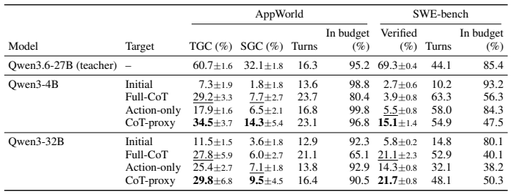
Table 1 : Task success of students distilled from the open teacher with each training target, on the AppWorld test-normal split (168 tasks, 56 scenarios) and on SWE-bench Verified (500 tasks). Every number is the mean over three seeds, with the standard deviation provided for the scores. Turns is the mean number of model responses per task. In budget is the share of trajectories that end before exhausting the token budget of the accumulated context.
出典 · CC BY 4.0 · Dawid J. Kopiczko, Tijmen Blankevoort, Yuki M. Asano · CoT-Proxy: Cross-Format Transfer for Distilling Long-Horizon Policies · 論文の図を引用 · 元のPDFの4ページ目から図の部分を抽出しています。Full-CoT学習は、AppWorldのQwen3-4Bで行動のみより11ポイント、SWE-benchのQwen3-32Bで7ポイント上回りました。残りの二つの設定では両者の差が3ポイント以内に収まり、推論を落とすコストは設定によって異なります。Full-CoT学生は最も多くのターンを使いましたが、どの設定でも成功率は最良になりませんでした。AppWorldでは、予算を使い切った軌跡がQwen3-4Bで20%、Qwen3-32Bで35%に達し、他の学習済み学生は最大でも10%でした。予算内で終わることが成功を意味しないことは、初期モデルが予算内で終わる割合が80から99%なのに最も少ないタスクしか解けない点からも分かります。
CoT-proxyは、空の思考ブロックの後に要約を足すことで、AppWorldのQwen3-4Bの成功率を17.9%から34.5%に、SWE-benchで5.5%から15.1%に上げました。CoT-proxy学生はTable 1の各列で平均値が最も高いものの、Full-CoTに対する差が統計的に有意なのはSWE-benchのQwen3-4Bだけです。要約は推論を学ばせずに信号を足すため、推論トークンは増えません。
閉じた教師GPT-5.6 Lunaへの適用
表2は、推論が隠された教師GPT-5.6 LunaからQwen3-4BとQwen3-32Bを学習した結果です。行動のみの学習では、Qwen3-4Bが7.3%から35.1%に、Qwen3-32Bが11.5%から44.4%に向上しました。CoT-proxyの学習では、同じ二つのモデルでそれぞれ48.2%と59.1%になりました。APIが返す要約は、オープン教師の場合と同じく空の思考ブロックとアクションの間に置かれるため、同じ信号として扱えます。
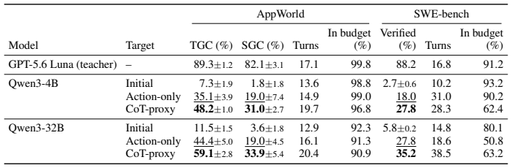
Table 2 : Task success of students distilled from the closed teacher, which has no full-CoT configura- tion as its reasoning is hidden. The CoT-proxy configuration uses the reasoning summaries returned by the API. The AppWorld recipe and evaluation are identical to Table 1, and every AppWorld num- ber is a three-seed mean, with its standard deviation for the scores. The SWE-bench students are trained on a larger set of teacher trajectories for five passes (Section 3) and are single runs, as is the teacher’s SWE-bench score. Turns is the mean number of model responses per task. In budget is the share of trajectories that end before exhausting the token budget of the accumulated context.
出典 · CC BY 4.0 · Dawid J. Kopiczko, Tijmen Blankevoort, Yuki M. Asano · CoT-Proxy: Cross-Format Transfer for Distilling Long-Horizon Policies · 論文の図を引用 · 元のPDFの5ページ目から図の部分を抽出しています。SWE-benchでは、閉じた教師が88.2%、オープン教師が69.3%を解決しています。閉じた教師の軌跡は2,970件に絞り、5パスで学習しました。行動のみでQwen3-4Bは2.7%から18.0%に、Qwen3-32Bは5.8%から27.8%になりました。CoT-proxyはQwen3-4Bで27.8%、Qwen3-32Bで35.2%になりました。このSWE-bench結果は単一の実行によるもので、シード間のばらつきは示されていません。推論を見せずに行動と要約だけで学習が成立する、というのが閉じた教師での結果の読み方です。
リプレイと要約の設計を検証
初期モデルからのKL発散は0.003から0.042 nats per tokenに上がり、リプレイがこの上昇を抑えていることが分かります。リプレイによるタスク成功率の向上は小さく、CoT-proxyで29.4%から34.5%に上がった場合でも、シードのばらつきの範囲内にあります。
リプレイプールを対象環境の中のものに置き換えると、三つの学習目標すべてで成功率が下がりました。対象領域で初期モデルへ寄せると、本来変えるべき方針まで固定されてしまうため、リプレイは環境の外から取る必要があります。
要約を思考ブロックの中に入れる変種(summary-as-CoT)は、同じ要約とアクションを使っても、オープン教師で23.4%、閉じた教師で33.9%にとどまりました。これはCoT-proxyの34.5%と48.2%を下回り、思考ブロックの中ではFull-CoTの29.2%にも届きません。著者らは、要約は思考ブロックの外で信号として働くと見ています。
能力の低いQwen3-1.7Bは要約が欠けるターンが12%あり、利得の大半を失いました。教師の推論を見せず、タスク・最後の観測・アクションから後付けの説明を書かせると、成功率は29.0%になり、行動のみの17.9%とCoT-proxyの34.5%の間に入ります。実際の推論の要約が最も効き、後付けの説明は推論も要約も得られない場合に使える、という読み方です。
可視応答を全文残すと、ほとんどの構成で成功率が下がりました。Full-CoTは29.2%から28.2%とほとんど変わらないのに対し、CoT-proxyはおよそ10から12ポイント下がり、行動のみは約5%まで落ちました。教師の可視テキストはCoT-proxyの代わりにはならず、思考ブロックを空にする学習目標はその除去に依存しています。
推論時の思考ブロックの変化
CoT-proxyの学生は学習時に要約を書くことを学んでいますが、推論時には要約タグを出力しません。これは、学習では要約とそのタグが常に空の思考ブロックの後に置かれ、推論時にはその文脈が現れないためだと考えられます。そのため、CoT-proxyの利得は推論時の要約生成ではなく、学習時の信号から来ていると読めます。
初期学生の思考ブロックは中央値541トークンで、タスクの最初のターンでは4,739トークンに達します。教師の思考の中央値は66トークンで、Full-CoT学習後の学生は70トークン、CoT-proxy学習後は49トークンまで縮みます。行動のみの学習は中央値219トークンで初期の傾向を大きく残し、最初のターンでは4,601トークンになります。
長さだけでなく言い回しも変わるのは、Full-CoT学習です。Full-CoT学生は最初の2ターンで、思考の85%を「The user wants」で始め、初期学生の「Wait」はほとんど使いません。初期学生は思考ブロックの98%で「Wait」を使っていたため、Full-CoTは言い回しまで教師に寄せたと言えます。行動のみとCoT-proxyの学生は初期の言い回しを保ち、「Okay」で始める割合はそれぞれ100%と86%です。
限界と未解決の課題
検証は二つのエージェント環境と、Qwen3-4BとQwen3-32Bの二つの学生で行われ、閉じた教師はGPT-5.6 Lunaの1つだけです。AppWorldの教師データは90タスクで、教師ごとの学習軌跡は270件にとどまります。閉じた教師のSWE-benchは単一の実行で、学習データも5パスで学習した1回の結果です。
リプレイによる成功率の改善はシードのばらつきの内側にあるため、効果の大きさは確定できません。CoT-proxyの優位のうち統計的に有意なのはSWE-benchのQwen3-4Bだけなので、ほかの差は限定的に読む必要があります。Full-CoTは多くのターンを使っても成功率が上がらず、その理由は本研究の検証の範囲では確定していません。
CoT-proxy学生は推論時に要約を出さないため、要約による利得の仕組みは学習時の信号の解釈にとどまり、直接の確認はできていません。閉じた教師のAPIを使うため、利用規約により学習への利用が制限される場合があり、確認が必要です。
論文情報
- 著者
- Dawid J. Kopiczko, Tijmen Blankevoort, Yuki M. Asano
- 学会・ジャーナル
- arXiv · プレプリント
- 公開日
- 2026年11月24日
- 登録日
- 2026年11月26日
- 更新日
- 2026年11月24日
- バージョン
- v1
- arXiv
- 2611.33148
- カテゴリ
- cs.CL
- ライセンス
- CC BY 4.0
- 掲載内容
- 論文情報・解説・論文の図
この解説は、Refivuの韓国語解説をAIで翻訳したものです。不正確な翻訳や誤りが含まれる可能性があります。論文と図の利用条件は各出典に従います。
アブストラクト
Reasoning models become long-horizon agents through reinforcement learning or, more cheaply, through fine-tuning on a stronger teacher's trajectories, which contain the teacher's chain-of-thought as well as its actions. The standard fine-tuning approach imitates both, yet the strongest teachers are closed models whose chain-of-thought is hidden behind an API. We show that the chain-of-thought can be left out altogether and that the long-horizon policy can be distilled from the teacher's actions alone. The student is trained on these trajectories with its reasoning block left empty, while a KL loss on a replay buffer of its own generations limits drift from its initial model. Surprisingly, the policy learned from these trajectories with an empty reasoning block carries over to inference with thinking enabled, where the student reasons in its own style while acting like the teacher, an effect we call cross-format transfer. Distilling the actions of Qwen3.6-27B raises the task success of Qwen3-4B on AppWorld from 7% to 18% and that of Qwen3-32B from 12% to 25%. We further introduce CoT-proxies, short summaries of the teacher's reasoning placed after the empty reasoning block, which raise Qwen3-4B further, to 35%. Since neither actions nor CoT-proxies need the hidden chain-of-thought, the recipe applies unchanged to closed teachers. Distilling GPT-5.6 Luna from its visible outputs and the reasoning summaries its API returns raises Qwen3-4B from 7% to 48% on AppWorld and from 3% to 28% on SWE-bench Verified.
論文の図
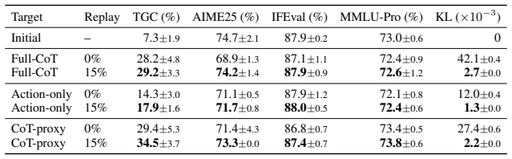
Table 3 : Replay fraction and capability retention for the Qwen3-4B student trained on AppWorld with open-teacher data. AIME25, IFEval and MMLU-Pro are the single-turn benchmarks with reported accuracy. KL is the held-out divergence from the initial model to the student in units of 10−3 nats per token, where lower is better. Every cell averages three training seeds, each evaluated once, and the better run of each pair is in bold.
出典 · CC BY 4.0 · Dawid J. Kopiczko, Tijmen Blankevoort, Yuki M. Asano · CoT-Proxy: Cross-Format Transfer for Distilling Long-Horizon Policies · 論文の図を引用 · 元のPDFの6ページ目から図の部分を抽出しています。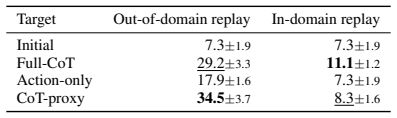
Table 4 : AppWorld task success (%) of Qwen3-4B with open-teacher data and 15% replay when the replay pool is out of domain or in domain, three training seeds per cell. The out-of-domain column repeats the runs of Table 1; the in-domain column replaces the replay pool by the initial student’s own AppWorld training trajectories.
出典 · CC BY 4.0 · Dawid J. Kopiczko, Tijmen Blankevoort, Yuki M. Asano · CoT-Proxy: Cross-Format Transfer for Distilling Long-Horizon Policies · 論文の図を引用 · 元のPDFの7ページ目から図の部分を抽出しています。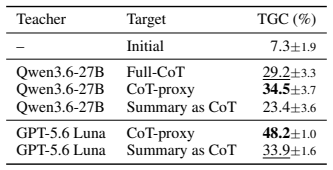
Table 5 : AppWorld task success of Qwen3-4B with 15% replay when the same teacher summary is placed after the empty think block (CoT-proxy) or inside it (summary as CoT), three training seeds per cell. The summary-as-CoT variant keeps the same summary text and the same actions but places the summary inside the think block and supervises it as the full-CoT target supervises the teacher’s thought. The remaining entries repeat the runs of Tables 1 and 2.
出典 · CC BY 4.0 · Dawid J. Kopiczko, Tijmen Blankevoort, Yuki M. Asano · CoT-Proxy: Cross-Format Transfer for Distilling Long-Horizon Policies · 論文の図を引用 · 元のPDFの8ページ目から図の部分を抽出しています。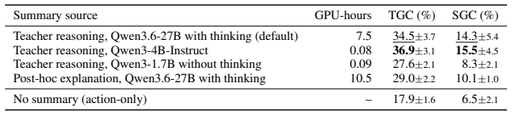
Table 6 : AppWorld task success of Qwen3-4B with open-teacher data when the summaries of the CoT-proxy target come from different sources, three training seeds per cell. The first three rows summarize the teacher’s reasoning with different annotators; the post-hoc explanation is written by the default annotator from the task, the last observation and the action, without teacher’s reasoning. GPU-hours are the wall-clock time of the annotation jobs on one H100.
出典 · CC BY 4.0 · Dawid J. Kopiczko, Tijmen Blankevoort, Yuki M. Asano · CoT-Proxy: Cross-Format Transfer for Distilling Long-Horizon Policies · 論文の図を引用 · 元のPDFの8ページ目から図の部分を抽出しています。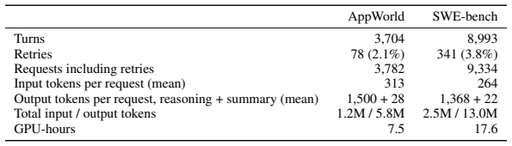
Table 9 : Cost of generating the CoT-proxy summaries for the open teacher’s training trajectories with the default annotator. A retry is an additional request after a rejected draft. GPU-hours are the wall-clock time of the annotation jobs on one H100.
出典 · CC BY 4.0 · Dawid J. Kopiczko, Tijmen Blankevoort, Yuki M. Asano · CoT-Proxy: Cross-Format Transfer for Distilling Long-Horizon Policies · 論文の図を引用 · 元のPDFの16ページ目から図の部分を抽出しています。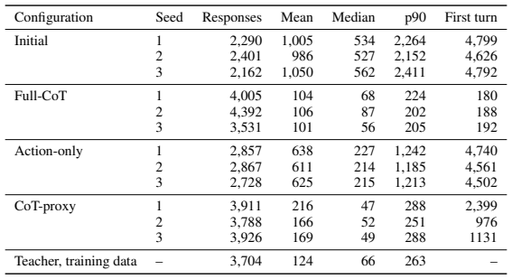
Table 12 : Think-block length in tokens per response for the Qwen3-4B students of Table 1 on AppWorld, per evaluation seed, and the teacher’s thoughts in the AppWorld training data. Mean, median and p90 are over the closed think blocks of each seed, and the first-turn column is the median over the first response of every task.
出典 · CC BY 4.0 · Dawid J. Kopiczko, Tijmen Blankevoort, Yuki M. Asano · CoT-Proxy: Cross-Format Transfer for Distilling Long-Horizon Policies · 論文の図を引用 · 元のPDFの17ページ目から図の部分を抽出しています。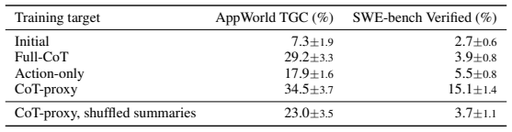
Table 14 : Task success of Qwen3-4B students trained on the open teacher’s trajectories, on App- World and SWE-bench Verified. The first four rows are from Table 1; the last row uses the CoT- proxy recipe with summaries shuffled across all training turns and trajectories. Every number is the mean over three seeds with its standard deviation.
出典 · CC BY 4.0 · Dawid J. Kopiczko, Tijmen Blankevoort, Yuki M. Asano · CoT-Proxy: Cross-Format Transfer for Distilling Long-Horizon Policies · 論文の図を引用 · 元のPDFの20ページ目から図の部分を抽出しています。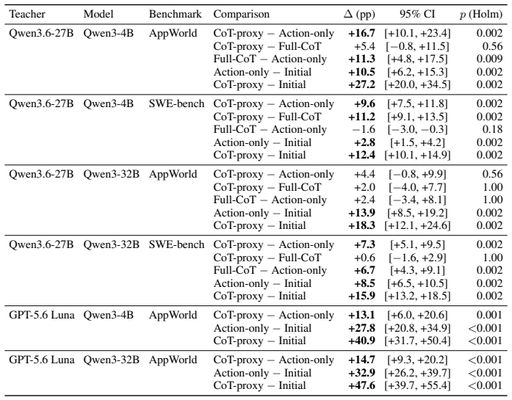
Table 16 : Paired differences in task success between training targets (percentage points; AppWorld TGC and SWE-bench Verified), averaged over three seed-matched runs. Confidence intervals are from a paired bootstrap over tasks (scenarios on AppWorld); p-values are from a paired permutation test, Holm-corrected within the open-teacher and the closed-teacher comparisons. Bold marksp < 0.05.
出典 · CC BY 4.0 · Dawid J. Kopiczko, Tijmen Blankevoort, Yuki M. Asano · CoT-Proxy: Cross-Format Transfer for Distilling Long-Horizon Policies · 論文の図を引用 · 元のPDFの21ページ目から図の部分を抽出しています。この論文を引用
Dawid J. Kopiczko, Tijmen Blankevoort, Yuki M. Asano (2026). CoT-Proxy: Cross-Format Transfer for Distilling Long-Horizon Policies. arXiv:2611.33148v1. https://arxiv.org/abs/2611.33148v1
BibTeX
@misc{kopiczko2026proxy,
  title = {{CoT-Proxy: Cross-Format Transfer for Distilling Long-Horizon Policies}},
  author = {Dawid J. Kopiczko and Tijmen Blankevoort and Yuki M. Asano},
  year = {2026},
  eprint = {2611.33148},
  archivePrefix = {arXiv},
  url = {https://arxiv.org/abs/2611.33148v1}
}