Paper commentary
Align the Pair, Not the Sample: Representation Alignment for Faster and Better One-Step Generato
Aligning only the reconstruction path speeds up one-step image generators
- Problem One-step generators have no real partner for each noise sample, so aligning the generative path to targets hurts recall. Standard representation alignment therefore does not carry over from diffusion.
- Method RePrime adds a frozen DINOv2 feature-alignment loss to the reconstruction stage of Priming. It leaves post-training unchanged and aligns only the paired reconstruction path, not the noise path.
- Results RePrime-B reached FID 1.303, compared to 1.373 for Priming-B after 160 priming epochs. RePrime-L reached FID 1.155, compared to 1.19 for Priming-L.
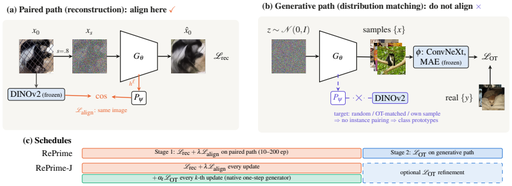
Figure 2 . Where to align a one-step generator. (a) On the paired path, the generator reconstructs a corrupted real image xs, and an intermediate feature h ℓ is aligned, through a light projector Pψ, with frozen DINOv2 features of the same clean image x0. (b) On the generative path, the same weights map noise to samples that are matched to real images by OT in frozen ConvNeXt/MAE feature spaces. A sample has no corresponding real image, so every alignment target we construct lacks instance correspondence and collapses coverage (Sec. 4.2). (c) RePrime aligns only during priming; RePrime-J trains both paths jointly.
Original paper · CC BY 4.0 · Li, Mingxiao, Huang, Xuantuo, Su, Encheng, Wang, Aoran, Zhang, Han, Zhang, Jinouwen, Tang, Shixiang · Align the Pair, Not the Sample: Representation Alignment for Faster and Better One-Step Generato · Original paper figure · Extracted the figure area from page 4 of the original PDF.Why one-step training stays costly
One-step generators turn noise into an image in a single forward pass, so one network evaluation gives one sample. Priming is a from-scratch recipe for a pixel-space transformer, and it runs in two stages. The first stage reconstructs heavily corrupted images, and the second matches the generator's samples to real images with entropic optimal transport in frozen feature spaces.
The recipe is efficient, but it still uses 160 priming epochs, and each OT update costs about 4.9 priming updates.
Diffusion training had the same cost problem, and representation alignment, known as REPA, addressed it by pulling intermediate features toward a frozen self-supervised encoder. Moving that idea to one-step generators is not direct, because the generator sees two kinds of inputs. On the paired path the model rebuilds a corrupted real image, and that image's clean version is known.
On the generative path the model maps pure noise to samples, and no real image corresponds to any of them.
Which path can carry an instance target
The authors start from an alignability argument, which asks when a target can teach a generator anything about its own input. If the target carries no information about the input beyond its class, the best prediction is constant within each class. In that case the loss can only pull all samples of a class toward one prototype. When the input still reveals its target, the optimum has to encode the semantics of that specific instance.
Even at \(x_s = 0.2\,x_0 + 0.8\,\epsilon\), the corrupted input still reveals \(x_0\). After 160 epochs, the generator's reconstruction sits closer to its own clean image in DINOv2 space (cosine 0.81) than to the class prototype (0.73). On the generative path, an OT-matched target is barely closer to its sample than a random same-class image, with cosine 0.221, compared to 0.213.
Figure 2 puts the two paths and the training schedules side by side. Its panels show that the paired path gets a DINOv2 target, while the generative path has no instance correspondence to match. This is why the authors align only the paired path.
The RePrime recipe
RePrime keeps the two stages of Priming and changes only the first one. A light projector takes the patch tokens of an intermediate block and maps them into the frozen DINOv2-L/14 feature space. The stage-1 objective becomes \(\mathcal{L}_{\text{rec}} + \lambda\,\mathcal{L}_{\text{align}}\), with \(\lambda = 0.5\).
The alignment term is one minus the cosine between each projected patch feature and its DINOv2 target, averaged over the patches. The projector is a two-layer GELU MLP of width 1024, and it is discarded after priming, so inference is unchanged. Alignment stays on throughout priming, at block 5 of 16 for B and block 10 of 32 for L.
RePrime-J drops the separate stage and trains both paths in one loop. At outer update t, the loss is the stage-1 loss plus \(\alpha_t\) times the OT loss, applied on every k-th update with k = 2. The OT weight ramps linearly from 0 to 1 over the first 25k updates, and alignment still acts only on the paired path.
Alignment on the generative and paired paths
The first test puts alignment on the generative path and asks whether the loss helps there. All 17 lowered recall from 0.452 to between 0.149 and 0.252. Precision was at least the baseline's in 16 of them, so samples bunched around typical modes of the class. Lowering the weight did not rescue it, since recall still fell to 0.252 at λ = 0.05.
Turning alignment off did not restore recall, which stayed at 0.242 after 1750 pure OT updates. In the OT ConvNeXt space the projector fit its targets almost perfectly, with cosine 0.998, yet recall still fell to 0.18–0.20. The authors read this as a well-fit target that does not help when it says nothing about the sample.
The paired path gives the opposite sign under the same protocol. Under that protocol, the RePrime starting point brings FD6r down from 14.71 to 12.89, and recall climbs from 0.452 to 0.469 with precision unchanged. Over 20 paired-path comparisons, FD6r improved by 1–18%, and recall never dropped by more than 0.005.
The authors then tested whether instance correspondence is the cause. They primed for 10 epochs with random same-class targets or with the own image's permuted tokens, and post-trained for 5k updates. Random targets recovered only 12–16% of the gain and permuted tokens 54%. Alignment only pays off when the target is tied to the particular input.
Where alignment changes the generator
Post-training moves the primed weights by only 2–4%, so the gain must come from what priming built. To locate where noise and real inputs meet, the authors fed 1,024 images of 16 classes as data or as noise with the same labels. The noise-vs-data gap is the Fréchet distance between the two feature sets, normalized by the trace of the data covariance.
Its minimum is 0.70 with alignment, compared to 1.81 without it, which is 2.6× smaller.
The gap alone does not explain quality. Generative-path alignment also closes it, to 0.47–0.61, mostly by pulling the noise features of each class together. The authors therefore measured semantic routing with a ridge probe trained on data-mode features at the interface, then applied to noise-mode features. Routing follows FD6r over 16 models, with a Spearman correlation of −0.90, while the gap shows Spearman ρ=0.00.
Random targets also form an interface at block 5, but its features predict held-out CLIP embeddings with R2 0.361, compared to 0.360 without alignment. The own image gives 0.413 on the same measure.
Accuracy and speed against Priming
At B scale with 160 priming epochs, RePrime-B lowered FID from 1.373 for Priming-B to 1.303. FD5r fell by 9.4%, from 11.27 to 10.20. The authors read this as an improvement that does not come from narrowing the distribution.
RePrime-L scored FID 1.155, compared to 1.19 for Priming-L and 1.33 for WF-XL/2. WF-XL/2 uses 14× more compute, and RePrime-B beats it with 24× less compute. The FID gain at L is 0.019, within seed variation, so the authors lean on FD5r, which fell 13.3%, from 7.41 to 6.43.
The authors varied priming from 10 to 200 epochs, each followed by 25k post-training updates. With 80 epochs, RePrime-B matched the 160-epoch baseline, with FD5r 11.24, compared to 11.27 for Priming-B. With 120 epochs it surpassed the 200-epoch baseline in all metrics, and the relative gain was largest at 10 epochs, at −16% FD5r.
At matched compute, RePrime-B at 80 epochs used 102.3 EFLOPs, compared to 105.0 for Priming-B at 120 epochs. It also scored FID 1.404, compared to 1.415, and FD5r 11.24, compared to 11.82. From the 160-epoch initializations, RePrime matched the baseline's final FD6r of 9.51 after 3.75k updates and passed it after 6.25k. That is 4× fewer post-training updates than the baseline needs.
Teacher, window and depth choices
The authors compared DINOv2 with the two OT feature spaces, ResNet-MAE and ConvNeXt. At 40 epochs DINOv2 improved FD6r by 16.5%, ResNet-MAE by 6.0% and ConvNeXt by only 1.3%. At full budget ResNet-MAE and ConvNeXt slightly hurt, with FD6r 9.65 and 9.95, compared to 9.51 without alignment, while DINOv2 gave 8.61. Final cosines were 0.97 for ConvNeXt, 0.80 for ResNet-MAE and 0.55 for DINOv2.
The authors read this as ease of alignment being inversely related to benefit.
Stopping alignment early did not help. At 40 epochs, FD6r was 15.89 for the first 25% of priming, 15.52 for the first 50%, and 14.79 for full priming. The authors attribute this to priming training at a single high noise level, where the target stays informative throughout.
Quality peaks at block 8 of 16 at 40 epochs, with FD6r 14.54, compared to 14.79 at block 5. The authors note that the block-5 default therefore understates the gain.
Single-stage training
Joint training runs both paths in one run, so noise can learn to use the interface while it forms. The authors check whether the placement principle still holds when OT shapes the generative path from the start.
In a 2×2 factorial at 40 epochs with a 1.25k-update OT probe, alignment lowered FD6r from 18.11 to 14.61 for the sequential recipe. For the joint recipe it lowered FD6r from 15.11 to 12.44. Joint training alone lowered FD6r from 18.11 to 15.11, and the alignment gain shrank from 3.50 to 2.67 only.
At full budget, native RePrime-J scored FD5r 9.75 after 200k joint updates and 9.33 after 240k. Two-stage B models peaked at 9.66, so the native model beats them without post-training. Its native FID was higher, 2.47 compared to 2.06 at 200k, but the gap closed from 1.16 at 50k to 0.17 at 240k. The authors read the FID gap as slower convergence of low-level statistics.
Refining with 25k OT updates lowered FID to 1.224, compared to 1.265 without alignment, and lowered FD6r by 8.5%.
Limitations
Text-to-image generation and other objectives were not tested.
All generative-path targets lack instance correspondence, so objectives that build their own correspondence remain open. The SF2 trajectory-consistency views are one such option, and the authors leave them untested here.
Most configurations were trained once, and the teacher adds compute that cached features would reduce. Re-runs and a consistent sign across seven budgets support the main conclusions.
Paper info
- Authors
- Li, Mingxiao, Huang, Xuantuo, Su, Encheng, Wang, Aoran, Zhang, Han, Zhang, Jinouwen, Tang, Shixiang
- Venue
- arXiv · Preprint
- First published
- 2026-11-22
- Added
- 2026-11-24
- Updated
- 2026-11-22
- Version
- v1
- arXiv
- 2611.29547
- Category
- cs.CV
- Original paper terms
- CC BY 4.0
- What we show
- Paper info, commentary and permitted figures from the original paper
AI commentary is a separate explanation from the original paper and may contain errors. The original paper and figures follow each source's terms of use and any rights noted separately.
Abstract
Representation alignment markedly accelerates diffusion training, but one-step generators raise a question that diffusion does not: \emph{which training path should receive the loss?} A one-step generator sees two kinds of inputs. Corrupted real images come with their clean counterpart, which provides an instance-paired target. Samples generated from pure noise have no corresponding real image, yet this is where the final model operates. We study this question on Priming, which trains one-step generators from scratch by reconstructing corrupted images and then matching feature distributions with optimal transport. Aligning the generative path, the natural choice, collapses recall ($0.45\!\to\!0.15$--$0.25$) in all 17 configurations we test, including five target constructions and loss weights down to $0.05$. Aligning the paired reconstruction path with a frozen DINOv2 encoder instead helps in every setting we test. A short analysis explains this asymmetry: when the target carries no instance information about the input, the optimal aligned feature is constant within each class, so the loss pulls samples toward class prototypes. A control confirms this: aligning the paired path to a random same-class image instead of the input's own image removes most of the gain. Inside the generator, paired-path alignment creates an interface block through which post-training routes noise, and the image semantics carried through it predict sample quality across 16 models. The resulting recipe, \method, accelerates \emph{both} training stages on ImageNet $256\!\times\!256$: it matches the 160-epoch baseline with $2\times$ fewer priming epochs, surpasses its final quality with $4\times$ fewer post-training updates, and lowers FID to 1.30 (B) and 1.155 (L) at the standard budget. A joint single-stage variant trains native one-step generators and reaches FID 1.22 with 115M parameters.
Quote from the paper
Li, Mingxiao, Huang, Xuantuo, Su, Encheng, Wang, Aoran, Zhang, Han, Zhang, Jinouwen, Tang, Shixiang (2026). Align the Pair, Not the Sample: Representation Alignment for Faster and Better One-Step Generato. arXiv:2611.29547v1. https://arxiv.org/abs/2611.29547v1
BibTeX
@misc{mingxiao2026align,
  title = {{Align the Pair, Not the Sample: Representation Alignment for Faster and Better One-Step Generato}},
  author = {Li, Mingxiao and Huang, Xuantuo and Su, Encheng and Wang, Aoran and Zhang, Han and Zhang, Jinouwen and Tang, Shixiang},
  year = {2026},
  eprint = {2611.29547},
  archivePrefix = {arXiv},
  url = {https://arxiv.org/abs/2611.29547v1}
}