Paper commentary
Exact on Paper: Which LLM Serving Shortcuts Flip Graded Answers, Measured Against the Noise of Reordering the Same Requests
Exact serving features flip graded answers no more than reordering requests does
- Problem Teams check that benchmark accuracy stays the same before enabling serving features like prefix caching. But accuracy is an aggregate, so a feature can keep it fixed while changing which individual requests are answered correctly.
- Method Each feature's flips are compared against restart and reordering noise.
- Results With default kernels, the seven exact features flip 1.47% to 1.78% of graded outcomes, none above the scheduling noise floor of 1.72%. The FP8 KV cache flips 3.36%.
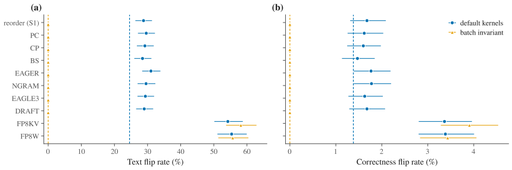
Figure 2 .Batch invariant kernels remove every flip of the exact features and leave the FP8 flips in place. (a) Text flip rate and (b) correctness flip rate of each configuration against R1, R2 and R3, under default kernels (circles) and batch invariant kernels (triangles); 3,380 items per configuration, bars are 95% cluster bootstrap intervals, dashed lines the restart floor of each arm. Under batch invariant kernels the reordered replica and all seven exact features reproduce the reference text on every item.
Original paper · CC BY 4.0 · Sharven Rane · Exact on Paper: Which LLM Serving Shortcuts Flip Graded Answers, Measured Against the Noise of Reordering the Same Requests · Original paper figure · Extracted the figure area from page 5 of the original PDF.Why an accuracy check can miss changed answers
Teams that enable a serving feature usually rerun a benchmark and check that accuracy holds. The documentation of most of these features says the output distribution stays the same, and speculative decoding is lossless in theory when arithmetic is exact. The gap is that floating point arithmetic in a batched engine doesn't behave exactly.
A request's logits shift with the other requests in its batch, with how its prompt is split into chunks, and with the kernel the engine picks. Under greedy decoding, a last-bit change in one logit can switch a single token, and that switch can push a math derivation onto another path. Because accuracy is one aggregate number, a feature can keep it fixed while the set of correct answers changes.
One GSM8K problem shows the mechanism: all three restarts of the reference configuration give 26. With prefix caching on, the text follows the reference for its first 46% of characters, then changes one word, and the derivation ends at 13.
Measuring this is harder than counting differences, because default kernels already change outputs between restarts.
Judging flips against rerun noise
The authors' key idea is to use rerun noise as the yardstick: a candidate's flips count only when they exceed what restarts and reordering already produce. The reference configuration is run five times, so each candidate is measured against several replicas rather than a single pair. Three of these runs are restarts in fresh processes with the canonical request order, and two are reorderings that change batch composition and nothing else.
For a candidate and its reference replicas, each item gets a per item flip probability: the share of candidate and reference pairs in which its graded outcome differs. The correctness flip rate is the mean of these per item probabilities over all items. The restart floor applies the same quantity to pairs of restart replicas, and the scheduling floor applies it to pairs of a reordered replica and a restart replica.
The excess flip rate subtracts the per item floor from the per item flip probability and then averages over items, so candidate and floor are paired on the same items. Accuracy change is the paired difference between the candidate and the mean reference accuracy. All intervals are cluster bootstrap intervals with 2000 resamples, where the cluster is the MMLU subject for MMLU and the item otherwise.
The authors fixed these hypotheses and rules before the main runs.
The runs behind the measurements
The model is Qwen3 4B Instruct 2507 in bf16, served by vLLM 0.33.0 on one RTX 5070 Ti with greedy decoding and seed 0.
The reference configuration keeps prefix caching off, uses an 8192-token prefill budget, allows 128 concurrent sequences, keeps CUDA graphs on, and uses a bf16 KV cache with no speculation. Each candidate changes one factor: prefix caching (PC), a 512-token prefill budget (CP), 16 concurrent sequences (BS), CUDA graphs off (EAGER), three speculative proposers (NGRAM, EAGLE3 and DRAFT), an FP8 KV cache (FP8KV) or dynamic FP8 weights (FP8W).
The authors call PC, CP, BS, EAGER, NGRAM, EAGLE3 and DRAFT the exact features, since under exact arithmetic none of them changes the greedy output, while FP8W serves as a known lossy positive control.
Grading is deterministic: rescoring the outputs of three runs changed none of 10,140 rows, and re-executing 421 generated programs gave no differing pass flags. Engine counters show that each feature is engaged, with 1,424,672 prefix cache hit tokens for PC and draft acceptance rates of 13.7% (NGRAM), 50.8% (EAGLE3) and 65.6% (DRAFT). No feature was excluded from the study.
Default kernels: exact features flip at the scheduling floor
Accuracy holds everywhere: the reference reaches 85.94% accuracy (95% CI 84.26 to 87.53), and every configuration's 90% accuracy interval sits inside the one point margin. The largest shift is EAGLE3 at +0.42 points (90% CI +0.12 to +0.73), which lies inside the margin even though its interval excludes zero. A plain accuracy check would have passed all eleven candidates.
With default kernels the seven exact features flip 1.47% (BS) to 1.78% (NGRAM) of graded outcomes. Three of them, EAGER, NGRAM and DRAFT, have one sided lower bounds on their excess over the restart floor above zero, at +0.12, +0.14 and +0.05 points. That makes C1 hold at exactly the threshold of three features.
The scheduling floor accounts for most of this excess, because the reordered replicas S1 and S2 also clear C1, with lower bounds of +0.04 and +0.11, although their configuration is unchanged. Against the scheduling floor of 1.72%, no exact feature has a positive lower bound, and the largest estimates are +0.06 (NGRAM) and +0.05 points (EAGER).
The authors read the excess as the size that reordering produces on its own, so the exact features flip answers the way production traffic does.
FP8 KV cache flips like FP8 weights
FP8KV flips 3.36% of graded outcomes (95% CI 2.80 to 3.96), and FP8W flips 3.38% (2.80 to 4.01).
So the aggregate accuracy hides flips that fall in both directions.
The authors read this as short answer tasks showing the precision effect most clearly. Section 4.1 tests whether numerical noise explains it: both floors include batch composition, kernel choice and preemption, and each REF replica sees about 1,947 preemptions.
Batch invariant kernels remove the exact-feature flips
With VLLM_BATCH_INVARIANT=1, each request's arithmetic no longer depends on the requests it shares a batch with. The prediction is that flips caused by batch dependence disappear, while flips caused by lower precision should remain. All fourteen configurations were rerun in this mode.
The three restart pairs of REF differ on no generated text, so the restart floor is zero for texts, answers and grades. The one sided 95% upper bound on that floor is 0.09% of items.
PC, CP, BS and EAGER produce zero text flips against the three restarts, as the preregistered C2 predicts.
FP8KV still flips 3.91% of graded outcomes (95% CI 3.28 to 4.53, 132 items), and FP8W flips 3.43% (2.83 to 4.06, 116 items). Both lie close to their default arm rates of 3.36% and 3.38%, so with a zero floor these flips belong to the precision change.
Under batch invariant kernels REF ran about 4% slower on a shared GPU, so the speed comparison stays exploratory.
A flip gate needs more than one replica pair
It reports the paired accuracy change with a 90% interval, which passes when the interval lies inside a one point margin. The flip test passes when the one sided 95% upper bound of the excess is at most 0.5 points and fails when its lower bound is above that, and the overall verdict fails if either test fails.
FP8W and FP8KV get FAIL on the flip test while passing the accuracy test. CP and BS pass, and the remaining exact features are inconclusive at this sample size.
For the null comparisons, each restart replica is held out against the other two, and R2 gets FAIL with an excess upper bound of +1.34 points. R1 and R3 get PASS. The three restart pairs differ on 25 items (R1 and R3) to 62 items (R1 and R2), which is 0.74% to 1.83% of items.
The authors treat a floor from one pair as a noisy estimate in its own right, so C3 is refuted in the default arm.
Which requests flip, exploratory
That margin predicts exact feature flips with ROC AUC 0.89 (95% CI 0.85 to 0.92), and its lowest decile holds 70% (60 to 79) of those flips. The authors attribute the weaker FP8 fit to FP8 also flipping items with a moderate margin.
Output length alone predicts exact feature flips with AUC 0.88 (0.84 to 0.91), and length and margin correlate at −0.76. The authors conclude that margin-based triage adds little beyond the observation that long outputs flip.
MATH500 has the highest flip rate for every configuration, from 4.53% to 6.53% for the exact features. They attribute this to a 4096-token derivation giving a switched token many chances to change the result.
On this shared GPU, FP8W ran 1.77 times and FP8KV 1.66 times as fast as REF. NGRAM (0.97), BS (0.84), EAGER (0.77) and DRAFT (0.50) were not faster at 128 concurrent sequences. The two fastest configurations are also the two that double the flip rate, and the speed numbers are exploratory.
What a team should check before enabling a feature
They recommend treating the FP8 KV cache as a lossy change.
Under batch invariant kernels the same features switch no generated token, so the audit gives a zero floor and any remaining flip belongs to the change. A gate built on one replica pair rejected an unchanged configuration, which is the failure this design is meant to prevent.
Limits of the study
The study covers one model, a 4B instruction model, one engine version and one consumer GPU. Each feature has one candidate run, and the candidate's own restart variability is not averaged out, which widens the interval rather than biasing it.
Three restart replicas make the floor estimate itself variable, and more replicas would narrow every excess interval. Request order is the only scheduling change that was controlled, and real traffic also changes arrival times and request lengths. The batch invariant result holds only for the kernels of vLLM 0.33.0, and a feature that falls back to a batch dependent kernel elsewhere wouldn't be exact there.
The GPU was shared with other jobs, so the speed numbers are indicative only. The claim concerns which requests are answered correctly, not a drop in accuracy, since every default arm configuration stayed accuracy equivalent.
Paper info
- Authors
- Sharven Rane
- Venue
- arXiv · Preprint
- First published
- 2026-11-22
- Added
- 2026-11-24
- Updated
- 2026-11-22
- Version
- v1
- arXiv
- 2611.29663
- Category
- cs.LG
- Original paper terms
- CC BY 4.0
- What we show
- Paper info, commentary and permitted figures from the original paper
AI commentary is a separate explanation from the original paper and may contain errors. The original paper and figures follow each source's terms of use and any rights noted separately.
Abstract
Teams enable serving features such as prefix caching, chunked prefill and speculative decoding after checking that benchmark accuracy is unchanged, because the engine documents them as exact. Accuracy is an aggregate, so a feature can hold it while flipping which requests are answered correctly. We serve one 4B instruction model in vLLM under nine single feature configurations and five replicas of a reference configuration, grade 3,380 requests from five benchmarks in every run, and compare each candidate with a restart floor (fresh process) and a scheduling floor (same requests in a different order). With default kernels every configuration keeps accuracy within one point, and the seven exact features flip the graded outcome of 1.47% (95% CI 1.13 to 1.85) to 1.78% (1.39 to 2.20) of requests, none above the scheduling floor of 1.72%, while the FP8 KV cache flips 3.36% (2.80 to 3.96), as many as FP8 weights. With batch invariant kernels all seven exact features, speculative decoding included, reproduce the reference text on every request, while the FP8 KV cache still flips 3.91% (3.28 to 4.53) of graded outcomes. A gate that compares against a single replica pair rejected an unchanged configuration, so we recommend certifying a serving change under batch invariant kernels, where the floor is zero, or against a scheduling floor measured from at least three replicas.
Quote from the paper
Sharven Rane (2026). Exact on Paper: Which LLM Serving Shortcuts Flip Graded Answers, Measured Against the Noise of Reordering the Same Requests. arXiv:2611.29663v1. https://arxiv.org/abs/2611.29663v1
BibTeX
@misc{rane2026exact,
  title = {{Exact on Paper: Which LLM Serving Shortcuts Flip Graded Answers, Measured Against the Noise of Reordering the Same Requests}},
  author = {Sharven Rane},
  year = {2026},
  eprint = {2611.29663},
  archivePrefix = {arXiv},
  url = {https://arxiv.org/abs/2611.29663v1}
}