Paper commentary
CivicBench: Robust Detection of AI-Generated Political Video
Tau-Anchor makes political video detectors harder to fool with pixel changes
- Problem Small pixel edits can hide AI-generated political video from detectors.
- Method Tau-Anchor starts from an encoder pretrained to resist adversarial perturbations. It fine-tunes that encoder on attacked clips and adds a margin term for fakes near the deployed threshold.
- Results Tau-Anchor scored .941 AUC on CivicBench, compared to at most .781 for published detectors.
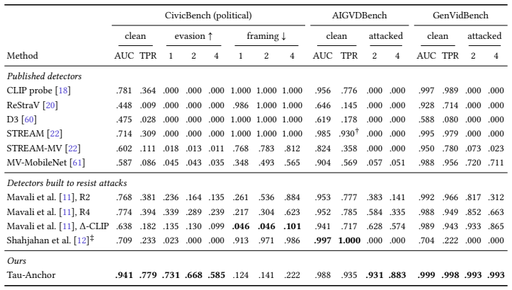
Table 2 Detectors under attack.On CivicBench (left), clean AUC and TPR, then TPR under evasion and attacked false-alarm rate under framing at 1, 2, and 4 gray levels. On the general benchmarks (right), clean AUC and TPR over five folds and TPR under evasion at 2 and 4 gray levels, over five folds for Tau-Anchor and for Mavali et al. on R4 and Δ-CLIP, and on fold 0 for the others. D3’s evasion cells rest on 19 clips. Those of STREAM-MV, MV-MobileNet, and Mavali et al. on R2 and R4 are upper bounds (Sec. E). †Not significantly different from Tau-Anchor (95% bootstrap).‡Fold 0 only. Its scores change with the GPU model (Sec. E).
Original paper · CC BY 4.0 · Mert Onur Cakiroglu, Elham Buxton, Mehmet Dalkilic, Hasan Kurban · CivicBench: Robust Detection of AI-Generated Political Video · Original paper figure · Extracted the figure area from page 10 of the original PDF.Why detectors fail under small pixel changes
A detector of AI-generated video returns a score for each clip, and the clip is flagged once that score reaches a threshold. The threshold is fixed in advance for a chosen false-alarm rate, so clips near it are the ones an attacker can push across. Whoever uploads a clip also controls its pixels, so a small edit can move the score. The authors name two directions: evasion hides a generated clip, and framing makes a real clip look generated.
Published detectors trained on a general benchmark reach an AUC of only .448 to .781 on CivicBench before any attack. They also flag 10.6% to 15.1% of real political footage, about two to three times the 5% target. At a budget of 1 gray level, nearly every generated clip is hidden from detectors that weren't built to resist attacks. A gray level is one step on the 0 to 255 pixel scale, so such an attack changes each pixel by at most 1/255.
The authors explain these failures through one quantity: an attack's reach, which is how far it can move a clip's score. So a detector can resist attacks by shrinking the reach, which mostly depends on the encoder, or by widening the margin of the fakes nearest the threshold.
The margin and reach idea behind Tau-Anchor
Tau-Anchor combines two changes, and each one targets a different part of the margin-and-reach condition. The first change is an image encoder pretrained to resist adversarial perturbations, which shrinks the reach. The second is a loss term that pushes the fake clips nearest the threshold further above it, which widens their margin. The detector is trained at the threshold where it will be deployed, not at a value chosen afterwards.
Reach matters here because the authors find that it grows almost linearly with the attack budget. This gives the authors a way to read the margin-and-reach condition from attack results at small budgets.
Tau-Anchor is fine-tuned on attacked real and generated clips from AIGVDBench, a general benchmark, rather than on political video. CivicBench is used only for evaluation, and no detector in the study trains on its clips. This keeps CivicBench a test of how detectors transfer to political footage without retraining.
What one Tau-Anchor training step does
Each step draws 2 of the 11 frames of every clip and gives each pixel a random start inside a box of ε equal to 4 gray levels. It then takes one signed gradient step of size ε/2 on the loss and clips the result back into that box and into the 0 to 255 range. The outcome is an attacked copy of each clip, produced inside the training loop itself.
The loss averages cross-entropy over each clean clip and its attacked copy, with weights that balance the classes and the generators. A margin term ρ is added over the attacked generated clips, and the threshold estimate is held fixed during that step. The paper defines ρ in its Eq. (2), which this excerpt doesn't reproduce.
A preservation penalty keeps the encoder's output close to that of a frozen copy of the original encoder, weighted by λ. AdamW then updates the trainable weights θ.
Madry's objective keeps the same encoder, fine-tuning, training attack and weight averaging, but replaces the loss. So the comparison with Madry's objective isolates the loss as the one difference between the two.
How the attacks and checks were set up
Each attack runs end to end against the full detector, with three methods: PGD for 100 steps, Auto-PGD with 100 steps and 5 restarts, and the Square attack with 1,000 queries. The Square attack is the one that needs only detector scores. Budgets are 1, 2, and 4 gray levels on CivicBench and go up to 8 on the general benchmarks. Successful attacks at 4 gray levels have a median PSNR of 37.2 dB, which the authors take as evidence that the changes stay small.
Thresholds are set at 5% false alarms on each test set's own real clips.
Clean and attacked results on CivicBench
Without an attack, Tau-Anchor reaches an AUC of .941 on CivicBench. The published detectors reach at most .781 without an attack, so the gap is already large before any attacker acts. At 5% false alarms, Tau-Anchor detects .779 of generated clips, compared to at most .394 for published detectors.
At 1 gray level, the published detectors keep at most .045 of generated clips flagged. Tau-Anchor keeps .668 at 2 gray levels and .585 at 4 gray levels. On the 179 fakes that both flag, Madry's objective loses 10.6 percentage points more of them at 4 gray levels (p<.001). Because the two share an encoder and fine-tuning, this gap points to the margin-based loss rather than the backbone.
Tau-Anchor's false-alarm rate under framing at 2 gray levels rises from 8% to 14%. Madry's objective gives the same rate on those clips.
Stronger attacks were run to check whether they break the defense more than PGD does. On Tau-Anchor's 196 paired attacked fakes, APGD and Square broke one more fake than PGD at 2 gray levels. They framed no real clip that PGD did not frame, so the framing result doesn't change.
Generators, real sources and general benchmarks
Tau-Anchor's AUC is .946 on CogVideoX1.5 and Wan2.1, which also appear in AIGVDBench, and .906 on their newer versions. On the four unseen generators the AUC is .956.
Dropping one real source at a time keeps Tau-Anchor's AUC between .933 and .949. STREAM's AUC runs from .684 to .744 across the same leave-outs, so the published detectors move more with the source mix.
Trained on GenVidBench alone, Tau-Anchor reaches an AUC of .791 on CivicBench, on par with STREAM. Trained on both general benchmarks, it reaches .941. Three recipes trained on GenVidBench reach a higher AUC than Tau-Anchor, including TRADES with the margin term at .847. The main paper uses the AIGVDBench models, because those generators are closer to the ones in CivicBench.
Limitations
Some evasion rates are only upper bounds, because a few attacks were left undecided. The authors count an undecided attack as failed for every detector except Tau-Anchor.
Shahjahan et al. gives different verdicts on A100 and V100 GPUs for 5% of 100 random CivicBench clips. Its attacked scores and its threshold therefore sit on different scales.
Those general-benchmark attacks use budgets up to 8, above the 4 gray levels used on CivicBench.
Tau-Anchor's advantage depends on the training set, since trained on GenVidBench it reaches .791 AUC. Three GenVidBench-trained recipes beat it on CivicBench AUC. CivicBench uses invented politicians and eight open generators, and each real scene kind comes mostly from one source.
Paper info
- Authors
- Mert Onur Cakiroglu, Elham Buxton, Mehmet Dalkilic, Hasan Kurban
- Venue
- arXiv · Preprint
- First published
- 2026-11-22
- Added
- 2026-11-24
- Updated
- 2026-11-22
- Version
- v1
- arXiv
- 2611.29766
- Category
- cs.CV
- Original paper terms
- CC BY 4.0
- What we show
- Paper info, commentary and permitted figures from the original paper
AI commentary is a separate explanation from the original paper and may contain errors. The original paper and figures follow each source's terms of use and any rights noted separately.
Abstract
AI-generated video of politicians can pass for real footage, and once such fakes are common, real footage can be dismissed as fake. Platforms address both problems with detectors, but whoever uploads a clip controls its pixels. Existing datasets of political video are small, show real politicians, and test no attacks. We introduce CivicBench, with 10,800 generated clips of invented politicians from eight open generators and 2,632 public-domain or openly licensed real clips. Each clip can be attacked, to hide a fake or to frame real footage. Published detectors trained on a general benchmark reach at most .781 AUC on CivicBench. Adversarial changes of 1 gray level per pixel hide nearly every generated clip from the detectors not built to resist attacks. An attack's reach is how far it can move a clip's score. A clip keeps its label when its margin from the threshold exceeds this reach, and we find that the reach grows almost linearly with the budget. On this basis, we propose Tau-Anchor, which fine-tunes an encoder pretrained on attacked images. It attacks real and generated clips during training and adds a margin term at its deployed threshold. It reaches .941 AUC on CivicBench. It also keeps .668 of generated clips flagged at 2 gray levels, against at most .289 for published detectors. When real clips are framed at the same 2 gray levels, Tau-Anchor's false alarms rise only from 8% to 14%, whereas four published detectors flag nearly every framed real clip at just 1 gray level. External political footage and two general benchmarks show the same pattern under attack. Code and data are available at https://github.com/KurbanIntelligenceLab/CivicBench.
Quote from the paper
Mert Onur Cakiroglu, Elham Buxton, Mehmet Dalkilic, Hasan Kurban (2026). CivicBench: Robust Detection of AI-Generated Political Video. arXiv:2611.29766v1. https://arxiv.org/abs/2611.29766v1
BibTeX
@misc{cakiroglu2026civicbench,
  title = {{CivicBench: Robust Detection of AI-Generated Political Video}},
  author = {Mert Onur Cakiroglu and Elham Buxton and Mehmet Dalkilic and Hasan Kurban},
  year = {2026},
  eprint = {2611.29766},
  archivePrefix = {arXiv},
  url = {https://arxiv.org/abs/2611.29766v1}
}