Paper commentary
Revisiting RadioGalaxyNET: modern detectors for radio galaxy detection and host identification
- Problem Not stated in the paper.
- Method Trains D-FINE-seg, YOLO26-pose and RF-DETR on the same RadioGalaxyNET split, scores them with the benchmark's COCO-style evaluation code, and then tests which benchmark properties change how results should be compared.
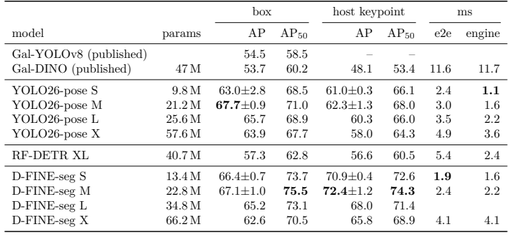
Table 1 : RadioGalaxyNET test split: box AP and host keypoint AP (%, COCO AP@[.5:.95]), Gal-DINO’s evaluation and protocol for all models, PyTorch weights. Rows with±are means and sample standard deviations over three training seeds; the other trained rows are single runs. Resampling the test images moves any single model’s AP by about 2 points (one standard deviation). Latency in ms, TensorRT fp16, batch 1, RTX 5070 Ti: end to end (e2e) through each framework’s own code, and engine only. Parameters are those of the deployed (fused) model.
Original paper · CC BY 4.0 · Argo Saakyan · Revisiting RadioGalaxyNET: modern detectors for radio galaxy detection and host identification · Original paper figure · Extracted the figure area from page 4 of the original PDF.Why RadioGalaxyNET needs a newer comparison
RadioGalaxyNET pairs an EMU pilot-survey radio cutout with a WISE 3.4µm infrared cutout of the same field, and each extended source carries a box, a class from FR-I, FR-II, FR-X or R, and a keypoint for its host. The strongest earlier results are Gal-YOLOv8 at 54.5 AP for boxes and Gal-DINO at 48.1 AP for host keypoints. Real-time detectors have changed considerably since those models were built, so the open question is how much current off-the-shelf models gain on this same benchmark.
A later result, LARGAL, reports 53.5 box AP, but it uses its own evaluation script, so its number is not on the benchmark's own scoring.
Data split and scoring code
The public release contains 2,799 images of 450×450 pixels, divided into 1,959 training, 420 validation and 420 test images, and the test split holds 611 sources. Every model is scored with Gal-DINO's evaluation code, which computes COCO box AP and keypoint AP with the benchmark's size ranges and an OKS sigma of 0.107. A stand-alone re-implementation reproduces Gal-DINO's released checkpoint at 53.73 box AP and 48.14 keypoint AP, matching the published numbers and Gal-DINO's own script.
Each model keeps its top 300 box and class pairs per image without non-maximum suppression, following the usual COCO protocol for detection transformers, and runs through its own framework's inference and post-processing code.
Training recipes and the changes that mattered
All detectors start from COCO weights and train at each framework's default input size, 640 pixels for D-FINE-seg and YOLO26 and 576 pixels for RF-DETR, with the 450-pixel images upsampled. The models trained are D-FINE-seg S, M, L and X, YOLO26-pose S, M, L and X, and RF-DETR XL, and each predicts one keypoint per object, the host.
For YOLO26 the best recipe on validation was the Ultralytics default for 200 epochs, which flips horizontally but not vertically, since vertical flips cost 25 box AP through the label offset. Using the benchmark's OKS sigma in the YOLO26 keypoint loss lowered host AP to 57.2 for S, against 61.0 with the Ultralytics default.
Left at the default, that loss crowds out classification, and the classifier never trains, which gives 15.4 box AP.
How the speed numbers were measured
All models run as TensorRT fp16 engines at batch size 1 on an idle RTX 5070 Ti, one after another in a single session.
D-FINE-seg S is the fastest model end to end at 1.9 ms per image. At equal size YOLO26 is faster in engine time, and the authors attribute D-FINE-seg's end-to-end lead to its leaner inference code. D-FINE-seg M matches YOLO26-pose S at 2.4 ms while scoring 4 more box AP and 11 more host AP. TensorRT engines score within 0.35 AP of PyTorch for every model.
Box and host AP against the published results
Every current model beats the published results, and D-FINE-seg M exceeds Gal-YOLOv8 by 12.6 box AP and Gal-DINO by 24.3 host AP. Other trained rows are single runs, and resampling the test images moves any single model's AP by about 2 points.
D-FINE-seg finds more sources, with AP50 of 75.5 against 71.0, while YOLO26 places its boxes more tightly.
RF-DETR XL reaches 57.3 box AP, below every YOLO26 and D-FINE-seg size.
Trained as box detectors alone over three seeds, D-FINE-seg M reaches 71.2 box AP and YOLO26 M reaches 69.4.
Host identification at one operating point
Host identification uses class-agnostic NMS at IoU 0.7, one threshold per model chosen for box F1 on validation, and counts a source as identified when the class matches, the box IoU is at least 0.5 and the host lies within OKS 0.5 of the labeled one. Every other kept detection counts as a false identification, so precision is identified sources per kept detection and recall is the identified share of the test sources whose host lies inside the image.
RF-DETR XL reaches F1 63.8 and Gal-DINO 59.2, so D-FINE-seg minus Gal-DINO is +12.7 with an interval of +9.2 to +16.0.
Host placement at the image center
Over all sources the host lead grows from 6.2 AP at OKS 0.5 to 17.4 AP at OKS 0.95, so the lead also depends on how strictly hosts are matched.
On 109 test fields rebuilt from raw data and centered on the CatWISE host position, 0 to 6 pixels away, D-FINE-seg S host AP falls from 82.9 to 76.5.
Multi-label submission and the 5 to 10 AP gap
The authors read the gain as coming from the extra class entries, not from duplicate boxes.
Adding NMS at 0.7 lowers every model by 5 to 10 AP: D-FINE-seg M falls to 58.5 box and 62.7 host AP, YOLO26-pose M to 61.4 box and 56.6 host AP, and Gal-DINO to 44.1 box and 39.5 host AP. On boxes YOLO26 M and L move ahead, with M ahead by 2.9 AP, while the host order holds.
Gal-YOLOv8's published number was computed with Ultralytics' validation, which also allows several classes per box.
Box label offset and flip augmentation
The authors attribute the 22 AP cost of the 1.5-pixel shift to the stricter IoU thresholds of COCO AP on these small boxes.
Rebuilding images from survey data
On the 355 rebuilt test images, D-FINE-seg S reaches 69.7 host and 59.8 box AP, against 71.2 and 66.8 on the same released images, and Gal-DINO reaches 50.3 host and 52.5 box AP, against 49.8 and 55.7. The two models keep their order on the rebuilt images.
Limits of the comparison
Most trained rows in Table 1 are single runs, so only the seed-averaged D-FINE-seg and YOLO26 M rows carry spread estimates.
RF-DETR is included only through its XL keypoint model, the sole released keypoint variant, which is a preview at 576 pixels. Table 2 uses PyTorch weights except for Gal-DINO, which is scored as its TensorRT fp16 engine.
The off-center subset is smaller than the centered one, and on it the two leading models are level on hosts. The split and label quirks shift exact numbers, and the authors state that they do not change the comparison between models. The LARGAL figure was measured with its own evaluation script, so it sits outside the benchmark's scoring.
Paper info
- Authors
- Argo Saakyan
- Venue
- arXiv · Preprint
- First published
- 2026-11-22
- Added
- 2026-11-24
- Updated
- 2026-11-22
- Version
- v1
- arXiv
- 2611.29798
- Category
- cs.CV · astro-ph.IM
- Original paper terms
- CC BY 4.0
- What we show
- Paper info, commentary and permitted figures from the original paper
AI commentary is a separate explanation from the original paper and may contain errors. The original paper and figures follow each source's terms of use and any rights noted separately.
Abstract
RadioGalaxyNET is the public benchmark for finding extended radio galaxies in EMU pilot-survey images, classifying them and locating their infrared hosts. Its best published results date from 2023: 54.5 box AP (Gal-YOLOv8) and 48.1 host keypoint AP (Gal-DINO). We train three current detectors, D-FINE-seg, YOLO26-pose and RF-DETR, on the same data and score them with the benchmark's own evaluation code, which reproduces the published Gal-DINO numbers exactly. All exceed the published results. D-FINE-seg M reaches 67.1 box AP and 72.4 host AP, 12.6 and 24.3 points above the best published results, and the highest host AP of the detectors we tested; on boxes it is level with YOLO26. Its host lead over YOLO26 comes from host-centered images, which make up most of the benchmark. End to end, D-FINE-seg S is the fastest model at 1.9 ms per image; engine against engine, YOLO26 is faster at the same size. We also report what matters for anyone using the benchmark: its scoring protocol adds 5 to 10 AP, its host labels sit at the image center, its box labels are offset from the image by 1.5 pixels, and its images can be rebuilt from the public survey data, which recovers sky positions and doubles as extra training data. We suggest that future work report host identification F1, as a measure closer to catalog use: D-FINE-seg M 71.8, YOLO26-pose M 70.5, RF-DETR 63.8, Gal-DINO 59.2.
Quote from the paper
Argo Saakyan (2026). Revisiting RadioGalaxyNET: modern detectors for radio galaxy detection and host identification. arXiv:2611.29798v1. https://arxiv.org/abs/2611.29798v1
BibTeX
@misc{saakyan2026revisiting,
  title = {{Revisiting RadioGalaxyNET: modern detectors for radio galaxy detection and host identification}},
  author = {Argo Saakyan},
  year = {2026},
  eprint = {2611.29798},
  archivePrefix = {arXiv},
  url = {https://arxiv.org/abs/2611.29798v1}
}