Paper commentary
LesionAgent: Training-Free Agentic Tumor Tracking and Response Assessment in Longitudinal CT
LesionAgent tracks lesions across CT scans and assesses treatment response without training
- Problem Response assessment chains several steps, and no single 3D foundation model performs all of them. Training one network end to end would need longitudinal annotations that barely exist.
- Method LesionAgent is an LLM agent that calls frozen 3D models as tools while a deterministic rule engine computes the RECIST response. Its registry carries each lesion across visits.
- Results It retrieves 89.0% of DeepLesion lesions without training on them, against 87.4% for TLT, which was trained on them.
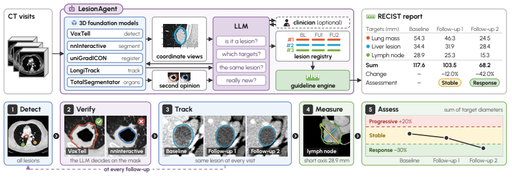
Figure 2 .LesionAgent.An LLM calls frozen 3D foundation models as tools (top). It checks their outputs in coordinate-labelled views, keeps every lesion at every visit in a registry (BL = baseline, FU = follow-up) and verifies masks with a second opinion. A deterministic guideline engine measures the lesions, assigns the response and writes the RECIST report. Optionally, a clinician answers the LLM’s questions (dashed). The bottom row shows the five steps of a read on real CT crops, from detecting all lesions to assessing the response.
Original paper · CC BY 4.0 · Maximilian Rokuss, Jeya Maria Jose Valanarasu, Alejandro Lozano, Benjamin Hamm, Yannick Kirchhoff, Fabian Isensee, Klaus Maier-Hein · LesionAgent: Training-Free Agentic Tumor Tracking and Response Assessment in Longitudinal CT · Original paper figure · Extracted the figure area from page 4 of the original PDF.Why response assessment stalls at the model level
Under RECIST 1.1, a radiologist must find every lesion in a 3D volume, pick up to five targets, match lesions across scans and decide whether a new finding is a new lesion.
3D foundation models now handle individual steps, such as text-prompted detection, promptable segmentation and registration. None of them performs the whole response assessment, because the agent also has to judge whether a finding is a lesion and whether it is the same lesion months later. Training one network for the full read end to end would need longitudinal annotations that barely exist, since recent releases cover one cancer type or a few dozen patients.
An agent for this task therefore has to act in 3D while it sees only 2D images, and a single wrong mask can flip the response.
The key idea: an LLM driving frozen 3D models
The core idea keeps the LLM in charge of judgement calls and gives it frozen 3D models as tools. Around these tools sit a lesion registry that carries every lesion across visits and a rule engine that turns measurements into a response.
Because the rules sit in the engine, another guideline such as iRECIST or RANO would change the engine and leave the agent as it is.
The agent acts through 18 typed tools and has no shell or file access, so it can't change anything outside its read.
One read, step by step
At baseline, the text-promptable model VoxTell proposes lesion candidates under several prompts. The agent accepts or rejects each candidate in rendered views, and each accepted lesion enters the registry with its mask.
At a follow-up, uniGradICON registers the scans and the lesion's point is carried into the new scan. LongiTrack then segments the lesion at that point, using its previous mask as context.
A finding that no tracked lesion covers becomes a candidate for a new lesion, and the agent accepts it only after checking the same spot at baseline.
For targets, the agent scores how reliably each measurable lesion can be measured again, and the score is lowered for ill-defined margins, necrosis or confluence.
Does the agent beat chained models on the full read?
The fixed-rule pipeline calls progression falsely 33 times over the 56 follow-ups of HCUCH and TumorMap, compared to twice for LesionAgent.
Even the weakest of three TumorMap reads beats every other automatic method on detection, tracking and response.
With Qwen3.8-27B running through the same harness, LesionAgent rises from 6% to 73% detection F1.
Which harness parts carry the gains
The ablations on HCUCH remove one part at a time from LesionAgent with Claude Opus 5.5 and measure automatic detection F1. Removing all 3D models drops detection F1 from 78 to 36, and the authors note that without 3D models the LLM doesn't see the lesions.
Replacing the guideline engine by LLM-assigned categories lowers response agreement from 95% to 79%.
Removing self-verification lowers detection F1 from 78 to 76 and response agreement from 95 to 91. The drops show that each part is kept for a reason, but a single removal doesn't show that the component is the only source of the gain.
Claude Code runs the same LLM with the same 3D models and no harness, and reaches a detection F1 of 41%, compared to 78% for LesionAgent. The authors attribute this gap to the harness, since the LLM and the 3D models are shared by both runs.
Tracking without training on DeepLesion
The DeepLesion benchmark gives a lesion at one visit and asks the method to retrieve it at the other, using 960 directed lesion pairs. LesionAgent ran zero-shot here, with no training on DeepLesion lesion pairs.
LesionAgent retrieves 89.0% of the lesions, compared to 87.4% for TLT, the best of the trackers trained on these pairs. Its mean centre error is 4.4 mm, compared to 6.0 mm for TLT.
LongiTrack returned empty masks for 20% of pairs and LesionLocator for 37%, compared to 0.2% for LesionAgent.
LesionAgent uses the same models as LongiTrack, so the difference lies in how the agent reacts to failures.
Against radiologists on each step
On LIDC, the authors added LesionAgent as a fifth reader on 436 screening CTs and scored it like each radiologist. It finds fewer nodules, with sensitivity 67 compared to 83%, so the detection step is its weak point.
Its time to progression matches in 11 of 12 series, and it chooses 17 of the radiologist's 25 target lesions.
The 20 of 23 agreement therefore sits within the range that expert readers reach on their own.
Limitations
Public longitudinal cohorts with clinical reads are still small, so larger cohorts have to test more responses and progressions. No clinician answered in the automatic evaluation, so the value of the ask-clinician step was not measured.
Paper info
- Authors
- Maximilian Rokuss, Jeya Maria Jose Valanarasu, Alejandro Lozano, Benjamin Hamm, Yannick Kirchhoff, Fabian Isensee, Klaus Maier-Hein
- Venue
- arXiv · Preprint
- First published
- 2026-11-20
- Added
- 2026-11-24
- Updated
- 2026-11-20
- Version
- v1
- arXiv
- 2611.27876
- Category
- cs.CV · cs.AI · cs.MA
- Original paper terms
- CC BY 4.0
- What we show
- Paper info, commentary and permitted figures from the original paper
AI commentary is a separate explanation from the original paper and may contain errors. The original paper and figures follow each source's terms of use and any rights noted separately.
Abstract
Every few months, a cancer patient's CT scans decide whether treatment continues. 3D foundation models can now detect, segment, register and track lesions, yet none of them reads the scans as a radiologist does. A radiologist decides which findings are lesions, which are the same lesion months later and whether a new spot means progression, and checks each decision against the extensive rules of a clinical guideline. We introduce LesionAgent, an LLM agent that performs this read end to end without task-specific training. It operates frozen 3D models as tools, acts in 3D through coordinate-labelled views, remembers every lesion across visits in a registry, verifies every model output it relies on, and leaves every number to a deterministic guideline engine. On four public longitudinal CT datasets, LesionAgent tracks more lesions and measures them more accurately than every automatic baseline, and where the same 3D models chained by fixed rules call progression falsely at 33 of 56 follow-ups, it does so twice. On clinical follow-up CTs, it agrees with the radiologists' response at 20 of 23 follow-ups, including every change in response, and without training on DeepLesion, it retrieves more of its lesions than every tracker trained on it (89.0% vs. 87.4%). Its harness, not its LLM, makes the difference: given the same LLM and 3D models but not the harness, Claude Code reaches a detection F1 of 41% and LesionAgent 78%, and an open-weight LLM that can run inside the hospital rises from 6% to 73%. LesionAgent and a napari reading app for any LLM are available at https://github.com/MIC-DKFZ/LesionAgent.
Quote from the paper
Maximilian Rokuss, Jeya Maria Jose Valanarasu, Alejandro Lozano, Benjamin Hamm, Yannick Kirchhoff, Fabian Isensee, Klaus Maier-Hein (2026). LesionAgent: Training-Free Agentic Tumor Tracking and Response Assessment in Longitudinal CT. arXiv:2611.27876v1. https://arxiv.org/abs/2611.27876v1
BibTeX
@misc{rokuss2026lesionagent,
  title = {{LesionAgent: Training-Free Agentic Tumor Tracking and Response Assessment in Longitudinal CT}},
  author = {Maximilian Rokuss and Jeya Maria Jose Valanarasu and Alejandro Lozano and Benjamin Hamm and Yannick Kirchhoff and Fabian Isensee and Klaus Maier-Hein},
  year = {2026},
  eprint = {2611.27876},
  archivePrefix = {arXiv},
  url = {https://arxiv.org/abs/2611.27876v1}
}