Paper commentary
Make Position Uninformative: Exchangeable Self-Distillation Flattens the Lost-in-the-Middle Curve
Exchangeable self-distillation makes reader accuracy flatter across document positions
- Problem Retrieval-augmented readers answer well when the relevant document is first or last but poorly in the middle. Earlier fixes lift the middle by lowering the start, so the worst position stays weak.
- Method ExSD trains a small LoRA adapter on shuffled contexts with the answer document at a random slot. It learns to reproduce the frozen model's answer when it reads that document alone, so no gold answers are needed.
- Results On 20-document MDQA, Vicuna-7B's worst-position accuracy rose from 51.3 for the frozen model to 58.4 with ExSD.
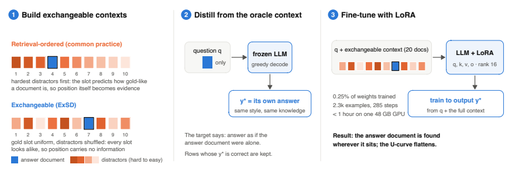
Figure 2 .Exchangeable Self-Distillation. (1)A ranked retriever puts the hardest distractors first. A document’s slot then predicts how answer-like it is, so position itself becomes evidence (Prop. 2). ExSD places the answer document at a uniformly random slot and shuffles the distractors, so every slot looks alike (Prop. 1).(2)The target is the frozen model’s own answer when it reads the answer document alone. (3)A LoRA adapter learns to give that answer from the full exchangeable context.
Original paper · CC BY 4.0 · Qingsen Ma, Dianyun Wang, Jiahong Liu, Irwin King · Make Position Uninformative: Exchangeable Self-Distillation Flattens the Lost-in-the-Middle Curve · Original paper figure · Extracted the figure area from page 4 of the original PDF.Why the answer in the middle gets lost
A reader scores highest when the answer document opens or closes the context and lowest when it lands mid-context. A retriever can't guarantee an edge placement, so the accuracy a user can rely on is the one at the worst position.
Existing fixes act either on positional signals at inference time or on the data used for fine-tuning. Pos2Distill and CORD can raise average accuracy, but they don't establish which part of the training data teaches the positional preference.
What training contexts teach about position
Cross-entropy training pushes the reader toward the Bayes predictive distribution, which weighs each document by its chance of holding the answer. A reader's positional prior is therefore the positional information carried by its training contexts. The optimal reader is \\( p^\\star(y\\mid q,x)=\\sum_{j=1}^{K} r_j(q,x)\\,p(y\\mid q,x_j) \\), where \\( r_j(q,x) \\) is the probability that slot j holds the answer.
With a uniform slot prior and exchangeable distractors, the readout is invariant to slot permutations, so the optimal reader ignores position. When distractors follow a slot-dependent order such as retrieval rank with the hardest first, the log readout gains a slot-dependent evidence term. Early slots then receive a smaller likelihood ratio, so the reader discounts them and acquires a recency bias.
Reversing the order shifts that bias toward primacy.
How ExSD builds its data and trains the adapter
ExSD keeps the base model frozen and trains only a small adapter, so the change lies in what the training examples look like and what the target is. Each training context places the answer document at a slot drawn uniformly among 20, and the 19 distractors are shuffled. The target is the frozen model's greedy answer when it reads the answer document alone, so only the identity of that document is needed, not a gold answer.
By default, the examples whose target misses every gold answer are dropped, which is the one place gold answers enter the recipe. For Vicuna-7B this gives 16.8M trainable parameters, 0.25% of the model, trained on 2,287 of 3,000 questions in 51 minutes on one 48 GB GPU.
Does the U-curve flatten on MDQA?
On the 452-question development split with 20 documents, ExSD raised Vicuna-7B's mean accuracy from 56.6 to 65.3 under the LITM prompt. Its worst position rose from 51.3 to 58.4, and the middle positions gained the most, by up to 18 points. On the held-out test split, read once, the mean rose from 52.0 to 60.7 and the worst position from 46.7 to 55.1.
On Qwen2.5-7B the gain reached every position, the first included, at 10, 20 and 30 documents. The spread across positions fell significantly in 9 of the 12 comparisons, and ExSD was trained on 20 documents yet also handled 30.
How ExSD compares with Pos2Distill, CORD and Ms-PoE
Under shared LoRA settings on Vicuna-7B development data, ExSD exceeded the reimplemented Pos2Distill by 7.9 points in mean accuracy and 5.8 points in worst-position accuracy. The mean difference from CORD is not significant, with 65.3 for ExSD compared to 64.4 for CORD on development data. The worst-position gains over CORD are significant, at +5.5 on development and +7.6 on the test split.
On the Ms-PoE protocol the frozen model scores 60.9 on MDQA-10 and 77.0 on KV-50, Ms-PoE scores 61.3 and 80.2, and ExSD scores 65.6 and 88.8. Attention supervision, which uses gold answers, ends 11.7 points below ExSD on worst-position accuracy on both splits.
Which training contexts shape the curve
The authors keep the questions, targets and adapter fixed on Vicuna-7B with 20 documents and vary only how the training contexts are arranged. Retrieval order with the hardest distractors first lowers the first position and tilts the curve toward the end more than exchangeable contexts do.
On the test split both retrieval-ordered recipes lose the first position, so the authors argue that retrieval-built training data needs to be made exchangeable.
Self-distilled targets against gold answers, and transfer
Gold-answer SFT costs Qwen2.5-7B three times as much LongBench accuracy as ExSD, because its answers shrink to the dataset's short format. On MMLU, ExSD keeps 91% of the frozen model's answers, compared to 81% for gold-answer SFT.
With Vicuna-7B, KV retrieval rises from 77.0 to 88.8 exact match, a task never seen in training. On TriviaQA with 20 passages, all five models improve, with Qwen 7B moving from 70.5 to 76.6.
Where the change sits inside the model
The authors probe retrieval heads, the attention heads that copy from the relevant document, and find their position-to-content ratio falls from 1.15 to 0.72 after ExSD. They explain this as ExSD shrinking the slot term and widening the content margin, so the heads rely more on content.
Adapting only the value and output projections matches the full recipe, while adapting only queries and keys loses accuracy.
Limitations
Vicuna-7B still rises toward the end at 20 documents, which the authors trace to rotary distance decay in its 4K-window base model. Shrinking the rotary step flattens the curve but blurs exact copying, so the per-document compression variant keeps the step inside each document.
The default recipe keeps only examples whose oracle answer contains a gold answer, so the filter consults gold answers. Against CORD, the mean differences are not significant, and on Qwen2.5-7B the worst-position gain is not significant at 10 documents.
Paper info
- Authors
- Qingsen Ma, Dianyun Wang, Jiahong Liu, Irwin King
- Venue
- arXiv · Preprint
- First published
- 2026-11-21
- Added
- 2026-11-24
- Updated
- 2026-11-21
- Version
- v1
- arXiv
- 2611.28638
- Category
- cs.CL · cs.AI
- Original paper terms
- CC BY 4.0
- What we show
- Paper info, commentary and permitted figures from the original paper
AI commentary is a separate explanation from the original paper and may contain errors. The original paper and figures follow each source's terms of use and any rights noted separately.
Abstract
Retrieval-augmented language models answer well when the relevant document comes first or last and poorly when it sits in the middle. Some fine-tuning recipes lift the middle by lowering the start. We show how training contexts teach positional bias. With a uniform answer slot and shuffled distractors, the optimal reader ignores position. Building on this result, Exchangeable Self-Distillation (ExSD) trains a small adapter on shuffled contexts to reproduce the model's answer when it reads the answer document alone. It needs no gold answers and only a few thousand examples. On six models from 1.5B to 32B parameters, ExSD raises both average and worst-position accuracy against the frozen model, including on a held-out test split. In controlled LoRA comparisons, it significantly improves both criteria over Pos2Distill. Against CORD, mean differences are not significant, while worst-position accuracy improves significantly in the 20- and 30-document settings. ExSD also matches or beats gold-answer fine-tuning, changes behavior on other tasks far less, and transfers to unseen tasks. Head probes show greater reliance on content over position.
Quote from the paper
Qingsen Ma, Dianyun Wang, Jiahong Liu, Irwin King (2026). Make Position Uninformative: Exchangeable Self-Distillation Flattens the Lost-in-the-Middle Curve. arXiv:2611.28638v1. https://arxiv.org/abs/2611.28638v1
BibTeX
@misc{ma2026make,
  title = {{Make Position Uninformative: Exchangeable Self-Distillation Flattens the Lost-in-the-Middle Curve}},
  author = {Qingsen Ma and Dianyun Wang and Jiahong Liu and Irwin King},
  year = {2026},
  eprint = {2611.28638},
  archivePrefix = {arXiv},
  url = {https://arxiv.org/abs/2611.28638v1}
}