Paper commentary
Predicting Rare-Mode Collapse in Recursive Generative Training from Single-Generation Calibration
Exact count propagation forecasts rare-mode collapse from single-generation fits
- Problem Recursive retraining can keep a rare region's sample count while its core erodes. Brute-force multi-generation chains to find failure boundaries need tens of thousands of model fits, which is computationally prohibitive.
- Method The authors pair an exact three-source multinomial count law with single-generation response banks. Pilot refits at sparse anchors are interpolated, forecasting multi-generation core-failure risk without running full chains.
- Results Exact propagation cut risk MAE to 0.49 percentage points across 2,178 settings, compared to 1.85 for the Gaussian approximation. On nine stationary learners, six-round core MAE fell to 2.60 to 5.69 percentage points.
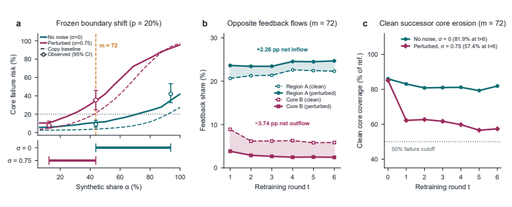
Fig. 8 . Fashion-MNIST latent-perturbation boundary displacement and round-by-round opposite regional transport atp= 20%. (a) Frozen calibrated core- risk curves (solid) versus proportion-copy baselines (dashed) across synthetic shareα= 1−m/128forσ= 0(teal) andσ= 0.75(plum), overlaid with independent validation observations and simultaneous 95% intervals. Lower strip confirms non-overlapping empirical 20% crossing brackets separated by the shared quotam= 72(α= 43.75%, amber dashed line). (b) Round-by-round paired regional membership of the 56 synthetic feedback rows returned each round atm= 72, σ= 0.75: latent perturbation induces persistent net inflow into rare regionA(21.8%→24.0%,+2.26pp average) while simultaneously causing persistent net outflow from coreB(6.5%→2.8%,−3.74pp average). (c) Resulting clean successor core coverage relative to referenceH p(B) across roundst= 0, . . . ,6atm= 72: clean core retention drops to 57.4% underσ= 0.75versus 81.9% underσ= 0.
Original paper · CC BY 4.0 · Zhang, Jingyao, Du, Mingyu, Han, Lu · Predicting Rare-Mode Collapse in Recursive Generative Training from Single-Generation Calibration · Original paper figure · Extracted the figure area from page 13 of the original PDF.Why coarse counts hide a rare mode's loss
Recursive retraining hits rare subpopulations with an asymmetric hazard. A rare category's aggregate count can stay flat or even grow while its characteristic core keeps shrinking. In the Fashion-MNIST chains, a classifier after six rounds still tags over a fifth of generated images as bags, yet the most typical bags had dropped to 57% of their reference share.
Monitoring coarse region counts therefore misses genuine mode loss, so the authors argue that core retention needs its own check.
They must keep finite-horizon core-failure risk under an allowable budget, which means locating the boundary in that three-dimensional space. Finding the boundary by brute force means running hundreds of independent multi-generation chains per setting, which needs tens of thousands of model fits. Existing collapse theory covers asymptotic absorption, local stability and score-divergence bounds, yet none gives calibrated finite-horizon failure probabilities for a specific learner.
A fixed-quota recursive loop and its risk target
Each round trains a successor on a pool of N rows, with N set to 128 in the primary experiments. Of those rows, m are fresh real samples from the reference mixture, and the other s = N − m come from the fitted parent. Among the synthetic rows, u are chosen uniformly at random, independent of their features, and passed through a Gaussian perturbation of scale sigma.
Holding these quotas fixed, rather than letting them fluctuate, is what later allows the count distribution to be computed exactly.
The regions are nested: the rare region A lies in the input space, and its core B sits inside A, which splits the space into A^c, A minus B and B. A chain fails at horizon G when its clean coverage of a region falls below gamma times the reference mass, and the indicator reads only that final round. Risk is the expectation of this indicator over data, feedback draws, perturbations and training randomness.
Because the indicator reads the final round alone, a chain that dips below the cutoff and then recovers does not count as a failure. The operating boundary is the set of settings where this risk equals beta, which is 0.20 in the primary experiments with gamma = 1/2 and G = 6.
Exact count propagation and the terminal risk identity
The next round's regional counts are a sum of three independent multinomial draws, one for each row source: fresh real rows, clean synthetic rows and perturbed synthetic rows. Conditioning on the parent gives this law exactly, because rows are independent given the parent and the perturbed rows are picked uniformly. Taking expectations splits the drift into three parts: the synthetic share, the parent's inherited bias, and the transport caused by perturbation.
\( E[Z_{t+1}/N \mid M_t] - r = \alpha\{(g_t - r) + \eta(g^\sigma_t - g_t)\} \) Replacing the fixed-quota convolution with an i.i.d. mixture keeps that mean but adds a positive semidefinite term to the covariance, so finite-sample tails differ.
Each transition matrix gives the probability of moving from one count state to the next under the true response law at that depth. The identity is exact for one-time marginals when the true depth-specific response is used, and it does not require the chain to be Markov in the count state. The only approximation enters where the true response is replaced by a pooled estimate, and that step is bounded later.
Estimating the learner's response from one-step refits
Pilot chains run at a few sparse anchors save the parent output clouds, each carrying a prior weight. For a target count k in the rare region, Bayes' rule weights each parent by its prior times the probability of that count. \( w_j(k) = \pi_j L_j(k) / \sum_i \pi_i L_i(k) \) Given the parent and the count, the source split is sampled from its conditional law, and full feature vectors are drawn from the matching source clouds.
Each conditional training set trains a fresh one-step refit, and the clean and perturbed probabilities are measured together so their pairing is kept. The failure probability at each count state is the fraction of refits that fall below the cutoff.
Between anchors, the response banks are combined by convex interpolation, while the count law still uses the exact target quotas. All forecasts are frozen before any independent validation chain runs, which keeps the test honest. Theorem 2 bounds the risk error by the total variation distance of the initial laws, the transition errors weighted by the oscillation of future risk, and the readout error.
\[ |R^{D}_{G} - \hat R| \le TV(\mu,\hat\mu)\,\mathrm{osc}(\hat v_0) + \sum_{t<G}\mathrm{osc}(\hat v_{t+1})\,E[\epsilon_t(X_t)] + E[\epsilon_h(X_G)] \] The bound grows when a learner drifts across rounds in a way the single-generation bank does not contain. Proposition 4 bounds boundary location: the error is at most epsilon plus L times the grid spacing over 2 lambda, so flat risk slopes widen the bracket.
\( |\hat z^* - z^*| \le \varepsilon + L\Delta z/(2\lambda) \)
Two ablations isolate what matters: the zero-perturbation response keeps the unperturbed bank, and conditional-mean transfer drops tail variance.
Count benchmark and the first two-dimensional DDPM boundaries
On a 2,178-setting three-axis grid, exact discrete propagation reached 0.49 percentage points of MAE, compared to 1.85 for the Gaussian normal approximation. Exact propagation's intervals covered 2,061 of 2,178 forecasts, while the Gaussian approximation covered only 927. The authors read the widening gap as evidence that discrete tails matter for rare-event forecasting, since the Gaussian error grows with omission bias.
The frozen 20% crossing at m = 28 and sigma = 0.90 lies at 6.250 to 6.875%, inside the combined empirical bracket of 4.375 to 7.500%. Where the risk slope is shallow, as at m = 56 or at the held-out sigma = 0.675, the brackets remain unresolved.
Why equal-variance perturbations can cross boundaries in opposite order
The authors compare two policies with the same per-row variance: perturb every synthetic row at scale sigma, or perturb a fraction a^{-2} of rows at scale a sigma. Gaussian smoothing acts as a heat flow, so the mass change inside a region equals a flux through its boundary. Around a peaked rare core the density falls outward, so mass leaks out, while across a broader boundary the gradient can point inward and pull mass into the rare region.
The identity splits the net change into inflow minus outflow, which is why regional occupancy and core retention can move apart.
Below d* the all-row policy crosses more often, and above it the sparse policy does. For a = 2 and sigma = 0.90, the threshold is d* = 1.463. In the count-benchmark geometry, all-row crossing reached 24.90% at d0 = 0.4, compared to 8.88% for the quarter-row policy, and fell to 0.34% at d0 = 3.0, compared to 1.46%.
Ten learners and the DDIM drift failure
The authors ran the same protocol on ten learners from eight architectural classes, including DDPM, DDIM, flow matching with two solvers, a GAN, an autoregressive model, a normalizing flow, a VAE and a KDE. On the nine stationary learners, calibrated six-round core MAE ranged from 2.60 to 5.69 percentage points, compared to 9.45 to 23.50 for the zero-perturbation baseline.
That is a 65 to 81 percent error reduction.
Standard DDIM is the counterexample: its calibrated MAE reached 16.38 percentage points, and it covered only 2 of 35 empirical intervals. The authors attribute this to drift outside the stationary conditional distribution that the pilot bank sampled, which is the case the error terms of Theorem 2 are meant to capture.
A multi-round stability probe tracks the core share within the rare region between rounds 3 and 5. Standard DDIM's log ratio is −0.195, with 47.4% round-6 outliers, while truncating its sampler brings the ratio to −0.047 and outliers to 12.5%. Truncation also cut calibrated core MAE from 16.38 to 4.91 percentage points. Because the thresholds were set on the first five learners, the authors treated that agreement as diagnosis, and then tested the locked probe prospectively on the last five.
Only two of the four prospective stable calls met the strict gate in full, so the probe catches gross drift but misses borderline cases.
Fashion-MNIST: forecasting the latent boundary shift
At p = 20%, each synthetic latent code is shifted by sigma times a per-dimension posterior standard deviation times Gaussian noise. \( z' = z + \sigma\, a_M \odot \epsilon \) Proportion copying was off by 10.78 percentage points and missed all four intervals.
Round by round at m = 72, perturbation brought net inflow into the rare region of +2.26 percentage points and net outflow from the core of −3.74 percentage points, on average per round. The authors describe this as the hidden collapse mechanism: the rare region keeps growing while its core drains. Over six generations, clean core retention fell to 57.4% of the reference with perturbation, compared to 81.9% without it.
Limitations
The image evidence covers one class pair, T-shirt/Bag, one reference prevalence of 20%, and two latent noise levels. Calibrated response banks are specific to the perturbation: transferring the zero-perturbation bank to sigma = 0.75 underpredicts core risk by 26.6 percentage points. Whether calibrated and proportion-copy forecasts differ on the 20% side across intermediate noise levels or other class pairs was not tested.
When the risk slope is shallow, low probability error does not yield narrow empirical crossing brackets. The stability probe flagged standard DDIM well but missed borderline settings for two of the prospective stable learners. Count-state granularity also matters: in the far two-dimensional geometry, scalar K overlooked intra-core dispersion and inflated error up to 8.1 percentage points.
Paper info
- Authors
- Zhang, Jingyao, Du, Mingyu, Han, Lu
- Venue
- arXiv · Preprint
- First published
- 2026-11-23
- Added
- 2026-11-25
- Updated
- 2026-11-23
- Version
- v1
- arXiv
- 2611.30897
- Category
- cs.LG · cs.AI
- Original paper terms
- CC BY 4.0
- What we show
- Paper info, commentary and permitted figures from the original paper
AI commentary is a separate explanation from the original paper and may contain errors. The original paper and figures follow each source's terms of use and any rights noted separately.
Abstract
Recursive generative training can preserve sample counts in a rare region while silently eroding its characteristic core. Mapping this finite-horizon collapse across real-data quotas, rare prevalences, and feedback perturbations via exhaustive multi-generation chains is computationally prohibitive. We develop a decoupled framework that forecasts multi-generation collapse probabilities and locates operating risk boundaries from independent single-generation conditional fits alone. Pairing an exact three-source multinomial count law with single-generation response banks propagates count marginals in closed form, backed by explicit calibration-error and boundary-resolution bounds. For additive Gaussian perturbations, we further prove that equal-variance all-row and sparse policies reverse their boundary-crossing order at a unique hyperplane distance. Across a 2,178-setting count benchmark, exact propagation cuts risk mean absolute error (MAE) from 1.85 to 0.49 percentage points (pp). Across ten two-dimensional learners, calibration achieves 2.60--5.69~pp six-round core MAE on nine stationary learners (65--81\% below an unperturbed baseline), diagnoses non-stationary outlier drift in standard DDIM (16.38~pp) via a stability probe, and resolves the predicted six-round geometric reversal. On Fashion-MNIST latent flow-matching chains, calibration outperforms direct-chain Gaussian-process interpolation at lower fit budgets and tracks the 20\% latent-perturbation boundary shift (3.14 versus 10.78~pp MAE for proportion copying) driven by opposing inflow to the rare region and outflow from its core.
Quote from the paper
Zhang, Jingyao, Du, Mingyu, Han, Lu (2026). Predicting Rare-Mode Collapse in Recursive Generative Training from Single-Generation Calibration. arXiv:2611.30897v1. https://arxiv.org/abs/2611.30897v1
BibTeX
@misc{jingyao2026predicting,
  title = {{Predicting Rare-Mode Collapse in Recursive Generative Training from Single-Generation Calibration}},
  author = {Zhang, Jingyao and Du, Mingyu and Han, Lu},
  year = {2026},
  eprint = {2611.30897},
  archivePrefix = {arXiv},
  url = {https://arxiv.org/abs/2611.30897v1}
}