Paper commentary
Token Pruning Needs a Protected Sink Token: Coherent Spatial Aggregation in Vision Transformers
MCTP shows that token pruning needs to keep a ViT's sink tokens
- Problem Prior pruning studies compare reduction algorithms, but not how a pretrained ViT responds when tokens are removed. That leaves open which tokens the model relies on.
- Method MCTP removes random patch-token subsets inside the network at a chosen block, then scores each token by whether the prediction survives with it kept.
- Results Protecting SigLIP 2's five highest-norm tokens cut its impact outside the object's box by up to 62%, while DINOv3's coherence collapsed without its prefix tokens.
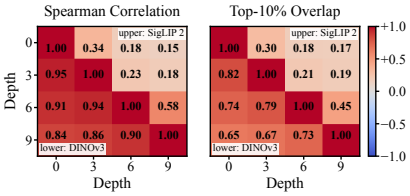
Figure 3 .Cross-depth consistency.Signed Spearman correlation (left) and top-10% overlap (right) of token impacts∆ i between pruning depths, for DINOv3 (lower triangle) and SigLIP 2 (upper triangle), averaged over the ImageNet-1k validation set.
Original paper · CC BY 4.0 · Wyatt, Julian, Willoughby, James, Clement, Allison, Voiculescu, Irina · Token Pruning Needs a Protected Sink Token: Coherent Spatial Aggregation in Vision Transformers · Original paper figure · Extracted the figure area from page 4 of the original PDF.Why pruning needs a per-model check
Attention in a ViT costs grow quadratically with the number of image tokens, so cutting tokens is an obvious way to save compute. Token pruning drops tokens from the sequence, token merging combines similar ones, and adaptive patch sizing gives different image regions different budgets. Most of the prior comparison work varies the reduction algorithm, keep rate, backbone and dataset.
What that work leaves out is how an existing pretrained ViT responds when tokens are removed from it. That leaves open which tokens such a model relies on, and whether that reliance holds as information moves through its blocks. The authors frame this as a question about depth, asking whether the important tokens stay the same as the model goes deeper.
Scoring tokens by removing them mid-network
The core idea is to remove tokens inside the network at a chosen block, keep a random subset, and check whether the prediction survives. A token that is kept in the draws where the prediction holds and removed in the draws where it fails is judged to matter. The authors call this Monte Carlo Token Pruning (MCTP), and it produces one impact map for each pruning depth.
The blocks before the pruning block run once per image, and their outputs are cached. Each of the 1,000 draws then keeps about K patch tokens, with K set to 10% of the 441 patch tokens, and the remaining blocks run on the prefix tokens plus that subset. The subset is drawn as square regions of the patch grid rather than as scattered single tokens.
For a token i, the impact compares the average predicted-class probability over draws that keep i with the same average over draws that remove it. \[\Delta_i = E[p_{\hat y}(x,\tau,l)\mid i\in\tau] - E[p_{\hat y}(x,\tau,l)\mid i\notin\tau]\] A larger impact means the predicted-class probability is higher, on average, when token i is kept than when it is removed.
The region sampler draws n×n blocks, with n set to 3 or 7, and clips the blocks that run past the image edge. On average a draw keeps 40.2 patch tokens, ranging from 16 to 49.
A 1,000-draw run at block 6 costs about 47 full forward passes, while masking the input 1,000 times would cost 1,000. RISE masks the input, whereas MCTP removes tokens inside the network at the chosen block.
Does token importance stay consistent across depth?
The authors report the mean Spearman over all depth pairs as ρ.
DINOv3 B/16 scored a mean ρ of 0.90, and SigLIP 2 B/16 scored 0.28. Figure 3 shows the pairwise correlations and overlaps, with DINOv3 in the lower triangle and SigLIP 2 in the upper.
The prediction-agreement test keeps the depth-0 top 25% or 50% of tokens and checks whether the prediction survives at later depths. So the consistency in the ranking also shows up in the predictions.
Five MCTP seeds give SigLIP 2 an inter-seed ρ of 0.56 to 0.88 at the same depth, compared to 0.28 across depths. So the low coherence of SigLIP 2 is not an artefact of Monte Carlo noise.
Does evidence concentration track stability, and is it on the object?
Effective support measures how widely the positive token impact is spread over the patches. Each image's positive impacts are normalised to sum to one, their entropy is taken, and the exponential of that entropy is divided by N. \[q^+_i = \frac{\max(\Delta_i,0)}{\sum_j \max(\Delta_j,0)}, \qquad H^+ = -\sum_i q^+_i \log q^+_i, \qquad \phi^+ = \frac{e^{H^+}}{N}\] A high value means the impact is shared across many patches, and a low value means it sits in a small region.
Prediction stability for a class k averages the stability indicator over all draws and all images of that class. The indicator checks whether the pruned prediction matches the unpruned prediction, not the true label.
To test whether the evidence falls on the object, the authors use the ImageNet-1k object boxes. Off-box mass m takes the normalised positive impact outside the boxes and divides it by the fraction of patches outside, so uniform impact gives m equal to 1. \[m = \frac{\sum_{i\notin G} q^+_i}{(N-|G|)/N}\] Only images whose unpruned prediction is correct enter this measure, so the highlighted impact relates to the box.
The coherent models keep off-box mass between 0.29 and 0.38 at blocks 0 and 9. The authors also find that SigLIP 2 has the most concentrated support at blocks 0 and 3, and that its support moves with depth.
Why SigLIP 2 loses its sinks under pruning
SigLIP 2 is the outlier in coherence, stability and off-box mass. Every other backbone carries at least a [CLS] token, so SigLIP 2 is the only one whose prefix tokens don't survive pruning. The authors hypothesise that high-norm sink tokens form on SigLIP 2's unprotected patch tokens, and that pruning then corrupts the representation.
To test whether DINOv3's coherence depends on its prefix tokens, the authors remove them at the pruning point and use the GAP readout. Its maps still stay on the object at blocks 6 and 9, with off-box mass 0.41 and 0.29, which the authors read as patch tokens that already gathered context from the sinks.
An empty register, which adds the same token without moving the activations, leaves mass and stability at SigLIP 2's baseline levels. So the gain comes from the moved activations, not from the extra token.
Protecting five random tokens changes mass very little, so the gain doesn't come from the sampling scheme.
Yet the five highest-norm tokens at block 3 mostly aren't the sinks of the unpruned model: 3.1% of the final block's top five appear there, compared to 80% at block 6. The protected tokens instead become sinks after pruning, and at block 3 a sink forms in only 12 to 16% of draws. When a sink does form at block 6 with the top five protected, it is one of the protected tokens in 92% of cases, compared to 14% with five random protected tokens.
Protecting the five highest-norm patch tokens also raises inter-seed agreement at all four depths. So the authors conclude that pruning the sink tokens collapses the prediction, and coherence goes with it.
Limitations
MCTP is too costly to make pruning decisions at inference, so the authors present it as a post-hoc analysis tool. The authors don't evaluate existing token pruning methods and don't propose a new one. Whether image context is needed outside the high-impact regions under pruning is left uncertain.
The authors note that SigLIP encoders are widely used in VLMs such as PaliGemma and LLaVA-OneVision, which makes the case relevant. Protecting tokens can't help at block 0, because the model hasn't yet embedded image context into its patch tokens.
The results come from ImageNet-1k classification with linear probes, so they don't show how pruning behaves on dense predictions. Extending the analysis to dense prediction and to token merging or adaptive patch sizing is left for future work.
Paper info
- Authors
- Wyatt, Julian, Willoughby, James, Clement, Allison, Voiculescu, Irina
- Venue
- arXiv · Preprint
- First published
- 2026-11-23
- Added
- 2026-11-25
- Updated
- 2026-11-23
- Version
- v1
- arXiv
- 2611.31025
- Category
- cs.CV
- Original paper terms
- CC BY 4.0
- What we show
- Paper info, commentary and permitted figures from the original paper
AI commentary is a separate explanation from the original paper and may contain errors. The original paper and figures follow each source's terms of use and any rights noted separately.
Abstract
Vision Transformers (ViTs) are a predominant architecture for computer vision, with token reduction emerging as a popular paradigm to improve their efficiency. Prior work compares reduction algorithms, but not how models respond to them, nor how their response changes with model depth. We propose Monte Carlo Token Pruning (MCTP), which estimates each token's impact on the prediction when tokens are explicitly removed during the forward pass. Applying MCTP to recent pretrained models, we observe that most, such as DINOv3, maintain a similar ranking of token importance at every depth (high Coherent Aggregation), while SigLIP 2 does not. This coherence requires predictions to survive pruning, which depends on keeping high-norm "sink" tokens: prefix tokens are kept by design, while prefix-free SigLIP 2 forms them on patch tokens, which pruning may remove. We show that in removing DINOv3's prefix tokens, its predictions and coherence collapse, while protecting only 5 tokens for SigLIP 2 cuts the token impact outside the object's bounding box by up to 62%. Beyond this, MCTP offers a post-hoc method to evaluate how a pretrained ViT responds to pruning, and suggests that token reduction methods should keep "sinks".
Quote from the paper
Wyatt, Julian, Willoughby, James, Clement, Allison, Voiculescu, Irina (2026). Token Pruning Needs a Protected Sink Token: Coherent Spatial Aggregation in Vision Transformers. arXiv:2611.31025v1. https://arxiv.org/abs/2611.31025v1
BibTeX
@misc{julian2026token,
  title = {{Token Pruning Needs a Protected Sink Token: Coherent Spatial Aggregation in Vision Transformers}},
  author = {Wyatt, Julian and Willoughby, James and Clement, Allison and Voiculescu, Irina},
  year = {2026},
  eprint = {2611.31025},
  archivePrefix = {arXiv},
  url = {https://arxiv.org/abs/2611.31025v1}
}