Paper commentary
Beyond Rigid Hands: Deforming Skin into Contact-Consistent Hand Meshes
Skin deformation makes rigid hand meshes conform to objects
- Problem Rigid hand meshes hover above or cut into objects where real skin would press. Existing refiners only move the pose, which can leave fingers penetrating the object.
- Method The authors deform a rigid MANO hand's skin onto the object instead of moving the pose.
- Results Band conformity rises from about 25% to 88% on DexYCB, while the pose barely changes.
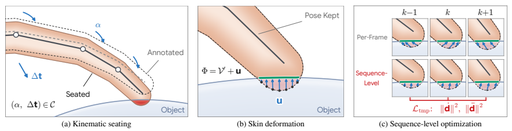
Figure 3 . Lifting a rigid hand in three stages. (a) Seating bends the annotated finger (dashed) toward the object by scaling its joint angles byα and shifting the wrist by ∆t within the box C, so that it presses slightly into the object (red). (b) The displacement u pushes the penetrating skin back onto the surface as a flat contact patch (green) without changing this pose, while the Jacobian regularizer keeps the skin from stretching. (c) Per-frame lifting changes the patch between frames although the finger barely moves (top), whereas the temporal prior Ltmp on the canonical deformationdkeeps it consistent (bottom).
Original paper · CC BY 4.0 · Seonghwan Park, Min-Gyu Park · Beyond Rigid Hands: Deforming Skin into Contact-Consistent Hand Meshes · Original paper figure · Extracted the figure area from page 3 of the original PDF.Where rigid hands misstate contact
Hand-object datasets and estimators describe the hand with MANO, a parametric model whose joints articulate while its surface stays rigid. That is enough for pose, but a grasp is decided at contact, and a rigid surface can't represent contact well. Real skin under grip flattens into patches that conform to the object, while a rigid surface can only hover above it or cut into it.
Existing refiners try to fix this by moving the pose, and their surface stays rigid throughout. Freeing one fingertip can leave the base of that finger inside the object, so the fix creates a new penetration. The authors argue that what's missing is a surface able to deform, not a better pose.
That raises the central question: can the skin of a rigid hand conform while its pose barely changes? Answering it is hard, because a deformed hand has no ground truth, so the lift must be checked against data the optimization never sees.
Deforming the skin instead of the pose
The key idea is to keep the rigid hand's pose nearly fixed and let its skin move onto the object. Figure 2 contrasts this with a pose refiner, which moves the finger away from the estimate and can leave its base inside the object. Simply snapping the skin onto the object would add contact, but it would stretch the skin, drift from the depth the camera sees, and flicker between frames.
To avoid those failures, the lift must satisfy three conditions together: no deep penetration, skin near the object lying on its surface, and only a small pose correction. Each condition maps to a stage: seating handles the pose, skin deformation handles the surface, and a temporal prior handles consistency across frames. The authors call these conditions contact consistency.
Seating the fingers and deforming the skin
Seating sets each finger joint to \(\theta'_j = (1+\alpha_j)\theta_j\) and moves the wrist to \(t' = t+\Delta t\). Because the scale keeps the input rotation axis, each joint bends or straightens without twisting. The authors optimize \((\alpha,\Delta t)\) with Adam, projecting onto the box C after each step. An attraction pulls palmar skin slightly inside the surface, a repulsion limits deeper penetration, and a prior keeps the correction small.
Seating alone barely raises band conformity, because the rigid surface still hovers or penetrates, so the fingers are pressed slightly in on purpose.
Skin deformation then displaces each seated vertex, giving the lifted mesh \(\Phi = M(\theta',\beta)+t'+u\). A direct projection onto the object would stretch the skin, so the method penalizes how far each face's Jacobian \(J_f = I + \nabla_f u\) departs from the identity. Because the penalty ignores translation, a skin patch can slide onto the surface as one piece without stretching.
The full displacement objective adds the attraction and penetration terms to the regularizer, plus a cap that limits how far each vertex moves.
Coupling frames in a clip
Lifting each frame alone lets nearby frames fall into different local minima, so an indentation can flicker even when the grasp barely changes. The fix is to compare displacements in a canonical rest frame, by applying the inverse of the bone-rotation blend \(A_{k,i}\) to each displacement \(u_{k,i}\). An indentation on the same part of the finger then keeps the same canonical value while the finger bends.
The authors penalize the first and second temporal differences of the canonical deformation, \(\dot d_k\) and \(\ddot d_k\), because grasp deformation changes slowly. These penalties apply only to consecutive contact frames, so deformation stays out of frames before contact. The clip is optimized jointly, with the per-frame objective, a wrist term and the temporal prior summed over all frames.
A learned head for estimated hands
Geometry can show where skin already meets the object, but it can't tell whether a finger should touch when the estimate leaves it short. The authors therefore learn this cue from the lifted annotations, where skin deformation has already produced contact.
The head is lightweight and attached to a frozen estimator, and it reads the pixel-aligned features plus each vertex's distance to the predicted object. One head is trained per estimator on lifted annotations of a dataset, and because the estimator is never updated, no retraining is needed.
At run time the predicted contact pulls the vertices it marks onto the surface during skin deformation.
Refining estimated hands at the estimated pose
The authors lift the outputs of HOISDF, UniHOPE and VPHO on DexYCB, using geometry alone and no learned head. Deeply penetrating vertices drop sharply, while the acceleration error barely changes.
Pose refiners move the other way: ContactOpt and GeneOH Diffusion lower band conformity below the estimate and add 4 to 20 mm of joint error.
How much the learned head adds
Geometry alone reaches only skin already near the object, so the authors guide the deformation with the contact head. For HOISDF, the F1 against the lifted annotation rises from 0.37 to 0.57 when the head replaces geometry as the source. Across the three estimators, the head raises F1 by 0.08 to 0.20.
The learned contact thus adds stability while keeping the estimated pose, with UniHOPE as the exception.
Lifting dataset annotations
Band conformity barely moves with seating, but skin deformation raises it from about 25% to 88% on DexYCB and to 71% on OakInk.
The authors conclude that most of the gain comes from skin deformation rather than the small pose correction.
On stability, lifting lowers the force-equilibrium residual at six gravity directions from 11.6% to 7.9% on DexYCB and from 13.1% to 7.6% on OakInk. Seating alone leaves slip and, on DexYCB, equilibrium largely unchanged.
Agreement with thermal contact
So the gain comes from covering contact the rigid annotation missed, not from adding false contact.
ContactOpt, even with a matched pose change and size, scores no more than 0.54.
Temporal consistency across clips
Per-frame lifts flip the sign of the deformation on skin that stays in contact, even when the grasp barely changes. The sequence-level lift evolves smoothly over the same nine frames.
On OakInk the same comparison goes from 34.5% to 82.7%, while band conformity stays within 4 and 6 points of the per-frame values.
Post-hoc filtering gets similar transfer but loses 12 and 11 points of band conformity. Re-projection restores conformity at the cost of transfer, so neither alternative keeps both high. Across 19 settings, the upper envelope of these alternatives still falls 7.6 and 10.3 points short in transfer at equal conformity.
Simpler corrections and depth agreement
With extra smoothing that matches the lift's stretch, the rule conforms only 29% of the band, compared to 48%.
Depth measures the residual to observed depth on DexYCB annotations, and the lift keeps it at 4.91 mm, compared to 4.75 mm for the rigid input. The pose-space variant gets 5.21 mm without gaining contact, and the contact-band rule gets 6.10 mm for similar conformity. The authors read this as the lift adding contact without leaving the observed surface.
Where the head's gain comes from
They also compare at an equal contact count, since more contact alone lowers the residual.
The gap holds under both measures, so the head's gain isn't only a matter of how much contact it adds.
Limitations
The estimator comparison covers HOISDF, UniHOPE and VPHO, and the annotation lift covers DexYCB and OakInk. Thermal agreement is checked only on ContactPose, with 1,766 grasps. The depth check uses DexYCB depth images only. HO3D results appear only in the supplement, and the stability numbers come from simulation and an equilibrium residual.
The authors plan to release code upon publication.
Paper info
- Authors
- Seonghwan Park, Min-Gyu Park
- Venue
- arXiv · Preprint
- First published
- 2026-11-24
- Added
- 2026-11-25
- Updated
- 2026-11-24
- Version
- v1
- arXiv
- 2611.31950
- Category
- cs.CV · cs.AI
- Original paper terms
- CC BY 4.0
- What we show
- Paper info, commentary and permitted figures from the original paper
AI commentary is a separate explanation from the original paper and may contain errors. The original paper and figures follow each source's terms of use and any rights noted separately.
Abstract
Hands grasp objects with soft skin. A fingertip flattens against a mug, and a palm curves around a bottle. Yet hand-object datasets and estimators represent the hand as a rigid articulated mesh, which hovers above or penetrates the object where skin would press against it. Existing refiners keep the mesh rigid and adjust only the pose, trading pose accuracy for physical plausibility. We ask whether a rigid hand can instead touch the object as skin does while staying close to its original pose. We lift annotated or estimated rigid hands to contact-consistent meshes through an optimization that (i) slightly adjusts the joints and wrist to bring the fingers onto the object, (ii) deforms the skin so that penetrating regions settle onto the surface, and (iii) keeps this deformation consistent over time. Since deformation reaches only skin already near the object, we further train a lightweight head on the lifted annotations to predict where an estimated hand should touch and steer the deformation there. Unlike existing refiners, the lift more than doubles the skin lying on the object surface for three published estimators while barely changing the pose. Guidance from the learned head further improves grasp stability by closing contact gaps that the estimate leaves open. Existing hand-object datasets and estimators can thus adopt contact-consistent hands without changing the hand model or retraining the estimators.
Quote from the paper
Seonghwan Park, Min-Gyu Park (2026). Beyond Rigid Hands: Deforming Skin into Contact-Consistent Hand Meshes. arXiv:2611.31950v1. https://arxiv.org/abs/2611.31950v1
BibTeX
@misc{park2026beyond,
  title = {{Beyond Rigid Hands: Deforming Skin into Contact-Consistent Hand Meshes}},
  author = {Seonghwan Park and Min-Gyu Park},
  year = {2026},
  eprint = {2611.31950},
  archivePrefix = {arXiv},
  url = {https://arxiv.org/abs/2611.31950v1}
}