Paper commentary
From Pairwise to Collective: Encoder Collections Make Unpaired Vision-Language Alignment Reliable
ConsensusAlign aligns unpaired vision and text encoders by pooling encoder collections
- Problem Unpaired alignment fits a map from feature geometry alone, so each encoder pair's separate search is fragile and often fails.
- Method ConsensusAlign pools each modality's encoders into one shared space, fits a single bridge, and derives every pair's map in closed form.
- Results Pooled fitting aligned all 21 vision-text encoder pairs, cutting mean FOSCTTM error from 0.1457 to 0.0099 across five seeds.
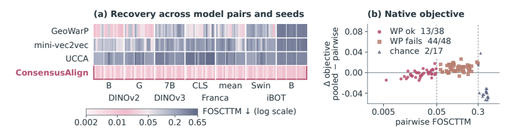
Figure 3 . Pooling recovers the grid, while native objective preference depends on the failure regime. (a) COCO validation FOSCTTM for seven vision configurations, three text encoders and five seeds (log color scale); ConsensusAlign uses the uniform 7 × 3 pool. (b) Native WP objective of polar(Wvℓ) minus that of the pairwise map, against pairwise FOSCTTM (103 cells with stored maps). The projected pooled map scores higher in 44/48 non-chance failures, but only 2/17 near-chance cells. Dashed lines mark the failure (0.05) and near-chance (0.3) cutoffs.
Original paper · CC BY 4.0 · Yin, Xuanhua, Mao, Shunqi, Xu, Chuanzhi, Wei, Boyu, Guo, Wei, Cai, Weidong · From Pairwise to Collective: Encoder Collections Make Unpaired Vision-Language Alignment Reliable · Original paper figure · Extracted the figure area from page 6 of the original PDF.Why pairwise unpaired alignment is fragile
Text-based retrieval and zero-shot classification need a map from vision features into a text encoder's space, and paired image-text data usually supplies that map. When no pairs exist, the map has to come from the geometry of the two feature spaces alone. GeoWarP solves this with Wasserstein Procrustes, while UCCA and vec2vec rely on other objectives.
The search is fragile: on the COCO grid, pairwise WP failed in 65% of pair-seed cells, judged by FOSCTTM above 0.05. A good objective value does not guarantee correct matches, because the WP objective can stay high even when the image-text matches it finds are wrong. Treating every pair separately also means M times N cross-modal fits for M vision and N text encoders.
The key idea: pool each modality before aligning
The key idea is that all encoders in a collection process the same inputs, so items correspond exactly within each modality. Because those correspondences are known, the representations of each modality's encoders can be merged into one shared space before any cross-modal search starts. This turns the search into one between two pooled spaces, which the authors use as a supervision source for unpaired alignment.
In the base COCO collection, the authors observed that the pooled image and text spaces had more similar geometry than any native encoder pair, and this motivated aligning the two pools. So the expensive cross-modal step runs once, while each encoder is linked to its own pool by a closed-form fit.
Building the pooled spaces and one bridge
Every vision encoder embeds the same images and every text encoder embeds the same texts, so each feature matrix has rows that line up with the others. The authors center each matrix with its fitting mean and normalize its rows. Pooling stacks the vision features horizontally along the item rows, then centers the columns and keeps the leading d = 768 right singular vectors as the basis.
In symbols, the paper forms \(Z_V = H T_V P_V\) with \(H = I_{n_x} - \frac{1}{n_x}\mathbf{1}\mathbf{1}^\top\), where \(P_V\) holds the leading singular vectors and no whitening is applied. Weighted Wasserstein Procrustes then runs on the centered, row-normalized pooled features, alternating a Hungarian assignment with an orthogonal Procrustes update.
The result is one orthogonal bridge \(C \in O(d)\), fitted with 30 restarts and 100 refinement updates on COCO, and pairwise WP used the same settings.
Native maps and two-encoder inference
The bridge works in pooled coordinates, so each encoder needs its own factor that moves it into its pool. That factor comes from the known item identities: \(Q_v = \mathrm{polar}(X_v^\top Z_V)\) for vision and \(R_\ell = \mathrm{polar}(Y_\ell^\top Z_L)\) for text, where polar(A) equals \(U_A V_A^\top\) from a thin SVD. No estimated permutation is needed for these fits, because their cross-covariances use the observed row correspondences.
The native map for a pair is the product \(W_{v\ell} = Q_v C R_\ell^\top\), which is formed once and has rank at most d. At inference, each query is centered with its fitting mean and normalized, and the pair is scored by cosine similarity of the image vector under \(W_{v\ell}\) with the text vector.
Down-weighting outlying encoders
With unit weights, every member enters the pool at full strength, so a poorly behaved member can pull the shared geometry. The authors therefore weight each encoder by how well it agrees with the others in its modality. The pooled Gram matrix is a weighted sum of the members' Gram matrices, with each weight entering squared.
Each member's agreement \(\kappa_v\) is its mean linear CKA with the other members, and the weight is \(w_v = \min(1, \kappa_v/\kappa_{\mathrm{med}})^2\), where \(\kappa_{\mathrm{med}}\) is the upper median member agreement. Because the weight enters squared, an outlier is attenuated to the fourth power of its relative agreement. Agreement is estimated on at most 8,000 shared fitting rows, and unit weights apply when a modality has fewer than three members.
Reusing the bridge for new encoders and corpora
A new encoder only needs its own map into its modality's pooled space, fitted from its features on the fitting images. Its factor is computed as \(Q_u = \mathrm{polar}(X_u^\top Z_V)\), and its maps then reuse the existing bridge and text factors.
On a new corpus, the source PCA bases, weights, bridge and concatenation means stay fixed. Target features are projected into the source basis and the native factors are refitted, rather than recomputing PCA, since a new PCA would change the coordinates the bridge joins.
Does pooling align the whole COCO grid?
On the COCO grid of seven vision configurations and three text encoders, pooled fitting aligned all 21 pairs in every seed. The pairwise GeoWarP row failed in 68 of 105 pair-seed cells, while ConsensusAlign failed in none. Across the five seeds, the GeoWarP baseline's error had an SD of 0.0151, compared to 0.0040 for ConsensusAlign.
The paired orthogonal reference, which uses true pairs, reached 0.0036, so the unpaired pooled fit sits above that bound. Figure 3a plots FOSCTTM for each cell on a log scale, with the failure cutoff marked.
Zero-shot classification and retrieval
The downstream tests use six vision configurations other than DINOv3, crossed with MPNet and Qwen3-Embedding-8B. AVG10 is the mean top-1 accuracy over ten datasets, and the paper also reports ImageNet-1k and Flickr30k R@1. Averaged over the 21 pairs, AVG10 rose from 10.9% under GeoWarP to 19.6% under ConsensusAlign.
To isolate usable interfaces, the authors also look only at the 21 pair-seed cells where pairwise WP already succeeds.
Aircraft and GTSRB stay weak even with paired orthogonal fitting, so the pooled gains do not close that gap. Fitting the pooled pipeline from stored features took 36.0 min on one 20-core CPU at seed 0, close to the 35.9 min for one pairwise WP fit. Building the native factors took 2.5 s, and those factors are then reused across encoder pairs.
Why pooling helps: geometry and controls
The base pooled spaces have linear CKA 0.73, above the 0.48 to 0.68 range of the native encoder pairs. Across 39 unit-weight vision-subset fits over 3 seeds, linear CKA and mean FOSCTTM have a Spearman correlation of −0.88. The authors take this geometry as the reason pooling helps the search.
Keeping the concat-PCA pools fixed, GPA and known-ID hyperalignment both reached FOSCTTM of 0.0104 and 0.0118 with no failed cells. Bridge replacements on the same pools did worse, with UCCA failing in all 105 cells and mini-vec2vec in 94. So the gains depend on the collective construction and on WP as the bridge solver, since WP stayed more reliable than the tested replacements.
Four pooled restarts reached FOSCTTM 0.0110 with no failed cell.
Adding a few paired anchors
The authors project k paired anchors into the fixed pools and include them in WP initialization and updates. On DINOv2-B/Qwen3-generative, the zero-pair pooled fit matches orthogonal fitting with 200 to 500 true pairs. The zero-pair pooled reference on that pair is 0.0079 with an SD of 0.0030 across three seeds.
The benefit of anchors is not uniform, and on the harder iBOT-B/MPNet pair WP with 1,000 anchors reached 0.0227. Zero-pair pooling on that same pair reached 0.0198, compared to 0.0227 for the anchored WP fit.
Reuse on DCI and DOCCI
On DCI and DOCCI, fresh pooled fits fail, while reusing the COCO bridge with refitted native factors succeeds.
The same diagnostic scores failed maps at most 0.0028 and successful maps at least 0.077.
Limitations
Adding the MAE configurations did not improve alignment monotonically, and agreement weighting gave a mean FOSCTTM of 0.0126 compared to 0.0099 for the base pool. I-JEPA-H attaches below the failure threshold, while MAE remains weak in the attachment tests. The main grid uses unimodally trained encoders on COCO, so these results cover that setting.
Paper info
- Authors
- Yin, Xuanhua, Mao, Shunqi, Xu, Chuanzhi, Wei, Boyu, Guo, Wei, Cai, Weidong
- Venue
- arXiv · Preprint
- First published
- 2026-11-21
- Added
- 2026-11-24
- Updated
- 2026-11-21
- Version
- v1
- arXiv
- 2611.28753
- Category
- cs.CV
- Original paper terms
- CC BY 4.0
- What we show
- Paper info, commentary and permitted figures from the original paper
AI commentary is a separate explanation from the original paper and may contain errors. The original paper and figures follow each source's terms of use and any rights noted separately.
Abstract
Strong vision and text encoders can be trained independently, but their representations are not directly comparable. Connecting them usually requires paired image-text data, which may be unavailable. Unpaired alignment instead fits a map between a vision and a text encoder from feature-space geometry alone, enabling text-based retrieval and zero-shot classification without paired data. Treating each pair independently leads to fragile searches, repeated fitting, and uncertain map quality. A collection of encoders supplies additional supervision: all vision encoders embed the same images and all text encoders the same texts. Correspondences within each modality are therefore known exactly, while the cross-modal correspondence remains hidden. ConsensusAlign pools each modality into a shared space, fits one unpaired cross-modal bridge, and transfers it in closed form to every encoder pair. New encoders join through same-modality fitting without repeating the cross-modal search. On 21 vision-text encoder pairs and five seeds, pooled fitting aligns every pair, whereas pairwise fits fail in 68 of 105 pair-seed cells. Mean alignment error (FOSCTTM) falls from 0.1457 to 0.0099, and zero-shot accuracy nearly doubles on ten datasets. Gains persist across the tested within-modality pooling constructions with a WP bridge. New corpora reuse the bridge through native maps fitted to unlabeled target features from every source encoder. Agreement with separately fitted reference maps detects failures on COCO.
Quote from the paper
Yin, Xuanhua, Mao, Shunqi, Xu, Chuanzhi, Wei, Boyu, Guo, Wei, Cai, Weidong (2026). From Pairwise to Collective: Encoder Collections Make Unpaired Vision-Language Alignment Reliable. arXiv:2611.28753v1. https://arxiv.org/abs/2611.28753v1
BibTeX
@misc{xuanhua2026from,
  title = {{From Pairwise to Collective: Encoder Collections Make Unpaired Vision-Language Alignment Reliable}},
  author = {Yin, Xuanhua and Mao, Shunqi and Xu, Chuanzhi and Wei, Boyu and Guo, Wei and Cai, Weidong},
  year = {2026},
  eprint = {2611.28753},
  archivePrefix = {arXiv},
  url = {https://arxiv.org/abs/2611.28753v1}
}