Paper commentary
DR Pixel: Page-Native Deep Research with Vision-Language Models
DR Pixel searches rendered document pages instead of OCR text
- Problem OCR-based deep research agents turn papers into text first, which loses tables, figures and equations before retrieval starts.
- Method DR Pixel retrieves and reads rendered page images with a VLM, instead of OCR text chunks.
- Results With GPT-5.4, DR Pixel scored 51.9 accuracy on DRPixelBench, compared to 46.3 for the text-and-figure pipeline.
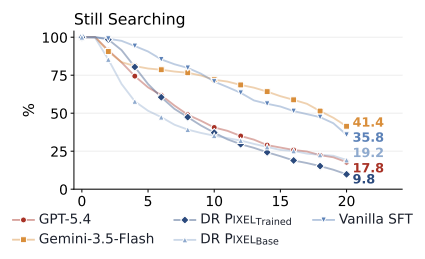
Figure 8 : Share of questions that issue at least k searches on DRPIXELBENCH. The harness stops a trajectory at 20 calls, so the right-hand endpoint of each curve is that model’s exhaustion rate. DR PIXEL Trained is the lowest curve from the twelfth search on and the only model that ends below 10%. Vanilla SFT and Gemini-3.5-Flash share a shape: both stay above 75% for the first eight searches and then run out of budget rather than deciding to stop.
Original paper · CC BY 4.0 · Tiansheng Hu, Yichuan Wang, James V. Talwar, Nicholas Tomlin, Chen Zhao, Sewon Min · DR Pixel: Page-Native Deep Research with Vision-Language Models · Original paper figure · Extracted the figure area from page 24 of the original PDF.Why text-first retrieval gets stuck
Deep research agents answer hard questions by searching a collection, reading what comes back, and reasoning again over several rounds. Scientific papers fit this pattern poorly, because much of their evidence sits in tables, charts, and equations rather than in running prose. Most systems therefore linearize each PDF into text first and run retrieval and reasoning entirely in text space.
Prior work commonly parses documents with document parsers or OCR before the agent starts searching.
The design loses evidence at the first step, because linearization discards or distorts visual structure. Information in figures, tables, or charts can become difficult or impossible to recover after that. Extraction and OCR errors also flow into retrieval and reasoning, so the downstream steps inherit them. Once parsing discards information, downstream retrieval and reasoning can't recover it.
Some prior work adds a second image-retrieval tool and lets the agent choose between text and image search. That still treats text and visual content as separate spaces, so a figure can lose its link to the text that explains it. Information loss during text parsing also remains in that setup. The authors therefore ask whether deep research can retrieve and reason over the rendered pages themselves, keeping each page as an image.
Their agent, DR PIXEL, keeps the ReAct loop and swaps the search tool and corpus for image-based ones.
Keeping each page as an image
The key idea is to make the rendered page the single unit of retrieval and the single unit the model reads. Earlier image-retrieval add-ons keep text and images in separate spaces, so the link between a figure and its explaining text gets lost. Keeping a page whole preserves that link, because the content is never converted into plain text.
DR PIXEL indexes rendered pages with a VLM embedding model, and the agent receives the retrieved images directly.
DR PIXEL searches 1,062,153 page images rendered from the PDFs and returns k= 3 pages.
The agent then writes its next thought and action from those images, using the same ReAct loop as the text setting. Writing the trajectory after T tool calls as H_T = (τ1, a1, f(a1, D), ..., τT, aT, f(aT, D)) makes the history explicit. The authors keep this loop and swap only the search tool and its corpus, so the change sits in retrieval and in what the model sees.
Retrieved images stay in context for the rest of the trajectory, so the agent reasons over all the evidence it has gathered.
A benchmark that needs several rounds and figures
Existing multimodal question sets mostly need only one or a few retrieval steps, so a single search often finds the gold page. Text-based deep research benchmarks avoid that shallowness, but they are text-only and often rely on templated questions. Some of them also use long-form answers that need nondeterministic, rubric-based evaluation, which makes grading harder.
The authors therefore set four properties a fitting benchmark needs: agentic search, multimodal evidence, non-templated questions, and short verifiable answers. They evaluate on four existing benchmarks but argue that page-native DR still needs a new one. Table 1 shows that DRPIXELBENCH is the only benchmark that meets all four properties.
DRPIXELBENCH covers scientific papers, where information is spread across text, tables, figures, and equations. The authors build it on a shared corpus of 99,055 papers, which they also share with AirQA, M3SciQA and IRPAPERS. Each question is generated from an abstract, so it stays tied to the paper's main contribution. Four automatic checks then test plausibility, gold-evidence sufficiency, the need for non-textual evidence, and whether parametric knowledge alone can answer.
Human experts rewrite the surviving questions for naturalness, and the benchmark ends with 500 QA pairs.
Each pair is labeled Text or Visual, depending on whether its evidence is running text or a table, figure, or equation. A Visual label means the question can't be answered from running text alone.
Page-native search before any training
Without any training, DR PIXEL retrieves rendered page images and reads them with a VLM, instead of OCR text chunks. The comparison uses two OCR-based baselines, text-only and text-plus-figure, under the same ReAct loop with at most 20 searches. The text baseline returns five chunks of 256 words, while DR PIXEL returns three page images. The k values were chosen so that each setting roughly matches the agent's retrieved token budget.
The authors report accuracy judged by GPT-5.4-mini under a strict prompt, using a majority vote over three independent judgments.
Gemini-3.5-Flash moved from 41.3 to 46.4 and Qwen3.6-27B from 34.9 to 40.1 when switching to DR PIXEL. Against the text-and-figure pipeline, the gain is 5.6 points for GPT-5.4, 5.1 for Gemini-3.5-Flash, and 5.2 for Qwen3.6-27B. Adding a figure-search tool added little, because the agents rarely called it despite explicit prompt instructions.
Across the three models, the page-native setup improves accuracy by 5.1 to 8.4 points over the OCR-based pipelines.
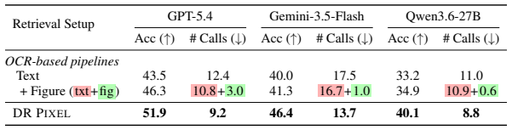
Table 2 : DR PIXELversus OCR-based retrieval pipelines, all with no training. OCR-based pipelines retrieve OCR text chunks (Text), optionally with a separate search on the figure corpus (+ Figure). DR PIXELretrieves and reads whole pages as images.Accis answer accuracy.# Callsis the number of tool calls per question, split into text and figure calls in the text-and-figure setting.
Original paper · CC BY 4.0Split by evidence source, DR PIXEL leads on questions that need tables and figures. On text and equation questions, DR PIXEL stays roughly level with the OCR settings. DR PIXEL also used 20% to 30% fewer retrieval calls than the OCR pipelines. So the accuracy gain doesn't come with a higher search cost.
The open-weight Qwen3.6-27B still scored 40.1, compared to 51.9 for GPT-5.4. That gap is what motivates training an open-weight model. Qwen3.6-27B found the gold page less often, with a page hit of 36.3 compared to 45.7 for GPT-5.4. It also used earlier pages less well, reaching 57.4 accuracy on questions whose gold page came from an earlier search.
GPT-5.4 reached 69.7 on those same earlier-search questions.
How counterfactual credit reweighting scores each step
Standard SFT copies every step of a GPT-5.4 teacher trajectory, including repeated or low-value searches, so the student learns to search too much. The authors borrow the idea behind process rewards and ask how much each step matters to the gold answer.
The score is the log-likelihood that the frozen base policy gives to the gold answer \(y^\star\) after a history \(H\), written \(\ell(H)=\log\pi_0(y^\star\mid H)\). A reasoning step's credit is \(c_{\tau_i}=\ell(H_T)-\ell(H_T\setminus\tau_i)\), the drop in that score when the step is removed from the full history. A search step's credit is \(c_{a_i}=\ell(H_i)-\ell(H_{i-1})\), the rise in that score caused by the results the search returned.
A step with credit at or below zero gets weight 0, and a positive credit with rank \(k/n\) among the \(n\) surviving steps of its type gets weight \(2\cdot k/n\). Multiplying by 2 keeps the average positive weight near 1, which matches the scale of standard SFT.
Reasoning steps are coupled to the search queries they produce, so a reasoning step is masked when its action was masked or when its likelihood gain falls below the median over all reasoning steps. A reasoning step that had zero weight from negative credit but passes the gain check is unmasked and given the median positive reasoning weight.
The training loss is token-level, with reasoning and search tokens weighted by their step weights and the final-answer tokens weighted by a constant \(\lambda\). The loss is \[\mathcal{L}(\theta)=-\sum_{i=1}^{T-1}\Big[\tilde w_{\tau_i}\sum_{t\in\tau_i}\log\pi_\theta(x_t\mid x_{<t})+w_{a_i}\sum_{t\in a_i}\log\pi_\theta(x_t\mid x_{<t})\Big]-\lambda\sum_{t\in a_T}\log\pi_\theta(x_t\mid x_{<t})\].
Because the minus sign turns the weighted log-likelihood into a loss to minimize, higher-weight tokens pull the policy harder toward the teacher's choices.
Whether training closes the gap to GPT-5.4
Training lifts Qwen3.6-27B from 40.1 to 52.1 accuracy on DRPIXELBENCH, slightly above GPT-5.4's 51.9. Both runs learn from the same teacher trajectories, so the comparison with plain SFT isolates the effect of the weighting. The untrained DR PIXEL Base scores 40.1, so the trained agent recovers the full gap to GPT-5.4.
Vanilla SFT trains on the same teacher trajectories, but it weights every token equally. The authors attribute this gap to the weighting suppressing the ineffective searches in the teacher trajectories.
The trained agent's gains are concentrated in retrieval, where it finds the gold page at 52.0 versus 45.7 for GPT-5.4. It does this while using 8.9 calls per question compared to 9.2 for GPT-5.4. The authors read this as post-training aligning query generation with the retriever's embedding space. These values are averages over three runs.
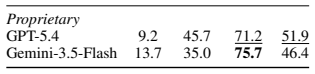
Table 4 : Results on DRPIXELBENCH.Tool/qis searches per question.PgHitis the percentage of questions that retrieves the gold page, andAcc |Pg is accuracy restricted to those questions. Results are averaged over three runs. DR PIXEL Trained matches GPT-5.4 in accuracy, retrieving the gold pages more often while using fewer searches.
Original paper · CC BY 4.0Transfer beyond DRPixelBench
The trained DR Pixel model improved over its base on IRPAPERS, M3SciQA and AirQA, by 9.6 to 14.4 points. The gains carry over because the behavior learned on DRPixelBench transfers to these external multimodal QA benchmarks. The search budget shifted unevenly across the three benchmarks, rather than rising or falling everywhere. DR Pixel Trained searched less on IRPAPERS and AirQA but more on M3SciQA.
On M3SciQA, the base model trailed GPT-5.4 most on document retrieval, by 15.0 points.
ViDoRe-V3 is a stronger test because its documents cover finance and human resources rather than science. The authors compared DR Pixel Trained with GPT-5.4, Gemini-3.5-Flash, the untrained base, and vanilla SFT on this corpus. Post-training raised both page retrieval and text retrieval by 4.1 points.
With page retrieval, the trained model scored 70.8 on ViDoRe-V3, within 1.8 points of the Page Oracle's 72.6. With text retrieval, the trained model reached 69.8, against 65.7 for the base model. Against the Text Oracle at 70.6, the trained model with page retrieval matched it.
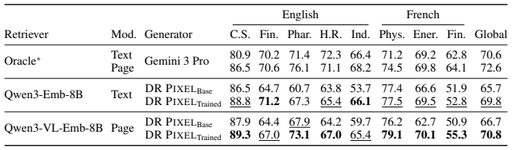
Table 6 : End-to-end accuracy on ViDoRe V3. Oracle∗ is ViDoRe V3’s published upper bound. DR PIXEL Trained improves over DR PIXEL Base with both page and text retrieval on documents outside its training domain, so the training generalizes well.
Original paper · CC BY 4.0Corpus size, page resolution and trajectory type
Corpus size is the first factor, and the trained model holds up better as the index grows. Growing the corpus from 20,000 to 99,000 papers lowers page hit for every model, with questions and gold documents held fixed. DR PIXEL Trained loses 8.0 points, while GPT-5.4 loses 12.5 points over the same growth. The authors say that this wider edge carries over into final answer accuracy.
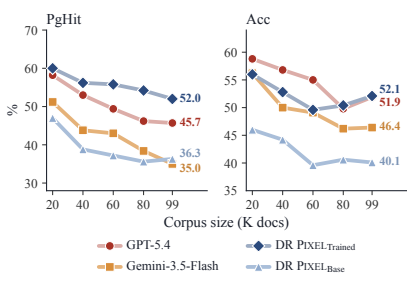
Figure 4 : Effect of corpus size on retrieval and final an- swer accuracy. Each panel varies the number of indexed documents from 20,000 to 99,055. DR PIXEL Trained is the most robust to corpus growth, with the slowest degradation in retrieval performance.
Original paper · CC BY 4.0Page resolution is the second factor, and it trades visual fidelity against inference cost. Processing high-resolution page images is expensive, so the authors cap each rendered page at 1.05 megapixels. That cap is roughly 50% of the native resolution. At this cap, input tokens fall by 30% to 48% across models. Accuracy drops by only 1.0 to 3.8 points, and page retrieval still beats OCR-based text retrieval by 2.7 to 7.4 points.
Output tokens rise a little at lower resolution, but they stay under 25% of all tokens.
Trajectory type is the third factor, and it decides which questions the fine-tuned agent handles well. The 2,500 training trajectories contain only Visual questions, so the authors test a Text alternative. That yields 46.0 accuracy, versus 50.2 with Visual fine-tuning. Visual fine-tuning stays within 1.4 points of Text fine-tuning on Text questions.
Text fine-tuning trails by 6 to 11 points on Visual questions.
Where the DR Pixel results stop
Only Qwen3.6-27B was trained, so the training gains are measured on one open-weight backbone. The training data are GPT-5.4 teacher trajectories for about 2,500 questions, run for one epoch. The training set contains only Visual questions, so the Text-question comparison is a separate run on 2,000 trajectories. The benchmark questions were generated by Gemini-3.5-Flash and then checked by human experts for naturalness.
Accuracy is judged by GPT-5.4-mini under a strict prompt, with a majority vote over three judgments. The ViDoRe-V3 result is limited by the benchmark itself, since only 1.7% of its questions need visual content. Because so few ViDoRe-V3 questions need the page image, the page and text retrieval settings stay close.
The corpus-size results come from the shared 99,055-paper corpus, with page-hit rate as the main measure. The page-resolution results use DRPIXELBENCH, where the 1.05 megapixel cap cut input tokens by 30% to 48%. Output tokens rise slightly at lower resolution, and the authors count them in the same token totals.
Paper info
- Authors
- Tiansheng Hu, Yichuan Wang, James V. Talwar, Nicholas Tomlin, Chen Zhao, Sewon Min
- Venue
- arXiv · Preprint
- First published
- 2026-11-2
- Added
- 2026-11-4
- Updated
- 2026-11-2
- Version
- v1
- arXiv
- 2611.03097
- Category
- cs.CV · cs.CL · cs.IR
- Original paper terms
- CC BY 4.0
- What we show
- Paper info, commentary and permitted figures from the original paper
AI commentary is a separate explanation from the original paper and may contain errors. The original paper and figures follow each source's terms of use and any rights noted separately.
Abstract
Complex documents such as scientific papers contain rich information in tables, figures, and equations; however, existing deep research (DR) agents typically reduce papers to OCR-extracted text. We instead ask whether vision-language models (VLMs) can enable page-native deep research: directly retrieving and reasoning over rendered document page images. We introduce DR Pixel, the first open-source end-to-end multimodal DR agent that uses rendered page images as its sole retrieval and reasoning unit, operating over a corpus of 1.06M pages. To evaluate this setting, we construct DRPixelBench, a benchmark on scientific papers requiring reasoning over text, figures, tables, and equations. Surprisingly, page-native DR already works well without training, outperforming OCR-based baselines across state-of-the-art models like GPT-5.4, Gemini-3.5-Flash, and Qwen3.6-27B, while requiring fewer tool calls. We next turn to DR training. A key challenge is that teacher trajectories for agentic supervised finetuning are noisy, mixing critical reasoning and action steps with redundant or failed attempts. To address this, we introduce counterfactual credit reweighting, a fine-grained credit assignment method that weights individual reasoning and action steps by their counterfactual contribution to the final answer. Our training improves retrieval recall by about 15 points and final accuracy by over 10 points on DRPixelBench, and likewise outperforms the untrained baseline on four existing benchmarks. On out-of-distribution ViDoRe-V3, DR Pixel comes within 1.8 points of an oracle that is given the gold pages directly. Our results suggest that the conventional OCR-then-retrieve pipeline is not only unnecessary but suboptimal: directly retrieving and reasoning over visual document pages makes complex DR both more effective and more efficient.
Quote from the paper
Tiansheng Hu, Yichuan Wang, James V. Talwar, Nicholas Tomlin, Chen Zhao, Sewon Min (2026). DR Pixel: Page-Native Deep Research with Vision-Language Models. arXiv:2611.03097v1. https://arxiv.org/abs/2611.03097v1
BibTeX
@misc{hu2026pixel,
  title = {{DR Pixel: Page-Native Deep Research with Vision-Language Models}},
  author = {Tiansheng Hu and Yichuan Wang and James V. Talwar and Nicholas Tomlin and Chen Zhao and Sewon Min},
  year = {2026},
  eprint = {2611.03097},
  archivePrefix = {arXiv},
  url = {https://arxiv.org/abs/2611.03097v1}
}