Paper commentary
Who Called? V33DA: A Physically Verified Multimodal Benchmark for Vocal Attribution in Zebra Finch Groups
Benchmark shows caller identity shortcuts fail on unseen zebra finches
- Problem Models can look accurate at picking the caller in a group because they recognize familiar voices, not because they use spatial evidence. Few datasets verify the caller physically, so this shortcut goes unnoticed.
- Method V33DA is a benchmark of 33,625 verified events with 5-channel audio, camera views, and 3D pose. Caller labels come from an on-body accelerometer that models never see, so they must select the caller from the visible candidates.
- Results Models that rely on familiar voices reach 86.5% on session-disjoint testing but 0% under leave-one-bird-out. Candidate-aware methods transfer much better to unseen birds.
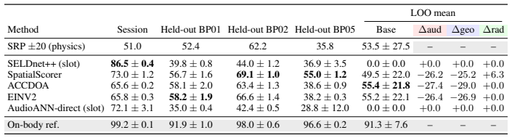
Table 3 :Vocal attribution and LOO modality interventions across benchmark regimes (rep- resentative subset) using V33DA.Attribution accuracy (%) for one representative method per family; the full 24-method matrix is in Appendix Table 18. The last three columns are LOO accuracy changes (points) when one input channel is removed at test time on a single seed-42 checkpoint: zeroing the audio (∆aud), shuffling candidate geometry across events (∆geo), or zeroing the radio features (∆rad). Negative values indicate degradation.Sessiontests new recordings of known birds; Held-out BP01/BP02/BP05rotate the test experiment;LOO meanaverages within-experiment leave-one-bird-out folds. Learned rows report mean ± std across seeds. The withheld on-body reference is a ceiling.
Original paper · CC BY 4.0 · Maris Basha, Yuhang Wang, Xiaoran Chen, Longbiao Cheng, Luca Yapura, Anja T. Zai, Mathieu Salzmann, Richard Hahnloser · Who Called? V33DA: A Physically Verified Multimodal Benchmark for Vocal Attribution in Zebra Finch Groups · Original paper figure · Extracted the figure area from page 8 of the original PDF.Why familiar voices mislead attribution scores
Once a call has been detected, a model still has to decide which visible bird produced it. Knowing the caller matters because it is the entry point to asking who communicates with whom and under what social conditions. The trap is that a model can be right for the wrong reason, because high accuracy may come from recognizing familiar voices.
Caller attribution in freely behaving groups is hard because the evidence is spread across modalities.
Existing resources each cover only part of this problem.
The gap is one dataset that pairs physical verification with synchronized group state and tests identity shortcuts directly. V33DA is built to fill it, on top of the BirdPark recording system. Its three regimes separate session-disjoint testing on familiar birds from leave-one-bird-out and held-out-experiment transfer. The primary task is candidate-conditioned caller attribution, and 3D source localization serves as a diagnostic of whether a method learned usable spatial evidence.
A model that only ranks candidates by familiar voice would fail the transfer regimes, which is the shortcut the benchmark is designed to expose.
How the verified benchmark is built
Caller labels in V33DA come from a sensor on the bird's body, not from a listener's judgement of the audio. The on-body accelerometer-derived vibration signal verifies who called, and the benchmark models never receive that channel. Instead, the withheld channel only defines an on-body reference ceiling that the other methods are compared against.
Each released event therefore pairs the verified caller label with every other input the models do see.
The recordings come from the BirdPark aviary, which houses three experiments that each hold 3 to 4 zebra finches. A 4-antenna receiver array provides per-bird radio telemetry, and 3D pose is triangulated from 5 keypoints per bird. Each released event carries 5-channel audio, three calibrated camera views, and per-frame 3D pose for every visible candidate.
Label construction starts on the demodulated on-body trace, where a multichannel WhisperSeg model proposes candidate windows for each bird. Every candidate vocalization is then reviewed by hand against the full multimodal evidence, which the authors describe as a consistency check. After review, the overlap filter removes 3,784 of 37,561 valid candidates, leaving 33,625 released events from 10 birds.
The three regimes test different kinds of transfer, and each one isolates a different shift. Session-disjoint testing uses held-out recording dates of birds seen during training. Held-out-experiment testing moves an entire cohort out, while leave-one-bird-out holds out one bird's vocalizations and keeps recording dates shared with training.
The model receives the detected call and its audio, the visible candidates' 3D pose and radio features, and it outputs one candidate. Top-1 accuracy is the main score, and 3D localization error serves as a diagnostic.
Transfer results across regimes
SELDnet++ shows why in-domain scores can mislead a benchmark user. It reaches 86.5% attribution accuracy on session-disjoint evaluation but drops to 0% under leave-one-bird-out. Its identity-slot output head learns one slot per training bird, so an unfamiliar bird has no slot that fits. SELDnet and AudioANN-direct fail in the same way, because they carry the same identity-slot head.
The authors removed that head in SELDnet++ open, which lifts leave-one-bird-out to 9.3%. That same change drops session accuracy to 61.5%, so the shortcut is both attractive and brittle.
Rows that score the visible candidates directly transfer much better than the slot models. SRP, SpatialScorer, ACCDOA, EINV2, and AudioANN-locfirst all fall in this group, and each one scores candidates directly or routes attribution through localization. The folds don't resolve the ordering among these rows, so the claim is about the family, not a single winner.
Attribution accuracy alone doesn't show that a model learned where the sound came from. The authors therefore score 3D localization as a diagnostic, and SpatialScorer reaches 19.7 cm on LOO. That is about 7 cm below the random-candidate baseline of 27.1 cm, and it closes about 31% of the range to the on-body reference. Close birds lower accuracy for ACCDOA, from 73.0% above 50 cm to 46.6% below 10 cm.
What the transferring models rely on
Transfer in V33DA depends on whether a model keeps audio, candidate geometry, and radio in play at test time. The authors ran three test-time interventions on a single seed-42 checkpoint, each removing or scrambling one input channel. For ACCDOA and EINV2, zeroing the audio cost 25 to 30 points on held-out BP01, held-out BP02, and leave-one-bird-out evaluation.
Shuffling candidate geometry across events cost 27 to 33 points on the same splits. Zeroing the radio features changed accuracy by less than a point, so radio adds little once geometry is known. Transfer therefore rests on clean audio together with correct candidate geometry.
On held-out BP05, where every method is weakest, the audio and geometry effects shrink to roughly 7 to 12 points. SpatialScorer is the exception there, since zeroing its radio costs 14.8 points. The authors read this as a formulation-dependent effect rather than a general property of radio.
Spacing between birds sets the timing margin the array has to work with. ACCDOA falls from 73.0% when the nearest competitor is above 50 cm to 46.6% below 10 cm. Random attribution moves only 4.8 points across the same bins. A GCC-PHAT decoder uses no learned identity and reaches 36.6% below 10 cm, against 26.3% for random attribution in that bin.
The authors read this drop as difficulty from short timing margins rather than lost spatial information.
Microphone count matters as well. In a matched LOO ablation, SpatialScorer falls from 51.2% with five microphones to 26.0% with zero microphones. The 51.2% is the intact baseline of that ablation protocol, not the three-seed summary of 49.5±22.0%. They didn't test the ablation on other models in this paper.
Stronger acoustic front ends don't close the gap on their own. With a fixed candidate-scoring head, frozen audio front ends reach 74 to 75% for familiar birds. Under leave-one-bird-out, the same front ends reach 22.8 to 24.1%, compared to 27.0% for random attribution. The authors read this as familiar-bird information being kept, without showing which tracked candidate called.
What the benchmark does not establish yet
V33DA's scope is bounded by a single sensing installation, so cross-installation transfer is not tested. The regimes don't say anything about how the method would behave in a different aviary with other geometry.
The 12-dimensional radio summary keeps only the standard deviation of the carrier, so the fast temporal structure is missing from the released features. Prior work by Rüttimann et al. (2025) linked these sub-framerate dynamics to fast movements such as wingflaps, but the released features don't carry them.
The authors leave those tasks to V33DA++, which they release as an unevaluated companion.
The fine-grained ordering among the transferring rows isn't resolved by ten LOO folds and three held-out experiments. SpatialScorer, ACCDOA, EINV2, SRP, and AudioANN-locfirst score candidates directly or through localization, and the authors don't separate them further.
Paper info
- Authors
- Maris Basha, Yuhang Wang, Xiaoran Chen, Longbiao Cheng, Luca Yapura, Anja T. Zai, Mathieu Salzmann, Richard Hahnloser
- Venue
- arXiv · Preprint
- First published
- 2026-10-28
- Added
- 2026-11-1
- Updated
- 2026-10-28
- Version
- v1
- arXiv
- 2610.38109
- Category
- cs.SD · cs.CV · cs.LG · q-bio.QM
- Original paper terms
- CC BY 4.0
- What we show
- Paper info, commentary and permitted figures from the original paper
AI commentary is a separate explanation from the original paper and may contain errors. The original paper and figures follow each source's terms of use and any rights noted separately.
Abstract
Deciding which member of an animal group produced a vocalization and where that vocalization was produced are central to studying social communication but are rarely evaluated with physically verified ground truth. Existing resources either localize sounds without identifying the caller, or recognize individuals from isolated vocalizations without reliance on the 3D candidate geometry. We close this gap with V33DA, a dataset-centered multimodal benchmark for spatial vocal attribution in social zebra finches: it comprises 33,625 verified events coupling 5-channel audio with three camera views, calibrated 3D pose for every visible candidate, and per-bird radio telemetry across 10 individuals and three experiments. Caller identity is verified from an on-body accelerometer-derived vibration signal; this channel is withheld from benchmark models and used only by an on-body reference ceiling. Given a detected vocalization and the visible candidate birds, the task is to select the caller. We evaluate it under three regimes: session-disjoint testing on familiar birds from held-out recording dates, held-out-experiment transfer to a new cohort, and leave-one-individual-out evaluation on a bird whose vocalizations are held out from training. Reference methods expose a consistent gap between in-domain accuracy and transfer to unseen individuals: methods that can exploit familiar vocal identity perform well on known callers but degrade sharply on unseen ones, whereas candidate-aware methods preserving explicit spatial reasoning transfer substantially better. The on-body reference stays near-perfect across regimes, confirming the internal consistency of the accelerometer-verified labels. We release V33DA with fixed protocols and code for the evaluated methods, and V33DA++, an unevaluated companion set of verified overlapping-call events and +/-2 s context windows.
Figures from the paper
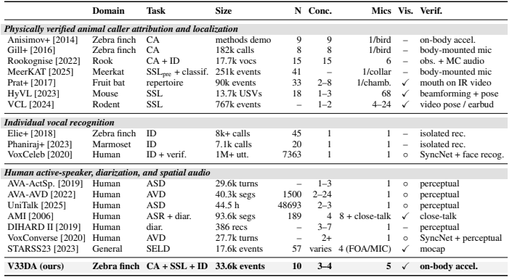
Table 1 :Comparison of V33DA with related datasets.Task abbreviations are defined in the text (classif. = classification, diar. = diarization, verif. = speaker verification).N: number of individuals; Conc.: individuals recorded concurrently;Mics: microphones;Vis.: synchronized video ( ◦: in- the-wild video without calibrated geometry);Verif.: source of the caller label (on-body accel. = accelerometer on the animal; body-mounted mic = microphone on the animal; perceptual = human annotation); vocs = vocalizations, utt. = utterances, segs = segments.
Original paper · CC BY 4.0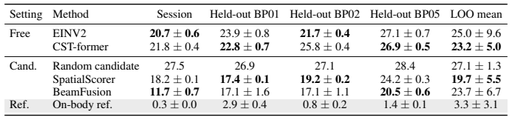
Table 4 :Localization across benchmark regimes (representative subset) using V33DA.Mean error in cm (lower is better).Setting: Free = unconstrained 3D regression; Cand. = candidate- conditioned (one of the visible birds). The full table is in Appendix Table 23. The random-candidate row picks one visible candidate uniformly at random; the shaded withheld on-body reference row is a ceiling for the candidate-conditioned setting only.
Original paper · CC BY 4.0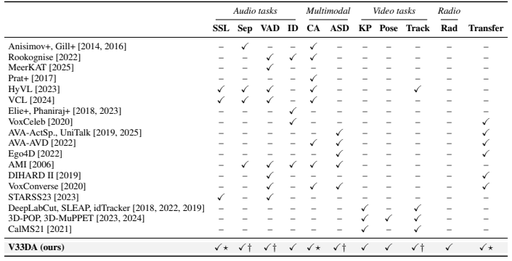
Table 5 :Task coverage of V33DA versus related resources.A checkmark indicates that the released data directly support the task. In the V33DA row, a star (⋆) marks tasks evaluated in this paper, and a dagger (†) marks tasks for which the unevaluated V33DA++ companion release provides data.
Original paper · CC BY 4.0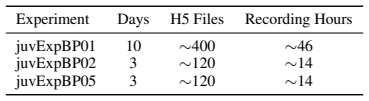
Table 6 : Raw data volumes per experiment.
Original paper · CC BY 4.0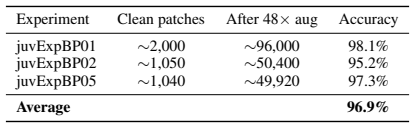
Table 7 : K-NN backpack color classification accuracy per experiment.
Original paper · CC BY 4.0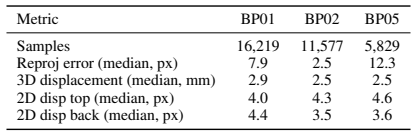
Table 9 : Quality metrics after filtering.
Original paper · CC BY 4.0
Table 12 : Pairwise inter-bird distances for all experiments. Experiment Bird pair Mean (mm) Median (mm) %<100 mm
Original paper · CC BY 4.0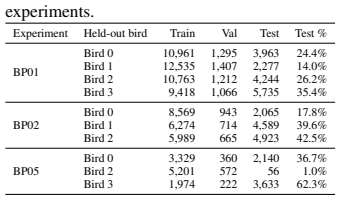
Table 13 : Per-fold ceiling estimates for LOO across all experiments. Experiment Held-out bird
Original paper · CC BY 4.0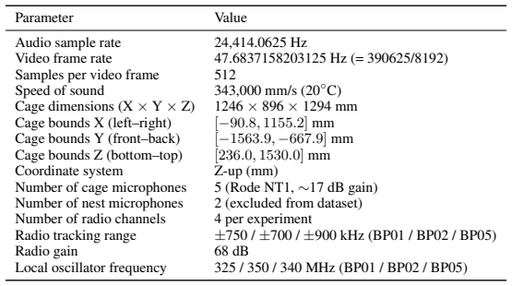
Table 15 : Recording system parameters and physical constants.
Original paper · CC BY 4.0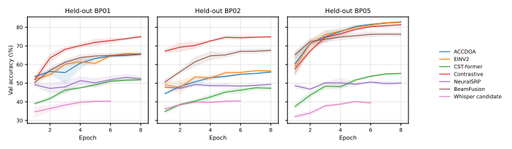
Figure 3 :Validation accuracy per epoch for matrix-family baselines on the three held-out- experiment splits.Lines are seed means, shaded bands are ±1 standard deviation across the three training seeds.
Original paper · CC BY 4.0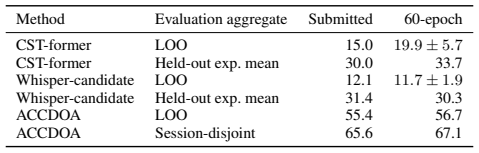
Table 16 :Attribution accuracy (%) with the submitted budget and with 60 epochs.Held-out exp. mean averages BP01, BP02, and BP05.
Original paper · CC BY 4.0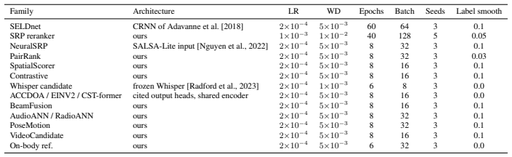
Table 17 : Shared hyperparameters across learned baselines.Architecture: source of the model design (ours = introduced in this work). Optimizer settings are shared defaults and were not tuned per method.
Original paper · CC BY 4.0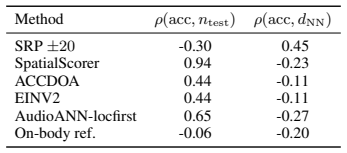
Table 21 :Simple predictors of LOO fold difficulty.Spearman correlation ρ across the 10 held- out-bird folds between fold-wise LOO accuracy, test-set size, and the held-out bird’s mean nearest- neighbor distance.
Original paper · CC BY 4.0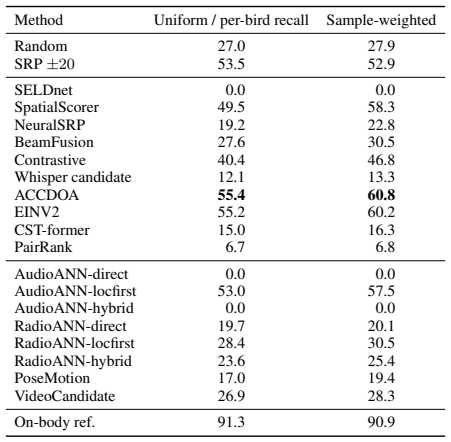
Table 22 :LOO accuracy / per-bird recall, uniform vs. sample-weighted across the 10 held- out-bird folds.Uniform columns match Table 3 and are also the per-bird recall average. Weighted columns use the test-set sizes in Table 11. Both columns average seeds within each fold before aggregating.
Original paper · CC BY 4.0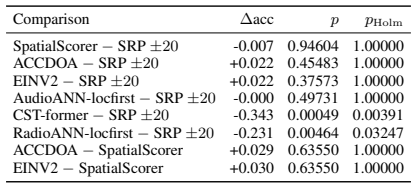
Table 26 :Selected paired transfer significance tests for attribution accuracy.Positive ∆acc means that the row method improves mean fold-wise transfer accuracy over the column method.
Original paper · CC BY 4.0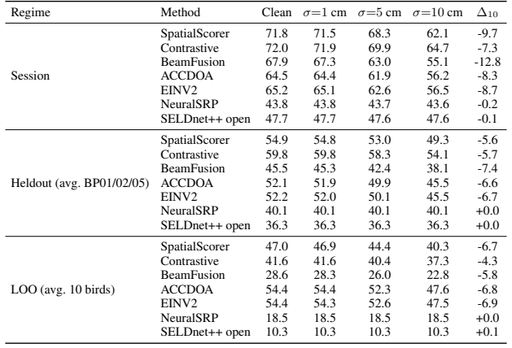
Table 27 :Mean attribution accuracy under test-time perturbation of candidate 3D position. Rows are grouped by evaluation regime. ∆10 is the drop at σ=10 cm relative to the clean column. Orientation perturbations (not shown) moved every cell by<0.1pt.
Original paper · CC BY 4.0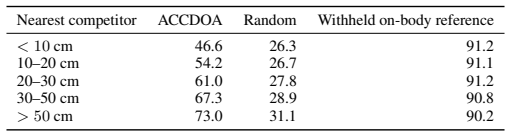
Table 28 :LOO attribution accuracy (%) by distance from the vocalizer to its nearest competing candidate.
Original paper · CC BY 4.0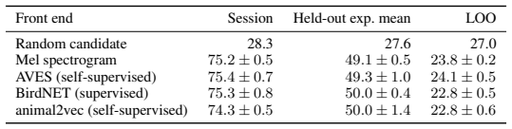
Table 29 :Frozen audio front ends under a fixed candidate-scoring head(accuracy, %). The held-out column averages BP01, BP02, and BP05.
Original paper · CC BY 4.0Quote from the paper
Maris Basha, Yuhang Wang, Xiaoran Chen, Longbiao Cheng, Luca Yapura, Anja T. Zai, Mathieu Salzmann, Richard Hahnloser (2026). Who Called? V33DA: A Physically Verified Multimodal Benchmark for Vocal Attribution in Zebra Finch Groups. arXiv:2610.38109v1. https://arxiv.org/abs/2610.38109v1
BibTeX
@misc{basha2026called,
  title = {{Who Called? V33DA: A Physically Verified Multimodal Benchmark for Vocal Attribution in Zebra Finch Groups}},
  author = {Maris Basha and Yuhang Wang and Xiaoran Chen and Longbiao Cheng and Luca Yapura and Anja T. Zai and Mathieu Salzmann and Richard Hahnloser},
  year = {2026},
  eprint = {2610.38109},
  archivePrefix = {arXiv},
  url = {https://arxiv.org/abs/2610.38109v1}
}