Paper commentary
A Theory of Cross-Validation Variance
Cross-validation variance splits into sampling noise and split noise
- Problem Cross-validation variance has been studied one design at a time, so no general theory says which design has the least variance.
- Method The authors weight each observation's validation and training roles by how often the splits use it, then split the variance into sampling variance and split noise.
- Results The authors prove that K-fold's first-order variance does not depend on K, since its weights are equal across observations by design.
Why cross-validation variance stayed unexplained
Cross-validation is used everywhere, yet its variance has mostly been studied one design at a time. The paper's question is which cross-validation design has the least variance, and no general theory has answered it yet.
Burman derived variance expansions for K-fold and repeated K-fold cross-validation. Each of these studies one design or one estimator, so none of them compares designs on a common footing.
They can't separate an observation's validation role from its training role, so the variation that refitting adds is left out. Asymptotic results, such as those of Austern and Zhou and Bayle et al., describe limits of these estimates. They identify validation, training and cross-covariance components of the asymptotic variance of K-fold. They don't give an exact finite-sample split of the variance itself, which is what the paper sets out to provide.
Two roles and the role weights
Each observation plays two roles in cross-validation, and the splits set how much weight it carries in each. Its validation weight is its share of all validation evaluations, v_i = N_i/M, where N_i counts the splits that hold it out. The validation weights sum to one across observations, so the estimate is a weighted average of the unit-level contributions.
Its training weight is its share of all training use, summed over the splits that train on it. Each split's share |V_r|/M is multiplied by the observation's share 1/|T_r| of that split's training set. The training weights also sum to one, so the two roles are measured on the same scale.
Monte Carlo cross-validation gives unequal weights, because the validation count N_i varies from split to split. For the bootstrap, the validation weight is N_i/M, and the training weight uses the multiplicities of each resample. The two bootstrap weights are separate random quantities, since N_i doesn't determine how often the other resamples draw i.
The estimate then splits into one term per observation plus higher-order terms built from sets of observations. For a single observation, the Hoeffding component is v_i(ℓ*_i − R_{p,n}) + w_i φ̄(Z_i), so each weight scales one influence. The validation influence and the training influence of one observation carry the constants σ_V², σ_T² and their covariance γ_0.
Averaging over the splits replaces each weight sum by its expectation, which gives the role moments Γ_D, Λ_D and Ω_D. The first-order variance is σ_V²Γ_D + σ_T²Λ_D + 2γ_0Ω_D, and each moment is the expected weight sum over the design. Conditioning on the data then separates sampling variance from split noise, which makes designs comparable at a common training size.
Why balanced weights win
Once the training size is fixed, design differences come only from how much the role weights move between draws of the splits. Sampling variance depends only on the training size, so every design at that size shares it and the split noise is the only place designs differ. K-fold has equal weights by construction, so the imbalance penalty for K-fold is zero and its first-order split noise vanishes.
The first-order variance of K-fold does not depend on K, so the choice of K is not a first-order matter. Under Monte Carlo cross-validation the penalty is of order 1/n, and it falls at 1/S as the number of splits grows. Repetition cuts the split noise of one partition by the factor 1/R, but it leaves the sampling variance unchanged.
For AUC, ordinary K-fold scores only pairs that share a fold, so its split noise grows with K. Paired K-fold fits all K2 combinations and evaluates every case–control pair once, which removes the pair-coverage noise.
Simulation check of the identity
The simulation fits a fixed-bandwidth Nadaraya–Watson smoother, which sits in the influence-function case of Section 2.4. The continuous outcome Y = η(X) + ϵ, with ϵ∼N(0,1), is scored by squared error (MSE).
The designs are K-fold with K∈{2,5,10}, leave-one-out for the unit-level metrics, and Monte Carlo cross-validation with (p, S) = (0.5,10) or (0.9,10). Leave-one-out holds out no case–control pair, and it has no split noise. The split noise is measured over 6000 datasets with 30 redraws.
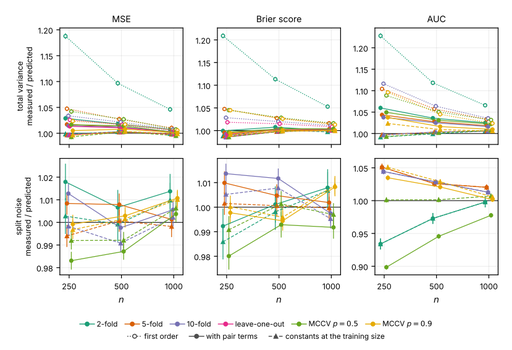
Figure 1 : Measured variance against the identity’s predictions, for three metrics, six designs, and three sample sizes. Error bars are one standard error. Top row: total variance over 10 5 datasets, as a ratio to the prediction at first order (hollow markers, dotted) and to the prediction with the limiting pair terms added (filled markers, solid). Bottom row: split noise over 6000 datasets with 30 redraws, as a ratio to the prediction with the pair terms. Triangles: ratio to the prediction with the constants at the training size, through order three for MSE and the Brier score and at first order for the AUC. Leave-one-out has no split noise.
Original paper · CC BY 4.0 · Nathaniel S. O'Connell, Jaime L. Speiser · A Theory of Cross-Validation Variance · Original paper figure · Extracted the figure area from page 24 of the original PDF.Across 51 cells, the ratio of measured to predicted total variance lies between 0.992 and 1.060. Across 45 nonzero cells, the split-noise ratio lies between 0.899 and 1.051. At first order alone, the discrepancy reaches 23% for total variance and 73% for split noise, so the pair terms are needed. With the finite-training corrections added, total-variance ratios fall between 0.994 and 1.004 for MSE and between 0.986 and 1.002 for the Brier score.
For the AUC, the same corrected ratios fall between 0.992 and 1.023.
The exception is the AUC pair-constant correction, which isn't computed and leaves K-fold split noise up to 7% from the prediction at n=250.
Where the evidence stops
The simulation checks the identity on one smoother and one population, with the bandwidth held fixed at 0.7. The predictions were tested only for the Gaussian kernel and the uniform covariate design, so other learners aren't covered by these numbers. The AUC's finite-training corrections weren't computed, and they leave K-fold split noise up to 7% from the prediction at n=250.
Refitting matters here: for the Brier score, the omitted training term accounts for 45% of first-order variance.
The AUC is evaluated with the indicator, and its constants come from a smoothed indicator extrapolated to a limit. Leave-one-out holds out no case–control pair, so it isn't a direct test of pairwise designs.
The theory covers bootstrap variants only under condition A3, and only for the first-order part of the identity. The bootstrap isn't fixed-size, so the full identity doesn't cover it.
Metrics whose comparable pairs are selected by the data, such as the concordance index under censoring, fall outside the theory. The pairwise analysis conditions on the labels, so label variation enters only through the class-stratified targets. The simulation also doesn't check the pairwise identity beyond the AUC under class-stratified folds.
Additional checks against the exact sample-mean variance, pair balance and non-A2(i) cases appear only in the supplement.
Paper info
- Authors
- Nathaniel S. O'Connell, Jaime L. Speiser
- Venue
- arXiv · Preprint
- First published
- 2026-11-10
- Added
- 2026-11-12
- Updated
- 2026-11-10
- Version
- v1
- arXiv
- 2611.14463
- Category
- stat.ML · cs.LG · math.ST
- Original paper terms
- CC BY 4.0
- What we show
- Paper info, commentary and permitted figures from the original paper
AI commentary is a separate explanation from the original paper and may contain errors. The original paper and figures follow each source's terms of use and any rights noted separately.
Abstract
Cross-validation estimates predictive performance by repeatedly splitting the data into training and validation sets, fitting the model on the first and evaluating it on the second. Every observation influences the estimate in two roles, through its own evaluation when it is held out and through the models it helps fit when it trains. The random splits determine its weight in each role. From this representation, we prove an exact finite-sample identity for the variance of the cross-validated estimate. For a given splitting scheme with a common training set size, the variance is a function of these weights, with constants of the model, the metric, and the population. It covers metrics averaged over observations, such as mean squared error, and over case--control pairs, such as the AUC. The identity shows which schemes to use. The variance decomposes into sampling variance, which depends only on the training size, and variance due to the random fold splitting, which arises when the weights change from one draw of the splits to the next. K-fold cross-validation, whose weights are equal across observations by design, is therefore variance optimal at first order; Monte Carlo and bootstrap cross-validation are not. The first-order variance of K-fold does not depend on K, and under reasonable conditions on the model leave-one-out has the smallest variance of any K-fold scheme. For the AUC the same holds for leave-pair-out, which evaluates every case--control pair. Finally, we show the cross-validated estimate is asymptotically normal with the identity's full variance. Together, these results provide a general theoretical foundation for inference on cross-validated performance and establish principles for selecting variance-optimal cross-validation designs.
Quote from the paper
Nathaniel S. O'Connell, Jaime L. Speiser (2026). A Theory of Cross-Validation Variance. arXiv:2611.14463v1. https://arxiv.org/abs/2611.14463v1
BibTeX
@misc{oconnell2026theory,
  title = {{A Theory of Cross-Validation Variance}},
  author = {Nathaniel S. O'Connell and Jaime L. Speiser},
  year = {2026},
  eprint = {2611.14463},
  archivePrefix = {arXiv},
  url = {https://arxiv.org/abs/2611.14463v1}
}