Paper commentary
Deep Reinforcement Learning for Stochastic Computation Offloading in Digital Twin Networks
- Problem Offloading computation in an IIoT network is hard when task arrivals and wireless channels change randomly over time and offloading, power, bandwidth and computation resources must be chosen jointly.
- Method Models the network with a digital twin, reduces the long-term energy efficiency problem to per-slot subproblems with Lyapunov optimization, and trains an asynchronous actor-critic agent to choose the offloading and resource allocation actions.
- Results In simulation with one MBS, three SBSs and 20 devices, the joint scheme reaches lower system cost than two partial-optimization benchmarks, and AAC reaches lower system cost than DQN over 5 to 20 devices.
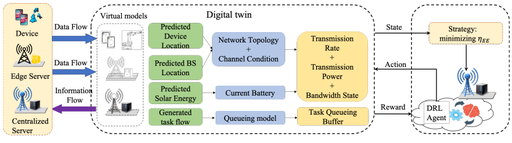
Fig. 3 : Digital twin enabled DRL algorithm
Original paper · CC BY 4.0 · Yueyue Dai, Ke Zhang, Sabita Maharjan, Yan Zhang · Deep Reinforcement Learning for Stochastic Computation Offloading in Digital Twin Networks · Original paper figure · Extracted the figure area from page 6 of the original PDF.Why IIoT offloading is a stochastic problem
IIoT connects sensors, instruments and other industrial devices so that they can communicate and interact, and the IDC forecast cited in the introduction expects 41.6 billion connected devices generating nearly 80 zettabytes of data by 2025. A digital twin addresses this by building a virtual model of a physical object from sensed data, so that the object's state can be predicted and analysed.
Computation offloading sends collected data and tasks from resource-limited devices to distributed servers at base stations, access points or road-side units, which speeds up processing and prolongs device battery life.
Much earlier offloading work assumed that each device runs a single computation task, which ignores the randomness of task arrivals in devices that keep generating data. The DRL offloading schemes cited in the introduction mainly decide between local execution and offloading under a deterministic task arrival model, so the authors do not regard them as directly applicable to IIoT networks.
Offloading decisions, transmission power, bandwidth and computation resources must be chosen together while the channel condition changes, which makes the joint problem difficult. Radio and computation decisions are coupled, bandwidth and power are also tightly coupled, and the mix of continuous variables with combinatorial structure makes the formulated problem hard to solve directly.
Digital twin network and task model
The architecture has three physical parts: distributed IIoT devices, SBSs and one centralized MBS, as shown in the architecture figure. Devices run data collection and parameter synchronization in their digital twin, SBSs build local virtual models of devices and SBSs, and the MBS, which carries an edge server and a DRL agent, constructs the network topology and designs the offloading and scheduling policy.
The network is a directed graph G = (U,B,ε) in which U holds the devices, B holds the base stations with the MBS as b0, and ε records which device is associated with which SBS. Each device is described by its maximal transmission power, its location and its local computation resource, and each base station by its location, its channel bandwidth and its computation resource.
A device communicates with the nearest base station, and a device that falls within the coverage radius of an SBS communicates with it; a device outside every SBS coverage area communicates with the MBS. The SBS rate is the allocated bandwidth times the logarithm of one plus a term built from transmission power, channel gain, a distance term with path loss exponent α, noise power σ² and interference from other SBSs; the MBS rate has the same structure without the interference term.
The authors ignore interference between the MBS and the SBSs, relying on frequency reuse and OFDMA to suppress it.
Each device adds λ_i(t) bits per slot to its local buffer, with E[λ_i(t)] = λ, and the buffer is taken to have sufficient capacity. The local queue is updated as \(Q_{li}(t+1)=\max\{Q_{li}(t)-\Psi_i(t),0\}+\lambda_i(t)\), where Ψ_i(t) is the local executed size plus the offloaded size. Each edge queue grows by the tasks offloaded from all devices and drains by Ψ_j(t), the size of tasks executed by the edge server, and stability requires bounded time-averaged expected queue lengths for both kinds of queue.
Local execution uses the CPU cycles per second and the required cycles per bit c over a slot of duration τ, and its energy is \(E_{li}(t)=\varsigma\tau f_{li}(t)^3\), where ς is the effective switched capacitance. Offloaded tasks cost uplink transmission energy and edge computation energy; the downlink energy for returning results is ignored because results are small.
The edge energy is the transmission term \(p_i(t)\tau\) plus the offloaded size times c, divided by the allocated edge resource \(f_{eij}(t)\), times the unit energy ε, and the total energy \(E_{tol}(t)\) sums the local and edge terms.
From the long-term ratio to a per-slot problem
The objective is the energy efficiency η_EE, the ratio of long-run total energy to long-run aggregate accomplished tasks, where the denominator sums the local sizes and the offloaded sizes. P1 minimizes this ratio over the per-slot action subject to bandwidth and power bounds, local and edge resource bounds, a constraint that the edge task size times c fits within \(f_{ej}\tau\), and the queue stability constraints (7a) and (7b).
Lyapunov optimization is used because it needs little prior knowledge of task arrivals, channel states and task buffers, and it turns the long-term objective into a series of short-term subproblems while the long-term constraints become queue stability conditions. The conditional drift is the expected one-slot change of L given the current queues, and the drift-plus-penalty function adds V times the expected η_EE(t), where V is a non-negative weight.
Bounding the drift gives a constant C minus the local backlog term weighted by Q_li(t)−β_i and the expectation of Ψ_i(t)−λ_i(t), minus the edge backlog term weighted by Q_ej(t), plus V times the expected η_EE(t). Minimizing the right-hand side of this bound per slot gives problem P2, which weights the energy-efficiency penalty by V and keeps the queue terms.
At the start of each slot the digital twin predicts the perturbation vector from the local task queue, using \(\beta_i = V\eta'_{EE}(t)+\Psi_{max}\) with \(\Psi_{max}=\max(\Psi_i(t))\); the paper writes η′_EE with a prime and does not separately define it. The authors take this form of β from the perturbation definition in prior work, because β affects the performance of the designed algorithm.
Solving P2 by decomposing it into sub-problems would require recomputing the optimum whenever channels or task queues change. The authors therefore use a DRL agent to produce the per-slot decision, expecting a near-optimal answer in real time.
State, action and reward for the DRL agent
The authors write P2 as a Markov decision process, and the digital twin builds the state that the DRL agent receives, as shown in the framework figure. The digital twin predicts user locations with KNN classification and a position prediction method from prior work, derives the maximal transmission power from predicted energy and the previous value, and updates user association with an online method.
The state at slot t is \(s(t)=\{R(t),F,p_{max}(t),w,\Theta(t)\}\), combining the transmission rate matrix, the computation resources, the maximal powers, the bandwidth vector and the queue lengths. R(t) is N by (M+1), F has length N+M+1, p_max(t) is N by 1, w is 1 by (M+1), and Θ(t) holds the local and edge queue lengths.
The action is the full operation a(t) = [w, p, Ψ, f_l, f_e], with bandwidth shares bounded by w_j, transmission powers bounded by p_i,max(t), edge task sizes bounded by f_ej τ/c, and local and edge resource shares bounded by their caps. All action variables are continuous, so the authors choose a policy gradient method instead of a value-based method with discrete actions.
The immediate reward is the negative of the V-weighted energy term plus the edge-queue term and the local-queue term, so that maximizing reward minimizes the per-slot objective of P2. The reward writes the edge-queue sum over devices i, whereas P2 sums that term over base stations j; the text does not comment on the difference. The agent maximizes the discounted cumulative reward over T slots with discount factor δ in [0, 1], and it receives a negative constant penalty when the constraints are not satisfied.
Actor-critic updates and asynchronous learners
Value-based methods such as DQN estimate Q-values and explore with an epsilon-greedy rule, which fits discrete actions poorly for this continuous action space. Policy-gradient methods optimize a parameterized stochastic policy along the gradient of expected reward, and AAC follows this route with an actor that outputs actions and a critic that evaluates them.
The policy gradient of the expected discounted reward is \(\nabla_{\theta_\pi}E_\pi[\sum_t\delta^t R^{imm}(t)]=E_\pi[\nabla_{\theta_\pi}\log\pi(s(t)|\theta_\pi)A^\pi(s,a)]\), where A^π(s,a) is the advantage function. The advantage is computed as \(A^\pi(s,a)=R^{imm}(s(t),a(t))+\delta v_{\theta_v}(s(t+1))-v_{\theta_v}(s(t))\), so it is positive when the realized reward and next-state value exceed the critic's current estimate.
The actor parameters move by \(\theta_\pi \leftarrow \theta_\pi+\alpha_\pi\sum_t\nabla_{\theta_\pi}\log\pi(s(t)|\theta_\pi)A^\pi(s,a)\), with α_π the actor learning rate. The critic parameters move along the gradient of the squared difference between the one-step target and the current value, with learning rate α_v.
Replay memory in DQN decorrelates samples but needs off-policy learning and a large memory; AAC instead reduces correlation between adjacent samples by running parallel learners. Learning agents sit at the SBSs and each follows its own environment copy with the same structure; after every t_max steps they send accumulated updates to the global agent at the MBS, which updates θ_π and θ_v asynchronously.
Each learning agent synchronizes its parameters, runs up to t_max steps, and computes a return from the critic value of the last state, while the global agent accumulates the actor and critic gradients and applies them.
Joint scheme, SBS count and device count
The numerical setting uses one MBS, three SBSs and 20 devices, with Rayleigh fading channels, a device maximum transmission power of 100 mW and a noise power of 10−11 mW. Bandwidths are 10 MHz for the MBS and 5 MHz for each SBS, the slot is 100 ms, c is 100 cycles/bit, and CPU capabilities are 0.5, 10 and 50 GHz for devices, SBSs and the MBS.
Actor and critic networks each have three fully-connected hidden layers of 128 neurons with ReLU, and the actor ends in eight softmax neurons while the critic ends in one linear neuron. System cost is the negative of the DRL cumulative reward, so lower system cost is better.
The joint scheme optimizes offloading, bandwidth, transmission power and computation resources together; it is compared with a variant without computation resource allocation and a variant without bandwidth and transmission power allocation. The joint scheme shows lower system cost than both partial variants. The variant without computation resource allocation has lower system cost than the variant without bandwidth and power allocation, which the authors read as bandwidth and transmission power having a larger effect on performance.
With N = 40 devices, system cost falls as the number of SBSs grows, while with N = 20 devices it changes little. The authors read this as SBS additions reducing cost when many devices are present, and as having little effect when devices are few.
Across 10 to 40 devices, system cost of all three schemes rises, which the authors attribute to more offloading requests consuming more communication and computation resources. The proposed scheme outperforms both benchmarks in this device-count comparison.
AAC against DQN and the learning rate
Over 5 to 20 devices, system cost rises with the number of devices for both algorithms, and AAC performs considerably better than DQN. The authors attribute the gap to DQN's action discretization, which may skip better actions. The authors also explain the rise in cost: for given computation resources, more devices lower the task execution rate and raise energy consumption.
Among the learning rates tested, 0.001 gives the lowest system cost for the proposed algorithm, so the authors take it as the best learning rate. The text does not list the other learning rates that were tested.
Limitations
All results are simulations under one main setting with one MBS, three SBSs, 20 devices and Rayleigh fading. The SBS-count study is reported only at 20 and 40 devices, and device scaling spans 10 to 40 devices for the scheme comparison and 5 to 20 devices for the DQN comparison. The only DRL baseline is DQN, and DDPG, which the introduction discusses, is not compared.
The downlink energy of returned results is ignored, and interference between the MBS and the SBSs is ignored. The paper does not explain how the eight softmax outputs of the actor map to the action components, which include N×(M+1) matrices. The reported results give system cost only; they include no digital twin prediction accuracy, no computation time and no sensitivity analysis for the weight V.
Paper info
- Authors
- Yueyue Dai, Ke Zhang, Sabita Maharjan, Yan Zhang
- Venue
- arXiv · Preprint
- First published
- 2020-11-17
- Added
- 2026-11-6
- Updated
- 2020-11-18
- Version
- v2
- arXiv
- 2011.08430
- Category
- cs.LG · cs.AI
- Original paper terms
- CC BY 4.0
- What we show
- Paper info, commentary and permitted figures from the original paper
AI commentary is a separate explanation from the original paper and may contain errors. The original paper and figures follow each source's terms of use and any rights noted separately.
Abstract
The rapid development of Industrial Internet of Things (IIoT) requires industrial production towards digitalization to improve network efficiency. Digital Twin is a promising technology to empower the digital transformation of IIoT by creating virtual models of physical objects. However, the provision of network efficiency in IIoT is very challenging due to resource-constrained devices, stochastic tasks, and resources heterogeneity. Distributed resources in IIoT networks can be efficiently exploited through computation offloading to reduce energy consumption while enhancing data processing efficiency. In this paper, we first propose a new paradigm Digital Twin Networks (DTN) to build network topology and the stochastic task arrival model in IIoT systems. Then, we formulate the stochastic computation offloading and resource allocation problem to minimize the long-term energy efficiency. As the formulated problem is a stochastic programming problem, we leverage Lyapunov optimization technique to transform the original problem into a deterministic per-time slot problem. Finally, we present Asynchronous Actor-Critic (AAC) algorithm to find the optimal stochastic computation offloading policy. Illustrative results demonstrate that our proposed scheme is able to significantly outperforms the benchmarks.
Quote from the paper
Yueyue Dai, Ke Zhang, Sabita Maharjan, Yan Zhang (2020). Deep Reinforcement Learning for Stochastic Computation Offloading in Digital Twin Networks. arXiv:2011.08430v2. https://arxiv.org/abs/2011.08430v2
BibTeX
@misc{dai2020deep,
  title = {{Deep Reinforcement Learning for Stochastic Computation Offloading in Digital Twin Networks}},
  author = {Yueyue Dai and Ke Zhang and Sabita Maharjan and Yan Zhang},
  year = {2020},
  eprint = {2011.08430},
  archivePrefix = {arXiv},
  url = {https://arxiv.org/abs/2011.08430v2}
}