Paper commentary
You Don't Need Feature Learning to Do In-Context Learning
Kernel machines show in-context learning needs no feature learning
- Problem Training on a finite set of tasks seems to rule out generalizing to new tasks in in-context learning. Models often memorize the training tasks instead, and it was unclear how generalization arises.
- Method The authors model the learner as kernel regression and split its solution into polynomial eigencomponents. They show the generalizing solution is a low-degree truncation of the memorizing solution, which kernel machines learn first as sample size grows.
- Results Kernel error on novel tasks bottoms out near the generalizing solution, so the model generalizes before it degrades into memorization. Feature learning is not needed for this in-context linear regression task.
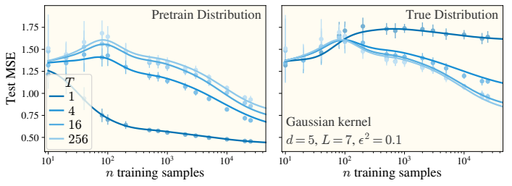
Figure 9 : Gaussian kernel learning curves on ICL Regression data.For four different settings (colors) of the task diversity T , we compute the expected test MSE as a function of the number of training samples n, and compare it to empirical errors obtained across 20 trials. Theoretical learning curve equations are provided in Section D, with validation of the eigensystem the equations are built off of provided in Sections E and F. Our data uses a Gaussian kernel with kernel width σker = √ 3, d= 5, L= 7, ϵ2 = 0.1 where our data is drawn x∼ N(0, Id/(dL)). Additionally, as T→ ∞, we find that the errors on the pretraining distribution match those of the true distribution, as expected. Further experimental details are in Section B.
Original paper · CC BY 4.0 · Joseph Turnbull, Jamie Simon · You Don't Need Feature Learning to Do In-Context Learning · Original paper figure · Extracted the figure area from page 31 of the original PDF.Why generalization in ICL looks paradoxical
In-context learning lets a model infer a task from a few examples in its prompt and apply it to a new input. Training covers only a finite set of tasks, drawn from a larger set of all possible tasks. A context pairs several examples (xi, yi) with one unpaired input, and the model must first infer the task from the pairs before applying it.
The most interesting test case is a new task that never appeared in training, so the model must extract that task from context alone. The best training strategy treats every new context as one of the training tasks and simply applies that task. Taken alone, that objective makes an unseen task look out of reach, and the authors call this a paradox.
The authors argue that generalization happens mid-optimization, as a milestone on the way to memorization. On this view, the generalizing solution is a simpler version of the memorizing solution, stopped before the model learns the higher-degree components needed to memorize the training set. They study this idea on the in-context linear regression setting of Raventós et al.
(2023), where each task is a linear map. Both the memorizing and the generalizing solution have closed forms in this setting, so the comparison is exact.
Which solution a model learns is largely set by its inductive biases, so the authors model the learner as kernel regression. Kernel regression has a well-developed spectral theory of its inductive bias, which they can reuse here. The main technical hurdle is computing the kernel eigendecomposition on this task, so that the existing theory applies.
Their resolution is that the generalizing solution is approximately a low-polynomial-degree truncation of the memorizing solution. As the dataset grows, kernel machines learn simple low-degree components first and high-degree components later.
Linear regression tasks and kernel regression as the learner
Each context is a sequence of noisy input-output pairs, where every task is a linear map and the label is the task vector applied to the input. Training contexts are built from a pool of T task vectors drawn from a standard Gaussian, so the pool is fixed before any context is sampled. For each training sample, a task is drawn uniformly from that pool, then L + 1 inputs are sampled from N(0, I_d / d).
Each label adds Gaussian noise with variance epsilon squared to the product of the task vector and the input. The authors call T the task diversity and L the context length. The unpaired final input x_{L+1} is the only input the learner must answer for, and its label y is held out as the target.
The learner is kernel regression, which takes n training contexts and their scalar targets as its supervised data. The kernel is positive semidefinite and rotation-invariant, and the ridge parameter delta is at least zero. The predictor is written as K_zZ times the inverse of K_ZZ plus delta I_n, applied to the targets y. Error is mean-squared error on new contexts from the training task distribution, averaged over the T pool tasks.
A second error is measured on novel contexts whose tasks are drawn from N(0, I_d), which is the prior distribution.
The memorizing solution minimizes error on the training distribution, and the authors write it as the dMMSE form. Its prediction is a weighted average of the training tasks applied to the unpaired input, with weights set by how well each task fits the context. The generalizing solution is the Bayes-optimal predictor on the prior distribution, and it is ridge regression on the context.
The authors expect kernel regression to learn the generalizing solution first and the memorizing solution as n grows. The moments and cumulants of the training task pool then describe what separates the two predictors.
The kernel view rests on a spectral picture: eigenfunctions with larger eigenvalues are learned first, a behavior called spectral bias. Kernel regression therefore makes it possible to ask which polynomial components of the memorizing solution are learned at each sample size.
Approximating the kernel eigenbasis
Kernel theory says that eigenfunctions with larger eigenvalues are learned first, a behaviour the authors call spectral bias. They approximate the kernel as an inner-product kernel and obtain its coefficients by matching the kernel on a sphere of radius r equal to the rms norm of z. They assume the coefficients fall off steeply, with c_l much larger than c_(l+1), which lets the eigensystem be built in stages.
The construction takes nested polynomial subspaces up to each order, orthogonalizes them with Gram-Schmidt in increasing order, and diagonalizes each one against the training distribution D_tr. Naive diagonalization of the empirical kernel would be costly, since the order-l subspace has dimension ((d+1)L+d) to the power l. At large context lengths the leading eigenfunctions have closed forms, while the remainder must be computed numerically.
The most important eigenfunctions are a degree-one linear readout with eigenvalue λ1 = c1 d, and a degree-three regression component that combines the labels with the inputs.
Each odd order 2l+1 with l at least 2 adds d to the power l+1 over l! memorizing components. The top eigenvalues at order l scale like c_l times L to the power (l-1)/2 times d to the power -l, with c_l scaling as L to the power -l/2. The authors check the eigensystem against a numerical eigensystem from a finite training set for several common rotation-invariant kernels, and the two agree very well.
The memorizing eigencoefficients come from the law of total expectation, so the authors never need to evaluate f_mem directly. For order 2l+1, the eigencoefficients are proportional to the expectation of beta to the power l+1, so they depend on cumulants up to order l+1.
Which target components each predictor needs
The authors get the eigencoefficients of the memorizing solution without ever evaluating it, by swapping in the raw target through the law of total expectation. Because the memorizing predictor is averaged over the training distribution, its coefficients equal those of the target y, which is far easier to work with. The coefficient on an order-(2ℓ+1) eigenfunction scales with the tensor of training-task moments up to order ℓ+1, written as cumulants rather than moments.
They use cumulants because orthogonalization against lower-order terms removes the lower-order contributions, leaving only the cumulant part. Even-order coefficients vanish by symmetry, so only odd-order eigenfunctions carry weight in the memorizing solution.
The generalizing solution gets the same treatment, with the training distribution replaced by the novel-task distribution N(0, I_d). A Gaussian has only first and second cumulants, so the generalizing solution is mainly the degree-three regression eigenfunction. The degree-one linear readout is left out because the tasks are drawn from a mean-zero distribution.
As L/d grows, XX^T approaches a constant times I_d, so the generalizing predictor approaches a third-order polynomial in the inputs and labels. The memorizing solution truncated at order 3 gives the same third-degree polynomial, so the generalizing solution is a degree-3 truncation of the memorizing one. Past degree three, the memorizing solution picks up higher-degree polynomials that the generalizing solution lacks, driven by the finite draws of the training tasks.
Reading the predictor as an estimated task
The kernel's eigenfunctions are polynomials of the raw data, but ICL questions are usually asked in task space. All eigenfunctions with non-zero coefficients are linear in x_{L+1}, so the kernel prediction equals beta-hat transpose x_{L+1} for an estimated task. That estimated task depends on the random input z, yet its expectation depends only on the pretraining task distribution and the true task beta-star.
The authors apply the same decomposition to f_gen and f_mem, writing each as a predicted task applied to the unpaired input.
Under the expectation, each factor y_k x_k^T turns into (L/d) beta-star, so a degree-(2l+1) eigenfunction becomes a degree-l function of beta-star. The mapping has an exception, since a degree-five eigenfunction with leading term has a single y_i and stays linear in beta-star.
At leading order, the generalizing task is L/(L+d+1) times beta-star, plus a further term of (d+1)L/((L+d+1)(L+d+3)) times beta-star. The memorizing task is the mean training task plus L/(L+d+1) times (beta-star minus the mean), plus higher-order terms. So the mean training task is the first thing a kernel learns, and the true task is the second.
Low-degree truncations of both solutions are what make this task-space view useful.
Three phases of learning as the sample size grows
Figure 1 runs a kernel regression on in-context linear regression with d=5, L=7 and T=16 training tasks. Phase 1 has the kernel learn the mean training task, which the authors write as the mean of the training task distribution. In phase 2 the kernel recovers approximately the true task minus that mean, so it nearly recovers the true task.
The three phases appear as shaded regions on the novel-task error curve.
On the training tasks, the kernel's error falls monotonically until it matches the memorizing solution. On novel tasks, the error is minimized at the end of phase 2, close to the generalizing solution. After that minimum, the novel-task error rises toward the memorizing solution in phase 3.
The authors predict that kernel regression learns the third-order components after roughly L^2 d^2/2 samples. There are roughly L^2 d^2/2 quadratic eigenmodes with larger eigenvalue, which is why that sample count appears. With those third-order components learned, the kernel's predictor becomes approximately a degree-three truncation of the memorizing solution.
That truncated predictor approximates the generalizing predictor, as seen experimentally in Figure 1. As n grows further, the predictor picks up higher-order components and eventually arrives at the memorizing solution.
Transience as underfitting
The authors argue that a model always minimizes the training objective, and that objective is met by implementing the memorizing solution. On the way there, the model implements low-degree truncations of the memorizing solution, and each truncation amounts to an approximation of the generalizing solution. So the model generalizes first and then degrades into memorization as training proceeds, which is the transience they set out to explain.
Transience here follows from the stopping point: the model halts before it learns the higher-degree memorizing components.
The authors contrast this account with circuit explanations, which posit competing memorizing and generalizing circuits. Their kernel models are fixed-feature, so they can't learn circuits at all. The random features networks trained with online SGD show the same three phases: the mean task, then generalization, then memorization. That error then rises back toward the memorizing oracle once the network learns higher-order statistics, beginning at n of about 10 to the 7.
The authors also test whether a small task pool can generalize, using a random features network with exactly T=4 tasks, d=3, and L=96. The pool is built so that the sample covariance is the identity and the sample mean is zero. Under those conditions the model generalizes near-perfectly once the optimal degree-three term is learned. Given infinite training samples, the model would eventually memorize, so the memorizing solution remains the endpoint.
Task diversity and Gaussianity of the training pool
The paper's account of task diversity starts from a sweep of the number of training tasks T with d=8, L=15 and epsilon squared 0.25. It then keeps approaching the generalizing solution until T is about 2^6 = 64 tasks. The trained models don't reach the generalizing solution exactly, partly because of the finite context length L used in training.
The authors read this as a refinement of the task-diversity picture of Raventos et al. (2023). The authors say the story of task diversity is independent of the transformer architecture, and it doesn't need feature learning to reproduce the headline results. As task diversity grows, the training task statistics become more Gaussian and more isotropic, and that drives the generalization.
For isotropic tasks, adding tasks makes the sampled covariance increasingly white, which the paper ties to Marchenko–Pastur eigenvalue behavior. Higher-order cumulants also decrease as more tasks are drawn, which shrinks the scale of the memorization-only eigencoefficients. So the number of tasks matters only through how Gaussian the pool becomes, since the higher-order statistics fall away as T grows.
The authors defer the details of these two effects to Section H.4.
The transformer experiments in Section 8 push the same idea further, with 12-layer GPT-2-style transformers trained with Adam on T=256 training tasks. Those pools are centered and whitened and differ mainly in their fourth cumulant. Whiten pools use i.i.d. Gaussian draws, partial kurtosis pools rescale the fourth cumulant to 0.3 times the Gaussian pool, and no kurtosis pools set it to 0.
With the kurtosis removed, the models stay generalizing, so task diversity's effect runs through non-Gaussian statistics.
Transformers and kurtosis
The authors ask whether the kernel account carries over to transformers, which can learn features. They train 12-layer GPT-2-style transformers with Adam on T=256 training tasks, with d=8, L=16 and ϵ²=0.25. Each pool is centered and whitened, and the pools differ mainly in their fourth cumulant. The no kurtosis pool is a symmetric pool with fourth cumulant set to zero.
The transformer trained on the no kurtosis pool stays generalizing throughout the entire training procedure. The transformer trained on the partial kurtosis pool stays generalizing longer than one given a typical kurtosis. The authors say this ordering is what their theory predicts. Removing the fourth cumulant leaves only higher cumulants of order 5 and above to memorize, which occurs much later in training.
Figure 5 shows that the transformers memorize by exploiting non-Gaussian statistics of their training tasks. The authors note that the slight difference between the oracles for each pool doesn't explain the onset of memorization. They also say all models first approach the generalizing solution, and the scale of the kurtosis sets when memorization begins.
The authors limit the scope here: they analyze only in-context linear regression with Gaussian inputs. They leave the effects of nonlinear ICL solutions and natural language to future work.
Limitations: where the claims stop
The analysis covers only in-context linear regression with Gaussian inputs, so the scope of the claims is narrow. They don't attempt to show that in full generality, so the claim that it causes ICL generalization stays a belief. Nonlinear ICL solutions are left to future work, and so is the question of how natural language affects the learned function.
Trained models don't exactly reach the generalizing solution, and the paper gives the finite context length L used for training as one reason. The trained models also don't fully reach the generalizing solution because of the finite context length, which the Section 7 analysis covers. The paper's account of a finite context length is the reason for this gap, so the match to the generalizing solution is approximate.
Anisotropic tasks add another limit, since any anisotropy in the training task covariance induces error in the novel task prediction.
Memorization is particularly hard to reach for models that can't perform feature learning, and the paper says so directly. Despite that, the transformer results in Figure 5 show that sequentially learning higher order statistics explains memorization even in transformer models. The authors also verified all LLM outputs independently, because LLMs often made implicit assumptions about the empirical cumulants.
Paper info
- Authors
- Joseph Turnbull, Jamie Simon
- Venue
- arXiv · Preprint
- First published
- 2026-11-10
- Added
- 2026-11-11
- Updated
- 2026-11-10
- Version
- v1
- arXiv
- 2611.13431
- Category
- cs.LG · cs.AI
- Original paper terms
- CC BY 4.0
- What we show
- Paper info, commentary and permitted figures from the original paper
AI commentary is a separate explanation from the original paper and may contain errors. The original paper and figures follow each source's terms of use and any rights noted separately.
Abstract
How should we understand memorization vs. generalization in in-context learning (ICL) tasks, and when does one happen vs. the other? To investigate, we study how rotation-invariant kernel machines learn the ICL linear regression task proposed by Raventos et al. (2023). By decomposing the task in the kernel eigenbasis, we obtain a spectral picture of learning in this ICL setting. This picture reveals that as sample size grows, kernel machines learn successively-higher-degree components of the memorizing solution, which depend upon successively-higher-degree statistics of the training task set. The generalizing solution is approximately a low-degree truncation of the memorizing solution, and so the model first generalizes, then degrades into memorization as training proceeds. The takeaways are threefold. First, if this case is indicative, learning a "generalizing" solution on an ICL task is really just underfitting the memorizing solution! Second, the fact that kernel machines can generalize on this task means that feature learning is inessential to ICL. Third, transformers empirically trained to do ICL are shown to memorize tasks through the higher-order statistics of the training tasks that the kernel-based theory predicts, suggesting it applies even to models capable of feature learning.
Figures from the paper
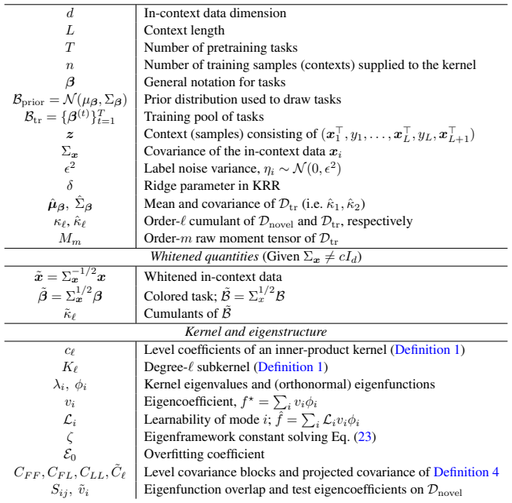
Table 1 :Quantities appearing throughout the main document and appendices.
Original paper · CC BY 4.0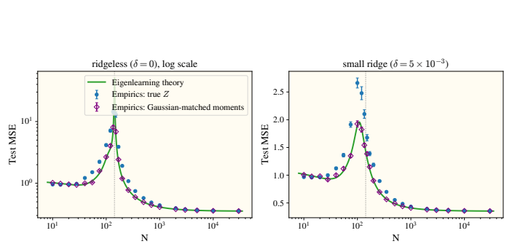
Figure 7 : One-dimensional ICL data breaks Gaussian universality.We compare the eigenframe- work’s predicted test MSE (line) against kernel regression trained on true ICL contexts (circles) and on a Gaussian surrogate with matched moments (diamonds), for T= 4 , d= 1 , L= 8 . We use a Gaussian kernel with kernel width σker = √ 3 and in-context data with covariance Σx ∼I d/(dL). The left panel is ridgeless (δ= 0 ) and the right uses a small ridge (δ= 5×10 −3). The Gaussian surrogate tracks the theory at every n. The true contexts agree away from the interpolation peak but exceed the prediction near it, most visibly at small ridge. Both datasets share the same theoretical curve, so the mismatch comes from the non-Gaussianity of one-dimensional ICL data rather than from the predicted eigenstructure. We observe no such failure ford >1.
Original paper · CC BY 4.0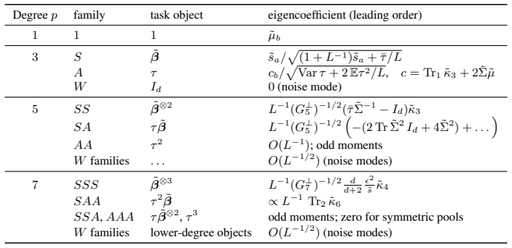
Table 2 .
Original paper · CC BY 4.0Quote from the paper
Joseph Turnbull, Jamie Simon (2026). You Don't Need Feature Learning to Do In-Context Learning. arXiv:2611.13431v1. https://arxiv.org/abs/2611.13431v1
BibTeX
@misc{turnbull2026need,
  title = {{You Don't Need Feature Learning to Do In-Context Learning}},
  author = {Joseph Turnbull and Jamie Simon},
  year = {2026},
  eprint = {2611.13431},
  archivePrefix = {arXiv},
  url = {https://arxiv.org/abs/2611.13431v1}
}