Paper commentary
Free Lunch Uncertainty: Sequence-Level Rényi Entropy from Particle Decoding for Adaptive LLM Reasoning
Sequence-level Rényi entropy from SMC decoding gives a free uncertainty signal for LLM reasoning
- Problem Cheap uncertainty signals only look at single tokens or one completion, while self-consistency needs many extra completions. Those extra completions cost compute that adaptive reasoning cannot easily afford.
- Method SRE reads a sequence-level Rényi entropy from the importance weights that Power-SMC already computes. It uses the uniform mean over particles at each step, so the entropy costs no extra completions or model calls.
- Results On MATH500, the order-1/2 member scores 0.022 to 0.044 AUROC above sequence log-probability with all four models tested.
Why whole-completion uncertainty is hard to get
Power sampling draws completions from a power distribution, where the model probability is raised to a sharpening exponent α above one. Power-SMC runs this with N parallel particles that are extended token by token, reweighted and resampled. It keeps the same particle budget N for every problem, so the fixed budget wastes compute on easy problems while hard problems may need more particles.
The authors frame uncertainty as a property of the full completion distribution, not of any single token. Self-consistency and semantic entropy capture answer-level disagreement, but they require K independent completions.
A model can be locally unsure at a few tokens yet follow one stable reasoning plan. A model can also give comparable probability to several incompatible solutions. Those two cases need different readings, and the zero-cost signals above don't tell them apart.
The authors observe that the SMC importance weights already estimate the normalizing constant Zα(x), which defines the sequence-level Rényi entropy. They call the resulting estimate SRE, and it adds no extra completions, classifiers, reward models, or model calls when a sampler is running. The same estimate also drives adaptive allocation, since an N=8 probe estimates SRE per problem and predicts whether more particles will help.
Reading a Rényi entropy out of SMC weights
The sampler already holds an estimate of the completion-level entropy, because its importance weights estimate the normalizing constant. The normalizing constant Zα(x) is the sum over completions of pθ(y|x) raised to α, and it defines the sequence-level Rényi entropy of the completion distribution. Because the readout comes from the sampler's own weights, the entropy costs no extra completions, classifiers or model calls.
Power-SMC draws each token from a proposal that corresponds to sampling at temperature 1/α, and it minimizes the variance of the incremental weight. The incremental weight for particle i at step t is the sum over tokens v of pθ(v|x, y(i)<t) raised to the power α.
The standard estimator multiplies the normalized weights W(i)t−1 into the incremental weights and takes the log of the sum over particles at each step. Because the logarithm is nonlinear, this quantity is a plug-in estimate of log Zα rather than an unbiased one. The authors instead use the uniform mean over particles at every step, which replaces the normalized weights by 1/N.
They define SRE as log of the estimate divided by 1−α, so each decoding step needs only one scalar accumulation. The stepwise version keeps a Spearman correlation of at least 0.98 with the blockwise estimate in every setting they test.
The stepwise estimate uses the next-token distributions of all N particles at every step, not mostly those of the highest-weight particles. Under blockwise resampling, resampling happens at block boundaries when the ESS is low. Once the exponent ramp has ended, each incremental weight equals e to the power (1−α) times hα of the prefix, up to the nucleus truncation of the proposal.
Each term of the standard estimator is therefore, up to a constant factor, one increment of the order-α chain rule.
Choosing an entropy order from a Rényi chain rule
The Rényi chain rule splits the order-β entropy of a completion into per-step terms, each an expectation over prefixes drawn from the order-β power distribution. The stepwise version computes the same per-step term at any order β from the next-token distributions the particles already hold, giving SREβ. SREβ is nonincreasing in β, so the family moves from a multiple of the length at β→0 toward the summed top-token term at β→∞.
The order-1/2 member has a search-effort reading: the expected number of draws before a target completion appears is at least e^{H_{1/2}(p)}, with equality for a proposal proportional to p^{1/2}. So SRE1/2 accumulates the log of per-step search effort along the particles.
Below 1/2 the tail of the vocabulary dominates every increment, so AUROC drops to 0.743 on MATH500 with Qwen2.5-7B.
The choice of order isn't tuned to a single setting. The authors also check that SRE1/2 keeps its margin when it is computed over only the 100 most likely tokens of each step.
Does the estimate hold at finite particle counts
Lemma 1 covers any particle count N of at least one and any α above one, for an SMC sampler that ends at the power distribution. The lemma studies the standard estimator of Eq. 4, and the paper defines the entropy estimate dSRE from its logarithm. Because the logarithm is nonlinear, log of the estimate is a plug-in rather than an unbiased estimator of log Zα.
In expectation the estimate of Zα stays at or below the true normalizing constant, with equality for full-support proposals. So the expected entropy estimate sits at or above the true sequence-level Rényi entropy, which the authors call upward bias. The proof of the lemma is in Appendix P.
The finite-N part says that with probability at least 1 minus δ, the estimate stays above Hα minus log(1/δ) divided by α−1. Here δ lies in (0,1), so a smaller δ gives a wider margin below the true entropy. At α=4 the estimate falls more than one nat under the true entropy in at most 5% of per-problem runs. The authors stress that this holds for every particle budget, including N=8.
The guarantee therefore has a non-asymptotic part for every N and an asymptotic part for large N. Lemma 1 applies to any SMC sampler that ends at the power distribution, whatever its intermediate targets are. The authors name APPS (Nguyen et al., 2026) as one such sampler, with details in Appendix Q. The lemma also covers Power-SMC as run, with its exponent ramp, nucleus-truncated proposal, and ESS-triggered resampling.
Selective prediction: SRE1/2 against zero-cost baselines
The authors rank problems by each signal and measure AUROC for predicting whether the returned answer is correct. Lower SRE counts as higher confidence, as do lower mean token entropy, higher log-probability and higher particle agreement. The comparison covers eight model and benchmark settings, each with 500 problems at N=32 and α=4. Besides the SRE signals, the baselines are mean token entropy, sequence log-probability, particle agreement and generation length, all read from the same run.
On MATH500, SRE1/2 scores 0.022 to 0.044 AUROC above sequence log-probability with all four models. Its values across the four models fall between 0.834 and 0.884, the best SRE signal range in these settings. In the Table 1 rows, SRE1/2 reaches .836, .850, .834 and .884, while sequence log-probability reaches .810, .805, .801 and .862. The margin holds for every model, so the gain doesn't hinge on one model family.
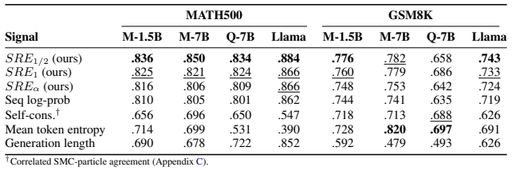
Table 1 : Selective prediction AUROC (N=32, α=4, 500 problems per setting). M: Qwen2.5-Math, Q-7B: Qwen2.5- 7B, Llama: Llama-3.1-8B-Instruct. SREα: stepwise accumulation of order α from the incremental weights (Eq. 6); SRE1 and SRE1/2: order-1 and order-1/2 members (Eq. 7). Best inbold, second best underlined. Bootstrap confidence intervals in Appendix I.
Original paper · CC BY 4.0 · Erfan Baghaei Potraghloo, Milad Heidari Sorkhehdizaj, Shahab Rahimirad, Aliasghar Pourghani, Seyedarmin Azizi, Souvik Kundu, Abolfazl Hashemi, Joseph Campbell, Vijay Gupta · Free Lunch Uncertainty: Sequence-Level Rényi Entropy from Particle Decoding for Adaptive LLM Reasoning · Original paper figure · Extracted the figure area from page 6 of the original PDF.On GSM8K the picture is mixed, because mean token entropy leads on Qwen2.5-Math-7B and Qwen2.5-7B. Those leads over SRE1/2 are not significant, with p=0.19 and 0.33. The order-1/2 member is the best signal on Qwen2.5-Math-1.5B and Llama-3.1-8B. SRE1/2 sits 0.023 to 0.041 above sequence log-probability on GSM8K. Generation length carries little information on GSM8K, at 0.48 to 0.63 AUROC against 0.68 to 0.85 on MATH500.
SREα stays above log-probability in all eight settings too, by up to 0.013, using only the incremental weights. Abstaining on the 20% highest-SRE1/2 problems raises accuracy on the rest from 75.8% to 86.0% for Qwen2.5-Math-7B. A logistic regression that combines SRE1/2 with the three baselines reaches 0.878 cross-validated AUROC.
Why order 1/2 wins and length is not the cause
At β=1/4 the Spearman ρ is at least 0.93, and AUROC drops to 0.743 on MATH500 with Qwen2.5-7B.
At α=4 the standard estimator stays within 0.004 AUROC of log-probability in all eight settings. The margin appears at order 1 with 0.004 to 0.051 and at order 1/2 with 0.022 to 0.044. That advantage grows with particle diversity, so it doesn't come only from the returned answer.
The authors check whether SRE1/2 is just a length proxy, since generation length alone reaches 0.68 to 0.85 AUROC on MATH500. Dividing SRE1 by length costs 0.11 to 0.48 AUROC on MATH500, because the division removes the accumulated part. Dividing SRE1/2 by the length lowers its AUROC from 0.850 to 0.708 on MATH500 with Qwen2.5-Math-7B.
Darrin et al. (2023) average a per-token Rényi divergence along one completion, whereas SRE accumulates and aggregates over the particle set. Malinin and Gales (2021) estimate sequence-level Shannon entropy from independent completions, and SRE1 applies that chain-rule sum to the particle set.
Does SRE predict the gain from more particles
The authors run a cheap N=8 probe, split the problems into terciles of SREα, and rerun them at N=64 on MATH500 with Qwen2.5-Math-7B. Accuracy changes by −1.2 points in the low tercile, +3.0 in the middle tercile, and +5.4 in the high tercile. The probe's SREα is computed from the same N=8 run that supplies the candidate answer, so the allocation decision needs no extra model call.
The tercile sizes are 167, 166 and 167 problems, out of 500 in total.
On Qwen2.5-Math-1.5B the gains are +0.6, +3.6, and +6.0 points, so the same rise appears in a second model. The authors also test whether the rise is just a re-draw effect, since an independent N=8 run gives another sample of the same problems. Against that, N=64 changes accuracy by −0.5, +2.1, and +2.8 points, and in the upper two terciles it gains 2.3 points more than a re-draw.
The 95% confidence interval for that extra gain runs from 0.2 to 4.4 points.
Log-probability reaches only 0.808 to 0.818 on the same task, so the order-1/2 signal ranks these problems better.
Two-pass policy: accuracy against compute
The two-pass policy starts with a probe that runs Power-SMC at N=8 particles and extracts SRE and a candidate answer. It compares SRE with a threshold θ, and problems above θ are re-run at N=64 particles. Problems below the threshold keep the probe answer, which serves as the fallback. The probe supplies the signal before the expensive run, so the gating decision needs no additional model call.
On MATH500 with Qwen2.5-Math-7B, the probe runs at N=8 and escalates problems whose SREα exceeds a threshold to N=64. Escalating the 40% of problems with the highest SREα matches uniform N=64 accuracy of 77.2% with 47.5% fewer particles. On two further seeds the saving is 22.5% and 32.5%, which averages 34.2% over three seeds. Escalating 60% with one rate for all seeds gives a three-seed mean of 76.6%, but it saves 27.5% of particles.
Random escalation saves nothing on average, at −0.8%, so the gain comes from the SRE ranking.
A three-way policy adds abstention, so it can abstain, escalate, or keep the probe answer. It matches uniform N=64 on the 80% most confident problems, reaching 85.1% against 85.0%. That policy uses 4.2× the probe's particle budget, where uniform N=64 uses 8×. Table 16 compares SREα with answer entropy over the probe's particles and with Self-Certainty.
Limitations of the evaluation scope
The evaluation covers mathematical reasoning only, so open-ended generation and multi-turn interaction weren't tested. The authors leave these other task types for future work.
The two-pass policy chooses between two particle budgets, so it doesn't cover more than two levels.
Paper info
- Authors
- Erfan Baghaei Potraghloo, Milad Heidari Sorkhehdizaj, Shahab Rahimirad, Aliasghar Pourghani, Seyedarmin Azizi, Souvik Kundu, Abolfazl Hashemi, Joseph Campbell, Vijay Gupta
- Venue
- arXiv · Preprint
- First published
- 2026-11-10
- Added
- 2026-11-11
- Updated
- 2026-11-10
- Version
- v1
- arXiv
- 2611.13414
- Category
- cs.LG · cs.AI · cs.CL
- Original paper terms
- CC BY 4.0
- What we show
- Paper info, commentary and permitted figures from the original paper
AI commentary is a separate explanation from the original paper and may contain errors. The original paper and figures follow each source's terms of use and any rights noted separately.
Abstract
Quantifying uncertainty over an entire LLM completion is critical for selective prediction and adaptive compute. Zero-cost signals such as mean token entropy and log-probability are local to tokens or to one completion, and self-consistency needs many extra completions. We show that Sequential Monte Carlo (SMC) decoding for power sampling already estimates the normalizing constant of the power distribution, which gives the sequence-level R'enyi entropy (SRE) of the model's completion distribution at zero marginal cost, with a guarantee at every particle budget. A R'enyi chain rule extends this readout to a family of stepwise entropies of any order. We prove that orders above one are tied to the most likely token of each step, which explains why they track log-probability, while the order-1/2 member accumulates the log of per-step search effort. This member is the best zero-cost selective-prediction signal in 10 of 13 settings. On MATH500 its AUROC is 0.022 to 0.044 above log-probability with all four models and within length quartiles, and the same order is selected when each setting is held out. An 8-particle probe identifies the problems that benefit from more particles, and a two-pass policy matches 64-particle accuracy on MATH500 with 34.2% fewer particles over three seeds.
Quote from the paper
Erfan Baghaei Potraghloo, Milad Heidari Sorkhehdizaj, Shahab Rahimirad, Aliasghar Pourghani, Seyedarmin Azizi, Souvik Kundu, Abolfazl Hashemi, Joseph Campbell, Vijay Gupta (2026). Free Lunch Uncertainty: Sequence-Level Rényi Entropy from Particle Decoding for Adaptive LLM Reasoning. arXiv:2611.13414v1. https://arxiv.org/abs/2611.13414v1
BibTeX
@misc{potraghloo2026free,
  title = {{Free Lunch Uncertainty: Sequence-Level Rényi Entropy from Particle Decoding for Adaptive LLM Reasoning}},
  author = {Erfan Baghaei Potraghloo and Milad Heidari Sorkhehdizaj and Shahab Rahimirad and Aliasghar Pourghani and Seyedarmin Azizi and Souvik Kundu and Abolfazl Hashemi and Joseph Campbell and Vijay Gupta},
  year = {2026},
  eprint = {2611.13414},
  archivePrefix = {arXiv},
  url = {https://arxiv.org/abs/2611.13414v1}
}