論文解説
Free Lunch Uncertainty: Sequence-Level Rényi Entropy from Particle Decoding for Adaptive LLM Reasoning
Free Lunch Uncertainty:適応的LLM推論のための粒子デコーディングによるシーケンスレベルRényiエントロピー
- 課題 完成全体の不確実性を、追加の完成や分類器を使わずに得られるかを検討します。
- 手法 Power-SMCが計算する重要度重みで正規化定数を推定し、シーケンスレベルRényiエントロピーSREを求めます。このSREを選択的予測と粒子配分に使います。
- 結果 MATH500では、SRE1/2が4つのモデルすべてで系列の対数確率より高いAUROCを示しました。N=8のprobeのSREで選んだ問題をN=64で再実行する方策は、3つのシードの平均で一様なN=64と同じ精度を、34.2%少ない粒子で達成しました。
問題:完成全体の不確実性
大規模言語モデルの完成(completion)全体に対する不確実性を定量化することは、選択的予測と適応的な計算資源の配分にとって重要です。既存の追加コストのないシグナルである平均トークンエントロピーと系列の対数確率は、それぞれ個々のトークンの局所的な曖昧さや、1つの完成だけに依存します。自己一貫性(self-consistency)と意味エントロピーは完成レベルの不一致を測定しますが、K個の独立した完成を追加で必要とします。この論文は、パワーサンプリングのためのSMCデコーディングがすでに計算している重要度重みから、完成分布の正規化定数を推定できるかを問います。
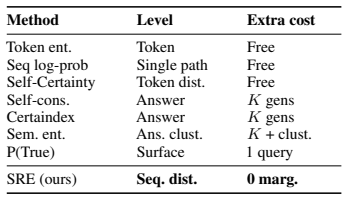
Table 6 : Comparison with LLM uncertainty methods. Level: the object the signal is computed on. Extra cost: computation beyond the decoding run that produces the answer.
出典 · CC BY 4.0 · Erfan Baghaei Potraghloo, Milad Heidari Sorkhehdizaj, Shahab Rahimirad, Aliasghar Pourghani, Seyedarmin Azizi, Souvik Kundu, Abolfazl Hashemi, Joseph Campbell, Vijay Gupta · Free Lunch Uncertainty: Sequence-Level Rényi Entropy from Particle Decoding for Adaptive LLM Reasoning · 論文の図を引用 · 元のPDFの12ページ目から図の部分を抽出しています。SMC重みからのSRE抽出
Power-SMCはN個の粒子を保持し、各トークンを提案分布からサンプリングし、重要度重みで重み付けし直し、重みが偏ったときに系統的リサンプリングを行います。著者らは正規化定数Z_α(x)の推定値log Z_αから、シーケンスレベルRényiエントロピーSRE = log Ẑ_α / (1−α)を定義します。実装では、各ステップで粒子の増分重みの一様平均の対数を累積する逐次累積(Eq. 6)を用いており、これはリサンプリング境界で追加の帳簿処理を必要としません。また、Rényiの連鎖律を使って、次数βのステップごとのエントロピー系列SREβを定義します(Eq. 7)。この系列のβ=1/2の要素は、ステップごとの探索努力の対数を累積したものとして解釈されます。
理論的保証と次数の選択
Lemma 1は、最終目標がπ_αであるSMCサンプラーについて、標準的な推定量の期待値がZ_α以下であり、系列レベルの推定値がH_αの上方バイアスを持つことを示しています。また、有限のNでは、δに関する確率的な下限を与えます。論文では、この保証がPower-SMCの実行方法そのままに当てはまると説明されています。次数については、β>1では各増分が最上位トークン項のβ/(β−1)倍以内に収まり上位トークンと結びつくと述べられ、β≤1では残りの確率質量の分散も反応すると記述されています。命題2では、目標完成を初めて引くまでの期待抽出回数が、どの提案分布についてもe^{H_{1/2}(p)}以上であり、q∝p^{1/2}のときに等号が成立すると述べられています。
選択的予測の検証
この設定では、SRE1/2はMATH500の4つのモデルすべてで、系列の対数確率より0.022から0.044高いAUROCを示しました。論文では、10個の設定のうち13個で次数1/2の要素が最良の追加コストなしのシグナルだと報告されています。GSM8Kでは、一部のモデルで平均トークンエントロピーの方が高くなりますが、論文ではこの差は有意ではないと報告されています。一方、SRE1は8つの設定すべてで系列の対数確率より0.004から0.051高くなっています。
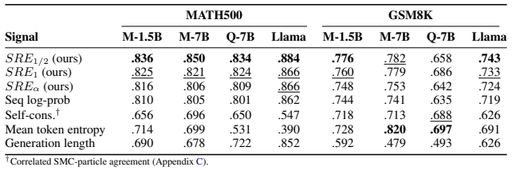
Table 1 : Selective prediction AUROC (N=32, α=4, 500 problems per setting). M: Qwen2.5-Math, Q-7B: Qwen2.5- 7B, Llama: Llama-3.1-8B-Instruct. SREα: stepwise accumulation of order α from the incremental weights (Eq. 6); SRE1 and SRE1/2: order-1 and order-1/2 members (Eq. 7). Best inbold, second best underlined. Bootstrap confidence intervals in Appendix I.
出典 · CC BY 4.0 · Erfan Baghaei Potraghloo, Milad Heidari Sorkhehdizaj, Shahab Rahimirad, Aliasghar Pourghani, Seyedarmin Azizi, Souvik Kundu, Abolfazl Hashemi, Joseph Campbell, Vijay Gupta · Free Lunch Uncertainty: Sequence-Level Rényi Entropy from Particle Decoding for Adaptive LLM Reasoning · 論文の図を引用 · 元のPDFの6ページ目から図の部分を抽出しています。適応的な粒子配分
2段階の方策では、N=8のprobeでSREを計算し、SREが閾値を超えた問題だけをN=64で再実行します。Qwen2.5-Math-7BをMATH500に適用した3つのシードの平均では、この方策は一様なN=64の実行と同じ精度を、粒子数を34.2%少なく使って達成しました。3分位の分析では、probe SREが高い問題群が、N=64の追加実行でより大きな精度向上を示しました。低いSREの三分位は3つの実行すべてで最大0.6ポイントの向上を示し、上位2つの三分位を合わせると1.2から4.8ポイントの向上でした。この結果は当該設定での観察であり、他のモデルやタスクへの一般化は論文では確認されていません。
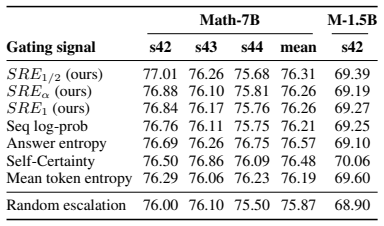
Table 16 : Gating signals for adaptive particle allocation, all computed from the same N=8 probe (MATH500, 500 problems; s42 to s44: seeds). Entries are the accu- racy (%) of the two-pass policy averaged over escalation rates from 0% to 100% in steps of 5%.
出典 · CC BY 4.0 · Erfan Baghaei Potraghloo, Milad Heidari Sorkhehdizaj, Shahab Rahimirad, Aliasghar Pourghani, Seyedarmin Azizi, Souvik Kundu, Abolfazl Hashemi, Joseph Campbell, Vijay Gupta · Free Lunch Uncertainty: Sequence-Level Rényi Entropy from Particle Decoding for Adaptive LLM Reasoning · 論文の図を引用 · 元のPDFの18ページ目から図の部分を抽出しています。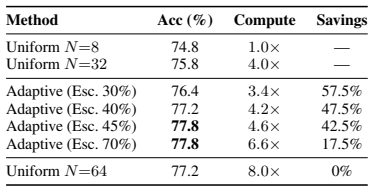
Table 17 : Adaptive particle allocation vs. uniform base- lines on MATH500 (500 problems, Qwen2.5-Math-7B). Esc. X%: escalate the X% of problems with the highest SREα to N=64. Compute is in N=8 units and adap- tive rows include the probe cost. Savings are relative to uniformN=64.
出典 · CC BY 4.0 · Erfan Baghaei Potraghloo, Milad Heidari Sorkhehdizaj, Shahab Rahimirad, Aliasghar Pourghani, Seyedarmin Azizi, Souvik Kundu, Abolfazl Hashemi, Joseph Campbell, Vijay Gupta · Free Lunch Uncertainty: Sequence-Level Rényi Entropy from Particle Decoding for Adaptive LLM Reasoning · 論文の図を引用 · 元のPDFの18ページ目から図の部分を抽出しています。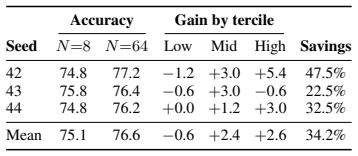
Table 18 : Adaptive particle allocation with three seeds (MATH500, 500 problems, Qwen2.5-Math-7B, α=4). Gain: accuracy at N=64 minus accuracy at N=8 within each tercile of probe SREα. Savings: parti- cles saved relative to uniform N=64 at the smallest escalation rate from which the two-pass policy matches uniformN=64accuracy.
出典 · CC BY 4.0 · Erfan Baghaei Potraghloo, Milad Heidari Sorkhehdizaj, Shahab Rahimirad, Aliasghar Pourghani, Seyedarmin Azizi, Souvik Kundu, Abolfazl Hashemi, Joseph Campbell, Vijay Gupta · Free Lunch Uncertainty: Sequence-Level Rényi Entropy from Particle Decoding for Adaptive LLM Reasoning · 論文の図を引用 · 元のPDFの18ページ目から図の部分を抽出しています。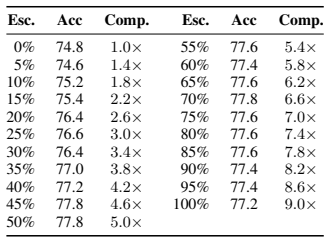
Table 19 : Accuracy (%) and average compute (in N=8 units, probe included) as a function of the frac- tion of highest- SREα problems escalated to N=64 (MATH500, 500 problems, Qwen2.5-Math-7B). Uni- formN=64: 77.2% at8.0×.
出典 · CC BY 4.0 · Erfan Baghaei Potraghloo, Milad Heidari Sorkhehdizaj, Shahab Rahimirad, Aliasghar Pourghani, Seyedarmin Azizi, Souvik Kundu, Abolfazl Hashemi, Joseph Campbell, Vijay Gupta · Free Lunch Uncertainty: Sequence-Level Rényi Entropy from Particle Decoding for Adaptive LLM Reasoning · 論文の図を引用 · 元のPDFの19ページ目から図の部分を抽出しています。適用範囲と限界
SREはSMC実行の粒子集合から計算され、論文では、単一の完成を最初からサンプリングするデコーディングは評価していないと明記されています。評価は数学的推論に限られ、オープンエンドの生成やマルチターンの対話は扱っていません。2段階の方策は2つの粒子予算の間の選択のみを扱い、モデル間や推論モード間のルーティングは評価していません。
論文情報
- 著者
- Erfan Baghaei Potraghloo, Milad Heidari Sorkhehdizaj, Shahab Rahimirad, Aliasghar Pourghani, Seyedarmin Azizi, Souvik Kundu, Abolfazl Hashemi, Joseph Campbell, Vijay Gupta
- 学会・ジャーナル
- arXiv · プレプリント
- 公開日
- 2026年11月10日
- 登録日
- 2026年11月11日
- 更新日
- 2026年11月10日
- バージョン
- v1
- arXiv
- 2611.13414
- カテゴリ
- cs.LG · cs.AI · cs.CL
- ライセンス
- CC BY 4.0
- 掲載内容
- 論文情報・解説・論文の図
この解説は、Refivuの韓国語解説をAIで翻訳したものです。不正確な翻訳や誤りが含まれる可能性があります。論文と図の利用条件は各出典に従います。
アブストラクト
Quantifying uncertainty over an entire LLM completion is critical for selective prediction and adaptive compute. Zero-cost signals such as mean token entropy and log-probability are local to tokens or to one completion, and self-consistency needs many extra completions. We show that Sequential Monte Carlo (SMC) decoding for power sampling already estimates the normalizing constant of the power distribution, which gives the sequence-level R'enyi entropy (SRE) of the model's completion distribution at zero marginal cost, with a guarantee at every particle budget. A R'enyi chain rule extends this readout to a family of stepwise entropies of any order. We prove that orders above one are tied to the most likely token of each step, which explains why they track log-probability, while the order-1/2 member accumulates the log of per-step search effort. This member is the best zero-cost selective-prediction signal in 10 of 13 settings. On MATH500 its AUROC is 0.022 to 0.044 above log-probability with all four models and within length quartiles, and the same order is selected when each setting is held out. An 8-particle probe identifies the problems that benefit from more particles, and a two-pass policy matches 64-particle accuracy on MATH500 with 34.2% fewer particles over three seeds.
この論文を引用
Erfan Baghaei Potraghloo, Milad Heidari Sorkhehdizaj, Shahab Rahimirad, Aliasghar Pourghani, Seyedarmin Azizi, Souvik Kundu, Abolfazl Hashemi, Joseph Campbell, Vijay Gupta (2026). Free Lunch Uncertainty: Sequence-Level Rényi Entropy from Particle Decoding for Adaptive LLM Reasoning. arXiv:2611.13414v1. https://arxiv.org/abs/2611.13414v1
BibTeX
@misc{potraghloo2026free,
  title = {{Free Lunch Uncertainty: Sequence-Level Rényi Entropy from Particle Decoding for Adaptive LLM Reasoning}},
  author = {Erfan Baghaei Potraghloo and Milad Heidari Sorkhehdizaj and Shahab Rahimirad and Aliasghar Pourghani and Seyedarmin Azizi and Souvik Kundu and Abolfazl Hashemi and Joseph Campbell and Vijay Gupta},
  year = {2026},
  eprint = {2611.13414},
  archivePrefix = {arXiv},
  url = {https://arxiv.org/abs/2611.13414v1}
}