Paper commentary
CogRSI: Evolving and Auditing Cognitive Reasoning Strategies
CogRSI evolves reasoning strategies and audits whether the learned rules are actually correct
- Problem Self-improving loops keep any edit that raises accuracy, but accuracy cannot show whether a learned rule is correct. A rule that helps may still be wrong as a rule.
- Method CogRSI pairs a grounded reader with a loop that writes a principle and keeps an edit only if accuracy rises by a margin. Rules are then run as code on stories with known answers.
- Results The gated library reached 96.6% pair validity on BigToM-U, against 94.0% with no principle.
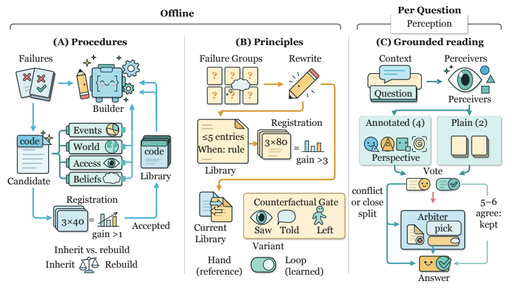
Figure 3 :CogRSI.(A) RSI over procedures writes tools that export perceptual access. (B) RSI over principles keeps a library of conditioned strategies and admits an update only if it passes the accuracy margin and, in the gated variant, the counterfactual gate. (C) The reader applies the strategies at test time. The semantic audit (§4.3) checks what the admitted strategies assert.
Original paper · CC BY 4.0 · Yandan zheng, Haoran Luo, Xinliang Zhou, Anhtuan Luu · CogRSI: Evolving and Auditing Cognitive Reasoning Strategies · Original paper figure · Extracted the figure area from page 4 of the original PDF.Why accuracy can't certify a learned strategy
Self-improving loops keep an edit to their own artifacts whenever a benchmark score goes up. Theory of mind makes a demanding test, since the system must track who saw what, who was told, and what each person believes. Two questions stay open: whether what the loop learns carries over to data it never saw, and whether a strategy that helps is also correct.
The learned principles transfer, since on 800 BigToM pairs that no system had seen, each one scores higher than the expert principle. Accuracy alone can't tell which learned rules are correct, so the authors check what the rules say.
The authors use a rule that treats being present in a room as enough for a character to know the events there. A rule can raise accuracy in trials while being wrong in situations it claims to cover, so accuracy can't separate a helpful rule from a correct one.
A reader that tracks who saw what
The reader tags each sentence or utterance with the characters who witnessed it, then answers from two copies of the story. PercepToM deletes whatever a character did not see, whereas this reader keeps the whole story and only adds who saw what. That design means a character's view is never lost, which matters for higher-order questions that need context the filter would drop.
The reader draws six samples at temperature 0.7, the same budget as self-consistency with k=6. Four of the samples read the annotated story, or the questioned character's view for conversations. The other two read the plain story, so the reader holds two readings of the same question.
CogRSI uses an expert principle that restricts a character's knowledge to three routes: seeing, being told, or working out from their own actions. The loops later write P instead, so the principle slot stays fixed while its content changes. Within the same reader, the annotated view beats PercepToM's filtered view by +1.3 narrative Main points ([+0.7, +2.0]).
The expert principle adds +3.0 Main points over no principle ([+2.2, +3.7]), so the reading and the principle each contribute.
Admitting rule edits by margin and gate
In every round the builder reads the library together with up to four failed questions drawn from a fresh set of 80 development items, and proposes one ADD, REVISE or RETIRE edit. The builder never sees what makes a rule valid, so registration is the only filter an edit passes through.
An edit is kept by a rule that compares its average accuracy gain across K new trial cohorts against a threshold, written as \[ \mathrm{reg}(x) \iff \frac{1}{K}\sum_{k=1}^{K}\Delta A_k(x) > \delta \] Noise is the reason for the threshold: a fixed principle moves by 2.7 points from one cohort of 80 questions to another.
The gated variant adds a second route: a candidate is kept if it reg^G \iff \left[\mathrm{reg} \wedge \Delta V \ge -3\right] \vee \left[\Delta V \ge 6 \wedge \Delta A \ge -0.5\right] in the form \[ \mathrm{reg}^{G} \iff \left[\mathrm{reg} \wedge \Delta V \ge -3\right] \vee \left[\Delta V \ge 6 \wedge \Delta A \ge -0.5\right] \] Here ΔV is the change in correctly answered gate pairs and ΔA is the mean accuracy gain, and the tolerances come from the reader's run-to-run noise.
The margin changes what gets kept: on 120 held-out development questions, 83.3% of kept updates helped with the 3-point margin, compared to 63.6% with the 1-point margin. The share of harmful updates falls from 31.8% to 16.7%.
Compiling rules and checking them on stories
The audit asks whether a learned rule is correct, which is a different question from whether it helps accuracy.
The compilers see only the rule text, so each rule is turned into code by two independent models. Before the freeze, three hand-written rules fixed the sandbox, the compile instructions and the shared-counterexample criterion.
This left 286 invalid, 44 valid, 84 ambiguous and 159 vacuous rules, which the authors report as the audit's final counts. Among the rules the audit could decide, 86.7% were invalid, with a range of 80.7 to 92.2.
The formal check catches cases the accuracy signal misses, such as a character who is in the room but asleep. One kept rule of a gated library says that when B was present, A believes B knows the resulting state.
Transfer to unseen BigToM pairs
The transfer test uses 800 BigToM-U pairs drawn from conditions that no system had answered before. A pair counts only when both of its versions are answered right, so one wrong answer sinks the whole pair. Each pair tests a single fact: in a flip pair the agent does or doesn't see a change, and in a same pair the agent does or doesn't see an irrelevant event.
The expert principle gives the baseline, since it is the hand-written rule that the loops try to match.
Against no principle at all, the gated library gains +2.6 points with interval [+1.4, +3.9], reaching 96.6% pair validity against 94.0. The accuracy-only library gains +2.8 over no principle, so the two loops transfer about equally well on this set. The gain comes from flip pairs, where the reader scores 94.9 against 91.2 without a principle.
On same pairs every principle stays near ceiling, at 98.2 against 97.8, so learned rules don't make the reader see missed events where none exist. SC (k=9) reaches 93.0, which is below the reader without a principle.
The gate adds nothing on this set, because the gated library minus the accuracy-only library gives −0.2, with interval [−1.4, +0.8]. Gated minus pairs-as-data gives −0.1, with interval [−1.1, +0.9], so the pair constraint doesn't change pair validity here. The authors read the transfer as coming from evolving the principle rather than from the gate.
Gains on new development questions don't carry over to test Main. The accuracy-only loop's principle scores 63.8 on development against 59.7 for the expert, yet it loses on test Main. So the expert principle beats the learned ones on test Main, while the learned principles win on BigToM-U.
What the learned rules say
The principle loops proposed 573 rules, and the semantic audit sorted them into invalid, valid, ambiguous and vacuous groups. Only 44 rules are valid, while 84 are ambiguous because the two translations disagree. Another 159 rules almost never apply to any story. Among the rules the audit could decide, 86.7% ([80.7, 92.2]) were invalid.
The audit's counterexample for one kept rule shows why trials miss this kind of error.
Counterexamples show the rules are wrong, but the effect is small. On 1139 rendered counterexamples, a learned rule turned a right answer wrong in 8.6% of cases. On 176 random control stories, the same rule did so in 2.8%. Without the rule, the reader already answered 29.4% of rendered counterexamples wrongly, so these stories are hard in themselves.
Removing every condition from the gated libraries changed BigToM-U pair validity by −0.5, with interval [−1.6, +0.4]. The authors read this as the reader treating the rules as general hints that it weighs against the story.
Accuracy and the gate can't flag these errors, because the gated library reached 96.6% pair validity on BigToM-U.
Limits of the CogRSI results
The results rest on one story generator, since every loop learns only from ExploreToM development data. The formal model covers physical access and testimony in one room, so other mental states aren't covered yet. The authors leave those other mental states for future work.
The audit depends on two models that translate each rule into code. Shared counterexamples guard against one bad translation, but both translations can still miss what a rule's author meant. Loops ran three to six seeds, and some arms weren't evaluated on every test set. All benchmarks are in English and mostly synthetic, so the results don't show how the reader behaves on natural text in other languages.
The backward-belief case is the clearest limit on the transfer claim. Every system stayed near 68.0% pair validity there, and flip pairs fell to 37.2%. Adding a principle changed little, with +0.2 and interval [−2.5, +2.8]. The authors don't claim that the learned principles help on this kind of inference.
Paper info
- Authors
- Yandan zheng, Haoran Luo, Xinliang Zhou, Anhtuan Luu
- Venue
- arXiv · Preprint
- First published
- 2026-10-31
- Added
- 2026-11-3
- Updated
- 2026-10-31
- Version
- v1
- arXiv
- 2611.01113
- Category
- cs.CL
- Original paper terms
- CC BY 4.0
- What we show
- Paper info, commentary and permitted figures from the original paper
AI commentary is a separate explanation from the original paper and may contain errors. The original paper and figures follow each source's terms of use and any rights noted separately.
Abstract
Can a language model learn better ways to reason about other people's minds by improving its own strategies, and are the strategies it learns actually right? We study this with cogrsi. A grounded reader marks who saw each event in a story and uses a short written principle to settle disagreements between its readings. With a principle written by experts, it beats self-consistency at the same token cost. A self-improvement loop then writes the principle itself. It keeps an update only if accuracy rises by a calibrated margin, and in one variant only if it also passes counterfactual test pairs. The learned principles transfer: on 800 BigToM pairs that no system had seen, each of them scores higher than the expert principle. We then check what the learned rules actually say. Each rule is translated into code and run on thousands of small stories with known answers. Most of them give a wrong answer in at least one situation they claim to cover, for example by treating a character who is in the room as knowing what happened even while asleep. Accuracy does not reveal which rules are wrong, and the counterfactual test does not fix this. A strategy can help in practice and still be wrong as a rule, so both need checking. Our code and data are publicly available.
Figures from the paper
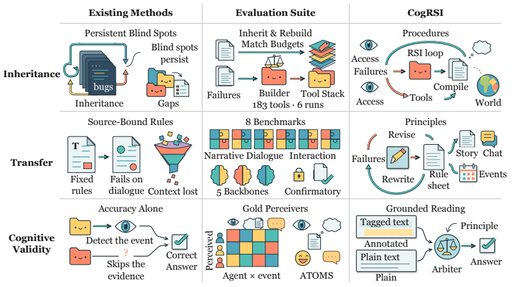
Figure 2 :Overview.Rows: what persists, transfer, cognitive validity. Existing self-improving and ToM methods leave them open. Our suite measures them, and CogRSI addresses them.
Original paper · CC BY 4.0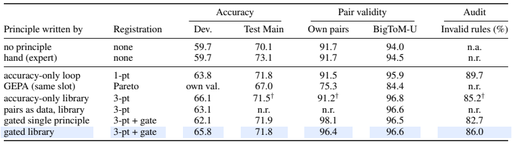
Table 1 :Who writes the principle.Same reader, backbone and sampling; only the principle changes. Registration: accuracy margin in points, with the counterfactual gate where stated (Pareto: GEPA’s own selection). Dev.: 300 unseen ExploreToM development questions per seed. Test Main: main test sample, eight benchmarks. Own pairs: 320 held-out pairs from our generator. BigToM-U: 800 BigToM pairs in conditions no system had seen. Invalid rules: share of the arm’s proposed rules with a formal counterexample (§4.3). Seeds: 6 for loops and libraries, 3 for GEPA and the single principle; †seeds 0–2 only. n.r.: not run; n.a.: not applicable.Every learned principle beats the expert one on BigToM-U; the gate changes validity on its own pairs only.
Original paper · CC BY 4.0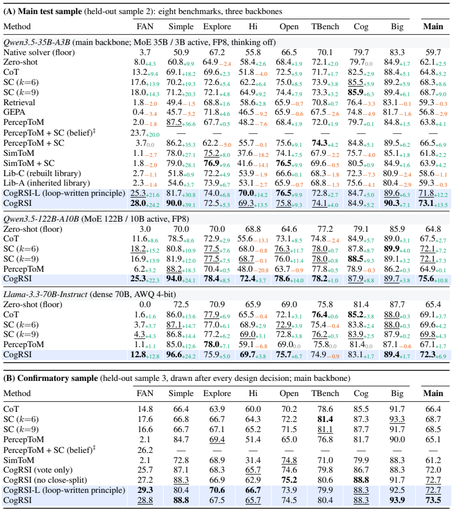
Table 3 :Main results.(A) Main test sample, three backbones. (B) Confirmatory sample. Accuracy (%) is the mean of runs: three in A, and in B three for CogRSI and SC (k=9), six loop seeds for CogRSI-L, one for the rest. Main averages the eight. Subscripts are gaps to the block floor. Bold is best, underline second. FAN is FANToM All∗. CogRSI has the best Main in every block. ‡FANToM only. —: does not apply.
Original paper · CC BY 4.0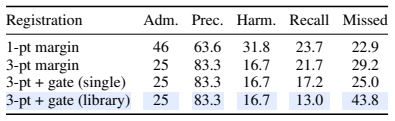
Table 5 :Selection quality(%, development data). Ev- ery candidate scored on 120 held-out questions. Adm.: rounds with an admission; Prec./Harm.: admitted up- dates that help/hurt; Recall: helpful candidates admitted; Missed: rounds with a helpful candidate and no admis- sion.The calibrated margin, not the gate, makes selection precise.
Original paper · CC BY 4.0
Table 6 : Stage 1 (E1) runs round by round: development accuracy of the solver with the current library (A: inherited, C: rebuilt; ⋆: tools admitted in that round) and the number of admitted tools (a round can admit more than one); right: the candidate tools each run wrote and how many encode perceptual access, nested belief or story parsing (a tool can encode several).Admission is rare, so the inheriting arm rarely has a library to inherit.
Original paper · CC BY 4.0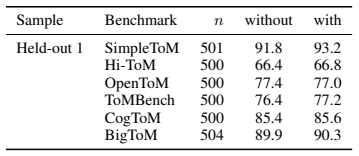
Table 7 : Development results without and with the ar- bitration of close splits, on the same six samples per question on held-out sample 1, the development set of the design without it. Rejected candidates are listed in the text.
Original paper · CC BY 4.0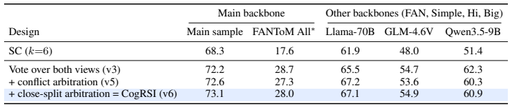
Table 8 : CogRSI’s design variants on every test condition (three runs each; per-benchmark results and every run in Table 20). Each design was frozen before its test runs; the close-split arbitration was added after the first test run of the design without it and was selected on development data only (§C.3).
Original paper · CC BY 4.0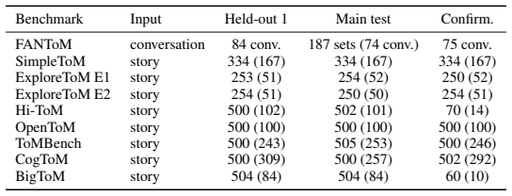
Table 10 : Samples per benchmark: questions (stories or groups in parentheses; FANToM: All∗ sets and conversa- tions). Held-out sample 1 is CogRSI’s development set; the main test sample is held-out sample 2; the confirmatory sample is held-out sample 3. SimpleToM: behavior and judgment questions scored.
Original paper · CC BY 4.0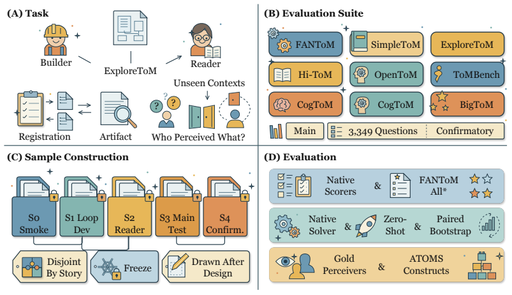
Figure 11 :Task and suite.(A) Task. (B) Eight benchmarks. (C) Sealed, disjoint samples. (D) Native scoring.
Original paper · CC BY 4.0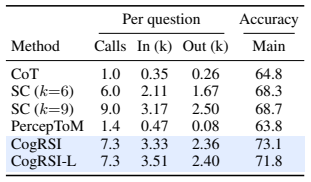
Table 11 : Cost per question (multiple-choice test bench- marks, main backbone; all calls, including perception, retries and arbitration) and overall accuracy (Table 3). SC (k=9) matches CogRSI’s tokens.
Original paper · CC BY 4.0
Table 12 : Annotate or filter? Accuracy on the five multiple-choice benchmarks of the main test sample, three runs. The third row gives PercepToM’s filtered reading our arbitration: where its answer and self-consistency’s differ, the evidential rule of §4.1 decides.
Original paper · CC BY 4.0
Table 15 : CogRSI against representative self-improving systems and ToM methods.What is kept: the artifact carried to later rounds;Access: how perceptual access enters reasoning;Rebuild: whether inheritance is tested against a rebuild with the same budget. Only CogRSI inherits across rounds and keeps the whole story while marking who perceived each part.
Original paper · CC BY 4.0
Table 16 : Backbones and hardware (NVIDIA H200 NVL 141 GB, RTX A6000 48 GB). All served with vLLM 0.30.0.
Original paper · CC BY 4.0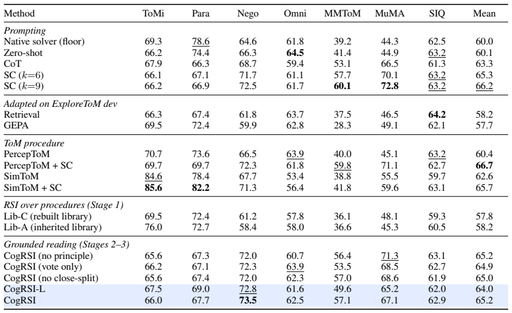
Table 17 :Seven test-only benchmarks(main backbone, main test sample, accuracy %, mean of three runs; CogRSI-L: six loop seeds). They were added after the first design was frozen and never used for development. Best in bold, second underlined.Here CogRSI is level with self-consistency, and SimToM leads on the ToMi family.
Original paper · CC BY 4.0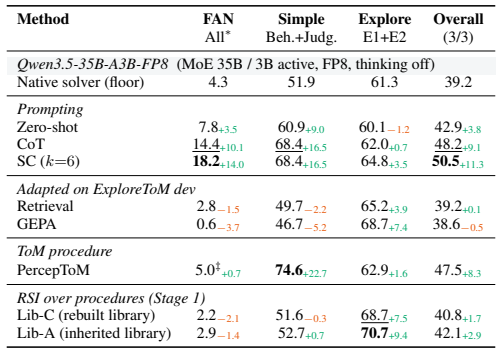
Table 18 :Full sealed test sets (RSI study, design frozen before its runs).Accuracy (%) per dataset, full sealed test sets of FANToM, SimpleToM and ExploreToM (October 6–9; before CogRSI v3 existed); smoke subsets excluded. Mean over three runs (CogRSI and baselines; GEPA: three optimizer seeds; Stage-1 tools: three loop seeds; CogRSI-L: one run per principle-loop seed). FANToM: official All∗ on short contexts. SimpleToM: mean of behavior and judgment. ExploreToM: mean of the E1 (physical access) and E2 (communication access) partitions. Subscripts: gap to the floor (the same native solver with an empty tool library). Best in bold, runner-up underlined. Overall averages the datasets every row has (count in the header). ‡PercepToM on FANToM is scored from its per-question results like every other system; the official scorer’s printed summary for these runs is higher and cannot be reproduced from the per-question results it writes (for every other system the two agree exactly). Per-metric detail in Table 21; every run in Table 24.
Original paper · CC BY 4.0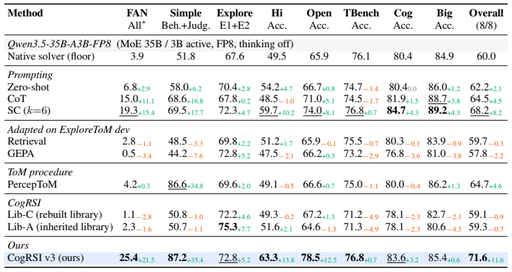
Table 19 :Development sample: held-out sample 1.Accuracy (%) per dataset, held-out sample 1, the development set of CogRSI’s arbitration (not a test sample); smoke subsets excluded. Mean over three runs (CogRSI and baselines; GEPA: three optimizer seeds; Stage-1 tools: three loop seeds; CogRSI-L: one run per principle-loop seed). FANToM: official All∗ on short contexts. SimpleToM: mean of behavior and judgment. ExploreToM: mean of the E1 (physical access) and E2 (communication access) partitions. Subscripts: gap to the floor (the same native solver with an empty tool library). Best in bold, runner-up underlined. Overall averages the datasets every row has (count in the header). Test results: Table 3.
Original paper · CC BY 4.0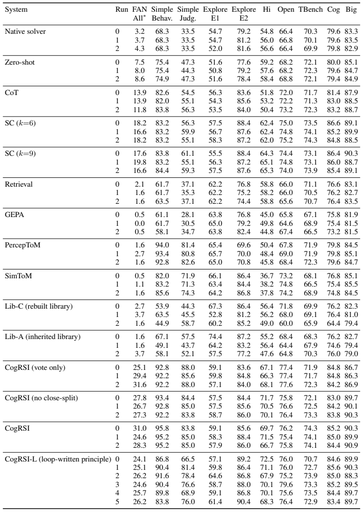
Table 20 : Every run behind the main test sample (Table 3) (accuracy %; FANToM: All∗ over 187 target sets). Runs of static baselines are independent executions; GEPA runs are optimizer seeds.
Original paper · CC BY 4.0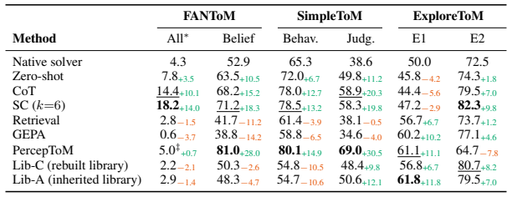
Table 21 : Per-metric detail for FANToM, SimpleToM and ExploreToM (same runs as Table 18). Subscripts: gap to the floor. †Fewer than three runs. ‡PercepToM on FANToM is scored from its per-question results like every other system; the official scorer’s printed summary for these runs is higher and cannot be reproduced from the per-question results it writes (for every other system the two agree exactly).
Original paper · CC BY 4.0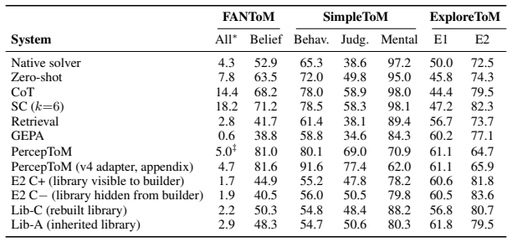
Table 22 : All systems, including rows kept out of Table 18: the original PercepToM adapter (v4) and the E2 branches (parent library plus new tools). Mental-state questions all have gold answer “No”, so a constant “No” scores 100%; this column is reported separately. †Fewer than three runs. ‡PercepToM on FANToM is scored from its per-question results like every other system; the official scorer’s printed summary for these runs is higher and cannot be reproduced from the per-question results it writes (for every other system the two agree exactly).
Original paper · CC BY 4.0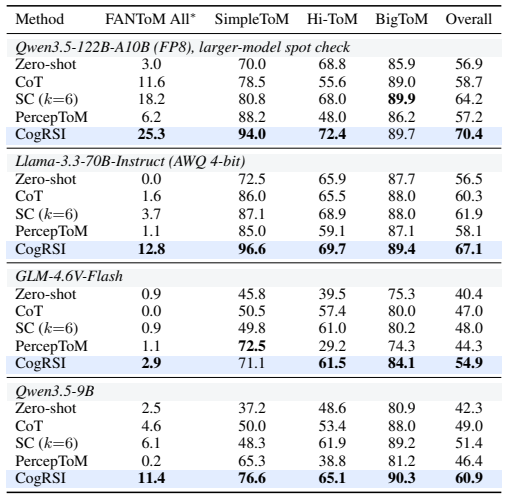
Table 23 : Other backbones. Same systems, prompts and test samples as Table 3; mean of three runs. SimpleToM: mean of behavior and judgment. Best per backbone in bold. †Fewer than three runs finished. On FANToM, CogRSI’s close-split arbitration does not apply (dialogue questions), so its FANToM cells reuse the runs of the variant without it (Appendix C.3).
Original paper · CC BY 4.0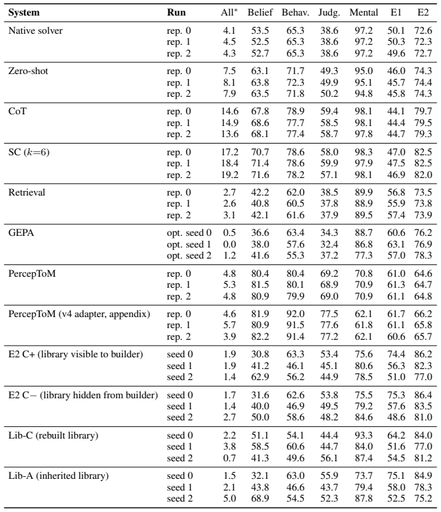
Table 24 : Every run behind Tables 18–22 (accuracy %). Repeats of static baselines are independent executions, not controlled sampling seeds. – = not run.
Original paper · CC BY 4.0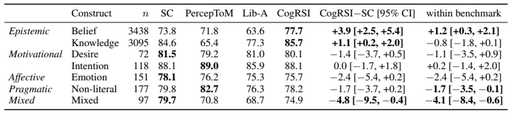
Table 25 : Accuracy by ATOMS construct (Beaudoin et al., 2020) on all test questions of the main backbone (main test sample, three runs each). The difference to self-consistency is bootstrapped over stories/conversations (2,000 resamples);within benchmarkcentres each question’s difference on its benchmark’s mean difference and resamples stories within benchmarks. Bold intervals exclude zero. Constructs with fewer than 50 questions (perception, other) are omitted.
Original paper · CC BY 4.0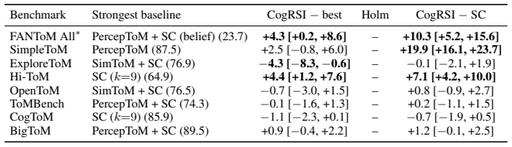
Table 26 : Paired differences (points) between CogRSI and the strongest baseline of each benchmark (its score in brackets) and self-consistency, main backbone, three runs per system. 95% intervals from 2,000 bootstrap resamples of stories or conversations; bold intervals exclude zero. Strongest baseline: the highest Table 3 score among all baselines, including SimToM + SC and PercepToM + SC. Holm: significant after Holm correction over the eight benchmarks (bootstrapp-values, familywise 0.05). An interval that includes zero is not evidence of equivalence.
Original paper · CC BY 4.0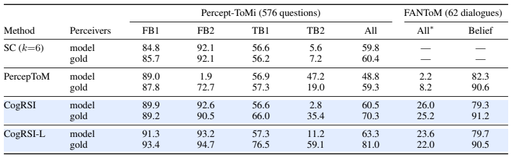
Table 27 :Perception or reasoning?Each system with its own perception call (model) and with the gold perceivers of Percept-ToMi and Percept-FANToM in place of that call (gold; nothing else changes). FB/TB: false/true belief, first/second order. SC never calls perception, so its gold rows are a control. Mean of three runs (CogRSI-L: six loop seeds).Gold perceivers lift both readers most on true-belief questions. On FANToM, belief accuracy rises and All∗ does not.
Original paper · CC BY 4.0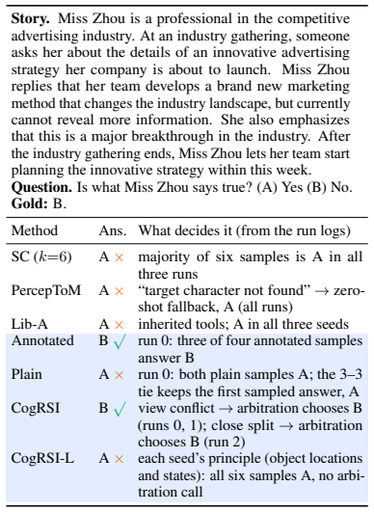
Table 28 :Case study: a ToMBench item every baseline misses and CogRSI gets right by arbitration.
Original paper · CC BY 4.0Quote from the paper
Yandan zheng, Haoran Luo, Xinliang Zhou, Anhtuan Luu (2026). CogRSI: Evolving and Auditing Cognitive Reasoning Strategies. arXiv:2611.01113v1. https://arxiv.org/abs/2611.01113v1
BibTeX
@misc{zheng2026cogrsi,
  title = {{CogRSI: Evolving and Auditing Cognitive Reasoning Strategies}},
  author = {Yandan zheng and Haoran Luo and Xinliang Zhou and Anhtuan Luu},
  year = {2026},
  eprint = {2611.01113},
  archivePrefix = {arXiv},
  url = {https://arxiv.org/abs/2611.01113v1}
}