Paper commentary
Temperature, Not Knowledge: What Recursive Self-Training and Its Remedies Do to a Language Model's Confidence
Self-training sharpens language model confidence, and label-free recalibration can recover it
- Problem Accuracy benchmarks miss when a self-trained model grows more confident in its mistakes. Remedies were judged by accuracy, so their effect on confidence was rarely measured.
- Method The authors split confidence into temperature and discrimination, then track both over five self-training rounds on Qwen3-1.7B. Matching predictive entropy to the calibrated starting model fixes temperature without labels.
- Results Standard self-training drifts confidence upward by +0.049 while AUROC only moves from 0.711 to 0.704. Pairing a ranking-improving loss with label-free recalibration improves both properties.
Why accuracy benchmarks miss confidence drift
Task performance eventually falls, which is the collapse that most of the literature measures.
ForTIFAI's confidence-aware losses skip or down-weight tokens the model already predicts with high confidence. None of these measures looks at confidence, even though confidence is the quantity the methods were designed around. So a remedy could miss its own target and still pass every check.
Confidence matters because users of a deployed model act on it. No accuracy benchmark will reveal that kind of decline. The first is temperature, which can be corrected after training by rescaling the logits. The second is discrimination, whether higher confidence goes with correct answers, which rescaling can't repair.
A simple loop that separates two properties of confidence
The authors separate confidence into temperature and discrimination. Temperature is how confident the model is overall, and rescaling its logits after training can correct it. Discrimination asks whether higher confidence goes with correct answers, and rescaling can't in general repair that. A single calibration number mixes the two, which is why the authors measure them apart.
The loop starts from Qwen3-1.7B with reasoning disabled. Each round, the current model answers a fixed pool of 3,000 questions drawn from TriviaQA and NQ-Open, at temperature 1.0, top-p 0.95 and at most 32 tokens. It is then fine-tuned on those 3,000 question-answer pairs for two epochs with LoRA, at rank 16, and the adapter is merged into the weights to give the next round's model.
Each round therefore trains on the previous model's own outputs, and the loop runs through M5.
Evaluation uses 600 English Global-MMLU items that don't overlap with the training pool. For each option letter, the authors take the log-probability after the answer cue, subtract that letter's mean over the evaluation set to cancel a positional prior, and renormalise. Full precision matters here: when stored as probabilities, 283 of the 600 items at g0 have a chosen-option confidence of at least 0.999999, so many items tie.
Ties would let any method that merely softens the model look better on AUROC, so the debiased log-probabilities are kept unrounded.
Discrimination is the AUROC of the chosen option's log-probability as a predictor of correctness. Average precision adds a view that weights the items the model is most confident about. Temperature is measured as calibration drift, which is mean confidence minus accuracy. At g0 the model answers 0.573 of items correctly with mean confidence 0.963, so its raw ECE of 0.391 is almost all overconfidence (0.390).
Because any softening lowers raw ECE, the authors calibrate first: they fit T0 on half the items at g0 (mean T0 = 10.5, held-out ECE 0.074), apply it at g5, read the drift on the other half, then swap the halves and average.
To track sharpening during training, the authors record mean per-token entropy on the answers each round generates. They summarise it as entropy kept per round, written \(\kappa = (H_4/H_0)^{1/4}\), which is the geometric mean of the ratios between successive rounds. A value of 1 means the model doesn't sharpen.
Self-training moves temperature more than knowledge
Under the standard loop, accuracy and AUROC barely move over five rounds. Accuracy goes from 0.573 to 0.567, and AUROC goes from 0.711 to 0.704. A paired bootstrap over items puts the AUROC change within noise in each seed. Raw ECE barely shows this, changing by +0.015, because the base model's mean confidence of 0.963 leaves little room to rise.
That drift makes the model clearly more confident than it should be.
The damage shows at the top of the ranking. Each seed's 95% bootstrap interval excludes zero for that drop. Accuracy on the most confident fifth of items drops from 0.867 to 0.800. So the model stays about as accurate overall, but its surest answers are less reliable than before.
A temperature fitted once at g0 goes stale, and the authors ask whether one scalar per round can fix this without labels. They use entropy matching, choosing each round's temperature so that mean predictive entropy on unlabelled inputs equals that of the calibrated M0. For every protocol except label smoothing, the resulting ECE is within 0.010 of the labelled oracle.
Label smoothing, run with one seed, reaches 0.102 against the oracle's 0.081. The authors plausibly trace this gap to smoothed targets changing the shape of the output distribution, not only its temperature.
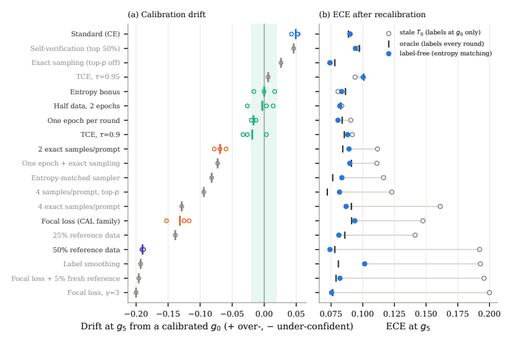
Figure 2 : All protocols, sorted by calibration drift. (a) Drift at g5 from a calibrated g0. Circles are seeds, bars are means, and the shaded band marks |drift| ≤0.02. Colours follow Figure 1, and grey labels mark arms with a single seed. (b) ECE at g5 under three temperatures: one fitted at g0 and never updated (stale), one chosen every round without labels by entropy matching (§4.1), and one refitted every round on labels (oracle). The label-free temperature comes within 0.010 of the oracle for every protocol except label smoothing.
Original paper · CC BY 4.0At 8B, training on reference data alone takes ECE to 0.247 under the stale temperature. The label-free temperature brings that ECE to 0.057, against an oracle of 0.059. That 8B check covers only the temperature diagnosis, since the authors didn't repeat the remedy comparison there. Self-training therefore leaves most of the model's knowledge and ranking in place and mainly moves its temperature.
That temperature can be recovered without labels.
Where the sharpening comes from
Cross-entropy on exact samples from the model's own distribution has zero expected gradient, so sharpening isn't built into self-training. Any sharpening must therefore come from places where the loop departs from that idealisation. The standard loop departs in two ways: it truncates its sampling, and it repeats each prompt's single answer.
With top-p 0.95, any step whose most likely token has probability at least 0.95 is sampled greedily. Greedy steps rise from 73% of steps at g0 to 90% at g5. The sampler keeps 81% of the model's entropy at the start and 64% after five rounds. A sharper model is sampled more greedily, so truncation feeds on itself.
Each prompt has one sampled answer, fitted for two epochs, which pulls the model toward that single answer. Under the standard loop, entropy on the training answers falls 60% over four rounds, from 0.293 to 0.117 nats. Exact sampling with top-p switched off raises entropy kept per round from 0.795 to 0.856. Repetition accounts for most of the sharpening, and truncation accounts for the rest.
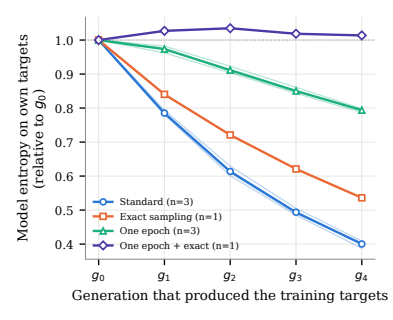
Figure 3 : The model’s mean entropy on the answers it generates for training, relative to round 0. Standard self- training (two epochs, top- p 0.95) sharpens the model steadily. Exact sampling (top-p off) slows the sharpen- ing, a single pass per round slows it more, and the two together keep the entropy flat. Thin lines are individual seeds.
Original paper · CC BY 4.0With both departures removed, a single pass over exact samples keeps entropy at 0.292 nats in round 0 and 0.296 in round 4. That arm has a single seed, so the authors treat it as confirmation of the mechanism rather than a separate result. Flat output entropy doesn't keep multiple-choice confidence at its fixed point. The authors propose two forces: fitting confident tokens sharpens the model, while moving weight toward uncertain tokens softens it.
Which remedies move temperature and which move ranking
Each remedy moves one property and not the other, and no protocol reaches the region where both properties are good.
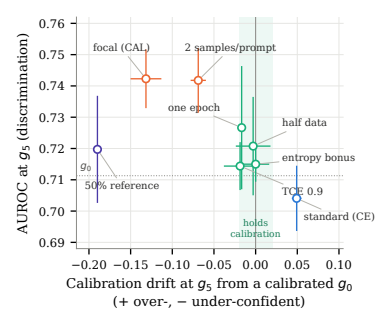
Figure 1 : Each replicated protocol on the two properties of confidence (mean ± sd over three seeds). Protocols in green keep a calibrated model calibrated (shaded band, |drift| ≤0.02); those in orange improve discrimination; violet is 50% reference data. The dotted line marks the starting model g0. No protocol reaches the upper centre, where both properties would be good.
Original paper · CC BY 4.0 · Dipto Sumit, Syeda Fabiayee Jahan, Farig Sadeque · Temperature, Not Knowledge: What Recursive Self-Training and Its Remedies Do to a Language Model's Confidence · Original paper figure · Extracted the figure area from page 2 of the original PDF.Their drifts are −0.019, +0.000 and −0.017, against +0.049 for standard training, each with p≤0.024. None of them costs accuracy, and none lifts AUROC: the values are 0.714, 0.715 and 0.727 against 0.704, each with p at least 0.176. Single-pass training does protect the top of the ranking, keeping average precision at 0.781 compared to 0.741 for standard training (p=0.010).
The focal loss, which down-weights each token by \((1-p_t)^{\gamma}\), raises AUROC to 0.742 with p=0.009 against CE. Two exact samples per prompt reach the same 0.742 with p=0.011, again without costing accuracy. Both overshoot into underconfidence, with drifts of −0.132 and −0.069. Three seeds can't separate the focal loss from simply training less, because it exceeds the step-matched half-data control by only +0.022 (p=0.127).
Reference mixing is the defence the collapse literature relies on most. Judged by raw ECE it looks like a clear improvement, with a change of −0.072 over five rounds. From a calibrated start, however, it ends at drift −0.190 (±0.001 across seeds), with accuracy 0.569 and AUROC 0.720 (p=0.261 against CE). Its raw-ECE path rises after an early softening, which the authors read as partial re-sharpening as the generated half is refitted.
Label-free recalibration brings its ECE to 0.074.
Keeping the more confident half of each round's answers is a simple form of confidence-based filtering.
The focal loss overshoots mainly in temperature, so label-free recalibration can remove the overshoot. A temperature can change how confidences rank across items, yet recomputed AUROC after recalibration is 0.750 for the focal loss against 0.699 for standard training (+0.051, p=0.001). So a ranking-improving loss combined with label-free recalibration gets what no single remedy in the study does.
Limitations
The remedy comparison uses one model, Qwen3-1.7B, one set of 600 multiple-choice items, and confidence read from option letters.
The effects are small in absolute terms, with AUROC differences of 0.02 to 0.04 and drifts of 0.02 to 0.13. With three seeds, the focal loss can't be separated from training less.
The authors tested one label-free recalibration, entropy matching, which they use as a diagnostic. Other methods, such as Thermometer, may track the oracle differently, and entropy-aware truncation inside the loop wasn't tested.
Paper info
- Authors
- Dipto Sumit, Syeda Fabiayee Jahan, Farig Sadeque
- Venue
- arXiv · Preprint
- First published
- 2026-10-31
- Added
- 2026-11-3
- Updated
- 2026-10-31
- Version
- v1
- arXiv
- 2611.01059
- Category
- cs.AI
- Original paper terms
- CC BY 4.0
- What we show
- Paper info, commentary and permitted figures from the original paper
AI commentary is a separate explanation from the original paper and may contain errors. The original paper and figures follow each source's terms of use and any rights noted separately.
Abstract
Recursive self-training can collapse language models, and many proposed remedies target overconfidence, yet their effects on confidence are rarely measured. We study a five-round self-training loop on Qwen3-1.7B, using three seeds per compared method, and distinguish confidence temperature (drift from a calibrated starting point) from discrimination (ranking correct answers above incorrect ones). Accuracy and overall discrimination remain nearly unchanged, but confidence sharpens and the most confident answers become less reliable. Matching predictive entropy to the calibrated starting model each round recalibrates nearly as well as label-based temperature fitting, at both 1.7B and 8B. Sharpening is not inherent to self-training: exact samples from a model's distribution have zero expected gradient. Instead, most drift comes from fitting each generated answer twice, with top-p truncation contributing the rest; removing both keeps entropy on generated outputs flat. Remedies affect the two properties differently: truncated cross-entropy, an entropy bonus, and single-pass training preserve temperature without improving discrimination, while focal loss and multi-sample targets improve discrimination but cause underconfidence. Reference-data mixing also overshoots. Pairing a ranking-improving loss with label-free recalibration achieves both.
Quote from the paper
Dipto Sumit, Syeda Fabiayee Jahan, Farig Sadeque (2026). Temperature, Not Knowledge: What Recursive Self-Training and Its Remedies Do to a Language Model's Confidence. arXiv:2611.01059v1. https://arxiv.org/abs/2611.01059v1
BibTeX
@misc{sumit2026temperature,
  title = {{Temperature, Not Knowledge: What Recursive Self-Training and Its Remedies Do to a Language Model's Confidence}},
  author = {Dipto Sumit and Syeda Fabiayee Jahan and Farig Sadeque},
  year = {2026},
  eprint = {2611.01059},
  archivePrefix = {arXiv},
  url = {https://arxiv.org/abs/2611.01059v1}
}