Paper commentary
Cord: Confidence-Anchored Order Residual Decoding for Masked Diffusion Language Models
Cord learns bounded corrections to confidence decoding for masked diffusion language models
- Problem Confidence decoding reveals the most predictable masked position now, but predictability does not show how useful that reveal will be later.
- Method Cord keeps confidence as the base ranking and learns bounded, prompt-conditioned corrections to it, trained from sequence-level rewards.
- Results Cord reaches 50.5% task success versus 30.6% for confidence decoding, averaged over three backbones.
Why confidence alone is not enough
Masked diffusion language models can reveal positions in many orders, and each revealed token becomes context for later predictions. Confidence is cheap to rank by, because the dLLM forward pass already produces it. But confidence describes how predictable a position is now, not how useful revealing it will be for later predictions.
The authors test this with oracle runs on a frozen LLaDA backbone, revealing ground-truth tokens before generation. On MBPP they reveal the structural skeleton of the canonical program, such as if, else, for, while, and return. So no single reveal bias fits both tasks: reasoning seems to favor coherent prefix expansion, while code favors sparse structural scaffolds.
Learned planners try to fix this by optimizing reveal positions directly. Many of them use reinforcement learning with sequence-level rewards, or auxiliary planning networks. These position-level formulations face a large action space and a temporal credit-assignment problem. The authors instead keep confidence as the base ranking and learn bounded geometric corrections to it.
When the residual coefficients are zero, CORD reduces exactly to Top-2 margin decoding, with the dLLM backbone frozen.
Confidence as the anchor, plus three geometric residuals
The anchor is the Top-2 margin, the gap between the two highest-probability non-special tokens at a masked position. This anchor matches the conventional confidence-based decoder, so the geometric residuals start from a known baseline. Before any combination, CORD z-scores the anchor over the still-masked positions at each step.
Direction maps each masked position's index onto a value between -1 and 1 across the response length L. Proximity measures the smallest index distance from a masked position to any revealed response token, and it is set to 0 when nothing is revealed yet. Bridge is an indicator that equals 1 when revealed response tokens lie on both sides of a masked position.
Prompt tokens never enter the revealed set, so the prompt-response boundary can't create a positional bias.
CORD normalizes each geometric signal the same way, and then multiplies it by its own learned coefficient. The score S(p,s) adds the normalized anchor to the three weighted residuals, and the highest-scoring masked position is revealed at each step. The anchor term stays active at every step, so the residuals only adjust the ranking that confidence already gives.
Because the residuals reweight the ranking, they never remove a masked position from consideration.
A negative direction coefficient favors earlier positions, while a positive one favors later positions. A negative proximity coefficient favors positions near revealed tokens, which encourages local continuation. A positive proximity coefficient favors distant positions, which promotes non-local seeding. The coefficients come from α = α_max ⊙ tanh(C(x)f(s)), so each correction stays bounded by its maximum magnitude.
How the coefficients change during decoding
CORD predicts one coefficient matrix per prompt, so the prompt's effect is fixed before decoding starts. The prompt is represented by mean-pooling the intermediate prompt hidden states from the backbone's first forward pass. That pooling gives a representation e(x) without requiring an additional backbone forward pass. A two-layer MLP maps e(x) to the mean coefficient vector, using a 128-dimensional hidden layer with SiLU activation.
The output is reshaped into a coefficient matrix with B = 3 residual channels and J = 8 state-basis functions, so n = 24.
The state basis f(s) turns the matrix into residual weights that change as decoding proceeds. The basis contains a bias term, the revealed fraction t, and sin(pi t), which together carry the diffusion step. Five further state features are appended, covering the confidence landscape and the reveal geometry. The remaining three describe reveal geometry, namely revealed components, bridge positions, and the largest contiguous masked run.
The coefficient matrix multiplies the basis, and a tanh bounds each residual by its alpha_max limit.
Because the coefficient matrix is fixed once C(x) is set, the residual weights are deterministic functions of the current state. A single matrix therefore specifies a full state-dependent reveal strategy, with no new policy decision at each step. During training, CORD samples around the predicted mean, while at inference it uses the mean program C(x) directly.
With the mean matrix and no sampling, decoding is deterministic through Eqs. 4 and 3.
Training in coefficient space with sibling rollouts
CORD turns the sequence-level reward into a coefficient update by treating each prompt as a contextual bandit. A token-level policy would take a stochastic decision at every decoding step, which creates a long chain of dependent actions and hard temporal credit assignment. Instead, CORD samples one perturbed coefficient vector per rollout, drawn around the predicted mean, and holds it fixed for the whole rollout.
Once the vector is sampled, every later reveal decision is deterministic, so the stochastic action space has only 24 dimensions.
The reward adds an indicator for a correct answer to a format indicator weighted by λfmt = 0.1. The format term lets the policy separate malformed outputs from valid but incorrect responses. Task-specific verifiers decide correctness: answer extraction with symbolic equivalence for math, sandboxed test execution for code, and clue and constraint checks for Sudoku.
For each prompt, CORD draws a group of K sibling rollouts from the Gaussian policy around µψ(x). Each sibling gets a leave-one-out advantage, which is its reward minus the mean reward of the other K minus 1 siblings. The advantages aren't divided by a within-group standard deviation, because that would amplify groups with only one success or one failure.
A group where every sibling earns the same reward gets zero advantage and adds no policy-gradient signal.
The score-function gradient flows only through the log-density of the sampled coefficient vector, never through the discrete reveal trajectory. Successful perturbations pull the predicted coefficient mean toward themselves, while unsuccessful ones push it away. Siblings share all randomness except the coefficient vector, using common random numbers when token generation is stochastic.
Each rollout batch gets one on-policy update, with no learned critic and no importance-ratio correction.
Main comparison across three backbones
Averaged over three backbones and five benchmarks, CORD reaches 50.5% task success, compared to 30.6% for confidence decoding. That is a gain of 19.9 points across the three backbones. The 32.0% to 48.2% pair in the abstract matches the LLaDA-8B-Instruct row of Table 1, not a three-backbone average.
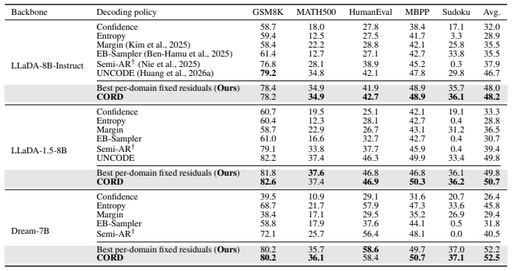
Table 1 :Main results across masked diffusion language models.Task success (%, higher is better). HumanEval and MBPP report pass@1; all other tasks report accuracy. The fixed residual uses the same geometric signals as CORD but keeps their coefficients constant throughout decoding.
Original paper · CC BY 4.0The stronger test compares CORD with the best per-domain fixed residual, which reuses the same direction, proximity, and bridge signals. Averaged over the three backbones, that fixed residual reaches 50.0%, while CORD reaches 50.5%. The authors attribute the remaining gap to adapting the residuals to the prompt and to the evolving decoding state.
The margin is small, so this comparison shows a modest benefit beyond a fixed residual.
CORD trains a separate lightweight policy for each backbone while keeping all backbone parameters frozen. The authors say this setup tests whether CORD exploits a general property of masked diffusion decoding. They didn't train one shared policy across the three backbones.
What each part of the adaptation contributes
The adaptation study in Table 2 splits CORD into variants, each averaged over the benchmarks and backbones. The fixed residual without prompt conditioning averages 46.1, and the prompt-only static variant averages 46.0. Time only keeps the decoding-progress basis but drops the state features, and it averages 46.9. State only keeps the state features but drops the time basis, and it averages 42.2.
Both single-basis variants stay below full CORD, which suggests that decoding progress and partial-response feedback both matter.
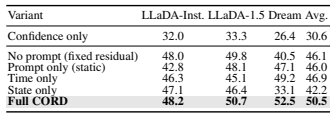
Table 2 :Decomposing adaptation in CORD. Mean task success (%) across all benchmarks.
Original paper · CC BY 4.0The channel ablation runs on LLaDA-8B-Instruct, with one task per domain: GSM8K, MBPP and Sudoku. Each variant removes one residual channel and retrains the coefficient policy under the same training setup. Full CORD averages 54.4 over these three tasks, so that figure isn't comparable to the five-benchmark average of 48.2. Removing bridge gives an average of 43.5, and Sudoku falls from 36.1 to 16.6.
Removing proximity gives an average of 48.9, a smaller drop than the other two channels.
Direction matters most on GSM8K, bridge matters most on Sudoku, and proximity adds a smaller but steady gain. The ablation covers only LLaDA-8B-Instruct, so the channel effects on the other two backbones aren't measured here.
What the learned reveals actually do
The audit runs CORD and an independent confidence-decoding baseline on the same CORD states, so the comparison isn't confounded by diverged trajectories. Each run uses greedy token decoding with T = 0, 256 generation steps, response length 256 and EOS suppression, with LLaDA-8B-Instruct kept frozen. The authors measure three things: how often CORD overrides confidence, how local the reveals are, and how often it picks two-sided positions.
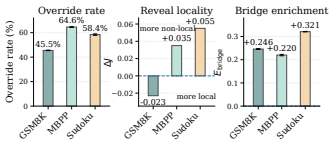
Figure 3 :Realized reveal behavior of CORD. ∆J <0indicates more local decoding than confidence, whereas∆J >0indicates more non-local decoding. PositiveE bridge indicates preferential selection of two-sided masked po- sitions beyond their availability.
Original paper · CC BY 4.0 · Chengwei Zhou, Zhaoyan Jia, Massoud Pedram, Gourav Datta · Cord: Confidence-Anchored Order Residual Decoding for Masked Diffusion Language Models · Original paper figure · Extracted the figure area from page 9 of the original PDF.The override rate counts how often CORD picks a different position from confidence at the same state. CORD overrides the same-state confidence decision on 45.5% of GSM8K steps, 64.6% of MBPP steps and 58.4% of Sudoku steps. Reveal locality is the normalized jump distance between consecutive reveals, written as ΔJ = J_CORD − J_conf. Negative ΔJ means more local decoding, and positive ΔJ means more non-local decoding.
GSM8K becomes slightly more local, at ΔJ = −0.023. MBPP and Sudoku become more non-local, at +0.035 and +0.055. The direction of the locality shift therefore depends on the task.
Bridge enrichment is positive on all three tasks, at +0.246 on GSM8K, +0.220 on MBPP and +0.321 on Sudoku. The authors read this as CORD actively favoring two-sided infilling beyond what candidate availability alone would produce. Together these audits show that the learned residuals change the realized reveal trajectory, and the change is task-specific.
Inference cost of CORD
CORD adds a 5.39% latency overhead on LLaDA-8B-Instruct, measured on one H200 GPU. Mean end-to-end generation latency rises from 6.31 s for confidence decoding to 6.65 s for CORD. CORD introduces no additional backbone forward passes, so the extra cost comes from the decoding procedure itself.
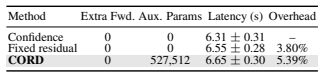
Table 4 :Inference efficiency on LLaDA-8B- Instruct.Latency (s) is measured on one H200 over20runs with256generated tokens and a maximum sequence length of1024; we report mean±standard deviation.
Original paper · CC BY 4.0The prompt-conditioned coefficient matrix is predicted once per response, so its cost is paid only at the start. Direction, proximity, and bridge are recomputed from the current reveal mask at every decoding step. The fixed-residual control incurs a 3.80% overhead, which suggests that most of the extra cost comes from geometric score computation.
The prompt-conditioned policy adds little inference cost on top of that score computation. CORD has 527,512 auxiliary parameters, and the table lists them next to the forward-pass count.
The authors summarize CORD as a lightweight framework that keeps confidence decoding as a stable reference. They don't report inference cost for other backbones in this section.
What the experiments leave open
The efficiency measurement covers only LLaDA-8B-Instruct, run on a single NVIDIA H200 GPU. The paper reports no latency figures for LLaDA-1.5 or Dream-7B.
The behavioral audit uses LLaDA-8B-Instruct alone, on GSM8K, MBPP and Sudoku. The oracle diagnostics cover only GSM8K and MBPP, with the LLaDA backbone frozen. Sudoku doesn't appear in these oracle diagnostics, so its reveal preferences stay unmeasured that way.
The channel ablation runs on LLaDA-8B-Instruct with one representative task per domain. The paper describes training cost only qualitatively, without training-time figures. Training evaluates multiple coefficient-space rollouts for each prompt, which drives that cost. The answer-probability reward is optional, and it needs one extra backbone forward pass.
The main comparison spans three backbones and five benchmarks, where CORD averages 50.5%. Transfer of a trained policy to a backbone it wasn't trained on isn't tested.
Paper info
- Authors
- Chengwei Zhou, Zhaoyan Jia, Massoud Pedram, Gourav Datta
- Venue
- arXiv · Preprint
- First published
- 2026-10-29
- Added
- 2026-11-1
- Updated
- 2026-10-29
- Version
- v1
- arXiv
- 2610.39372
- Category
- cs.CL · cs.AI
- Original paper terms
- CC BY 4.0
- What we show
- Paper info, commentary and permitted figures from the original paper
AI commentary is a separate explanation from the original paper and may contain errors. The original paper and figures follow each source's terms of use and any rights noted separately.
Abstract
The decoding order of masked diffusion language models (dLLMs) can substantially affect generation quality, yet common decoders typically apply the same reveal rule throughout generation. Confidence provides a strong default, but it measures how decisively a position can be predicted now, not how useful revealing that position will be for subsequent decoding. We propose Cord, a lightweight prompt-conditioned policy that retains confidence decoding as a stable reference and learns when and how to depart from it through geometric residuals over generation direction, proximity to revealed context, and two-sided infilling. The residuals adapt to both the prompt and the evolving partial response. Rather than sampling a new policy action at every decoding step, Cord samples a single low-dimensional coefficient matrix per rollout, which induces an entire state-dependent reveal trajectory. This yields a contextual-bandit formulation trained directly from sequence-level rewards, without step-level credit assignment or backbone updates. Across three dLLMs and five reasoning, code, and constraint-satisfaction benchmarks, Cord improves average task success from 32.0% under confidence decoding to 48.2%, and further improves over the best per-domain fixed residual. Behavioral audits show that the learned residuals induce substantial, task-dependent changes in reveal locality and two-sided infilling. Cord adds only $0.53$M trainable parameters, requires no additional backbone forward passes, and incurs only 5.39% inference latency overhead.
Quote from the paper
Chengwei Zhou, Zhaoyan Jia, Massoud Pedram, Gourav Datta (2026). Cord: Confidence-Anchored Order Residual Decoding for Masked Diffusion Language Models. arXiv:2610.39372v1. https://arxiv.org/abs/2610.39372v1
BibTeX
@misc{zhou2026cord,
  title = {{Cord: Confidence-Anchored Order Residual Decoding for Masked Diffusion Language Models}},
  author = {Chengwei Zhou and Zhaoyan Jia and Massoud Pedram and Gourav Datta},
  year = {2026},
  eprint = {2610.39372},
  archivePrefix = {arXiv},
  url = {https://arxiv.org/abs/2610.39372v1}
}