Paper commentary
Only Accepted Tokens Count: An Energy Accounting of Speculative Decoding Under Latency Targets
Speculative decoding saves less energy as batches grow and drafts get less accepted
- Problem Prior work judges speculative decoding by accepted length and speedup, not energy. It never separates draft energy from verify energy, so the energy cost stayed unclear.
- Method The authors pair each speculative run with a same-batch baseline and measure how much energy the draft takes. By removing the draft, they split decode energy into draft and verify shares.
- Results The best drafting scheme per model saved a median 54% of energy per token at batch 1, and 15 to 52% at batch 64.
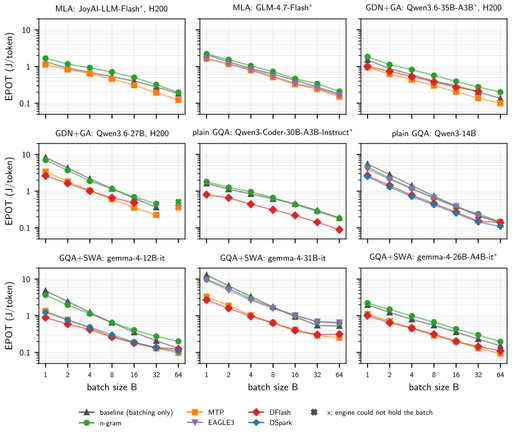
Fig. 2 . Energy per output token against batch with CUDA graph capture enabled for 9 of the 11 models, grouped by attention family and labelled where the panel ran on the H200, with the non-speculative baseline in grey, asterisks marking Mixture-of-Experts models, crosses at batches the engine ran below the requested concurrency, and lines that stop short ending where the engine could not start.
Original paper · CC BY 4.0 · Bole Ma, Ayesha Afzal, Jan Eitzinger, Harald Koestler, Gerhard Wellein · Only Accepted Tokens Count: An Energy Accounting of Speculative Decoding Under Latency Targets · Original paper figure · Extracted the figure area from page 7 of the original PDF.Why batching alone can't meet a tight latency target
Serving a model involves two targets that operators and users both feel, energy per token and the time between a user's tokens. Decode sets the time between tokens, because each pass reads all of the model's weights to produce a single token. The arithmetic units wait on memory during that read, so both the energy and the time follow the bytes moved.
Batching is the first lever, and it shares one weight read across many requests. Batching does nothing for any individual user, though. On the Mixture-of-Experts models that same time grows 2.5 to 4.0 times, because each added request adds its experts' weights to the read.
Speculative decoding then becomes the only remaining lever, because a drafter proposes several tokens at low cost and the model verifies them in one pass.
Prior work evaluates speculation by accepted length and wall-clock speedup, and that work doesn't separate draft energy from verify energy. The open question is therefore what speculation costs in energy, since the drafter still has to be paid for once batching has amortised the weight read.
The idea: spend one weight read on several tokens
A drafter lets one weight read produce more than one token by proposing several tokens that the served model checks together. The served model checks all k drafted tokens in one pass, which turns a vector product into a small matrix product. At serving batch the same extra tokens displace useful work for every request in the pass. So the quantity that matters is the number of tokens accepted per verification, not the fraction of drafted tokens accepted.
The five schemes differ in where the drafter comes from, and so in what a draft costs. A head drafts one token per pass, so a draft of k tokens takes k small passes run in sequence. The block size is set in training and counts the last accepted token that opens it, so DFlash-16 drafts 16 tokens per block. Every scheme also sends the last accepted token through verification, so the model verifies one token more than the drafter proposes.
The measurement covers 11 models that span 4 attention families, so the drafter comparison is not tied to one architecture. Five of the 11 models are Mixture-of-Experts models, marked with asterisks in Table 1.
How the runs were set up
The study covers 11 models from 4 attention families, run under 5 published drafting schemes against non-speculative baselines. Five of the 11 models are Mixture-of-Experts models, and every run uses one NVIDIA H100 SXM5 with a 700 W power limit. Three models run their batch sweeps on an H200 instead, measured at 4.44 TB/s and 722 TFLOP/s: JoyAI-LLM-Flash and the two Qwen3.6 hybrids.
Each run generates 512 tokens per request, and a batch of B means B requests submitted together with no further arrivals. Each batch draws from a pool of 96 distinct prompts, sent through each model's chat template with default settings.
Energy comes from the GPU's cumulative energy counter, read at 10 Hz, so a generation's energy is the difference between two readings. The counter covers the GPU board only, so it leaves out the host processor, host memory, network and cooling. That omission favours n-gram drafting, because its matching runs on the host. The energy saving is the fraction by which the speculative energy per token falls below that of its paired baseline.
DSpark's confidence-scheduled verification is a non-default mode, so the authors didn't use it in any result. Production engines capture the decode step in CUDA graphs, so the authors keep capture enabled for every saving they report. Capture helps the non-speculative baseline more than the speculative run, so measuring with capture disabled credits speculation with overhead it never removed.
The credit from capture is under 10 percentage points on dense models and 19 to 39 points at single stream on Mixture-of-Experts models.
Where the saving is largest and where it fades
On the dense models the same drafter saves energy at single stream.
The saving fades as batch grows, because batching has already spread the weight read over many requests, so the drafter has less to divide. Some schemes cost energy there: n-gram drafting costs energy on every model except Qwen3-Coder-30B-A3B-Instruct, and DFlash-16 costs energy on Qwen3-4B and Qwen3-8B. On the dense Qwen3 models, the ones closest to the two grouped-query models of Fernandez et al., this reproduces the sign change they report.
Does the served text change how much a drafter recovers
The co-trained MTP heads lose little, so on GLM-4.7-Flash the largest saving is the same on both pools.
On gemma-4-12B-it and gemma-4-31B-it, the DFlash drafter and the assistant save the most, and on conversation both accept about as many tokens.
No post-hoc drafter's published training set contains Romansh, yet every model still writes it, so a co-trained head saw what its model saw. Each model continued the article in its language, and only responses that stayed in Romansh were scored, 7 to 11 per model and drafter at a batch of 1.
In Romansh, every drafter on them costs energy, and the post-hoc drafters cost the most. On gemma-4-12B-it the assistant keeps 66 to 69% of its English accepted length, no more than the third-party DFlash drafter. Both lose most of their saving, so the outcome follows when a drafter was trained rather than who trained it.
How speculation compares with a larger batch
The authors ask whether a larger non-speculative batch can replace speculation, comparing runs at different batch sizes. For each speculative run they find the smallest baseline batch that uses no more energy per token than that run. Latency caps the batch size, and that cap is what motivates speculation.
Figure 4 puts speed and energy on the same axes, which shows why batching only partly replaces speculation. On dense models each user keeps close to the same rate throughout.
For a service without a latency constraint, batching is the cheaper way to cut energy. For a latency-constrained service, speculation supplies per-user speed that batching cannot, and on Mixture-of-Experts models it recovers speed that batching gives up. The gemma-4-31B-it model meets that objective only with speculation. The time figures are means over each generation, because the runs don't record timestamps for per-token percentiles.
Without speculation, the 1500 MHz lock cost 3 to 7% of throughput and lowered energy per token by 4 to 11% at every batch. With DSpark-7 or DFlash-16 at batch 16 or more, the GPU already runs between 1450 and 1700 MHz, so the same lock saves no energy.
Verification costs more than drafting
Decode energy splits into a draft share and a verify share, and the authors measure that split by removing the draft. The speculative run skips the drafter's passes after the first step and reuses that step's draft at every later step. Verification keeps its number of tokens and shape, so the only difference between the two runs is the energy of the draft.
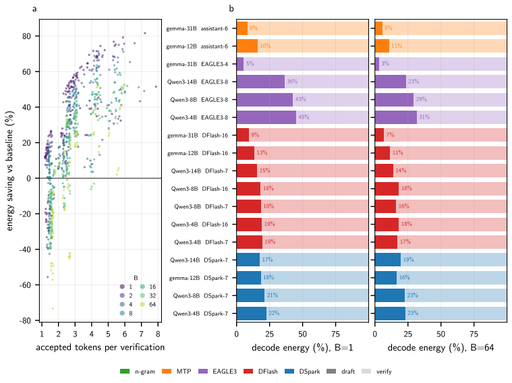
Fig. 5 . Energy saving against accepted tokens per verification for every model, scheme and batch that has a baseline run at the same batch size, coloured by batch (a), and the share of decode energy spent drafting and verifying at 𝐵=1and 𝐵=64with capture enabled for every dense model and scheme, measured by removing the draft (b).
Original paper · CC BY 4.0Halving the cost of a block drafter would therefore lower decode energy by at most 12%, so the drafter is the smaller lever.
Acceptance is the obvious metric for ranking drafters, since drafter training optimises it and every release reports it. Acceptance alone doesn't tell which drafter uses less energy, because the ranking changes with batch while acceptance barely does. The block drafter also verifies more tokens per request, and acceptance counts only the tokens kept.
Once the batch is fixed, however, acceptance does predict the saving, and the saving rises with accepted tokens per verification.
The authors didn't report a draft and verify split for the Mixture-of-Experts models. So the subtraction used on dense models doesn't hold for them, and the authors left their split out.
Does speculation reach the compute-bound regime
The standard explanation says speculation pushes decode toward the compute-bound regime, where arithmetic rather than memory limits the step. The authors measured the operating point with hardware counters instead of inferring it. They ran this on an H100 and on an H200. The counters captured the first decode steps after the prompt, with prompts of 1024 tokens and of about 260 tokens.
Combined with batch, the same verified tokens move the operating point a long way.
DSpark-7 verifies fewer than half as many tokens and stays below the H100 balance point at every batch.
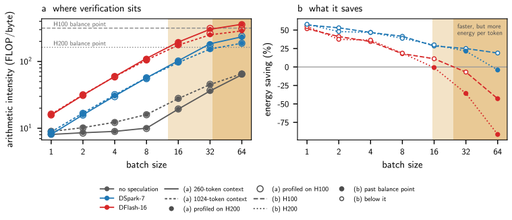
Fig. 6 . Arithmetic intensity of a decode step on Qwen3-4B against batch, with the balance point of each GPU as a horizontal line (a), and the energy saving of the same drafters with capture enabled on each GPU, filled where the step at that batch is past the balance point of that GPU (b), shaded in (a) from the batch at which the DFlash-16 step crosses each balance point and in (b) from the batch at which its saving turns negative on each GPU.
Original paper · CC BY 4.0Crossing the balance point is not a gain in energy, and it marks where the saving ends.
The H200 also changes the baseline energy through its memory and power behaviour. The balance point therefore explains where the saving changes sign, but not how large the saving is.
Measurement pitfalls and limits
The authors list several conditions that change a reported saving without any visible sign in the result file. A batch that the engine resolves below the requested concurrency can also differ between GPUs, as the MTP head on Qwen3.6-27B at batch 16 held 12 requests on the H100 and all 16 on the H200.
The stated limits are mean time between tokens as the latency measure, a GPU-board-only counter, short prompts, batches stopping at 64, and an n-gram sweep over drafted tokens only. The roofline covers Qwen3-4B alone, and longer prompts and batches above 64 were not tested.
Paper info
- Authors
- Bole Ma, Ayesha Afzal, Jan Eitzinger, Harald Koestler, Gerhard Wellein
- Venue
- arXiv · Preprint
- First published
- 2026-10-29
- Added
- 2026-11-1
- Updated
- 2026-10-29
- Version
- v1
- arXiv
- 2610.40287
- Category
- cs.DC · cs.AI · cs.LG · cs.PF
- Original paper terms
- CC BY 4.0
- What we show
- Paper info, commentary and permitted figures from the original paper
AI commentary is a separate explanation from the original paper and may contain errors. The original paper and figures follow each source's terms of use and any rights noted separately.
Abstract
Large language model serving is limited by facility power. Energy per token determines how many tokens a datacenter can serve, while a latency target bounds how quickly each user receives them. During decode, every weight is read from memory for every generated token. Batching amortizes this read across users but makes no individual user faster. Speculative decoding does: a drafter proposes several future tokens, and the target model verifies them in a single forward pass that reuses the same weight read. Because every drafted token must be verified whether or not it is accepted, the energy speculation saves depends on how many drafted tokens are accepted. This saving is hard to pin down. It varies across target models from different attention families and across drafting schemes, and it depends on the text being served. Every drafter we evaluate accepts fewer tokens on conversation than on code, and every trained drafter accepts fewer on Romansh, a low-resource language, than on English. We measure speculative decoding under production serving conditions (SGLang, CUDA graphs enabled) on H100 and H200 GPUs, at batch sizes up to 64 across 5 corpora. On dense models, verification, not drafting, dominates the energy cost. The saving shrinks as the batch grows, because batching has already shared the weight read that speculation would divide among the accepted tokens. At large batch sizes, block drafters push verification past the balance point between arithmetic and memory traffic into the compute-bound regime, where the saving becomes a loss, and a drafter with low acceptance raises energy per token. Meeting a tighter latency target with speculation then costs additional energy. Larger batches lower energy per token without speculation. Speculation adds to that saving only when acceptance is high, and on the model we tested it leaves little headroom for latency-preserving DVFS.
Quote from the paper
Bole Ma, Ayesha Afzal, Jan Eitzinger, Harald Koestler, Gerhard Wellein (2026). Only Accepted Tokens Count: An Energy Accounting of Speculative Decoding Under Latency Targets. arXiv:2610.40287v1. https://arxiv.org/abs/2610.40287v1
BibTeX
@misc{ma2026only,
  title = {{Only Accepted Tokens Count: An Energy Accounting of Speculative Decoding Under Latency Targets}},
  author = {Bole Ma and Ayesha Afzal and Jan Eitzinger and Harald Koestler and Gerhard Wellein},
  year = {2026},
  eprint = {2610.40287},
  archivePrefix = {arXiv},
  url = {https://arxiv.org/abs/2610.40287v1}
}