Paper commentary
Testimony from Timelines: Evidence-Grounded Significance Testing of Temporal Clinical Hypotheses
Language models can be made to run significance tests on clinical timelines
- Problem Language models answer temporal clinical questions with fluent claims and no test behind them. Benchmarks grade only the final verdict, which hides wrong choices about which records count.
- Method ART splits the work into three stages: the model plans and retrieves records, and a fixed function runs the statistical test.
- Results On the test set, ART scored 0.806 with the Qwen2.5 pair, compared to 0.577 for EHRSQL-C.
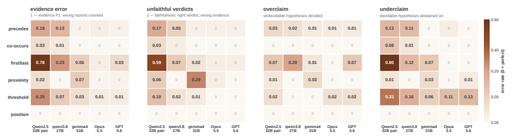
Figure 3 : Evidence errors ofArton the test set, by hypothesis family and model (Section 5.3); 0 is perfect in every panel. The colour scale is square-root.
Original paper · CC BY 4.0 · Chengyang He, Wenlong Zhang, Koduvayur Subbalakshmi, Ping Wang · Testimony from Timelines: Evidence-Grounded Significance Testing of Temporal Clinical Hypotheses · Original paper figure · Extracted the figure area from page 5 of the original PDF.Why a right verdict can still mislead
A temporal verdict can come out right while the reasoning behind it is wrong, and that is the failure this paper targets.
Figure 1 makes this concrete with a Moderna hypothesis over 983 reports, where 30 mention both Pain and Asthenia. That count is supported at p < 0.0001, so the verdict is right. The four reports where Asthenia comes first drop out, so the count no longer reflects the rate the hypothesis asks about.
The full pipeline keeps n = 22 and k = 18 and gives p = 0.002, so both the evidence and the verdict hold up. Strata grades each of these decisions, with gold for the plan, evidence sets and verdict.
The evaluated systems make most of their errors in choosing which reports enter the denominator, and accuracy alone doesn't reveal that gap. EHRSQL-C overclaims mostly on inconclusive hypotheses, where a wrong denominator moves the tail. Underclaim is concentrated in the open models, and EHRSQL-C with the Qwen2.5 pair answers insufficient on nearly four decisive hypotheses in ten.
What Strata contains and how its gold is made
Strata builds its hypotheses over the MedTempo clinical timelines, which come from VAERS adverse-event reports for three COVID-19 vaccines. The source holds 3,166 reports, with 1,164 Janssen, 1,019 Pfizer and 983 Moderna reports. Each report is a leveled order of stages, and a term's first mention fixes its stage. Events at one stage co-exist, with no order between them, so the timeline can't say which came first.
The pool holds 8,735 hypotheses across 26 template groups and four registers, and a held-out test set of 1,500 hypotheses sits apart from it.
Each hypothesis has a denominator D, the reports that can witness it, and a numerator N, the subset that supports it. For a precedes hypothesis, the denominator keeps only reports where both events sit at distinct stages. For a co-occurs hypothesis, the numerator keeps the same-stage reports, so the two families count different records. The benchmark withholds only the mapping from wording to rule and test, and scoring that mapping is what a system is judged on.
Every instance ships a plan, its evidence sets, one-sided p-values and a verdict of supported, refuted or insufficient. A verdict is insufficient when some arm has fewer than 10 reports, which is the floor. Gold is computed mechanically from the timelines, and a deterministic oracle reproduces every gold label. The null follows from the shape of each hypothesis, so order hypotheses take 0.5 and two-arm hypotheses compare two rates.
Order hypotheses use a one-sided exact binomial, and two-arm hypotheses use Fisher's exact test.
How Art turns a hypothesis into a verdict
The key idea is to let the model handle the language and the retrieval, while a fixed function runs the statistics. Art has three stages, articulate, retrieve and test, and each stage writes an output that the next one reads. The design keeps the test out of the model's hands, because agents that write their own analysis also write their own denominator and test.
In S1 the model reads the hypothesis, its difficulty level and its cohort, and composes a plan. The plan names the events, the denominator primitive, the arms, the null, the tail, the test family and the floor. The mapping from wording to hypothesis type is withheld, so the model has to compose the plan rather than look it up. A check compares the plan with the codebook, and a violation sends the model back with the violations named, for up to two re-asks.
In S2 the model writes one SQL statement per arm over the timeline database. The harness resolves the plan's hypothesis type and writes only that type's conditioning rule into the prompt, which is the contract. The statement runs in a read-only sandbox, and the rows are aggregated into n and k per arm together with their report identifiers.
A heuristic recheck fires when an arm's denominator equals its numerator, or when an empty arm sits beside a full one, since both can be correct.
For an order hypothesis such as A precedes B, the denominator keeps the reports with both events at distinct stages: \( D=\{r\in C : A,B\in r,\; s_r(A)\neq s_r(B)\} \). S3 runs the plan's test on n and k, using a binomial against p0 = 0.5 for an order hypothesis. If any arm has fewer than 10 reports, the verdict is insufficient, and otherwise the one-sided p-values decide at \(\alpha = 0.05\).
Because S3 is deterministic, the paper treats it as needing no verification of its own.
Whether the gain rests on correct evidence
Art scores 0.806 with the Qwen2.5 pair, compared to 0.577 for EHRSQL-C. That is a gain of 0.23 for the Qwen2.5 pair, with 0.13 for qwen3.8 and 0.12 for gemma4. Each of these gains reaches p below 0.001 under the paired sign-flip test over facts. gemma4 scores 0.981 with Art, which sits within 0.01 of the frontier models at no marginal API fee.
The codebook matters most, because EHRSQL-C gains 0.05 to 0.22 over EHRSQL for the open models.
A right verdict can still rest on the wrong reports, so the authors score the evidence sets and the trace as well. The trace score extends the FEVER score to the whole chain of decisions, so it credits a system only when every decision is jointly right. With the Qwen2.5 pair, only 0.41 of EHRSQL-C's right verdicts rest on the gold denominator.
Art raises faithfulness and trace for every open model, and at the frontier EHRSQL-C and Art are nearly exact on every measure.
Removing the contract costs the Qwen2.5 pair 0.14, while qwen3.8 and gemma4 lose 0.03 to 0.05. Verify-and-repair adds +0.14 for qwen3.8 and +0.13 for gemma4 at the first re-ask, and costs the frontier models 0.01 to 0.02.
Art's remaining errors concentrate in a few hypothesis families, and the plan exposes most of their causes. qwen3.8 scores 0.69 on position with every evidence set exact, because its plan keeps the tailgreater after the hypothesis is negated.
Limits and open questions
The results rest on one corpus, so the codebook and the denominator primitives carry most of the corpus-specific work. The benchmark is built from MedTempo timelines of 3,166 VAERS adverse-event reports for three COVID-19 vaccines. Another corpus of timelines would enter the framework only by writing those two components, which the authors say is the design's next step.
The authors did not test a different corpus, so the transfer of the framework to other timelines remains open.
Each verdict depends on the codebook the authors chose, and they left alternative codebooks for future work. Held-out templates were also not tested, so whether systems carry the stated rules to new wording stays unresolved.
The frontier comparison is incomplete because the remaining frontier cells were not run, to bound API cost. Verdict accuracies carry 95% bootstrap intervals over facts, so small gaps between systems need reading against those intervals.
Paper info
- Authors
- Chengyang He, Wenlong Zhang, Koduvayur Subbalakshmi, Ping Wang
- Venue
- arXiv · Preprint
- First published
- 2026-10-29
- Added
- 2026-11-1
- Updated
- 2026-10-29
- Version
- v1
- arXiv
- 2610.40619
- Category
- cs.CL · cs.IR
- Original paper terms
- CC BY 4.0
- What we show
- Paper info, commentary and permitted figures from the original paper
AI commentary is a separate explanation from the original paper and may contain errors. The original paper and figures follow each source's terms of use and any rights noted separately.
Abstract
Ask a language model whether sales tend to dip after a product recall, or whether one side effect tends to follow another after a vaccine, and it answers in a fluent sentence that reads like a finding, with no test behind it. Assertions about how events unfold across many cases fill the Web, and each is a temporal hypothesis that only a significance test over the right records can settle. The verifier must specify the null, select the test and decide which records bear on the hypothesis, and any of these choices can go wrong while the conclusion still comes out right. Yet benchmarks for language-model data analysis grade only the conclusion, with the relevant data handed over. We study the problem in health, where a wrong verdict is costly, and present STRATA, a benchmark that grades every decision on the way to a verdict: 8,735 hypotheses over the clinical timelines of vaccine adverse-event reports, with gold plans, evidence sets, p-values and verdicts derived under a released codebook and reproduced by a deterministic oracle. We also propose ART (articulate, retrieve, test), a staged paradigm that exposes each decision as an inspectable output. Extensive experiments with five model configurations show that systems fail mostly at choosing which records count, a verdict-evidence gap that accuracy alone conceals. ART closes most of this gap and brings a 31B open model to within 0.01 of the frontier models under the same paradigm; the frontier models succeed once given the codebook.
Figures from the paper
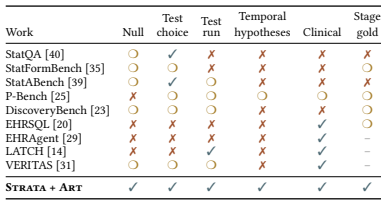
Table 1 : Comparison of representative related work on what each work asks and scores (full version: Appendix A).Test choice: chosen and scored;Test run: the verdict follows from the test result;Stage gold: gold beyond the answer. ✓ yes, ❍ partly,✗no, – n/a.
Original paper · CC BY 4.0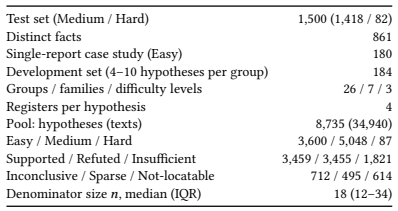
Table 2 : Basic data statistics. Per-group sizes are in the hy- pothesis catalogue (Appendix B); Easy hypotheses have no insufficient class.
Original paper · CC BY 4.0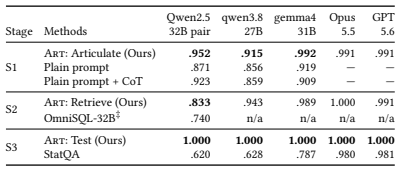
Table 4 : Stage baselines on the test set: verdict accuracy with one stage filled byArt’s component or a baseline, the oth- ers gold or deterministic. CoT: zero-shot chain-of-thought. ‡Fine-tuned from Qwen2.5-Coder-32B. Bold: best per column within a stage where a baseline exists. Dash: run not made.
Original paper · CC BY 4.0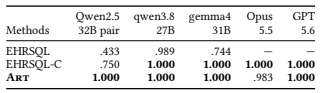
Table 5 : Verdict accuracy on the 180 single-report hypotheses (20 per group). Bold: best per model; a dash marks a run not made.
Original paper · CC BY 4.0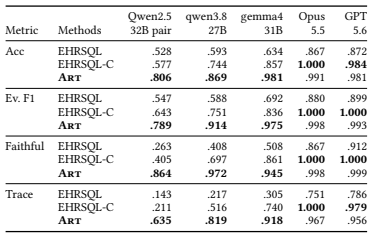
Table 6 : Evidence behind the verdicts on the test set, for the end-to-end systems that return evidence sets (Section 5.3); Acc repeats Table 3; Ev. F1: Evidence F1; Faithful: Faithfulness. Bold: best per metric and model.
Original paper · CC BY 4.0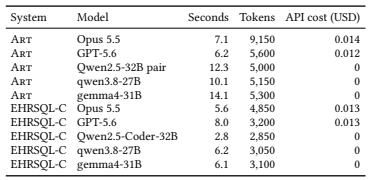
Table 9 : Cost and latency per hypothesis (test set for the local models, usage counts from the test runs for the frontier mod- els).Artrows are the two base calls without repair; tokens are prompt plus completion, and GPT-5.6’s completion count includes its hidden reasoning tokens. Local latencies are mea- sured on one RTX A5000 with the model fully resident; the Qwen2.5 pair’s latency includes swapping the two models between stages.
Original paper · CC BY 4.0Quote from the paper
Chengyang He, Wenlong Zhang, Koduvayur Subbalakshmi, Ping Wang (2026). Testimony from Timelines: Evidence-Grounded Significance Testing of Temporal Clinical Hypotheses. arXiv:2610.40619v1. https://arxiv.org/abs/2610.40619v1
BibTeX
@misc{he2026testimony,
  title = {{Testimony from Timelines: Evidence-Grounded Significance Testing of Temporal Clinical Hypotheses}},
  author = {Chengyang He and Wenlong Zhang and Koduvayur Subbalakshmi and Ping Wang},
  year = {2026},
  eprint = {2610.40619},
  archivePrefix = {arXiv},
  url = {https://arxiv.org/abs/2610.40619v1}
}