Paper commentary
Rethinking Pre-pretraining
Synthetic pre-pretraining rarely beats plain natural-language training under matched compute
- Problem Prior pre-pretraining gains came from one fixed setup, with the weight initialization held constant. Compute also goes to synthetic data instead of more natural-language training, so the benefit was unclear.
- Method The authors split one compute budget between synthetic data and natural language.
- Results Pre-pretraining never outperforms pure natural-language training in compute-matched runs. The 5.4% perplexity gain in an NCA reproduction appears only under the original initialization.
Why pre-pretraining gains are hard to trust
Pre-pretraining trains a model on synthetic data before ordinary pretraining, hoping it picks up priors that help later language learning. Reported gains cover k-Dyck, neural cellular automata, and procedural tasks, with up to 8.6% lower perplexity for NCA. Those prior studies kept the weight initialization fixed while they changed the curriculum.
So a reported gain could depend on the baseline setup as much as on the synthetic data itself. Yamaguchi et al. also kept the initialization scheme fixed, so this pattern extends to concurrent work.
Compute is the second open question, because every PPT step uses compute that could fund more natural-language training. When natural language is scarce, extra compute mostly buys repeated passes over the same tokens. PPT is motivated by the same scarcity, so repetition and PPT become rival answers to one question.
The authors revisit synthetic PPT across several training regimes, since its robustness across configurations remained unclear. Their three synthetic distributions are k-Dyck, NCA, and declarative reference corpora. In the data-unconstrained sweeps, no PPT method significantly outperforms the baseline on natural-language validation BPB. Under the original initialization, the authors recover a 5.4% perplexity gain from PPT in an NCA reproduction.
So an initialization choice can decide whether a PPT gain is real or merely a baseline artifact.
How the PPT pipeline is wired
Pre-pretraining runs a short synthetic phase first, and the transformer body is the only part that carries into natural-language training. k-Dyck is a formal language over k bracket types, where every opening bracket must eventually be closed. The paper uses k-Shuffle Dyck with k=128, the variant that Hu et al. (2025) found performs best.
NCA starts from a random initial grid and a randomly initialized convolutional neural network that serves as the update rule. Each rollout is filtered by its gzip compression ratio, and only rollouts in the highest compression band are kept. The retained grids are flattened like a 2D image and concatenated in time step order into one token sequence.
Figure 2 shows that each 2×2 patch of an NCA grid becomes one token, with start and end tokens between grids. DeclRef is the paper's own addition, built to test retrieval from context, and its keywords, scope brackets, names and values each become a unique token.
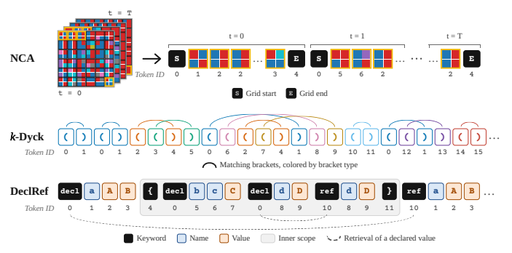
Figure 2 :Tokenizing synthetic pre-pretraining data.For NCA, each grid of a rollout is split into2×2patches that each become one token, and grids are concatenated in time order with start and end tokens. Fork-Dyck, the opening and closing bracket types are each their own token. For DeclRef, keywords, scope brackets, names and values are unique tokens. In the example shown, a reference inside the opened scope retrieves the value of a name declared in that scope, and after the scope closes a reference retrieves the value of a name declared before the scope. Generation and tokenization details are given in Section 2 and Appendix A.
Original paper · CC BY 4.0 · Alexander Stern, Tim Rocktäschel, Acyr Locatelli, Laura Ruis · Rethinking Pre-pretraining · Original paper figure · Extracted the figure area from page 5 of the original PDF.Each run receives a share α of one total budget C for PPT, and the remaining (1−α)C goes to natural-language pretraining. The paper tries α values of 0, 0.01, 0.05 and 0.10, but α = 0.10 was run only in the data-constrained regime. Because α is a share of compute rather than of tokens, each phase's token count follows from the allocation.
The over-Chinchilla setting trains an 881M-parameter model on 50B tokens, with NCA and k-Dyck each at 1% (500M tokens).
At the phase boundary, the vocabulary expands to its natural-language size, and the embedding table and language-modeling head are reinitialized. The C4 control instead runs both phases under one learning-rate schedule with no optimizer state reset, because resetting hurt its final loss. The authors recommend that control setup for future PPT work, since prior implementations used a separate phase and a reset.
The NanoChat fork trains transformer block weights with Muon, while embeddings and the unembedding table train under AdamW. In all three compute-matched settings, the models use the spectral-based default initialization of NanoChat.
LLMTuna proposes each new hyperparameter configuration from a rolling context of earlier trials and their results. It optimizes held-out validation BPB, and the authors found it more sample-efficient than Optuna. The main metric is BPB on a held-out FineWeb split of about 10M tokens, and every metric is the mean over three seeds. BLiMP and DCLM CORE serve as downstream checks, and DCLM CORE aggregates 22 benchmarks.
NCA gains depend on the embedding initialization
That single change improves the no-PPT baseline by 9.0%, which is more than the gain NCA reported.
Applying the same N(0,0.02) initialization to every parameter of the NCA method leaves the two results indistinguishable. The NCA run still receives its extra compute, yet the baseline's own initialization outweighs the PPT effect.
This reproduction doesn't retune the number of PPT tokens under the new initialization, so it doesn't identify the best NCA setting. Its purpose is to measure how much gain the baseline gets before any PPT data is added. The best NCA configuration under the original scheme is studied in the later additive-compute and compute-matched experiments.
Those later runs tune the initialization too, and the spectral-based scheme wins for the baseline at 1B tokens.
Small natural-language budgets versus 1B tokens
The additive setting fixes the model at 336M parameters and sets natural-language budgets to 50M, 100M and 1B tokens. For each budget, the authors vary the PPT token count from 5M up to 1B and ask which amount minimizes final validation loss. One scheme is the N(0,0.02) initialization used by Hu et al. (2025), applied to every parameter. Another follows Lee et al.
(2026), drawing token embeddings from N(0,1) and the remaining parameters from N(0,0.02). The third is the spectral-based initialization of NanoChat, which the authors use as their default.
At 50M and 100M natural-language tokens, both NCA and k-Dyck beat the best no-PPT baseline, which used spectral-based initialization. The authors take this to mean the synthetic languages instill useful inductive biases at low budgets. Table 1 shows k-Dyck at 50M raising DCLM CORE accuracy from 0.024±0.004 to 0.032±0.003 over the no-PPT baseline.
At 1B tokens under spectral-based initialization, every PPT method falls within the baseline's seed spread.
Under the alternative baseline initialization, both curricula still appear to improve on the baseline at 1B tokens. Figure 4 reports that under the other initializations the gain persists at every budget. The additive setting thus shows two overlaid effects, which the authors separate by initialization. Gains at small budgets hold regardless of initialization, but the 1B gain appears only against baselines without spectral-based initialization.
So the claim that the advantage disappears by 1B tokens holds under spectral-based initialization.
Compute-matched results across three regimes
When PPT competes with natural language for one FLOP budget, the data-constrained run shows a clear answer. Moving any share of that budget to PPT raises FineWeb validation BPB in the data-constrained setting with 100M natural-language tokens and a 1×10 18 FLOP budget. The rise levels off beyond 5%, so the authors read the extra PPT share as a steady cost rather than a gain.
So the scarcity case, which is the one PPT is meant for, still favours repetition.
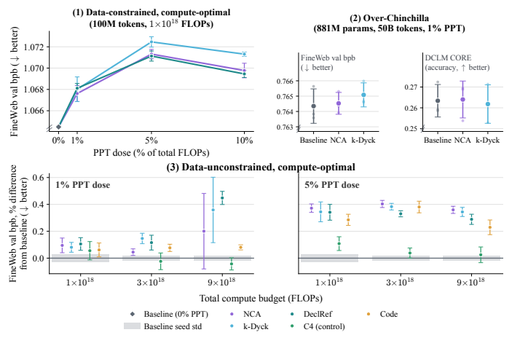
Figure 1 :Across all regimes, allocating compute to PPT never beats spending it on natural language.(1) Data-constrained: FineWeb validation bits per byte (BPB) against the fraction of a fixed1×10 18-FLOP budget spent on PPT, with repetition over 100M natural-language tokens. Op- timal model sizes range from 561M to 708M parameters. (2) Over-Chinchilla: an 881M-parameter model trained on 50B tokens,∼12×the compute-optimal token count, scored on FineWeb BPB and DCLM CORE. The PPT methods spend 0.5B tokens on PPT and 49.5B on FineWeb. (3) Data- unconstrained: the optimal model size found at each budget varies with the PPT method, from 179M to 186M parameters at1×10 18 FLOPs, 252M to 336M at3×10 18, and 438M to 561M at9×10 18.
Original paper · CC BY 4.0The authors had earlier found that repeated training on natural language stays more useful than the synthetic corpora they test, even when unique tokens are scarce. At each budget, the authors search model size to minimize validation loss, so every model is trained at compute-optimality. No PPT method significantly outperforms the baseline in natural-language validation BPB, and the C4 control matches the baseline.
The 1% PPT share sits closer to the baseline than the 5% share at the two smaller budgets.
The over-Chinchilla run trains an 881M-parameter model on 50B tokens, about 57 tokens per parameter. NCA and k-Dyck each receive a 1% PPT share, which is 500M tokens, and the rest goes to natural language. Neither NCA nor k-Dyck improves on the baseline in validation loss or DCLM CORE accuracy in this run. Across all three regimes, the authors use the spectral-based default initialization, since it performed best at the largest additive budget.
Benchmark gains are small and mixed
On BLiMP, the data-constrained DeclRef run at 10% of compute scores 0.731±0.005, against 0.721±0.004 for the no-PPT baseline. Higher is better on both benchmarks, so this is the one data-constrained entry above its baseline. The paper leaves open how significant that gap is, since it calls the significance unclear. DeclRef and code show some improvement at the lowest compute budget, but the C4 control scores similarly on DCLM CORE.
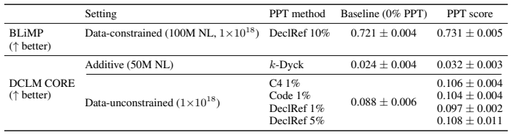
Table 1 :Downstream benchmark improvement.Across the models reported in Figures 1 and 4, these are the cases whose aggregate BLiMP or DCLM CORE score sits above their baseline. How- ever, C4, the natural-language control, reaches a DCLM CORE score in the same range as the PPT methods. In this table, NL denotes natural-language tokens.
Original paper · CC BY 4.0In the data-unconstrained setting, the C4 control at 1% reaches a DCLM CORE score of 0.106±0.004, against 0.088±0.006 for the baseline. A natural-language control landing in the same range as the synthetic methods means the lift isn't specific to synthetic data. In the additive setting with 50M natural-language tokens, k-Dyck PPT raises DCLM CORE accuracy from 0.024±0.004 to 0.032±0.003.
Table 1 lists this additive case as one of the few entries that sit above the baseline.
Beyond the aggregates, some PPT methods improve specific BLiMP sub-tasks while losing ground on others. Because those gains and losses offset each other, most PPT methods land on par with the baseline in aggregate.
Why gains don't carry into pretraining
Ibrahim et al. (2024) report that a switch between two natural languages already causes forgetting. The authors test the same risk on NCA, k-Dyck and code by tracking validation BPB across the phase boundary. At the boundary, validation BPB on the PPT corpus immediately starts increasing, so the models lose that ability.
Interleaving takes a different route and holds 5% of every batch as PPT data throughout training. Both schedules spend the same total compute on the PPT distribution, so placement is the variable that changes. Under interleaving, the models keep their PPT ability and continue to improve on it over the run. Interleaving lowers FineWeb BPB for some PPT methods, but not significantly for all of them.
These runs aren't hyperparameter-tuned, so the configurations in Appendix D.5, Table 7 serve only as a rough check.
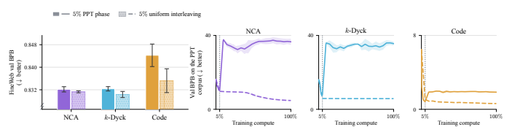
Figure 5 :Uniformly distributing the PPT data across training, rather than front-loading it, prevents forgetting on the PPT distribution.In the interleaved runs,5%of every batch consists of NCA,k-Dyck, or code throughout training. In the PPT runs, the same5%of compute is instead spent up front, at2.7×10 19 FLOPs. Left: FineWeb validation BPB at the end of training. Right: validation BPB on the PPT corpus itself across the whole run, one panel per corpus on its own scale, with the gray dotted line marking5%of total compute. Under the PPT schedule the models lose this ability at the PPT-to-PT boundary; under interleaving they keep it and continue to improve on it. Elsewhere in this work the vocabulary is replaced at the phase boundary for the synthetic PPT distributions, which means the PPT corpus cannot be scored after the PPT phase. Every run here instead shares a single vocabulary, extended to hold the NCA andk-Dyck tokens, so the corpus can be tracked throughout training. These runs are not hyperparameter-tuned (configurations in Appendix D.5, Table 7), so the FineWeb panel is included only to show that the interleaved runs sit in a similar range to their PPT counterparts.
Original paper · CC BY 4.0Code is the telling case, because most code PPT tokens also appear during PT. Even so, code loss rises after the phase boundary. The authors read this as code-specific priors being overwritten once the data shifts to natural language.
Limits on the conclusions
A full hyperparameter sweep wasn't feasible past 9×10 18 FLOPs, because every trial costs a lot. Over-Chinchilla runs tune only peak learning rates and borrow the other settings from smaller budgets. Baseline and PPT methods get the same reduced sweep, so their comparison stays matched. PPT's compute share is fixed at 1% and 5% in the data-unconstrained setting instead of being tuned.
The paper doesn't test shares in between, or shares that change with the total budget.
Riazhskykh et al. (2026) show that a tokenizer alone can change how PPT behaves. Since the setup stays fixed across baseline and PPT runs, any gap should come from PPT itself. The authors report validation BPB, while prior work often reports perplexity, which yields larger relative differences. So BPB differences can't be read directly against the perplexity numbers in prior work.
Across three synthetic corpora and several regimes, PPT never beat spending the compute on natural language. Prior studies held the initialization scheme fixed, so the authors suggest robustness checks should vary it too. The study is limited to language modeling, so other data modalities weren't examined. Whether better interleaving schedules make synthetic data a better use of compute remains an open question.
What the results do and don't settle
The main conclusion concerns natural-language validation loss, and across the tested corpora and regimes, PPT compute never came out ahead of natural-language training. Even the multi-epoch setting over 100M tokens didn't change this result. The additive setting at the smallest natural-language budgets is the one exception, where a benefit held against a well-initialized baseline.
Prior studies fixed the initialization while varying the curriculum, which isolates the curriculum effect but leaves the initialization axis untested. The authors therefore want future robustness checks to vary initialization for both PPT and no-PPT methods.
The scaling analysis points the same way, since a power law fit to each method found no PPT recipe scaling better than the baseline. Code is a sharper case, because most of its tokens also appear during PT, yet loss on the code distribution still rose after the boundary.
Aggregate benchmarks may hide narrower gains, since BLiMP phenomena and DCLM CORE sub-tasks shift in both directions. Targeted evaluations could reveal such capabilities, and gradual integration of synthetic data could help retain them. Synthetic data may still matter in other data modalities, which this language-modeling study didn't examine.
Interleaving prevents forgetting but doesn't significantly improve natural-language performance, so the authors call for testing better interleaving schedules.
Paper info
- Authors
- Alexander Stern, Tim Rocktäschel, Acyr Locatelli, Laura Ruis
- Venue
- arXiv · Preprint
- First published
- 2026-10-29
- Added
- 2026-11-1
- Updated
- 2026-10-29
- Version
- v1
- arXiv
- 2610.40051
- Category
- cs.CL · cs.AI
- Original paper terms
- CC BY 4.0
- What we show
- Paper info, commentary and permitted figures from the original paper
AI commentary is a separate explanation from the original paper and may contain errors. The original paper and figures follow each source's terms of use and any rights noted separately.
Abstract
We report that allocating compute to synthetic pre-pretraining (PPT) never outperforms pure natural-language training in our compute-matched experiments. This holds across four PPT curricula (k-Dyck, neural cellular automata (NCA), declarative reference corpora, and code) and three training regimes: data-constrained, data-unconstrained, and a high token-to-parameter-ratio regime (881M parameters trained on 50B tokens). When natural language is scarce, repeated epochs over a 100M-token corpus beat every synthetic curriculum on natural-language validation loss, with no consistent downstream accuracy advantage from PPT. We find that PPT gains reported in prior work are sensitive to the weight initialization scheme. In an NCA reproduction, we recover a 5.4% perplexity improvement from PPT under the original initialization scheme. An alternative scheme improves both methods, but the no-PPT baseline more, closing the gap between them. However, when PPT receives additional compute rather than a share of the natural-language budget, gains persist at small natural-language budgets even with improved initialization, but disappear by 1B tokens. Finally, models forget what they learn during PPT in subsequent natural-language training; interleaving the same data throughout training prevents forgetting, but does not significantly improve natural-language performance. Our results suggest limited benefits of synthetic pre-pretraining as a distinct training stage and motivate rethinking how such data are used in language model training.
Quote from the paper
Alexander Stern, Tim Rocktäschel, Acyr Locatelli, Laura Ruis (2026). Rethinking Pre-pretraining. arXiv:2610.40051v1. https://arxiv.org/abs/2610.40051v1
BibTeX
@misc{stern2026rethinking,
  title = {{Rethinking Pre-pretraining}},
  author = {Alexander Stern and Tim Rocktäschel and Acyr Locatelli and Laura Ruis},
  year = {2026},
  eprint = {2610.40051},
  archivePrefix = {arXiv},
  url = {https://arxiv.org/abs/2610.40051v1}
}