Paper commentary
ParaTTT: Parallelizing Test-Time Training Layers with Deep Memories
Parallel refinement lets nonlinear test-time training layers run much faster
- Problem Nonlinear test-time training memories must update one token at a time, so they run slowly. Existing code such as TTT-MLP uses block approximations that run several times slower than linear recurrences.
- Method ParaTTT parallelizes deep nonlinear memories by refining a guess of the hidden-layer gradients. Each round runs three chunkwise-parallel passes instead of a token-by-token loop.
- Results With two refinement steps at 4K context, ParaTTT evaluates the inner loop 32× faster than TTT-MLP at matched error.
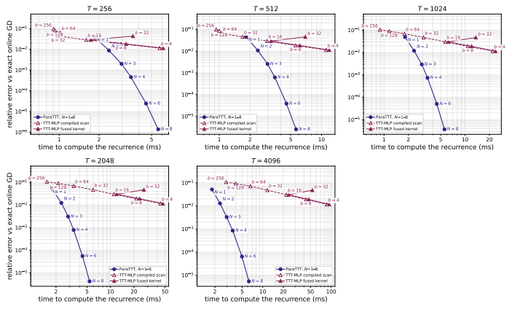
Figure 7 : Relative error against exact online GD versus the time to compute the forward recurrence of one 340M layer (batch 1), at five sequence lengths; same setting and legend as
Original paper · CC BY 4.0 · Noel Loo, Neehal Tumma, T. Konstantin Rusch, Mathias Lechner, Alexander Amini, Daniela Rus · ParaTTT: Parallelizing Test-Time Training Layers with Deep Memories · Original paper figure · Extracted the figure area from page 34 of the original PDF.Where nonlinear memories stall
A test-time training layer keeps its memory inside a small network's weights, and each token nudges them by online gradient descent. A linear update stays linear in the recurrent state, so it keeps the exact chunkwise-parallel form. A nonlinear memory can also adapt its features, not only its readout, and that added expressivity is the reason for deep memories.
Each token's gradient in that case is evaluated at weights produced by all preceding updates. This dependency blocks the chunkwise rearrangement, so the exact recurrence has to be stepped through one token at a time.
Existing code such as TTT-MLP gets parallelism by evaluating every gradient in a block at the weights that entered the block. Blocks still run sequentially, taking T/b steps, so larger blocks cut sequential depth but coarsen the approximation. Smaller blocks are more faithful but need more sequential steps, so speed and fidelity trade against each other.
Titans and LaCT follow the same block form, with momentum and weight decay for Titans and very large blocks for LaCT. The authors set out to close this gap, and their route is to refine the gradient trajectory rather than to block it.
Refining a guess of the gradient trajectory
ParaTTT changes the inner loop from a sequential walk over tokens into a loop over whole-sequence guesses. Each round runs three passes that are all parallel over tokens.
The forward pass builds the features that the current gradient guess implies. The readout pass computes each token's loss gradient with respect to its features. The backward pass carries these gradients through the hidden layers to form the next estimate. Each round is built from modified versions of existing parallel recurrences, such as Gated DeltaNet, Mamba-2, and gated linear attention.
The authors expected this to work because the gradients are small objects compared with the memory state. Each gradient is a d-dimensional vector, while the fast-weight state has O(d^2) entries. Once the gradients are fixed, the fast-weight trajectory becomes a linear recurrence. That linear recurrence runs on chunkwise linear recurrent kernels, so the full weight trajectory and its transition Jacobian never need to be formed.
ParaTTT therefore iterates on the pre-activation gradient at each token and hidden layer.
The exact online gradient descent recurrence is a fixed point of this iteration. In practice, two iterations suffice for the reported models. Decoding requires no refinement iterations, since the loop only computes the prefill.
One refinement round, pass by pass
A round starts from the current guess of the hidden-layer gradients and runs a forward pass that builds the features implied by that guess. Each refinement consists of three parallel passes, and the forward pass constructs the features from the current gradient estimate. The forward pass evaluates the resulting feature trajectory, so the features it produces feed the next stage directly.
The readout pass takes those features and computes each token's loss gradient with respect to its features. That readout pass is the gated-delta-rule kernel with its final read transposed, which the authors call DELTARULEGRAD. DELTARULEGRAD returns the feature gradient for each token, which the backward epilogue then consumes.
The backward pass converts those feature gradients into a new hidden value for the next iteration. It passes the gradients through the transposed Jacobian of the projection, and then through the transposed Jacobian of SiLU. The projection's transposed Jacobian is the identity inside the unit ball and the normalizing term outside it. A damped Picard step mixes this new value with the previous iterate, so each update moves only a fraction λ of the way.
Decoding skips refinement entirely, because a new token needs only the exact recurrence. The number of rounds N therefore shapes only the prefill, which is where the authors set the trade-off. They train at N equal to 2 by default, and the ParaTTT models evaluate at their training N with the chunkwise prefill.
Does iteration beat the block approximation on speed
TTT-MLP's block form fixes its error by block size, so its error can only drop with smaller blocks and a longer sequential loop. ParaTTT's error instead falls as the iteration count N rises, so the two methods can be compared at matched error. The comparison uses one random inner MLP at T = 4096, with the output error measured against exact gradient descent.
Each configuration is plotted as output error against the time needed to compute the recurrence.
At T = 4096, two ParaTTT iterations match the error of TTT-MLP at block size about 5, in 32× less time. The figure marks this equal-error point with an arrow, and the N = 8 setting approaches the bf16 noise floor. At T = 16,384 that gap grows to 8.5×.
That is the 4.9× training speedup reported in the abstract. ParaTTT still retains roughly one-third the throughput of the linear baselines. Real text tells a similar story, with the trained models converging in few iterations.
What the speedup does to language modeling and recall
Position-wise perplexity shows where ParaTTT's gain appears along the sequence.
On the zero-shot benchmarks, ParaTTT has the best perplexity among the recurrent models at both scales. ParaTTT also shows stronger recall than Gated DeltaNet and Mamba-2 on SWDE and FDA at both 340M and 1.3B. The authors read this as the nonlinear memory improving over the evaluated linear baselines, a claim limited to those baselines.
TTT-MLP runs its nonlinear memory in blocks, and it costs much more to train. It matches Gated DeltaNet on WikiText-103 but is far behind on LAMBADA. It provides little improvement on recall, so the block-based nonlinear memory doesn't close the gap on this task.
ParaTTT does well on recall even though decoding uses the exact recurrent gradient-descent update. Training, however, used the iterated approximation, so the prefill and decode paths differ. The authors conclude that this prefill–decode discrepancy doesn't prevent strong recall.
Centering and the iteration count
The authors compare three readouts: zero-initialized, learned but uncentered, and centered. The learned uncentered readout gives the hidden layers a gradient from the first token, but its output carries the bias before any test-time learning. The centered readout applies the fast readout to the features and the slow readout to how far those features drift from the slow features.
Because of this, the readout is zero at the start of a sequence while its Jacobian is not.
Relative to Gated DeltaNet, the zero-init readout moves LAMBADA perplexity from 29.66 to 32.62 while improving recall. The largest NIAH gain from centering appears at 32K.
The authors take the zero-init ablation as evidence that centering is needed to unlock the gains of refinement. Over-iterating the model trained at N=2 degrades performance slowly, while the model trained at N=5 exhibits little degradation.
So the iteration count N is a training-time choice that trades LAMBADA perplexity against recall.
What the design choices cost
The authors timed one token-mixing layer on MI325X GPUs in bf16, with batch 8 and 20 iterations after 3 warm-up runs. The fused TTT-MLP kernel supports only head dimension 64 and block size 16, so the authors used a compiled PyTorch scan elsewhere.
The uncentered learned readout adds its offset to the final read of DELTARULEGRAD. Relative to the zero-initialized readout, that offset costs 12% of layer time at 4K and 9% of training throughput. Centering also needs 9 GiB of activation memory, so it costs about 11% of training throughput in total.
In the reference implementation, this body costs 17% of layer time at every length, 35.6 ms against 30.4 ms at 4K. The authors call it the more cost-effective choice, because SWDE rose from 28.4 to 41.9 and NIAH at 4K rose from 7.2 to 32.6.
Peak memory at N=2 is 2.5 times that of Gated DeltaNet, both for one layer and for the full 340M model in training. For one layer at batch 8 and T=4096, ParaTTT needs 6.5 GiB, against 2.6 GiB for Gated DeltaNet.
Where the evidence stops
The convergence result covers only a two-layer variant, while the authors state the method for arbitrarily deep memories. For deeper memories, the paper's support is empirical, since its proof of geometric convergence applies to the two-layer variant. The proof holds only under sufficient contraction conditions, and the authors note that practical models lie outside the assumptions of Theorem 1.
For practical models, the authors rely on the observation that two iterations suffice.
Over-iterating the N=2 model degrades it slowly, so the iteration count at evaluation should match the count used in training. The model trained at N=5 shows little degradation, which the authors read as adaptation to the finite-N prefill used during training. The paper reports speed only on MI325X GPUs in bf16, so the speedups are measured on that one setup.
The fused TTT-MLP kernel supports only head dimension 64, so larger head dimensions fall back to a compiled scan.
The per-iteration error comparison instead uses one random inner MLP at T=4096. So the error-versus-compute curves and the trained-model agreement numbers come from different setups.
Paper info
- Authors
- Noel Loo, Neehal Tumma, T. Konstantin Rusch, Mathias Lechner, Alexander Amini, Daniela Rus
- Venue
- arXiv · Preprint
- First published
- 2026-10-28
- Added
- 2026-11-1
- Updated
- 2026-10-28
- Version
- v1
- arXiv
- 2610.38255
- Category
- cs.LG
- Original paper terms
- CC BY 4.0
- What we show
- Paper info, commentary and permitted figures from the original paper
AI commentary is a separate explanation from the original paper and may contain errors. The original paper and figures follow each source's terms of use and any rights noted separately.
Abstract
Test-time training (TTT) layers replace the linear fast-weight memory of modern recurrent architectures with a small neural network trained online by gradient descent. This nonlinear memory is more expressive than the linear memories of Gated DeltaNet and Mamba-2, but is difficult to parallelize: existing implementations such as TTT-MLP rely on sequential, block-wise weight updates that run several times slower than chunkwise-parallel linear recurrences. Moreover, their block-wise execution only approximates the token-by-token online recurrence, whereas linear recurrences admit an exact chunkwise-parallel evaluation. We introduce ParaTTT (PTTT), an algorithm for parallelizing arbitrarily deep nonlinear memories by iteratively refining estimates of the inner-loop gradient trajectory. Starting from a guess of the hidden-layer gradients, each refinement consists of three chunkwise-parallel passes: a forward pass that evaluates the resulting feature trajectory, an exact gated-delta-rule pass that computes the readout trajectory and its feature gradients, and a backward pass that propagates these gradients into a new estimate. The exact online gradient descent recurrence is a fixed point of the iteration, while decoding requires no refinement iterations. We prove geometric convergence for a two-layer variant under sufficient contraction conditions. In practice, two iterations suffice. With two refinement steps at 4K context, PTTT evaluates the inner-loop trajectory $32\times$ faster than TTT-MLP with the block approximation at matched error, while the full 340M model trains $4.9\times$ faster. Models trained at 340M and 1.3B parameters match or exceed Gated DeltaNet and Mamba-2 and remain competitive with same-size Transformers on language-modeling perplexity and zero-shot accuracy, with better recall than the linear recurrences.
Figures from the paper
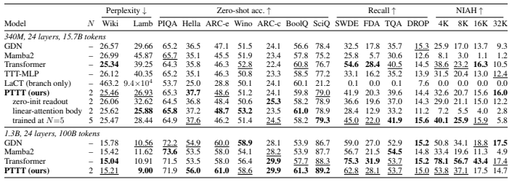
Table 1 : Main results at 340M and 1.3B. Recall follows the generation protocol of Arora et al. (2024a); NIAH is the RULER needle average at the given length. Best per column and size in bold, second best underlined. A couple of notes: (1) LaCT fast-weight branch only is an ablation of the published hybrid. (2) The zero-init readout removes both centering and the learned initialization;
Original paper · CC BY 4.0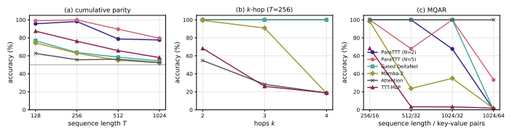
Figure 6 : Synthetic nonlinear-state tasks (two layers, width 256 except width 512 for MQAR with 64 pairs; mean over three seeds at the best learning rate). (a) Cumulative parity against sequence length; the dotted line is chance. (b)k-hop pointer following atT= 256. (c) Multi-query associative recall for increasing sequence length and number of key-value pairs.
Original paper · CC BY 4.0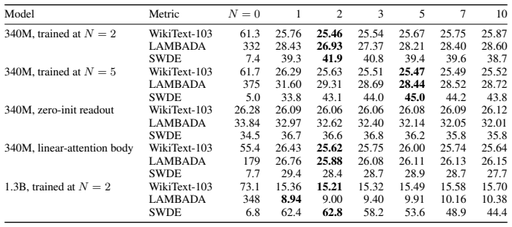
Table 3 : Perplexity (WikiText-103, LAMBADA) and SWDE accuracy of the ParaTTT models as a function of the number of iterations at evaluation. Bold: bestNfor the centered models.
Original paper · CC BY 4.0Quote from the paper
Noel Loo, Neehal Tumma, T. Konstantin Rusch, Mathias Lechner, Alexander Amini, Daniela Rus (2026). ParaTTT: Parallelizing Test-Time Training Layers with Deep Memories. arXiv:2610.38255v1. https://arxiv.org/abs/2610.38255v1
BibTeX
@misc{loo2026parattt,
  title = {{ParaTTT: Parallelizing Test-Time Training Layers with Deep Memories}},
  author = {Noel Loo and Neehal Tumma and T. Konstantin Rusch and Mathias Lechner and Alexander Amini and Daniela Rus},
  year = {2026},
  eprint = {2610.38255},
  archivePrefix = {arXiv},
  url = {https://arxiv.org/abs/2610.38255v1}
}