Paper commentary
Estimating Implicit Expected Log Density Ratios
Velocity Flow Matching reduces error when estimating expected log density ratios
- Problem Density ratio estimators degrade when the two densities diverge, and ELDR estimation inherits that failure.
- Method VFM anneals a two-sided ratio estimator along a path through p*, unlike one-sided methods that estimate each density alone.
- Results VFM had a median error of 0.279 on the DoKLs ablation at KL 0.3, versus 1.49 for TDRE.
Why ELDR estimation gets stuck
Many machine learning tasks need the expectation of a log density ratio under a third distribution, not the ratio at a single point. The authors call this quantity the expected log density ratio, or ELDR, and write it as the expectation under p* of log(p0/p1). The usual route is to estimate the ratio with density ratio estimation (DRE) and then average the estimated log ratio over samples of p*.
The plug-in estimator takes n* samples drawn from p* and averages the estimated Rb at each sample. This plug-in route treats the ELDR as a by-product of a full function estimate, even though the target is a single scalar.
A second route writes the ELDR as a difference of two KL divergences, KL(p*||p1) minus KL(p*||p0), and estimates each one. The authors say this is hard to scale when the distributions are divergent, even when they are evaluated in-distribution. The difficulty is often blamed on the density chasm: when the ratio takes extreme magnitudes, many samples are needed to tell a weak estimator from a strong one.
Formal results show that confidently bounding KLs requires exponentially as many samples. Annealing through intermediate problems with smaller KL divergences helps, but test-time evaluation then becomes divergent for some components, or for all of them when p* diverges from both p0 and p1.
Binary DRE, due to Gutmann and Hyvärinen, labels samples by whether they come from p0 and trains a classifier. Its optimal discriminator logits are exactly R(X) = log{p0(X)/p1(X)}, so the classifier learns the log ratio directly. One-sided DRE methods instead estimate p0, p1, or their logs, and compounding errors arise when p1(X) is close to zero.
The key idea: a scalar target and a path through p*
Treating the ELDR as one scalar target changes what the estimator has to learn, because it no longer needs a full density ratio function. The ELDR is a simpler object than an entire density ratio, since it is a scalar rather than a function. The authors observe that in implicit-density settings they typically appear as the expectation of a nuisance density ratio, or as a difference of KL divergences.
They propose that these quantities be considered a single, scalar estimation target instead. The ELDR is defined as the expectation under p* of log(p0/p1), which equals KL(p*||p1) minus KL(p*||p0). The authors' theory suggests that methods tailored to this estimand can avoid some of the limits that DRE-based plug-ins run into.
The annealing idea from DRE carries over, but here the annealing path runs through p*. This choice makes the KLs that appear in the finite-sample bounds the quantities being controlled. Annealing in DRE is usually done between p0 and p1, which means the test-time evaluation can be divergent for some components. Path-based DRE methods such as TDRE, MDRE, TSM and CTSM already use annealed paths between p0 and p1.
Velocity Flow Matching (VFM) is the authors' novel two-sided path-based approach, built on stochastic interpolation.
VFM is the first approach to ELDR estimation in this work, and it adapts a DRE method rather than building a new estimator from scratch. The authors describe it as a naïve baseline that learns and manipulates the transport equation of a stochastic interpolation. They also describe their results as providing novel insight even when p* is in {p0, p1}.
What the finite-sample bounds say about estimating ELDRs
The first bound concerns an interval on an ELDR built from N samples of p*, given perfect knowledge of p0 and p1. With high probability, such a delta-confident interval is bounded by a factor of the symmetric KL between p0 and p1. Its width scales on the order of 1/N, so more samples of p* tighten the interval only at that rate. The paper also gives an N-free width result: reaching a given width with probability at least 1 minus delta prime needs a factor of order e to the 1/N.
A second result says that any N-sample interval differs, with high probability, from the trivial bound KL(p*||p0) + KL(p*||p1) by at most 2 log N. This trivial bound holds with probability one, so the result says the sample-based interval can't do much better than it.
The third result covers the case where p0 and p1 are sampled with M0 and M1 samples and p* is known. Here the interval is bounded by a factor of KL(p*||p0) + KL(p*||p1), with N = min{M0, M1}. The authors note that these results hold even when p* equals p0 or p1. They also say the results agree with conjectures about DRE's finite-sample limits under divergence of p1 from p0.
How VFM computes its estimate
At run time, the plug-in estimator averages a learned log ratio over samples drawn from p*. Written out, the estimate is the mean of R-hat at the points x_i* drawn from p*, where R-hat approximates log(p0/p1). The estimator needs only sample access to p* and a learned ratio, so it has no likelihood access to p* at evaluation time.
The classifier-based Binary DRE labels samples from p0 and p1 and reads the log ratio from the logits of an optimal discriminator. Annealed variants such as TDRE, MDRE, TSM and CTSM move through intermediate distributions, because a weak classifier can separate divergent samples. FMDRE is one-sided and built on flow matching, so it estimates log p0 and log p1 rather than the ratio directly.
VFM is a two-sided path-based approach built on a stochastic interpolation, which the authors present as a naive baseline. VFM learns the transport equation of that interpolation and manipulates it to produce the log ratio. Because the output is a log ratio, VFM fits the same plug-in average as the other methods. The authors anneal along a probability path through p* to control the KLs in their bounds.
Benchmark evidence for the triangular and VFM variants
In the model comparison benchmark, the authors use 3D Gaussians prescribed at a sweep of KL distances. Each dataset draws 8192 samples from each of p0 and p1, and N* is drawn from the set 2048, 4096, 8192 and 16384. The figure reports results with N* = 4096, and the error of some triangular variants is lower than their bases over certain KL ranges.
CTSM and some baselines don't show this pattern, since the authors note that the baselines' regret is greater in most of the sweep. The gap grows with KL in that benchmark, which makes the comparison most informative at larger divergences.
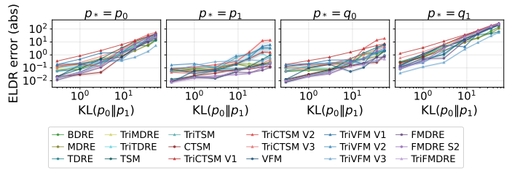
Figure 3 : The mean model selection error± SE with N = 8192, N∗ = 4096as KL levels vary. With the exception of some small KL levels and CTSM, the regret of baselines is greater, and the gap increases with the KL. In fact, someimproveover certain KL ranges.q0 bisects p0, p1 while q1 divides both externally. More metrics and plots for otherN, N∗ pairs are available in App. F.3.
Original paper · CC BY 4.0 · Avi Amalanshu, Chandler Squires, Yizhou Lu, Pradeep Ravikumar · Estimating Implicit Expected Log Density Ratios · Original paper figure · Extracted the figure area from page 10 of the original PDF.The DoKLs ablation with p* equal to q1 and N=1024 gives the clearest head-to-head between VFM and a DRE baseline. TDRE's median at the same KL is 1.49, so VFM's error is lower in that cell. This is one cell of a larger table, so the gap should be read at this N and KL, not as a general ranking.
In the EIG experiment with p* equal to p0, the Figure 1 caption says triangular variants typically outperform their base variants. The caption adds that this is particularly so for values of beta that are hard for the base variant. The exception the caption names is the p*-anchored barycentric-path variant V2 of CTSM.
Semi-synthetic setups on natural data
The authors need natural-data settings where p0 and p1 still keep likelihood access, because ground truth for ELDRs on complex data is itself hard to get. Most earlier ELDR benchmarks use synthetic distributions with explicit densities, such as Gaussians and their invertible transformations, or surrogate metrics. The authors balance two goals: distributions that are high-dimensional and realistic, and p0 and p1 that provide likelihood access for evaluation.
To build one problem instance, they select mixture weights w*, w0 and w1 over the set of class labels Y. Each distribution is then defined as pi(x) as a weighted sum over classes of wi times µ(x|y), for i in {0, 1, *}. Varying these mixture weights yields different instances with different divergences between p*, p0 and p1.
The classes are the canonical ten digits, 0 to 9, which are labels in the base dataset. The classes are the 14 ontology categories of DBpedia-14, such as Company, Artist, Animal and WrittenWork.
The pendulum setting uses trajectories of a torque-controlled pendulum as data. One run is trained on the upright reward and the other on a reward blended toward swing-down, while p* is the rollout of a mixture policy. The authors sample 5000 trajectories of horizon T=20 per distribution. The ELDR error results for these three settings appear in Fig.
4b, 4c and 4d.
Limitations and open questions
Triangular methods expose more hyperparameters than their DRE bases, such as the vertex and height of the triangle. For a practitioner, the search space needed to find good values is larger than for the base DRE methods. The authors standardized by giving every method a uniform computational budget, which they say yields a fair comparison.
The hyperparameter formulation might be replaced by extending the same principles of designed probability paths to OOD-test time. Promising directions named by the authors include sampling correctors and pre-computed transport maps.
At the largest KL levels, every method is far from the true ELDR. Because the spread among methods contracts there, the ranking is less informative in that regime. Optimization is the first open thread: estimating ELDRs is already hard, and optimizing them is harder. The popular reparameterization trick for ELBO may suggest that ELDR estimation readily enables first-order optimization, but the authors caution this is not necessarily true.
Under suitable regularity conditions, the gradient of the ELDR with respect to the parameters splits into two terms, T1 and T2. The first term T1 is tractable, since it is an expectation over the base distribution of a reparameterized integrand. The second term T2 is an expectation under the parameterized distribution of the gradient of the log ratio, and it is not necessarily tractable.
Paper info
- Authors
- Avi Amalanshu, Chandler Squires, Yizhou Lu, Pradeep Ravikumar
- Venue
- arXiv · Preprint
- First published
- 2026-10-28
- Added
- 2026-11-1
- Updated
- 2026-10-28
- Version
- v1
- arXiv
- 2610.38151
- Category
- cs.LG · cs.AI · stat.ML
- Original paper terms
- CC BY 4.0
- What we show
- Paper info, commentary and permitted figures from the original paper
AI commentary is a separate explanation from the original paper and may contain errors. The original paper and figures follow each source's terms of use and any rights noted separately.
Abstract
When exact probabilities cannot be computed, \emph{density ratio estimation (DRE)} is a key subroutine in the wide range of applications where density ratios appear, from experimental design to generative modelling and reinforcement learning. In this paper, we introduce the concept of an \emph{expected log density ratio (ELDR)}: log density ratios that are integrated under some third, possibly distinct measure. We show many problems with implicit densities where DRE is naïvely used are actually ELDR estimation tasks, and prove fundamental limitations on finite-sample ELDR estimation. Based on these results, we argue that the typical DRE-based approaches are unsuitable for ELDR estimation, and provide some foundational motivation towards bespoke ELDR estimators. To demonstrate, we propose a simple modification to some DRE methods that allows samples convergent to the integral distribution to appear in training data. We show through benchmarks that this can improve ELDR estimation error.
Quote from the paper
Avi Amalanshu, Chandler Squires, Yizhou Lu, Pradeep Ravikumar (2026). Estimating Implicit Expected Log Density Ratios. arXiv:2610.38151v1. https://arxiv.org/abs/2610.38151v1
BibTeX
@misc{amalanshu2026estimating,
  title = {{Estimating Implicit Expected Log Density Ratios}},
  author = {Avi Amalanshu and Chandler Squires and Yizhou Lu and Pradeep Ravikumar},
  year = {2026},
  eprint = {2610.38151},
  archivePrefix = {arXiv},
  url = {https://arxiv.org/abs/2610.38151v1}
}