논문 해설
ParaTTT: Parallelizing Test-Time Training Layers with Deep Memories
ParaTTT: 깊은 메모리를 활용한 테스트 시간 학습 계층의 병렬화
- 연구 문제 ParaTTT는 비선형 MLP 기반 test-time training 메모리의 순차 gradient 재귀를 chunkwise-parallel 커널의 반복으로 근사하여 병렬 계산하는 방법입니다.
- 연구 방법 은닉층 gradient 추정치를 반복 정제하여 정확한 순차 재귀를 고정점으로 삼는 방식입니다.
- 주요 결과 340M 전체 모델은 TTT-MLP보다 4.9배 빠르게 학습하며, 340M과 1.3B 모델은 여러 perplexity와 recall 지표에서 선형 순환 기준선과 비교해 경쟁력 있는 결과를 보입니다.
순차 TTT 메모리의 병렬화 문제
ParaTTT가 다루는 문제는 test-time training(TTT) 레이어의 비선형 메모리를 빠르게 계산하는 것입니다. TTT에서는 순환 상태를 온라인 gradient descent로 학습되는 작은 MLP의 가중치로 보며, 이 구조는 선형 메모리보다 표현력이 큽니다. 그러나 토큰마다 gradient가 그 이전 모든 갱신이 반영된 가중치에서 계산되므로 전체 궤적을 순차적으로 따라가야 합니다. 기존 TTT-MLP는 블록 단위 미니배치 근사로 이를 완화하지만, 블록 안에서는 같은 시작 가중치의 gradient를 사용하므로 정확한 토큰별 재귀와 다른 계산이 됩니다. 저자들은 이 블록 크기가 순차 깊이와 근사 정확도 사이의 절충을 만든다고 설명합니다.
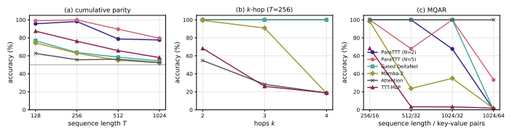
Figure 6 : Synthetic nonlinear-state tasks (two layers, width 256 except width 512 for MQAR with 64 pairs; mean over three seeds at the best learning rate). (a) Cumulative parity against sequence length; the dotted line is chance. (b)k-hop pointer following atT= 256. (c) Multi-query associative recall for increasing sequence length and number of key-value pairs.
원문 · CC BY 4.0 · Noel Loo, Neehal Tumma, T. Konstantin Rusch, Mathias Lechner, Alexander Amini, Daniela Rus · ParaTTT: Parallelizing Test-Time Training Layers with Deep Memories · 원문 그림 인용 · 원본 PDF 30쪽에서 그림 영역을 추출했습니다.반복 정제를 통한 은닉층 gradient 궤적 추정
ParaTTT는 은닉층 pre-activation gradient의 추정치 D를 두고, 이를 반복 정제하여 내부 가중치 궤적을 얻습니다. 각 반복은 세 단계로 구성됩니다. 첫째, 현재 추정치 D로 은닉층의 fast weight 궤적을 chunkwise scan으로 계산합니다. 둘째, readout은 고정된 feature 위에서 Gated DeltaNet 형태의 gated-delta-rule로 정확히 계산되고 토큰별 feature gradient를 얻습니다. 셋째, 이 feature gradient를 은닉층으로 역전파해 새 추정치를 만듭니다. 갱신은 λ=0.8인 damped Picard step으로 수행됩니다.
저자들은 정확한 순차 gradient descent의 재귀가 이 반복의 고정점이라고 설명합니다. 디코딩은 반복 없이 캐시된 가중치에서 한 토큰의 정확한 gradient step으로 수행되며, N은 prefill에만 영향을 줍니다.
고정점과 수렴 조건
고정점 성질은 gradient 추정치 D가 정확한 순차 gradient의 값과 일치할 때 반복이 그 값을 유지한다는 뜻입니다. 저자들은 감쇠가 없는 반복에서 N≥T이면 정확한 순차 재귀가 재현된다는 명제를 제시합니다. 기하급수 수렴은 두 층 변형에 대해서만 증명되며, soft clipping, 고정된 학습률·감쇠 범위, 그리고 Lipschitz 상수 ρ<1이라는 조건을 요구합니다. 이 정리는 hard projection, hidden delta rule, centering을 포함한 실제 학습 모델을 직접 다루지 않으므로, 실제 모델의 수렴은 별도 측정으로 확인합니다.
속도와 언어 모델링 결과
4K 컨텍스트에서 N=2인 ParaTTT는 기본 block size 16의 TTT-MLP보다 전체 340M 모델을 4.9배 빠르게 학습합니다. 이 학습 속도는 같은 MI325X 환경에서 bf16으로 측정된 처리량입니다. 언어 모델링에서는 340M과 1.3B 모델이 WikiText-103과 LAMBADA perplexity에서 선형 순환 기준선과 비교되고, SWDE와 FDA 같은 recall 과제에서 Gated DeltaNet과 Mamba-2보다 높은 결과를 보고합니다. 다만 Attention은 여러 recall과 긴 컨텍스트 검색 지표에서 가장 좋은 결과를 보입니다. 반복을 더 많이 쓴 N=5 모델은 recall을 개선하지만 LAMBADA perplexity와 32K NIAH에서는 다른 결과를 보입니다.
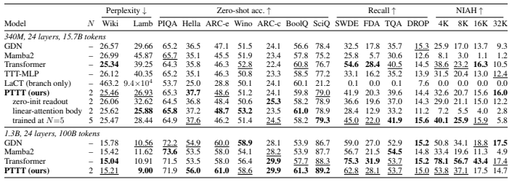
Table 1 : Main results at 340M and 1.3B. Recall follows the generation protocol of Arora et al. (2024a); NIAH is the RULER needle average at the given length. Best per column and size in bold, second best underlined. A couple of notes: (1) LaCT fast-weight branch only is an ablation of the published hybrid. (2) The zero-init readout removes both centering and the learned initialization;
원문 · CC BY 4.0 · Noel Loo, Neehal Tumma, T. Konstantin Rusch, Mathias Lechner, Alexander Amini, Daniela Rus · ParaTTT: Parallelizing Test-Time Training Layers with Deep Memories · 원문 그림 인용 · 원본 PDF 8쪽에서 그림 영역을 추출했습니다.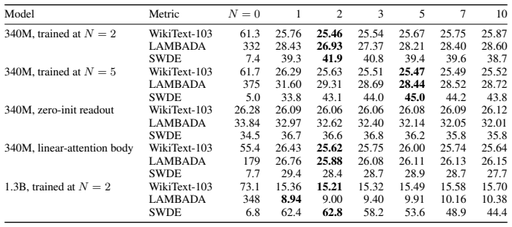
Table 3 : Perplexity (WikiText-103, LAMBADA) and SWDE accuracy of the ParaTTT models as a function of the number of iterations at evaluation. Bold: bestNfor the centered models.
원문 · CC BY 4.0 · Noel Loo, Neehal Tumma, T. Konstantin Rusch, Mathias Lechner, Alexander Amini, Daniela Rus · ParaTTT: Parallelizing Test-Time Training Layers with Deep Memories · 원문 그림 인용 · 원본 PDF 30쪽에서 그림 영역을 추출했습니다.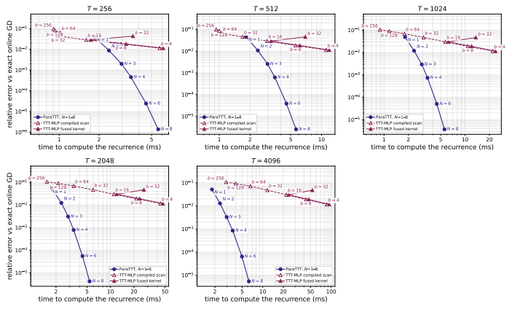
Figure 7 : Relative error against exact online GD versus the time to compute the forward recurrence of one 340M layer (batch 1), at five sequence lengths; same setting and legend as
원문 · CC BY 4.0 · Noel Loo, Neehal Tumma, T. Konstantin Rusch, Mathias Lechner, Alexander Amini, Daniela Rus · ParaTTT: Parallelizing Test-Time Training Layers with Deep Memories · 원문 그림 인용 · 원본 PDF 34쪽에서 그림 영역을 추출했습니다.수렴 측정과 적용 범위
학습된 모델에서 반복 수를 늘린 결과는 정확한 재귀와의 top-1 agreement와 TV distance로 측정됩니다. 원문은 반복이 없을 때 약 60%, 한 번 반복하면 약 90%, 두 번 반복하면 약 94% 정도의 일치가 나타난다고 보고합니다. 이 결과는 학습된 모델이 자주 쓰는 실제 텍스트 설정에서의 관찰이며, 정리가 보장하는 기하급수 수렴과 같은 성질은 아닙니다. 따라서 이 근거는 두 층 이론 설정이 실제 모델 전체로 일반화된다는 주장을 뒷받침하지 않습니다.
논문 정보
- 저자
- Noel Loo, Neehal Tumma, T. Konstantin Rusch, Mathias Lechner, Alexander Amini, Daniela Rus
- 학회·저널
- arXiv · 프리프린트
- 최초 공개일
- 2026년 10월 28일
- 등록일
- 2026년 11월 1일
- 수정일
- 2026년 10월 28일
- 버전
- v1
- arXiv
- 2610.38255
- 분류
- cs.LG
- 원문 이용 조건
- CC BY 4.0
- 제공 범위
- 논문 정보, 해설, 허용된 원문 그림
AI 해설은 논문 원문과 별개의 설명이며 오류가 있을 수 있습니다. 원문과 그림은 각 출처의 이용 조건과 따로 표시된 권리를 따릅니다.
초록
Test-time training (TTT) layers replace the linear fast-weight memory of modern recurrent architectures with a small neural network trained online by gradient descent. This nonlinear memory is more expressive than the linear memories of Gated DeltaNet and Mamba-2, but is difficult to parallelize: existing implementations such as TTT-MLP rely on sequential, block-wise weight updates that run several times slower than chunkwise-parallel linear recurrences. Moreover, their block-wise execution only approximates the token-by-token online recurrence, whereas linear recurrences admit an exact chunkwise-parallel evaluation. We introduce ParaTTT (PTTT), an algorithm for parallelizing arbitrarily deep nonlinear memories by iteratively refining estimates of the inner-loop gradient trajectory. Starting from a guess of the hidden-layer gradients, each refinement consists of three chunkwise-parallel passes: a forward pass that evaluates the resulting feature trajectory, an exact gated-delta-rule pass that computes the readout trajectory and its feature gradients, and a backward pass that propagates these gradients into a new estimate. The exact online gradient descent recurrence is a fixed point of the iteration, while decoding requires no refinement iterations. We prove geometric convergence for a two-layer variant under sufficient contraction conditions. In practice, two iterations suffice. With two refinement steps at 4K context, PTTT evaluates the inner-loop trajectory $32\times$ faster than TTT-MLP with the block approximation at matched error, while the full 340M model trains $4.9\times$ faster. Models trained at 340M and 1.3B parameters match or exceed Gated DeltaNet and Mamba-2 and remain competitive with same-size Transformers on language-modeling perplexity and zero-shot accuracy, with better recall than the linear recurrences.
원문 인용
Noel Loo, Neehal Tumma, T. Konstantin Rusch, Mathias Lechner, Alexander Amini, Daniela Rus (2026). ParaTTT: Parallelizing Test-Time Training Layers with Deep Memories. arXiv:2610.38255v1. https://arxiv.org/abs/2610.38255v1
BibTeX
@misc{loo2026parattt,
  title = {{ParaTTT: Parallelizing Test-Time Training Layers with Deep Memories}},
  author = {Noel Loo and Neehal Tumma and T. Konstantin Rusch and Mathias Lechner and Alexander Amini and Daniela Rus},
  year = {2026},
  eprint = {2610.38255},
  archivePrefix = {arXiv},
  url = {https://arxiv.org/abs/2610.38255v1}
}