논문 해설
SpaceAct: Benchmarking 3D Spatial and Temporal Reasoning via Closed-Loop Action and Active Perception
SpaceAct: 폐루프 행동과 능동적 지각을 통한 3D 공간 및 시간 추론 벤치마킹
- 연구 문제 기존 3D 공간 추론 평가는 정적 질의응답이나 특권 좌표 기반 저수준 조작에 머물러, 카메라 이동과 연속 물리 행동의 결과를 충분히 검증하지 못합니다.
- 연구 방법 SpaceAct는 좌표 없이 눈금자가 있는 RGB 관측으로 6-DoF 행동을 수행하게 하며, SAPA는 턴마다 능동 카메라, 배치 도구 호출, 첫 위반 절단과 분할 화면 롤백을 사용합니다.
- 주요 결과 상위 세 모델에서 기준 계획은 점수 격차의 44%를 줄였지만 충돌은 변하지 않았고, 계획에 정확한 3D 상태를 더하면 점수가 96.6이 되고 충돌은 0.5로 줄었습니다.
기존 평가의 공백
3D 공간 추론을 평가하는 기존 벤치마크는 대개 정적 이미지나 영상에 대한 객관식 질의응답입니다. 이 방식에서 모델은 카메라를 움직여 가려진 부분을 확인하지 않으며, 잘못된 행동의 충돌이나 붕괴 결과를 직접 겪지도 않습니다. 반대로 상호작용형 구현 평가는 가정용 과제를 언어 상식 문제로 줄이거나, 저수준 조작에서 외부 탐지기가 준 3D 좌표와 모션 플래너를 사용합니다. 이 논문은 이러한 공백을 메우기 위해 SpaceAct를 제시합니다. SpaceAct는 레고형 블록과 기계식 퍼즐을 바탕으로 6개 범주, 36개 과제 계열, 108개 검증된 인스턴스를 구성합니다. 좌표는 주지 않고 눈금자가 있는 RGB 시점만 제공합니다.
또한 모델이 숙고하는 동안 시계를 멈추고 물리 행동으로만 진행하도록 설계합니다.
SAPA의 턴 구조와 실행 규칙
SAPA는 모델 독립적인 능동 지각 에이전트입니다. 각 턴에서 모델은 눈금자와 투영 벽이 있는 RGB 관측 또는 동적 과제의 5프레임 스트로브 스트립을 받습니다. 여기에 과제 목표, 물리 규칙, JSON 형식, 도구 목록, 최근 10개 텍스트 턴과 2개 이미지, 모델이 다시 쓰는 지속 메모가 더해집니다. 모델은 하나의 JSON 객체로 근거 설명, 메모 갱신, 1개에서 5개의 도구 호출을 반환합니다. 도구 호출은 0.05스터드 또는 0.5도 이하의 부분 스텝으로 실행되며, 모션 플래너 없이 연속 경로의 충돌과 정적 평형을 검사합니다. 위반이 처음 나타나는 지점에서 실행을 자르고 남은 호출은 건너뜁니다. 그 다음 프레임은 위반 순간과 롤백된 유효 상태를 나란히 보여 주는 1280×640 분할 화면입니다.
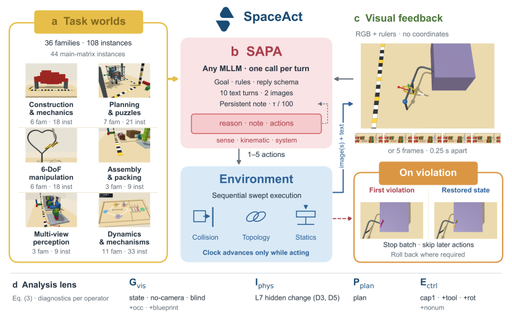
Figure 4 : The SpaceAct task suite and the SAPA active-perception agent. (a) The six task categories contain 36 task families and 108 verified instances in total (44 in the main matrix). (b) At each turn, the input comprises actively acquired RGB observations with rulers, task rules, the available tools, and a dynamic memory (a bounded history window plus a persistent note). A single MLLM call per turn jointly performs 3D localization (𝒢vis), physics identification (ℐphys), multi-step planning (𝒫plan), and frame-aware control (ℰctrl), returning a JSON response with a rationale, a memory update (note), and 1–5 tool calls; the four capabilities are a diagnostic decomposition, not four separate calls. The tool calls execute sequentially in swept substeps of at most 0.05 stud or 0.5°, without a motion planner, under collision/topology and static-equilibrium checks, and the simulation clock is frozen while the model deliberates. (c) Observations are RGB images with rulers and no coordinates; dynamic tasks provide five frames from the same viewpoint at 0.25-s intervals. The first violation truncates execution and skips the remaining calls, returning a 1280 × 640 split-screen rollback view (left: the violating contact; right: the last valid state). (d) The diagnostic conditions grouped by the operator of Eq. (3) that they replace or stress.
원문 · CC BY 4.0 · Chenglong Shi, Zekai Yuan, Yue Song, Jon Pu, Will Wu · SpaceAct: Benchmarking 3D Spatial and Temporal Reasoning via Closed-Loop Action and Active Perception · 원문 그림 인용 · 원본 PDF 10쪽에서 그림 영역을 추출했습니다.계획과 3D 상태를 나눈 진단
이 논문의 핵심 진단은 고수준 계획과 3D 시각 grounding을 분리하는 것입니다. +plan 조건은 턴과 영역 수준의 기준 계획을 추가하고 거리 정보는 모델에 맡깁니다. +state 조건은 +plan에 정적 레이아웃 텍스트와 매 턴의 정확한 3D 포즈를 더합니다. 두 조건은 중첩되어 있으므로 +plan의 효과는 계획의 가치를, +plan에서 +state로 가는 변화는 계획을 안 뒤에도 남는 3D 상태의 가치를 보여 줍니다. 상위 세 모델은 8개 공유 L5 인스턴스에서 22쌍으로 비교되었습니다. 평균 점수는 기준 65.1에서 +plan 80.3, +state 96.6으로 올랐습니다. 충돌 수는 +plan에서 5.2에서 5.2로 변하지 않았고, +state에서 0.5로 줄었습니다.
같은 순서는 5위부터 8위까지의 네 모델에서도 나타났습니다. 이 모델들은 계획만으로 평균 10.9에서 35.3으로 올랐지만 충돌은 21.5에서 28.0으로 늘었습니다.
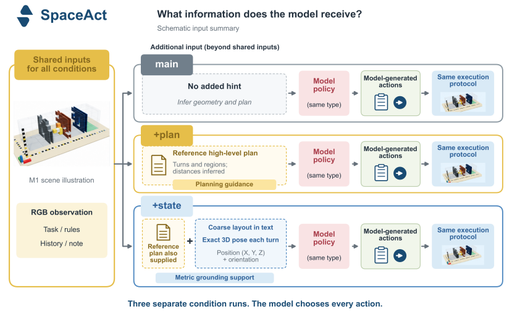
Figure 3 : Inputs of the three controlled-diagnostic conditions (schematic), each run separately on the same instances. All conditions share the RGB observation, task and rules, history, and note; the model generates every action, and all actions run under the same execution protocol. +plan adds a reference high-level plan (turns and regions; distances are left to the model). +state supplies the reference plan as well, plus the coarse layout as text and the exact 3D pose of the payload at every turn.
원문 · CC BY 4.0 · Chenglong Shi, Zekai Yuan, Yue Song, Jon Pu, Will Wu · SpaceAct: Benchmarking 3D Spatial and Temporal Reasoning via Closed-Loop Action and Active Perception · 원문 그림 인용 · 원본 PDF 9쪽에서 그림 영역을 추출했습니다.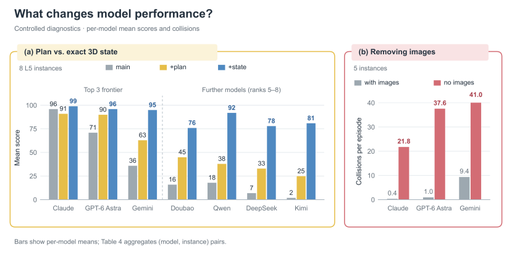
Figure 7 : Controlled diagnostics per model. (a) Mean score under main, +plan, and +state on the eight shared L5 instances for the top-3 frontier models and the four further models; Claude Opus 5.5 is averaged over its six pairs with complete runs. (b) Collisions per episode with and without image input on the five blind-test instances (top-3 models).
원문 · CC BY 4.0 · Chenglong Shi, Zekai Yuan, Yue Song, Jon Pu, Will Wu · SpaceAct: Benchmarking 3D Spatial and Temporal Reasoning via Closed-Loop Action and Active Perception · 원문 그림 인용 · 원본 PDF 17쪽에서 그림 영역을 추출했습니다.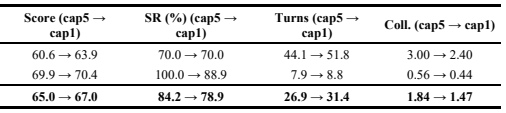
Table C.3 : Per-model breakdown of +plan, +state, nonote, and nosplit diagnostics across the 7 diagnostic models (score / SR). Pairs with an abandoned run are excluded (Section 5). †Claude Opus 5.5: six tasks for main, +plan, and +state, and two tasks for nonote and nosplit.
원문 · CC BY 4.0 · Chenglong Shi, Zekai Yuan, Yue Song, Jon Pu, Will Wu · SpaceAct: Benchmarking 3D Spatial and Temporal Reasoning via Closed-Loop Action and Active Perception · 원문 그림 인용 · 원본 PDF 26쪽에서 그림 영역을 추출했습니다.주 평가와 이미지 제거 조건
주 행렬은 각 패밀리의 가장 어려운 설정으로 구성된 44개 인스턴스이며, 10개 프런티어 MLLM을 인스턴스마다 시드 100으로 한 번씩 실행했습니다. Claude Opus 5.5는 평균 점수 79.1과 SR 93.2%를 기록했고, GPT-6 Astra는 65.0과 84.1%, Gemini 4 Argon은 42.1과 65.9%를 기록했습니다. 점수는 41개의 채점 인스턴스 평균이며, SR은 44개 전체를 기준으로 합니다. 이미지 입력을 제거한 blind 조건은 B1, M1, M3, B6, P2 등 블라인드 시험 인스턴스에서 실행되었습니다. 이 조건에서 상위 모델의 충돌은 에피소드당 3.6에서 33.5로 약 9배 늘었습니다.
다만 막힌 행동과 롤백으로 장면 경계를 드러낼 수 있었던 과제에서는 SR이 77.8%를 유지했습니다. 반면 P2와 B6처럼 전역 상태를 이미지로 봐야 하는 과제에서는 SR이 83.3%에서 16.7%로 떨어졌습니다.
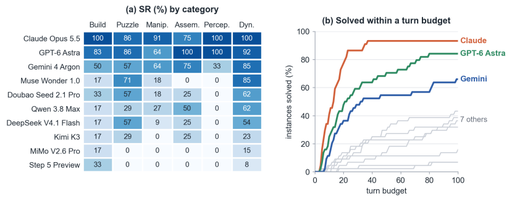
Figure 5 : Category profiles and solving speed. (a) Success rate (%) of each model by task category on the main matrix. (b) Cumulative fraction of main-matrix instances solved within a given turn budget; the three strongest models are highlighted and the remaining seven are shown in gray.
원문 · CC BY 4.0 · Chenglong Shi, Zekai Yuan, Yue Song, Jon Pu, Will Wu · SpaceAct: Benchmarking 3D Spatial and Temporal Reasoning via Closed-Loop Action and Active Perception · 원문 그림 인용 · 원본 PDF 15쪽에서 그림 영역을 추출했습니다.L7 난이도와 시간 과제의 차이
L5와 L7을 모두 가진 여덟 계열을 비교하면 공간 계열의 차이가 뚜렷합니다. M1, M2, M3, M4, M5, A1의 6개 공간 계열에서 L7은 지각과 좌표계 레버를 추가하지만 과제 계획은 바꾸지 않습니다. 이 경우 평균 점수는 26.2에서 13.7로 떨어졌고, 쌍 단위로는 37쌍에서 낮아지고 20쌍에서 높아졌습니다. 반면 시간 계열 D3와 D5는 L7에서 숨겨진 물리 변화를 추가하지만 평균 점수가 46.5에서 46.6으로 거의 변하지 않았습니다. 따라서 이 결과는 숨겨진 물리 변화에 대한 적응을 보여 주며, 공간 계열의 하락은 지각과 좌표 변환 비용으로 읽힙니다.
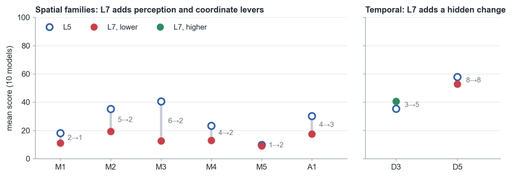
Figure 6 : Difficulty levers. Mean score over the 10 models at L5 (open circles) and L7 (filled; red if lower, green if higher) for the eight families that include both tiers; annotations give the number of solved episodes at L5 → L7. Left: spatial families , where L7 adds perception and coordinate-frame levers. Right: temporal families, where L7 adds an undisclosed physical change.
원문 · CC BY 4.0 · Chenglong Shi, Zekai Yuan, Yue Song, Jon Pu, Will Wu · SpaceAct: Benchmarking 3D Spatial and Temporal Reasoning via Closed-Loop Action and Active Perception · 원문 그림 인용 · 원본 PDF 15쪽에서 그림 영역을 추출했습니다.실패 유형과 적용 범위
배치 프로토콜에서 미해결 완전 궤적 227개를 분석하면 가장 흔한 실패는 충돌 루프와 관찰 루프입니다. 충돌 루프는 턴의 40% 이상에서 충돌이 있는 경우이고, 관찰 루프는 행동의 60% 이상이 카메라 행동인 경우입니다. 두 유형은 함께 46%를 차지합니다. 또한 프런티어 모델 충돌의 44%에서 71% 사이가 다음 턴의 다른 충돌로 이어졌습니다. 이는 분할 화면이 접촉 위치를 보여 주더라도 모델이 그것을 정확한 기하 수정으로 바꾸기 어렵다는 관찰입니다. 한편 Claude Opus 5.5는 주 실험에서 17개 셀의 재시작이 필요했고, 20회 실행은 API 오류로 완료되지 않았습니다. 규칙 변형 점검은 연습 문제의 기억을 완전히 배제하지 못합니다.
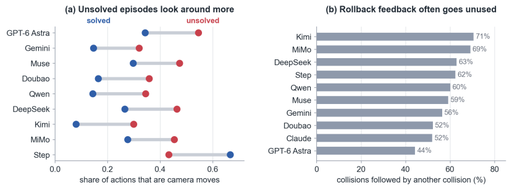
Figure 8 : Behavioral signatures. (a) Share of actions that are camera moves in solved vs. unsolved episodes, for the nine models with both solved and unsolved trajectories. (b) Percentage of collisions that are immediately followed by another collision on the next turn.
원문 · CC BY 4.0 · Chenglong Shi, Zekai Yuan, Yue Song, Jon Pu, Will Wu · SpaceAct: Benchmarking 3D Spatial and Temporal Reasoning via Closed-Loop Action and Active Perception · 원문 그림 인용 · 원본 PDF 18쪽에서 그림 영역을 추출했습니다.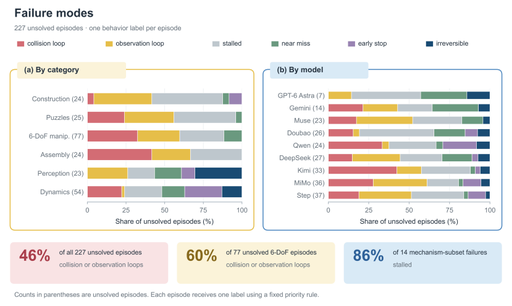
Figure 9 : Failure modes of the 227 unsolved batched-protocol episodes with complete trajectories, broken down (a) by category and (b) by model (number of unsolved episodes in parentheses). Each episode receives a single signature in the priority order defined in Section 6.6.
원문 · CC BY 4.0 · Chenglong Shi, Zekai Yuan, Yue Song, Jon Pu, Will Wu · SpaceAct: Benchmarking 3D Spatial and Temporal Reasoning via Closed-Loop Action and Active Perception · 원문 그림 인용 · 원본 PDF 19쪽에서 그림 영역을 추출했습니다.
Table D.1 reports per-model trajectory signatures across the 38 main-matrix instances that use the batched protocol: mean actions per response (k), percentage of model calls saved by batching, share of actions that are camera moves in solved vs. unsolved episodes, percentage of collision turns immediately followed by another collision on the next turn, percentage of collision turns followed by a camera inspection, mean batch size before vs. after a collision, and share of turns that update the persistent note.
원문 · CC BY 4.0 · Chenglong Shi, Zekai Yuan, Yue Song, Jon Pu, Will Wu · SpaceAct: Benchmarking 3D Spatial and Temporal Reasoning via Closed-Loop Action and Active Perception · 원문 그림 인용 · 원본 PDF 26쪽에서 그림 영역을 추출했습니다.논문 정보
- 저자
- Chenglong Shi, Zekai Yuan, Yue Song, Jon Pu, Will Wu
- 학회·저널
- arXiv · 프리프린트
- 최초 공개일
- 2026년 10월 28일
- 등록일
- 2026년 11월 1일
- 수정일
- 2026년 10월 28일
- 버전
- v1
- arXiv
- 2610.38405
- 분류
- cs.RO · cs.AI
- 원문 이용 조건
- CC BY 4.0
- 제공 범위
- 논문 정보, 해설, 허용된 원문 그림
AI 해설은 논문 원문과 별개의 설명이며 오류가 있을 수 있습니다. 원문과 그림은 각 출처의 이용 조건과 따로 표시된 권리를 따릅니다.
초록
To solve problems in 3D space rather than merely describe images, multimodal large language models (MLLMs) need 3D spatiotemporal reasoning: reconstructing 3D geometry from occluded 2D views, anticipating physical dynamics, and executing precise, closed-loop actions. Prior studies test passive VQA on static images or symbolic planning, requiring no execution or supplying privileged coordinates while ignoring collision, statics, and timing. We introduce SpaceAct, an interactive benchmark evaluating 3D spatiotemporal reasoning via closed-loop physical action and active perception, with SAPA, a Spatiotemporal Active-Probing Agent framework. Built on interlocking bricks and mechanical puzzles, it has 108 verified instances across 36 task families in six categories, without privileged coordinates, and diagnostic modes (+plan, +state, no-camera, blind, L7 levers). In brick-bridging or aperture-threading, models rotate the camera to resolve occlusion, read in-scene rulers, output 6-DoF poses under swept-collision and statics checks, and self-correct via split-screen rollback feedback (dynamic tasks freeze time during deliberation and give five strobe frames). Across 10 frontier MLLMs on the 44 hardest instances, scores span 4.8-79.1 (seven solve at most 27.3% of 6-DoF tasks); for the top three, a reference plan (+plan) closes 44% of the gap while leaving collisions at 5.2 per episode, whereas adding exact 3D state (+state) closes 90% and cuts collisions to 0.5; for four others, +plan lifts the mean score from 10.9 to 35.3 and +state to 81.8; and 46% of failures are collision or observation loops. SpaceAct and SAPA advance evaluation to closed-loop physical interaction, showing that even with a valid plan, MLLMs remain bottlenecked by 3D visual grounding and action refinement, while offering a testbed for active multi-view exploration and explicit 3D grounding.
원문 인용
Chenglong Shi, Zekai Yuan, Yue Song, Jon Pu, Will Wu (2026). SpaceAct: Benchmarking 3D Spatial and Temporal Reasoning via Closed-Loop Action and Active Perception. arXiv:2610.38405v1. https://arxiv.org/abs/2610.38405v1
BibTeX
@misc{shi2026spaceact,
  title = {{SpaceAct: Benchmarking 3D Spatial and Temporal Reasoning via Closed-Loop Action and Active Perception}},
  author = {Chenglong Shi and Zekai Yuan and Yue Song and Jon Pu and Will Wu},
  year = {2026},
  eprint = {2610.38405},
  archivePrefix = {arXiv},
  url = {https://arxiv.org/abs/2610.38405v1}
}