논문 해설
Compositional Flows for 3D Molecule and Synthesis Pathway Co-design
3D 분자와 합성 경로 공동 설계를 위한 조합형 플로우
- 연구 문제 연속 3D 상태와 구성 단계를 함께 생성해야 하는 약물 설계 문제에서 기존 diffusion·flow matching과 2D 합성 기반 생성 모델은 구성 제약과 3D 상호작용을 함께 다루기 어렵습니다.
- 연구 방법 CGFlow는 구성 구조를 시간 간격마다 추가하는 흐름과 연속 상태를 보간하는 흐름을 결합하고, GFlowNet의 trajectory balance로 구성 정책을 학습합니다. 이를 약물 설계에 적용한 3DSynthFlow는 합성 synthon과 3D 포즈 모델을 함께 사용합니다.
- 주요 결과 LIT-PCBA 포켓 특이적 최적화에서 3DSynthFlow는 도킹 점수와 ligand efficiency에서 비교 기준선보다 우수하다고 보고되며, 고득점 다양 모드 수는 RxnFlow 대비 4.2배로 제시됩니다. 포켓 조건부 생성에서는 high β 설정의 평균 Vina 점수가 -9.42 kcal/mol입니다.
구성 구조와 연속 3D 상태를 함께 다루기 어려운 이유
합성 경로처럼 단계적으로 쌓이는 객체를 생성하려면 구성 구조를 다뤄야 하고, 3D 분자처럼 연속 좌표도 함께 다뤄야 합니다. 원문은 표준 diffusion과 flow matching이 객체의 모든 차원을 한꺼번에 모델링하기 때문에, 구성 단계를 통해 객체를 만드는 과정을 직접 표현하지 못한다고 설명합니다. 이 때문에 무효한 생성 행동을 마스킹하기 어렵고, 구성 공간에서 보상에 따른 신뢰도 있는 신용 할당이 제한됩니다. 약물 설계에서는 합성 가능성이 실험 검증에 중요하므로, 이 한계가 실제 문제로 이어집니다. 또한 기존 합성 기반 생성 모델들은 주로 2D 분자 그래프에 머물러 단백질-리간드 3D 상호작용을 직접 다루지 못합니다.
CGFlow의 두 흐름과 구성 흐름의 보간
CGFlow는 구성 구조를 전달하는 Compositional Flow와 연속 상태를 전달하는 State Flow라는 두 흐름을 함께 사용합니다. 객체 x는 구성 구조 C와 연속 상태 S의 쌍으로 표현되며, C는 순서가 있는 구성 요소의 수열입니다. 시간 t에서 추가된 구성 요소의 수 k(t)는 λ 간격의 이산 단계로 증가하며, 시간 0에서는 빈 구조, 시간 1에서는 완성 구조가 됩니다. 연속 상태는 각 구성 요소가 생성된 시점부터 보간되며, 상태 흐름은 구성 요소별 local time을 사용해 더 최근에 추가된 요소에 더 큰 불확실성을 줍니다. 구성 요소가 아직 생성되지 않은 상태는 초기화되지 않으므로, 구성과 좌표가 함께 시간에 따라 정의됩니다.
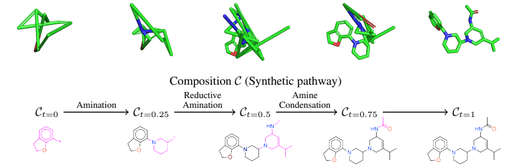
Figure 1 . Overview of 3DSynthFlow generation. 3D Molecule x = (C, S) consisting of its synthesis pathway C and 3D conformation S (visualized using x). CGFlow generation interleaves 1). the continuous process for modeling position S, and 2). the sequential sampling of synthesis steps at discrete intervals (t={0, 0.25, 0.5, 0.75}). The modeling of synthesis pathways and position are both dependent on the object xt = {St, Ct}, ensuring the interplay between the two processes.
원문 · CC BY 4.0 · Tony Shen, Seonghwan Seo, Ross Irwin, Kieran Didi, Simon Olsson, Woo Youn Kim, Martin Ester · Compositional Flows for 3D Molecule and Synthesis Pathway Co-design · 원문 그림 인용 · 원본 PDF 2쪽에서 그림 영역을 추출했습니다.상태 흐름 손실과 구성 흐름의 궤적 균형 학습
학습은 두 모델로 나뉩니다. 상태 흐름 모델은 구성 구조와 연속 상태로 이루어진 객체 x_t를 입력받아 깨끗한 연속 상태를 예측하며, 이미 생성된 구성 요소들에 대한 MSE 손실 L_state로 학습됩니다. 구성 흐름 정책은 사전 학습된 상태 흐름 모델을 고정한 상태에서, 최종 객체 x1의 보상 R(x1)을 이용해 trajectory balance 손실로 학습됩니다. 원문은 연속 상태 샘플링이 결정적이 되도록 초기 상태 S0를 고정된 난수 시드로 샘플링한다고 밝히며, 이 가정 아래에서 궤적이 객체 x_t를 유일하게 정한다고 설명합니다. 이 구성은 온라인 학습을 가능하게 하여 현재 정책이 만든 새 데이터에서 학습할 수 있게 합니다.
합성 synthon과 3D 포즈 예측으로 본 3DSynthFlow
3DSynthFlow는 CGFlow를 약물 설계에 적용한 방법으로, 합성 경로와 3D 분자 구조를 함께 생성합니다. 원문은 38개의 이분자 Enamine 합성 프로토콜을 사용하고, 합성 경로를 최대 두 단계로 제한한다고 보고합니다. 분자는 완전한 분자가 아니라 결합 지점을 가진 synthon으로 표현되며, 결합 지점이 하나인 brick은 시작 분자와 종료에, 두 개인 linker는 연결에 쓰입니다. 상태 흐름 모델은 Semla 구조를 확장한 HierSemla로 매개변수화되며, 단백질을 원자와 잔기 수준에서 계층적으로 부호화합니다. 구성 흐름 모델은 RxnFlow 구조를 바탕으로 수정되어 3D 단백질-리간드 복합체를 입력으로 받습니다.
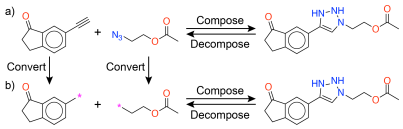
Figure 4 . Illustration of synthesis-based composition rules. (a) reactant unit-based and (b) synthon unit-based (ours).
원문 · CC BY 4.0 · Tony Shen, Seonghwan Seo, Ross Irwin, Kieran Didi, Simon Olsson, Woo Youn Kim, Martin Ester · Compositional Flows for 3D Molecule and Synthesis Pathway Co-design · 원문 그림 인용 · 원본 PDF 6쪽에서 그림 영역을 추출했습니다.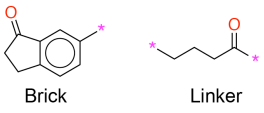
Figure 6 . Examples of brick and linker synthons.
원문 · CC BY 4.0 · Tony Shen, Seonghwan Seo, Ross Irwin, Kieran Didi, Simon Olsson, Woo Youn Kim, Martin Ester · Compositional Flows for 3D Molecule and Synthesis Pathway Co-design · 원문 그림 인용 · 원본 PDF 16쪽에서 그림 영역을 추출했습니다.LIT-PCBA 포켓 특이적 최적화의 결과
포켓 특이적 최적화에서 3DSynthFlow는 LIT-PCBA 표적별로 생성된 상위 100개의 다양한 모드를 Vina 도킹 점수와 AiZynthFinder 성공률로 평가되었습니다. 표 1은 처음 다섯 표적의 Vina 결과를 보고하며, 원문은 3DSynthFlow가 친화도와 ligand efficiency에서 기준선보다 일관되게 높다고 보고합니다. 합성 성공률은 3DSynthFlow가 68.58%, RxnFlow가 65.35%로, 저자들은 두 방법의 합성 가능성이 비슷하다고 해석합니다. 다만 이 점수는 QED>0.5 필터와 Tanimoto 다양성 선택을 거친 상위 100개 집합에 대한 값이며, 전체 생성 분자 집합에 대한 값이 아닙니다.
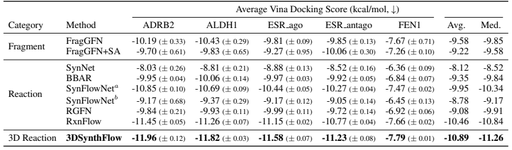
Table 1 . Average Vina docking score of Top-100 diverse modes.We report two versions of SynFlowNet (v2024.05a and v2024.10b). Avg. and Med. are the average and median values over the average docking scores for all 15 LIT-PCBA protein targets. The results for the remaining 10 target proteins are reported in Appendix. 17 The best results are in bold.
원문 · CC BY 4.0 · Tony Shen, Seonghwan Seo, Ross Irwin, Kieran Didi, Simon Olsson, Woo Youn Kim, Martin Ester · Compositional Flows for 3D Molecule and Synthesis Pathway Co-design · 원문 그림 인용 · 원본 PDF 7쪽에서 그림 영역을 추출했습니다.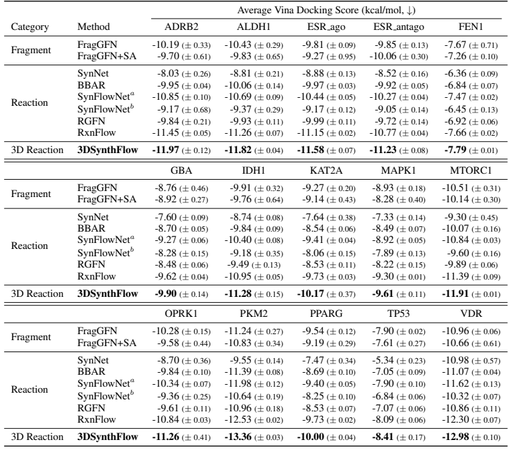
Table 17 . Average Vina docking score for top-100 diverse modes generated against 15 LIT-PCBA targets. The best results are in bold.
원문 · CC BY 4.0 · Tony Shen, Seonghwan Seo, Ross Irwin, Kieran Didi, Simon Olsson, Woo Youn Kim, Martin Ester · Compositional Flows for 3D Molecule and Synthesis Pathway Co-design · 원문 그림 인용 · 원본 PDF 25쪽에서 그림 영역을 추출했습니다.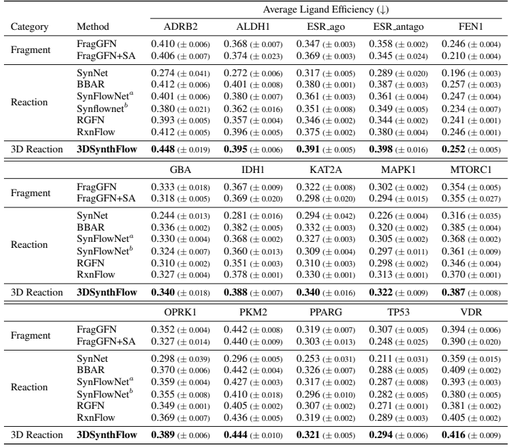
Table 18 . Average ligand efficiency for top-100 diverse modes generated against 15 LIT-PCBA targets. The best results are in bold.
원문 · CC BY 4.0 · Tony Shen, Seonghwan Seo, Ross Irwin, Kieran Didi, Simon Olsson, Woo Youn Kim, Martin Ester · Compositional Flows for 3D Molecule and Synthesis Pathway Co-design · 원문 그림 인용 · 원본 PDF 26쪽에서 그림 영역을 추출했습니다.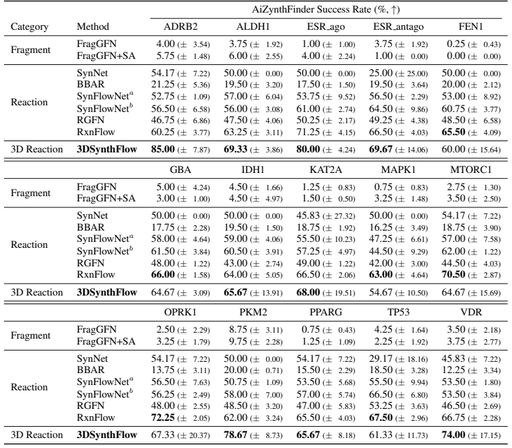
Table 19 . Average success rate of AiZynthFinder for top-100 diverse modes generated against 15 LIT-PCBA targets. The best results are in bold.
원문 · CC BY 4.0 · Tony Shen, Seonghwan Seo, Ross Irwin, Kieran Didi, Simon Olsson, Woo Youn Kim, Martin Ester · Compositional Flows for 3D Molecule and Synthesis Pathway Co-design · 원문 그림 인용 · 원본 PDF 27쪽에서 그림 영역을 추출했습니다.2D 기준선 대비 고득점 모드의 샘플링 효율
샘플링 효율 실험은 QED>0.5, Vina<-10 kcal/mol, 다른 모드와의 Tanimoto 유사도<0.5를 만족하는 고득점 다양 모드를 셉니다. 64,000개 분자를 샘플링한 뒤 3DSynthFlow는 평균 4432.3개, RxnFlow는 1062.6개의 모드를 찾았다고 보고되며, 이는 원문이 말하는 4.2배의 차이입니다. 그림 5는 처음 네 표적에 대해 3개 시드로 샘플링 예산별 발견 모드 수를 보여 주고, 표 16은 다섯 표적의 시드 2개 평균을 제시합니다. FEN1은 같은 수의 모드를 맞추기 위해 Vina 기준이 -7 kcal/mol 이하로 완화되었다는 점을 함께 읽어야 합니다.
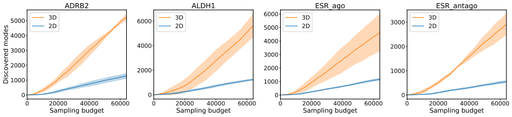
Figure 5 . Number of discovered modes (satisfying Vina <-10 kcal/mol, QED >0.5, Sim <0.5) as a function of sampling budget for the first four LIT-PCBA targets for 3DSynthFlow (3D) vs RxnFlow (2D) across 3 seeds. Higher is better.
원문 · CC BY 4.0 · Tony Shen, Seonghwan Seo, Ross Irwin, Kieran Didi, Simon Olsson, Woo Youn Kim, Martin Ester · Compositional Flows for 3D Molecule and Synthesis Pathway Co-design · 원문 그림 인용 · 원본 PDF 8쪽에서 그림 영역을 추출했습니다.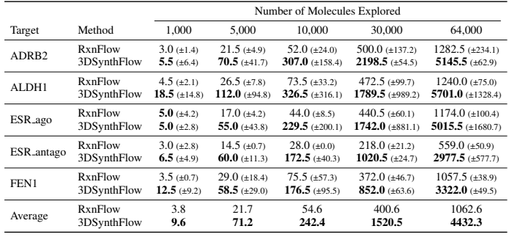
Table 16 . Average number of diverse modes discovered versus the number of molecules explored. The best results are in bold. Results are computed over 2 seeds.
원문 · CC BY 4.0 · Tony Shen, Seonghwan Seo, Ross Irwin, Kieran Didi, Simon Olsson, Woo Youn Kim, Martin Ester · Compositional Flows for 3D Molecule and Synthesis Pathway Co-design · 원문 그림 인용 · 원본 PDF 24쪽에서 그림 영역을 추출했습니다.CrossDocked2020 포켓 조건부 생성의 결과
포켓 조건부 생성에서는 학습된 단일 모델로 100개의 테스트 포켓마다 100개 분자를 생성합니다. 3DSynthFlow는 β 설정을 low, medium, high로 바꾸어 보고되며, high β의 평균 Vina 점수는 -9.42 kcal/mol로 RxnFlow의 -8.85보다 낮습니다. 또한 AiZynth 성공률은 36.1%로 보고됩니다. 이 설정의 보상 프록시는 CrossDocked2020 학습 세트에서 학습한 프록시이므로 포켓 특이적 최적화의 보상과 같지 않습니다. 원문은 이 프록시의 정확도 한계로 도킹 점수 개선이 포켓 특이적 설정만큼 크지 않다고 설명합니다.
도킹 보상 계산 방식의 절제 결과
보상 계산 절제 실험은 전체 도킹과 3DSynthFlow가 예측한 포즈에 대한 국소 최적화 도킹을 비교합니다. 표 11의 캡션은 ADH1 pocket으로, 본문은 ALDH1 표기로 설명하므로 표기 차이를 함께 확인해야 합니다. 전체 도킹에서 3DSynthFlow는 -11.82, 국소 최적화에서는 -11.44를 보고합니다. 원문은 국소 최적화가 더 빠르다고 설명하지만, 이 설정에서도 전체 도킹으로 학습한 결과보다 낮은 성능을 보였습니다. 저자들은 예측 포즈의 입체 충돌이 보상 정확도를 낮출 수 있다고 해석합니다.
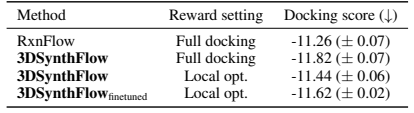
Table 11 . Ablation study on reward setting for Vina docking scores. Evaluated on the ADH1 pocket. Results are averaged over 3 runs.
원문 · CC BY 4.0 · Tony Shen, Seonghwan Seo, Ross Irwin, Kieran Didi, Simon Olsson, Woo Youn Kim, Martin Ester · Compositional Flows for 3D Molecule and Synthesis Pathway Co-design · 원문 그림 인용 · 원본 PDF 22쪽에서 그림 영역을 추출했습니다.합성 행동 공간과 포즈 예측의 한계
저자들은 합성 기반 행동 공간이 arm과 linker synthon에 기반하므로 고리 형성 반응 같은 비선형 합성 경로를 아직 탐색하지 않는다고 밝힙니다. 이 제약은 중간 상태의 이탈기 원자가 사라지거나 새 고리가 생기는 것을 막기 위해 선택되었습니다. 원문은 더 큰 빌딩 블록 라이브러리로 탐색 공간을 확장하면 이 제약을 완화할 수 있다고 제안합니다. 또한 국소 최적화 점수의 낮은 성능에서 보듯이, 포즈 예측 모듈의 정확도가 보상 신호의 품질을 제한할 수 있습니다.
논문 정보
- 저자
- Tony Shen, Seonghwan Seo, Ross Irwin, Kieran Didi, Simon Olsson, Woo Youn Kim, Martin Ester
- 학회·저널
- arXiv · 프리프린트
- 최초 공개일
- 2025년 4월 10일
- 등록일
- 2026년 10월 31일
- 수정일
- 2025년 7월 15일
- 버전
- v2
- arXiv
- 2504.08051
- 분류
- cs.LG · cs.AI
- 원문 이용 조건
- CC BY 4.0
- 제공 범위
- 논문 정보, 해설, 허용된 원문 그림
AI 해설은 논문 원문과 별개의 설명이며 오류가 있을 수 있습니다. 원문과 그림은 각 출처의 이용 조건과 따로 표시된 권리를 따릅니다.
초록
Many generative applications, such as synthesis-based 3D molecular design, involve constructing compositional objects with continuous features. Here, we introduce Compositional Generative Flows (CGFlow), a novel framework that extends flow matching to generate objects in compositional steps while modeling continuous states. Our key insight is that modeling compositional state transitions can be formulated as a straightforward extension of the flow matching interpolation process. We further build upon the theoretical foundations of generative flow networks (GFlowNets), enabling reward-guided sampling of compositional structures. We apply CGFlow to synthesizable drug design by jointly designing the molecule's synthetic pathway with its 3D binding pose. Our approach achieves state-of-the-art binding affinity on all 15 targets from the LIT-PCBA benchmark, and 5.8$\times$ improvement in sampling efficiency compared to 2D synthesis-based baseline. To our best knowledge, our method is also the first to achieve state of-art-performance in both Vina Dock (-9.38) and AiZynth success rate (62.2\%) on the CrossDocked benchmark.
원문 인용
Tony Shen, Seonghwan Seo, Ross Irwin, Kieran Didi, Simon Olsson, Woo Youn Kim, Martin Ester (2025). Compositional Flows for 3D Molecule and Synthesis Pathway Co-design. arXiv:2504.08051v2. https://arxiv.org/abs/2504.08051v2
BibTeX
@misc{shen2025compositional,
  title = {{Compositional Flows for 3D Molecule and Synthesis Pathway Co-design}},
  author = {Tony Shen and Seonghwan Seo and Ross Irwin and Kieran Didi and Simon Olsson and Woo Youn Kim and Martin Ester},
  year = {2025},
  eprint = {2504.08051},
  archivePrefix = {arXiv},
  url = {https://arxiv.org/abs/2504.08051v2}
}