논문 해설
Graph World Model
그래프 세계 모델
- 연구 문제 기존 세계 모델은 비구조화 데이터에 치우쳐 있고, 그래프 파운데이션 모델은 정해진 그래프 학습 과제에 머물러 다중 모달·다양한 과제로 확장하기 어렵습니다.
- 연구 방법 상태를 다중 모달 노드의 그래프로 두고 행동을 행동 노드로 표현하며, 텍스트 변환 기반 GWM-T와 모달리티별 인코더 기반 GWM-E 두 변형으로 메시지 전달을 수행합니다.
- 주요 결과 하나의 GWM이 여러 과제에서 도메인 특화 기준선과 비교 가능하거나 더 나은 점수를 보고하며, 다중 홉 그래프와 제로샷·퓨샷 설정에서도 이득을 보고합니다.
구조화된 데이터를 다루는 세계 모델의 한계
세계 모델은 관측을 상태로 보고 행동이 주어졌을 때 다음 상태를 예측하는 틀입니다. 그러나 기존 세계 모델은 주로 비디오 같은 비구조화 데이터에 초점을 맞추며, 디지털 세계에 널리 존재하는 그래프 형태의 구조화 데이터는 충분히 다루지 못합니다. 그래프 기반 파운데이션 모델도 제안되었지만, 원문에 따르면 이들은 정해진 그래프 학습 과제에 머물러 다중 모달 입력이나 그래프 예측 이외의 과제로 쉽게 확장되지 않습니다. 이 논문은 상태를 그래프로 모델링하고 행동을 행동 노드로 표현하여 이 간격을 메우려는 Graph World Model(GWM)을 제안합니다.
행동 노드와 메시지 전달을 갖춘 GWM의 구조
GWM은 현재 상태를 그래프로 두고 각 노드가 이미지, 표, 텍스트 중 하나 이상의 모달리티를 가지도록 구성합니다. 행동은 현재 상태의 노드를 조회하는 행동 노드로 표현되며, 직접 구조와 관련된 의도된 행동(노드·간선·그래프 수준)과 RAG처럼 유사도 계산으로 대상을 찾는 의도되지 않은 행동으로 나뉩니다. 전이 함수는 노드, 간선, 그래프를 갱신하는 방식으로 다음 상태를 만듭니다. 두 변형은 같은 골격을 공유하면서 정보를 다루는 방식이 다릅니다. GWM-T는 모든 모달리티를 텍스트로 변환해 토큰 수준 메시지 전달을 수행하고, GWM-E는 모달리티별 인코더로 임베딩을 만든 뒤 임베딩 수준에서 메시지를 전달합니다.
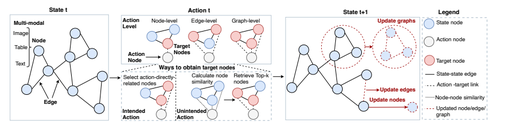
Figure 1 . Multi-modal world state transition can be modeled via graphs. We model the current state as a graph and each node contains one or more modalities from image, table, and text. Further, the world action is modeled as an action node that queries the current state nodes. We categorize actions into two types: intended actions, which include three levels—node, edge, and graph—and unintended actions, whose implementation involves similarity computation similar to RAG. Finally, the transition function updates states at three different levels based on state and action: update nodes, update edges, and update graphs.
원문 · CC BY 4.0 · Feng, Tao, Wu, Yexin, Lin, Guanyu, You, Jiaxuan · Graph World Model · 원문 그림 인용 · 원본 PDF 3쪽에서 그림 영역을 추출했습니다.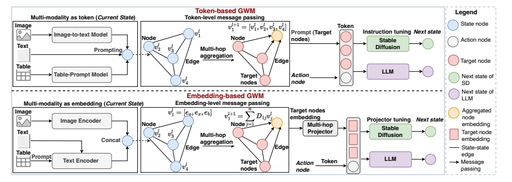
Figure 3 . Framework of GWM. For both token-based and embedding-based GFM, we initially unify the multi-modal current state into graph nodes, conduct message passing, and then combine actions to predict the next state across different modalities through respective decoders. The key distinctions are: 1) Token-based GWM integrates multi-modalities into text, whereas embedding-based GWM uses modality-specific encoders to process them into embeddings; 2) Token-based GWM utilizes text-based methods for message passing, while embedding-based GWM operates at the embedding level; 3) Token-based GWM converts information into prompt form for the decoder, while embedding-based GWM employs a multi-hop projector to manage embedding-level information.
원문 · CC BY 4.0 · Feng, Tao, Wu, Yexin, Lin, Guanyu, You, Jiaxuan · Graph World Model · 원문 그림 인용 · 원본 PDF 5쪽에서 그림 영역을 추출했습니다.임베딩 기반 GWM의 다중 홉 집계와 학습
GWM-E는 노드 임베딩 ev를 CONCAT(ea, et, eb)로 만들고, 모달리티가 없으면 0 벡터를 사용합니다. 이후 정규화 인접 행렬 Ã = D^(-1/2) A D^(-1/2)를 사용해 l-홉 그래프 임베딩 X(l)e = Ã^l · Xe를 계산하며, 이 계산은 파라미터가 없습니다. 이어 MLP 기반 투영기 fc가 각 홉의 임베딩을 디코더용 통합 임베딩 Xc로 변환합니다. 학습에서는 LLM 파라미터를 고정하고 투영기 파라미터만 미세 조정합니다. 이미지 디코더인 Stable Diffusion에서는 그래프 조건 토큰을 텍스트 조건 토큰과 이어 붙여 사용합니다.
여러 과제에서의 비교 결과
저자들은 하나의 GWM을 여러 과제에서 학습하고 과제별로 도메인 특화 기준선과 비교합니다. 다중 모달 매칭 평가에서 Multi-Modal-Paper 데이터셋의 GWM-E는 Accuracy 96.23, Recall 97.21, F1 Score 97.13을 보고합니다. 에이전트 협업 과제인 AgentClinic에서는 GWM-E가 Accuracy 45.00, GWM-T가 Accuracy 50.00을 기록합니다. LongBench v2 RAG 과제에서 GWM-E는 Overall 33.32로 GPT-4o mini의 29.01보다 높고, ALFWorld 계획 과제에서는 F1 Score 92.13으로 T5 FT의 91.82보다 높습니다.
이 점수들은 각 과제의 기준선과 설정 아래에서 보고된 결과이며, 모든 과제에서 일관되게 우세하다는 뜻은 아닙니다.
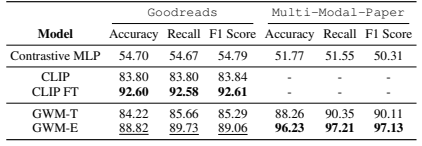
Table 3 . Multi-modal matching results on Goodreads and Multi-Modal-Paper. It aims to predict the correspondence be- tween different modal-ities. For Goodreads, this task is to predict text-image correspondences. As for Multi-Modal-Paper, it aims to predict text-image, text-table, and table-image correspondences. Note that CLIP and CLIP FT cannot be applied to Multi-Modal- Paper since it includes matching tasks beyond text-image.
원문 · CC BY 4.0 · Feng, Tao, Wu, Yexin, Lin, Guanyu, You, Jiaxuan · Graph World Model · 원문 그림 인용 · 원본 PDF 7쪽에서 그림 영역을 추출했습니다.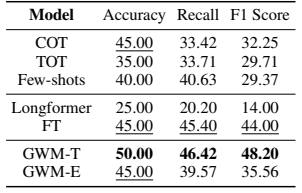
Table 6 . Multi-agent collaboration results on AgentClinic. This task is to answer medical questions by leveraging interactions between agents and external knowledge sources. Compared to classic LLM baselines, GWM-T achieves state-of-the-art results.
원문 · CC BY 4.0 · Feng, Tao, Wu, Yexin, Lin, Guanyu, You, Jiaxuan · Graph World Model · 원문 그림 인용 · 원본 PDF 8쪽에서 그림 영역을 추출했습니다.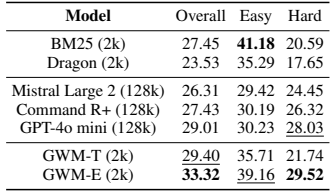
Table 7 . Retrieval-augmented generation on LongBench v2. It is a challenging long-context question-answering task that is cat- egorized into easy and hard levels. Compared to classic RAG baselines and LLM models with extended contexts, GWM with limited context length achieved the best results. The result also demonstrates the superiority of GWM-E over GWM-T in tasks involving long contexts.
원문 · CC BY 4.0 · Feng, Tao, Wu, Yexin, Lin, Guanyu, You, Jiaxuan · Graph World Model · 원문 그림 인용 · 원본 PDF 8쪽에서 그림 영역을 추출했습니다.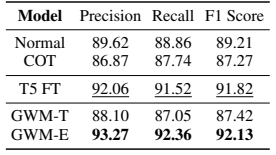
Table 8 . Planning and optimization results on ALFWorld . It is to evaluate how well the methods can imitate the trajectory of expert strategies to effectively assist in solving optimization problems. Compared to classic LLM baselines and text generation baselines, GWM-E has achieved the best results.
원문 · CC BY 4.0 · Feng, Tao, Wu, Yexin, Lin, Guanyu, You, Jiaxuan · Graph World Model · 원문 그림 인용 · 원본 PDF 8쪽에서 그림 영역을 추출했습니다.다중 홉 그래프와 제로샷·퓨샷 적응
다중 홉 실험에서 저자들은 GWM-E를 그래프 없음과 1~4홉 설정으로 비교합니다. 원문은 그래프 도입이 모든 과제에서 성능을 높였다고 보고하며, 홉 수를 지나치게 늘리면 과평활화와 중복 정보로 성능이 떨어질 수 있다고 설명합니다. 제로샷·퓨샷 실험은 Agent와 RAG 과제에서 Single Data, Zero-shot, 그리고 10% 데이터로 미세 조정한 설정을 비교합니다. RAG의 zero-shot 결과는 Single Data보다 높게 보고되지만, 이는 두 과제의 실험 조건 안에서 읽어야 합니다.
현재 구현의 범위와 한계
저자들은 현재 GWM이 텍스트, 표, 이미지 모달리티를 지원하며 다른 모달리티로의 확장은 향후 계획으로 남겨 둡니다. 또한 현재 구현은 동질적 그래프에 초점을 두고 있어 이질적 구조까지 포괄하는 확장은 아직 과제로 남습니다. 본문의 실험 결과는 각 과제의 데이터셋, 백본, 기준선 설정 아래에서 얻은 것이므로 이 범위 밖의 일반화는 별도 검증이 필요합니다.
논문 정보
- 저자
- Feng, Tao, Wu, Yexin, Lin, Guanyu, You, Jiaxuan
- 학회·저널
- arXiv · 프리프린트
- 최초 공개일
- 2025년 7월 14일
- 등록일
- 2026년 10월 29일
- 수정일
- 2025년 7월 14일
- 버전
- v1
- arXiv
- 2507.10539
- 원문 이용 조건
- CC BY 4.0
- 제공 범위
- 논문 정보, 해설, 허용된 원문 그림
AI 해설은 논문 원문과 별개의 설명이며 오류가 있을 수 있습니다. 원문과 그림은 각 출처의 이용 조건과 따로 표시된 권리를 따릅니다.
초록
World models (WMs) demonstrate strong capabilities in prediction, generation, and planning tasks. Existing WMs primarily focus on unstructured data and cannot leverage the ubiquitous structured data, often represented as graphs, in the digital world. While multiple graph foundation models have been proposed, they focus on graph learning tasks and cannot extend to diverse multi-modal data and interdisciplinary tasks. To address these challenges, we propose the Graph World Model (GWM), a world model that supports both unstructured and graph-structured states with multi-modal information and represents diverse tasks as actions. The core of a GWM is a generic message-passing algorithm to aggregate structured information, either over a unified multi-modal token space by converting multi-modal data into text (GWM-T) or a unified multi-modal embedding space by modality-specific encoders (GWM-E). Notably, GWM introduces action nodes to support diverse tasks, where action nodes are linked to other nodes via direct reference or similarity computation. Extensive experiments on six tasks from diverse domains, including multi-modal generation and matching, recommendation, graph prediction, multi-agent, retrieval-augmented generation, and planning and optimization, show that the same GWM outperforms or matches domain-specific baselines' performance, benefits from multi-hop structures, and demonstrates strong zero-shot/few-shot capabilities on unseen new tasks. Our code for GWM is released at https://github.com/ulab-uiuc/GWM.
원문 인용
Feng, Tao, Wu, Yexin, Lin, Guanyu, You, Jiaxuan (2025). Graph World Model. arXiv:2507.10539v1. https://arxiv.org/abs/2507.10539v1
BibTeX
@misc{tao2025graph,
  title = {{Graph World Model}},
  author = {Feng, Tao and Wu, Yexin and Lin, Guanyu and You, Jiaxuan},
  year = {2025},
  eprint = {2507.10539},
  archivePrefix = {arXiv},
  url = {https://arxiv.org/abs/2507.10539v1}
}