논문 해설
Mesh Based Simulations with Spatial and Temporal awareness
공간 및 시간 인식을 갖춘 메시 기반 시뮬레이션
- 연구 문제 메시 기반 시뮬레이션의 ML 대리모델은 노드 단위 손실과 explicit Euler형 다음 단계 예측에 머물러 있어 플럭스 일관성과 강성 동역학을 충분히 다루지 못합니다.
- 연구 방법 Multi Node Prediction으로 중심 노드와 이웃을 함께 예측하고, Temporal Correction으로 예측자-보정자 형태의 교차 어텐션 잔차를 도입하며, 3D RoPE로 기하 위치 정보를 어텐션에 넣습니다.
- 주요 결과 Aneurysm 절제 실험에서 Multi Node Prediction, Temporal Correction, 3D RoPE의 구성요소가 1-step 및 all-rollout RMSE 개선과 연결되었다고 보고됩니다. 이 결과는 주로 Transformer 기준의 Aneurysm 실험에서 확인되었습니다.
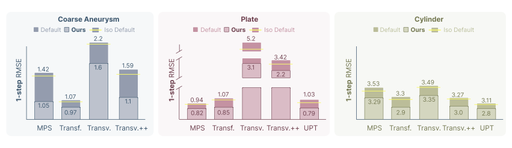
Figure 2 .Results on 1-step RMSE.We see improvements for all models and all datasets. Since our approach incurs a slight increase in the number of trainable parameters, we also compute the metric for the original architecture with the same number of parameters as ours (represented by the yellow lines).
원문 · CC BY 4.0 · Paul Garnier, Vincent Lannelongue, Elie Hachem · Mesh Based Simulations with Spatial and Temporal awareness · 원문 그림 인용 · 원본 PDF 6쪽에서 그림 영역을 추출했습니다.기존 학습 방식의 한계
이 논문은 GNN과 Transformer 기반 메시 시뮬레이션 대리모델이 빠르게 발전했지만, 학습 방식은 노드 단위 지도학습과 explicit Euler형 다음 단계 예측에 머물러 있다고 지적합니다. 노드별 오차는 각 노드를 따로 평가하므로 FEM에서 중요한 요소 경계의 플럭스 연속성을 직접 제약하지 않습니다. 또한 u_{t+1}=u_t+Δt Φ(u_t) 형태의 업데이트는 강성(stiff) 동역학에서 불안정해지고 긴 궤적에서 오차가 누적될 수 있다고 설명합니다. 저자들은 이 두 지점을 개선 대상으로 삼습니다.
Multi Node Prediction의 학습 구조
Multi Node Prediction은 중심 노드 i의 잠재 표현 z_i^L로 i와 1-hop 이웃 j∈N(i)의 다음 단계 값을 함께 예측하는 보조 학습 목표입니다. 중심 노드는 내부 노드에서 무작위로 샘플링되며, 각 이웃은 인코더로 얻은 특징과 중심 잠재 표현을 담은 별 모양 시퀀스로 구성됩니다. 이 시퀀스는 링 셀프 어텐션을 쓰는 작은 Transformer T_θ′로 처리되고, 같은 디코더 D로 이웃 값을 복원합니다. 전체 목표는 L=L_main+αL_MNP이며 α=0.2입니다. 추가 모듈은 학습 중에만 사용되어 학습 시간을 약 5% 늘린다고 보고됩니다.

Figure 11 .Effect on latent representation.While training architecture with and without Multi Node Prediction, we encode the next-step target to obtain a latent target, and compute it’s difference with the current latent representation at each stage of the architecture. We display the differences after zero spatial processing, and afterLspatial processing.
원문 · CC BY 4.0 · Paul Garnier, Vincent Lannelongue, Elie Hachem · Mesh Based Simulations with Spatial and Temporal awareness · 원문 그림 인용 · 원본 PDF 21쪽에서 그림 영역을 추출했습니다.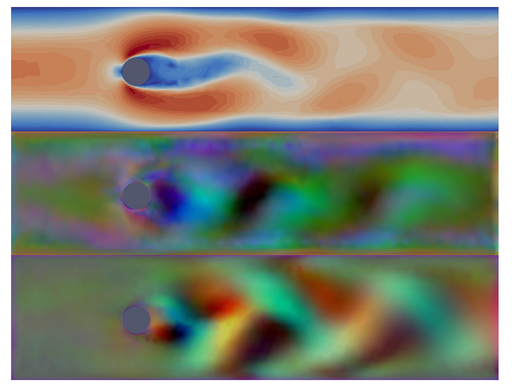
Figure 12 .The next step velocity (target field) is presented in the top row. The latent representation without MNP is presented in the second row, while the latent representation with MNP is presented in the bottom row.
원문 · CC BY 4.0 · Paul Garnier, Vincent Lannelongue, Elie Hachem · Mesh Based Simulations with Spatial and Temporal awareness · 원문 그림 인용 · 원본 PDF 21쪽에서 그림 영역을 추출했습니다.Temporal Correction과 θ-method 해석
Temporal Correction은 공간 처리 뒤의 예측 상태 Z̃_{ℓ+1}을 질의로, 이전 상태 Z_ℓ을 키와 값으로 하는 교차 어텐션을 사용합니다. 게이트 G(C)와 혼합 MLP M(C)를 더해 Z_{ℓ+1}=Z_ℓ+ϕ^t_ℓ(C)를 얻으며, 이는 예측자-보정자 형태의 잔차 갱신입니다. 원문은 이 블록이 explicit residual 업데이트보다 더 넓은 안정한 one-step 맵 집합을 표현할 수 있다고 주장하며, 이를 위해 θ-method를 내장한 테스트 방정식 분석(Theorem B.3)을 제시합니다. 여기서 θ≥1/2이면 A-안정이며, θ=0인 Forward Euler는 안정성 디스크에 제한됩니다.
다만 저자들은 신경망이 실제로 적절한 θ를 학습한다고 증명하지는 않는다고 해석합니다.
3D RoPE와 기하 위치 정보
3D RoPE는 쿼리와 키의 채널 쌍을 x, y, z 축에 나누어 중심화된 좌표 p̃_i에 비례한 각도로 회전시킵니다. 이 회전을 적용하면 두 노드의 어텐션 점수는 각 축의 상대 오프셋 p̃_j−p̃_i에 의존하게 되므로, 방향에 따라 달라지는 이동이나 확산을 표현하는 데 쓰인다고 설명합니다. 원문은 이 방법이 추가 파라미터 없이 이웃 희소성을 유지한다고 밝힙니다.
데이터셋과 학습 조건
검증에는 Cylinder, DeformingPlate, Coarse Aneurysm 데이터셋이 사용됩니다. Cylinder와 DeformingPlate는 1000개 학습 궤적과 100개 테스트 궤적을, Coarse Aneurysm은 100개 학습 궤적과 20개 테스트 궤적을 사용합니다. 모델은 20 epoch 동안 AdamW(β1=0.9, β2=0.95)로 학습되며, 최대 학습률은 10^-3입니다. 평가 지표는 1-step RMSE와 All-Rollout RMSE이며, 원문은 다섯 개의 랜덤 시드에 대해 평균을 보고합니다. 노이즈 주입은 다음 단계 예측 학습에만 적용됩니다.
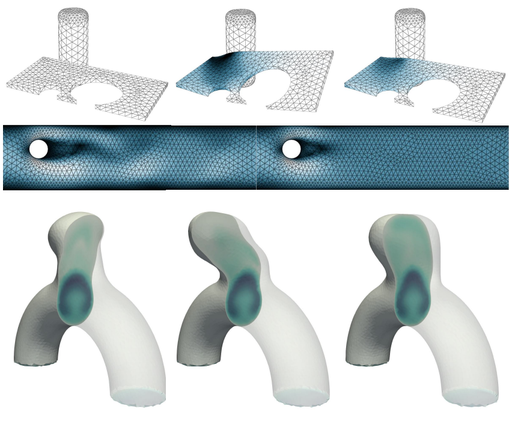
Figure 7 .We display details of our three primary datasets: DeformingPlate, Cylinder and Coarse Aneurysm. For the first two, we also display the mesh used for the simulations, while we discard it from the Aneurysm visualisation for practicality purposes.
원문 · CC BY 4.0 · Paul Garnier, Vincent Lannelongue, Elie Hachem · Mesh Based Simulations with Spatial and Temporal awareness · 원문 그림 인용 · 원본 PDF 13쪽에서 그림 영역을 추출했습니다.
Table 1 .Datasets used in the experiments, their features as well as if some temporal history is used. Finally, we also present the average number of nodes per mesh, together with solver, train/test trajectories, rollout length, and time step.
원문 · CC BY 4.0 · Paul Garnier, Vincent Lannelongue, Elie Hachem · Mesh Based Simulations with Spatial and Temporal awareness · 원문 그림 인용 · 원본 PDF 14쪽에서 그림 영역을 추출했습니다.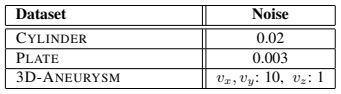
Table 2 .Noise levels applied to each dataset, per feature, during training.
원문 · CC BY 4.0 · Paul Garnier, Vincent Lannelongue, Elie Hachem · Mesh Based Simulations with Spatial and Temporal awareness · 원문 그림 인용 · 원본 PDF 14쪽에서 그림 영역을 추출했습니다.Aneurysm 절제 결과
Aneurysm 데이터셋의 Transformer 절제 실험에서 Multi Node Prediction은 1-step 및 all-rollout RMSE를 함께 개선한다고 보고됩니다. 원문은 256개 중심(노드의 약 2.5%)만으로도 개선이 나타나며 1024개 중심은 256개 대비 두 배의 개선을 준다고 설명합니다. 또 Temporal Correction은 게이팅과 혼합 메커니즘이 없을 때 교차 어텐션만으로는 성능을 악화시킨다고 보고합니다. 3D RoPE는 절대 좌표와 함께 사용될 때 강한 개선을 보였다고 기술됩니다. 이 결과들은 주로 Aneurysm 데이터셋과 Transformer 기준의 절제 실험에서 얻은 것입니다.
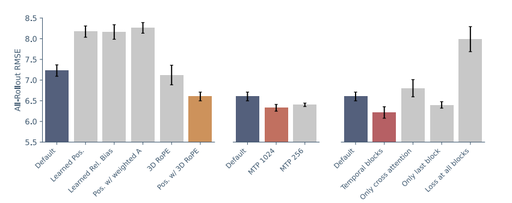
Figure 5 .Ablation StudiesWe present our ablation studies for all three improvements and their alternatives. Ablations related to RoPE are in the left, to Multi-node Prediction in the middle, and to Temporal Correction in the right.
원문 · CC BY 4.0 · Paul Garnier, Vincent Lannelongue, Elie Hachem · Mesh Based Simulations with Spatial and Temporal awareness · 원문 그림 인용 · 원본 PDF 9쪽에서 그림 영역을 추출했습니다.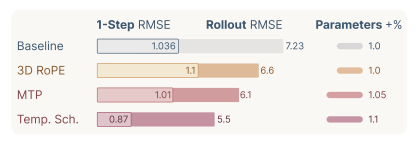
Figure 8 .Impact of each upgrade.We detail the improvement in term of 1-step and all-rollout RMSE on the Aneurysm dataset for the Transformer architecture. We also detail the increase in terms of trainable parameters.
원문 · CC BY 4.0 · Paul Garnier, Vincent Lannelongue, Elie Hachem · Mesh Based Simulations with Spatial and Temporal awareness · 원문 그림 인용 · 원본 PDF 18쪽에서 그림 영역을 추출했습니다.적용 범위와 남은 질문
원문은 Cylinder 데이터셋에서 파라미터 규모 확장에 따른 개선이 항상 일관적이지는 않다고 보고합니다. 기하 이동 실험은 Reynolds 수 일반화 연구가 아니라 기하 이동 평가로 해석되어야 합니다. 또한 Temporal Correction의 안정성 분석은 테스트 방정식과 θ-method에 대한 정리이며, 실제 신경망이 최적 θ를 학습한다는 증명은 아닙니다. 이 논문은 이들 조건과 구현 범위 밖의 일반화를 주장하지 않습니다.
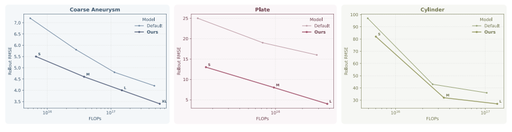
Figure 3 .Scaling with model size.All rollout RMSE for a Transformer model on the three different datasets. Even when training models larger and larger, our approach keeps scaling similarly to the previous model.
원문 · CC BY 4.0 · Paul Garnier, Vincent Lannelongue, Elie Hachem · Mesh Based Simulations with Spatial and Temporal awareness · 원문 그림 인용 · 원본 PDF 8쪽에서 그림 영역을 추출했습니다.논문 정보
- 저자
- Paul Garnier, Vincent Lannelongue, Elie Hachem
- 학회·저널
- arXiv · 프리프린트
- 최초 공개일
- 2026년 5월 2일
- 등록일
- 2026년 10월 29일
- 수정일
- 2026년 5월 2일
- 버전
- v1
- arXiv
- 2605.01542
- 분류
- cs.LG · cs.AI · physics.comp-ph
- 원문 이용 조건
- CC BY 4.0
- 제공 범위
- 논문 정보, 해설, 허용된 원문 그림
AI 해설은 논문 원문과 별개의 설명이며 오류가 있을 수 있습니다. 원문과 그림은 각 출처의 이용 조건과 따로 표시된 권리를 따릅니다.
초록
Machine Learning surrogates for Computational Fluid Dynamics (CFD), particularly Graph Neural Networks (GNNs) and Transformers, have become a new important approach for accelerating physics simulations. However, we identify a critical bottleneck in the field: while architectures have advanced significantly, the common underlying training paradigms remain bound to naive assumptions, such as node-wise supervision and explicit Euler time-stepping. These legacy choices ignore the stiff dynamics and local flux continuity inherent to numerous partial differential equations resolution methods, such as Finite Element, Difference, or Volume (FEM). In this work, we propose a unified framework to bridge the gap between geometric deep learning and rigorous numerical analysis. We introduce three key innovations: (1) Multi Node Prediction, a stencil-level objective that predicts field values for a node's full local topology, enforcing spatial derivative consistency; (2) Temporal Correction, replacing unstable explicit schemes with a predictor-corrector via temporal Cross-Attention; and (3) Geometric Inductive Biases, leveraging 3D Rotary Positional Embeddings (RoPE) to robustly capture rotational symmetries in unstructured meshes. We evaluate this framework across three architectures (MeshGraphNet, Transolver, and a Transformer) on diverse physics datasets. Our approach yields consistent improvements in accuracy and stability, particularly in long-horizon rollouts, while producing latent representations that generalize to unseen subtasks such as Wall Shear Stress or Pressure prediction. Code is available at https://github.com/DonsetPG/graph-physics.
원문 인용
Paul Garnier, Vincent Lannelongue, Elie Hachem (2026). Mesh Based Simulations with Spatial and Temporal awareness. arXiv:2605.01542v1. https://arxiv.org/abs/2605.01542v1
BibTeX
@misc{garnier2026mesh,
  title = {{Mesh Based Simulations with Spatial and Temporal awareness}},
  author = {Paul Garnier and Vincent Lannelongue and Elie Hachem},
  year = {2026},
  eprint = {2605.01542},
  archivePrefix = {arXiv},
  url = {https://arxiv.org/abs/2605.01542v1}
}