논문 해설
What Has a Foundation Model Found? Using Inductive Bias to Probe for World Models
파운데이션 모델은 무엇을 발견했는가? 귀납적 편향을 이용해 세계 모델을 탐색하기
- 연구 문제 기반 모델이 시퀀스 예측 학습으로 세계 모델을 실제로 학습했는지 평가하는 것이 문제입니다.
- 연구 방법 주어진 세계 모델과 일관된 합성 데이터셋에 기반 모델을 적응시키고, R-IB와 D-IB로 예측이 상태 구조를 따르는지 측정합니다.
- 주요 결과 궤도 궤적 트랜스포머는 정확한 궤적 예측에도 뉴턴 상태에 대한 낮은 귀납 편향을 보였고, 격자 문제와 Othello에서도 상태 구조보다 합법 다음 토큰 분할을 따르는 경향이 나타났습니다.
기반 모델이 세계 모델을 학습했는지 묻는 문제
기반 모델은 시퀀스를 예측하는 학습만으로 대상의 더 깊은 구조를 찾을 수 있다는 전제에 기대어 있습니다. 케플러의 행성 궤도 예측이 뉴턴 역학으로 이어진 것처럼, 예측 성능이 높다고 해서 모델이 세계 모델을 학습했다고 보기는 어렵습니다. 이 논문은 모델이 새로운 과제에 적응할 때 보이는 귀납 편향을 조사하여 이 질문에 답하려 합니다. 핵심은 예측 정확도가 아니라 소량의 정보에서 어떻게 외삽하는지를 보는 데 있습니다.
inductive bias probe의 구성
inductive bias probe는 주어진 세계 모델과 일관된 합성 데이터셋을 여러 개 생성하고, 각 데이터셋에 기반 모델을 적응시킨 뒤 그 예측이 세계 모델의 상태 구조를 따르는지 측정합니다. 같은 상태의 입력은 예측이 같아야 하고(R-IB), 서로 다른 상태의 입력은 예측이 달라야 합니다(D-IB). 일반 설정에서는 외삽 예측 가능성을 정의하고, 세계 모델의 오라클 기준과 비교하여 귀납 편향을 계산합니다. 이 방식은 표현의 물리적 형태에 의존하지 않고 상태의 동등성만 사용합니다.
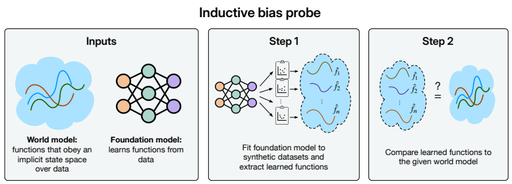
Figure 2 . An inductive bias probe measures whether a foundation model has an inductive bias toward a given world model. The probe involves repeatedly fitting a foundation model to small, synthetic datasets and comparing the functions it learns to the functions in the given world model.
원문 · CC BY 4.0 · Keyon Vafa, Peter G. Chang, Ashesh Rambachan, Sendhil Mullainathan · What Has a Foundation Model Found? Using Inductive Bias to Probe for World Models · 원문 그림 인용 · 원본 PDF 3쪽에서 그림 영역을 추출했습니다.궤도 궤적 실험에서 나타난 뉴턴 편향의 부재
궤도 궤적 실험에서는 109M 파라미터 트랜스포머를 궤도 시퀀스의 다음 토큰 예측으로 사전 학습했습니다. 이 모델은 R2가 0.9999보다 높은 궤적 예측 성능을 보였지만, 합성 선형 함수에 대한 미세 조정에서 뉴턴 상태에 대한 귀납 편향은 낮게 나타났습니다. 힘 벡터를 예측하도록 미세 조정한 뒤 기호 회귀를 적용하면 얻은 법칙은 뉴턴의 중력 법칙과 달랐고, 은하 표본마다 서로 다른 법칙이 복원되었습니다. 이 결과는 해당 설정의 트랜스포머에 대한 관찰이며 다른 모델 전체로 일반화되지는 않습니다.
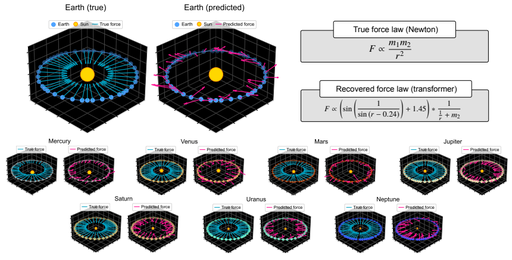
Figure 1 . Each pair of panels illustrates the trajectory of a planet in the solar system and its gravitational force vectors, comparing the true Newtonian forces (left) to the predicted forces (right) from a transformer foundation model pretrained on orbital sequences and fine-tuned to predict forces. While the model excels at generating accurate predictions of planetary trajectories, it does not have an inductive bias toward true Newtonian mechanics; moreover, its force predictions recover a nonsensical force law, as revealed by symbolic regression.
원문 · CC BY 4.0 · Keyon Vafa, Peter G. Chang, Ashesh Rambachan, Sendhil Mullainathan · What Has a Foundation Model Found? Using Inductive Bias to Probe for World Models · 원문 그림 인용 · 원본 PDF 2쪽에서 그림 영역을 추출했습니다.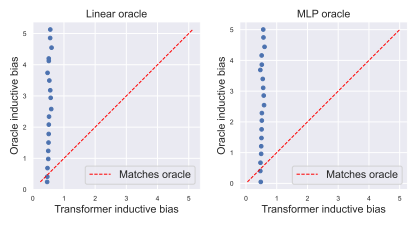
Figure 4 . Inductive bias probe performance (Equation 6) for a trans- former pretrained on orbital trajectories. Values shown are the ab- solute value of the inductive bias metric. A 45-degree line would indicate perfect inductive bias toward an oracle that extrapolates based on the Newtonian state vector.
원문 · CC BY 4.0 · Keyon Vafa, Peter G. Chang, Ashesh Rambachan, Sendhil Mullainathan · What Has a Foundation Model Found? Using Inductive Bias to Probe for World Models · 원문 그림 인용 · 원본 PDF 5쪽에서 그림 영역을 추출했습니다.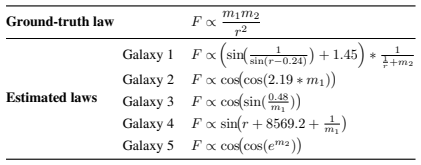
Table 1 . Force equations recovered via symbolic regression of a transformer pretrained on orbital data and fine-tuned to different galaxy samples. The model recovers different equations for each sample, never recovering the true law.
원문 · CC BY 4.0 · Keyon Vafa, Peter G. Chang, Ashesh Rambachan, Sendhil Mullainathan · What Has a Foundation Model Found? Using Inductive Bias to Probe for World Models · 원문 그림 인용 · 원본 PDF 7쪽에서 그림 영역을 추출했습니다.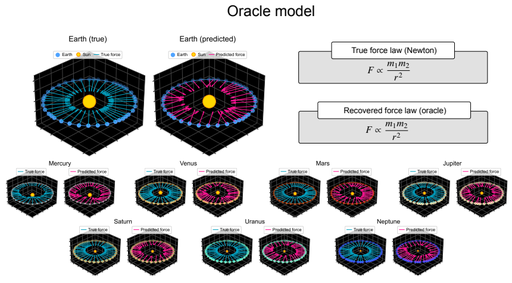
Figure 8 . Each pair of panels illustrates the trajectory of a planet in the solar system and its gravitational force vectors, comparing the true Newtonian forces (left) to the predicted forces from anoracle modelthat predicts force vectors based on the true state matrices. A symbolic regression recovers the true gravitational law from its predictions.
원문 · CC BY 4.0 · Keyon Vafa, Peter G. Chang, Ashesh Rambachan, Sendhil Mullainathan · What Has a Foundation Model Found? Using Inductive Bias to Probe for World Models · 원문 그림 인용 · 원본 PDF 17쪽에서 그림 영역을 추출했습니다.
Table 8 . Orbit trajectory prediction performance (MSE) for models pre-trained on next-token prediction. Each column shows prediction accuracy when forecasting planetary positions 1, 5, or 100 time steps ahead from position 500 in the sequence. We compare the transformer model to two simple baselines (one that always predicts a planet’s position at the previous timestep, and another that uses the per-orbit mean). All results are evaluated on held-out test trajectories.
원문 · CC BY 4.0 · Keyon Vafa, Peter G. Chang, Ashesh Rambachan, Sendhil Mullainathan · What Has a Foundation Model Found? Using Inductive Bias to Probe for World Models · 원문 그림 인용 · 원본 PDF 21쪽에서 그림 영역을 추출했습니다.격자 문제와 Othello에서의 귀납 편향과 다음 토큰 분할
격자 문제에서는 상태 수가 많아질수록 귀납 편향이 떨어지며, 트랜스포머는 RNN, LSTM, Mamba, Mamba-2보다 일관되게 낮았습니다. Othello에서는 모든 모델이 합법 다음 수를 거의 정확하게 예측했지만, 귀납 편향 지표는 낮게 나타났습니다. 다음 토큰 분할을 기준으로 D-IB를 분해하면, 합법 다음 토큰이 같은 서로 다른 상태 쌍의 예측이 다른 쌍보다 더 예측 가능하게 나타났습니다. 저자들은 이 결과를 모델이 보드 상태 대신 다음 토큰 분할을 따르는 경향으로 해석합니다.
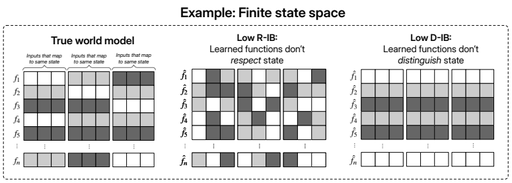
Figure 3 .An illustration of the inductive bias probe when the given world model has a finite state space. Each row represents a function and each column represents an input xi, with inputs belonging to the same state grouped together. The shading illustrates each function’s value at the corresponding input. A foundation model has low R-IB (middle) if it learns functions that divide states, while a foundation model has low D-IB (right) if it learns function that merge states.
원문 · CC BY 4.0 · Keyon Vafa, Peter G. Chang, Ashesh Rambachan, Sendhil Mullainathan · What Has a Foundation Model Found? Using Inductive Bias to Probe for World Models · 원문 그림 인용 · 원본 PDF 4쪽에서 그림 영역을 추출했습니다.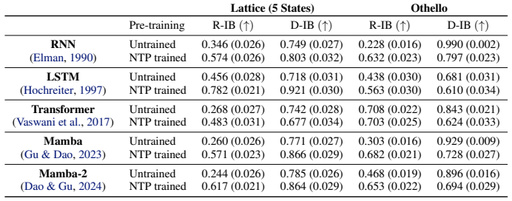
Table 2 . Theinductive bias towards respecting state(R-IB) andinductive bias towards distinguishing state(D-IB) metrics (1 is perfect performance, 0 is equivalent to noninformative model). “NTP-trained” represents a model pre-trained on next-token prediction, while “untrained” refers to a model trained on the same synthetic tasks, initialized from scratch.
원문 · CC BY 4.0 · Keyon Vafa, Peter G. Chang, Ashesh Rambachan, Sendhil Mullainathan · What Has a Foundation Model Found? Using Inductive Bias to Probe for World Models · 원문 그림 인용 · 원본 PDF 8쪽에서 그림 영역을 추출했습니다.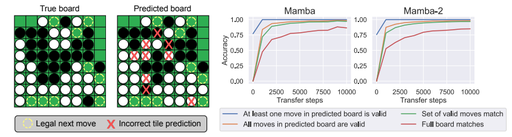
Figure 6 . On the left, a true Othello board implied by a sequence, and on the right, the predicted board from a model fine-tuned to predict boards. Although the prediction has errors, the set of predicted next tokens exactly matches the true board. On the right, metrics about board reconstruction during fine-tuning. Consistently, even as Mamba models struggle to recover full boards, they recover them well enough such that the sets of valid next moves match those in the true boards.
원문 · CC BY 4.0 · Keyon Vafa, Peter G. Chang, Ashesh Rambachan, Sendhil Mullainathan · What Has a Foundation Model Found? Using Inductive Bias to Probe for World Models · 원문 그림 인용 · 원본 PDF 9쪽에서 그림 영역을 추출했습니다.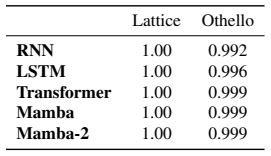
Table 7 .Results for the next token test (Toshniwal et al., 2022; Li et al., 2023) for models pre-trained on next-token prediction.
원문 · CC BY 4.0 · Keyon Vafa, Peter G. Chang, Ashesh Rambachan, Sendhil Mullainathan · What Has a Foundation Model Found? Using Inductive Bias to Probe for World Models · 원문 그림 인용 · 원본 PDF 20쪽에서 그림 영역을 추출했습니다.세계 모델 지정의 한계
이 방법은 평가할 세계 모델을 먼저 지정해야 합니다. 따라서 모델이 실제로 사용하는 표현을 자동으로 찾는 문제는 해결하지 못합니다. 저자들은 세계 모델을 자동으로 구성하는 방법이 향후 과제라고 밝힙니다. 또한 Othello 실험의 합성 데이터셋 구성과 리샘플링 방식은 해당 실험의 설정이므로 다른 입력 분포로 옮기면 결과가 달라질 수 있습니다.
논문 정보
- 저자
- Keyon Vafa, Peter G. Chang, Ashesh Rambachan, Sendhil Mullainathan
- 학회·저널
- arXiv · 프리프린트
- 최초 공개일
- 2025년 7월 9일
- 등록일
- 2026년 10월 30일
- 수정일
- 2025년 12월 27일
- 버전
- v4
- arXiv
- 2507.06952
- 분류
- cs.LG · cs.AI
- 원문 이용 조건
- CC BY 4.0
- 제공 범위
- 논문 정보, 해설, 허용된 원문 그림
AI 해설은 논문 원문과 별개의 설명이며 오류가 있을 수 있습니다. 원문과 그림은 각 출처의 이용 조건과 따로 표시된 권리를 따릅니다.
초록
Foundation models are premised on the idea that sequence prediction can uncover deeper domain understanding, much like how Kepler's predictions of planetary motion later led to the discovery of Newtonian mechanics. However, evaluating whether these models truly capture deeper structure remains a challenge. We develop a technique for evaluating foundation models that examines how they adapt to synthetic datasets generated from some postulated world model. Our technique measures whether the foundation model's inductive bias aligns with the world model, and so we refer to it as an inductive bias probe. Across multiple domains, we find that foundation models can excel at their training tasks yet fail to develop inductive biases towards the underlying world model when adapted to new tasks. We particularly find that foundation models trained on orbital trajectories consistently fail to apply Newtonian mechanics when adapted to new physics tasks. Further analysis reveals that these models behave as if they develop task-specific heuristics that fail to generalize.
원문 인용
Keyon Vafa, Peter G. Chang, Ashesh Rambachan, Sendhil Mullainathan (2025). What Has a Foundation Model Found? Using Inductive Bias to Probe for World Models. arXiv:2507.06952v4. https://arxiv.org/abs/2507.06952v4
BibTeX
@misc{vafa2025what,
  title = {{What Has a Foundation Model Found? Using Inductive Bias to Probe for World Models}},
  author = {Keyon Vafa and Peter G. Chang and Ashesh Rambachan and Sendhil Mullainathan},
  year = {2025},
  eprint = {2507.06952},
  archivePrefix = {arXiv},
  url = {https://arxiv.org/abs/2507.06952v4}
}