논문 해설
Right Now, Wrong Then: Non-Stationary Direct Preference Optimization under Preference Drift
지금은 옳고 그때는 틀리다: 선호 드리프트 하의 비정상 직접 선호 최적화
- 연구 문제 선호가 시간에 따라 바뀌는 데이터에서 표준 DPO는 오래된 선호를 노이즈처럼 취급해 성능이 떨어질 수 있습니다.
- 연구 방법 NS-DPO는 Dynamic Bradley-Terry 모델을 사용하고, 데이터 시점에 따라 지수 할인 γ를 DPO 손실에 추가합니다.
- 주요 결과 log-linear 오프라인 이론에서 γ 선택에 따른 regret 상한을 제시하고, LLM 실험에서 표류 조건별로 DPO와 IPO 등 기준선보다 높은 성능을 보고합니다.
선호 표류가 있는 데이터의 문제
LLM 선호 최적화 알고리즘은 대부분 인간 선호가 시간에 따라 변하지 않는다는 정상성(stationarity)을 가정합니다. 그러나 여러 시기에 걸쳐 모은 선호 데이터에서는 새로운 정보, 사회적 영향, 문화적 변화로 선호가 바뀔 수 있습니다. 이때 DPO와 같은 표준 방법은 오래된 선호 레이블을 노이즈처럼 취급하고 최신 데이터와 같은 무게로 학습하므로 성능이 떨어질 수 있습니다. 이 논문은 이러한 비정상(non-stationary) 선호 표류를 직접 다루는 방법과 이론적 보장을 제시합니다.
Dynamic Bradley-Terry 모델과 NS-DPO 손실
NS-DPO는 시점 t에 따라 달라지는 보상 r(x, a, t)를 갖는 Dynamic Bradley-Terry 모델을 사용합니다. 각 데이터 포인트는 프롬프트, 선호 응답, 비선호 응답과 선호가 표현된 시점 t_i를 가지며, 현재 시점 T의 보상을 추정할 때 최대우도 손실에 γ^(T-t_i-1) 가중치를 곱합니다. 여기서 γ는 0과 1 사이의 할인 계수이며, 과거 데이터일수록 가중치가 지수적으로 작아집니다. 저자들은 어떤 선호가 바뀌었는지 알지 못하는 상황을 가정하므로 오래된 데이터 전체를 낮은 가중치로 취급하는 설계를 택했다고 설명합니다. 이 구조에서 γ가 1에 가까워지면 정상 Bradley-Terry 손실로 회복됩니다.
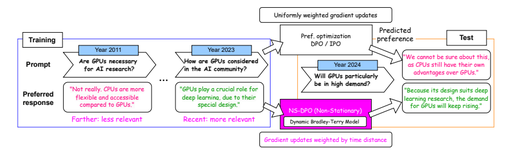
Figure 1 : Human preferences are dynamic and influenced by a variety of factors (e.g. environment change and societal influence). However, standard preference optimization approaches (e.g., DPO and IPO (Rafailov et al., 2024; Azar et al., 2024)) do not account for this non-stationarity. In contrast, NS-DPO robustly learns on non-stationary data by using a Dynamic Bradley-Terry model, and adjusts the loss to discount older datapoints and concentrate learning on the latest data.
원문 · CC BY 4.0 · Seongho Son, William Bankes, Sayak Ray Chowdhury, Brooks Paige, Ilija Bogunovic · Right Now, Wrong Then: Non-Stationary Direct Preference Optimization under Preference Drift · 원문 그림 인용 · 원본 PDF 2쪽에서 그림 영역을 추출했습니다.오프라인 이론 분석의 가정과 상한
이론 분석은 log-linear 정책 클래스 π_θ를 가정하고, 전체 선호 표류를 θ*_t 변화량의 ℓ2 합 Σ‖θ*_{t+1}−θ*_t‖₂ ≤ B_T로 제한하는 Variation Budget Bound를 둡니다. 또한 파라미터 경계, 식별성, 특징 커버리지와 시점별 데이터 수 제약을 추가합니다. 이 조건에서 Theorem 3은 γ=1−(B_T/T)^(3/4)를 택할 때 regret이 Õ(d B_T^(3/4) n^(−1/4)) 수준이라고 보고합니다. 또한 Corollary 4는 B_T→0인 정상 선호 설정에서 γ=1−(B_T/T)^α와 0<α<2/3를 쓰면 O(n^(−1/2)) 회복이 가능하다고 제시합니다.
이 결과들은 위 가정과 상수에 조건부이며, 모든 비정상 설정이나 임의의 정책 클래스에 대한 보장으로 읽으면 안 됩니다.
LLM 실험 설정과 비교 기준
실험은 Llama-2-7b-chat-hf를 LoRA로 미세조정하는 설정과, Llama-3.2-1b-it를 전체 파라미터로 미세조정하는 설정을 포함합니다. 데이터는 UltraFeedback 기반의 UltraFeedback-RM과 UltraFeedback-LM, Helpful-Harmless에서 만든 TV-HH, GlobalOpinionsQA에서 만든 2C NSGO입니다. 비교 기준은 정상 DPO, IPO, 시간 단계 정보를 프롬프트에 넣는 tDPO입니다. 평가 지표로는 테스트 데이터에서의 reward accuracy, TV-HH의 win rate, UltraFeedback-LM의 AlpacaEval2 LCWR이 사용됩니다.
설정별 γ와 τ 값은 모델과 데이터에 따라 달라지므로 한 값으로 일반화하지 않습니다.
표류 조건별 결과
TV-HH에서 변화점 t_cp가 늦어질수록 NS-DPO는 DPO보다 높은 win rate를 보였다고 보고됩니다. 이 결과는 변화점이 현재 시점에 가까울수록 최신 선호 샘플이 줄어들고, NS-DPO가 오래된 선호 샘플을 할인하여 최신 샘플에 학습을 집중한다는 저자의 해석과 함께 제시됩니다. UltraFeedback-LM에서는 NS-DPO가 DPO와 SW-DPO보다 높은 LCWR을 보고합니다. 2C NSGO의 점진 표류에서도 NS-DPO는 DPO보다 reward accuracy가 높다고 보고되며, tDPO는 정상 DPO와 큰 차이를 보이지 않았습니다. 반면 선호 표류가 없는 UltraFeedback 설정에서는 NS-DPO가 DPO와 거의 같은 reward accuracy를 보였습니다.
성능 차이는 γ 값에 따라 달라지므로 특정 γ의 결과를 모든 설정의 결과로 확대하지 않습니다.
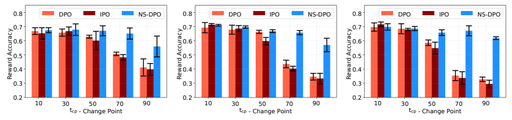
Figure 3 : NS-DPO consistently outperforms DPO and IPO as the change point, tcp nears the present T= 101 for varying strengths of preference shift on theTV-HHdataset using the Llama-2-7b-chat-hf model. [Left] ρdiff = 0.7. [Middle] ρdiff = 0.8. [Right] ρdiff = 0.9. We note that as the value of tcp increases, the performance difference between NS-DPO and the baselines increases. This is because as the change point moves closer to the present time step, the number of samples available from the updated preference distribution decreases. NS-DPO discounts samples with old preferences, focusing learning upon the small number of samples with up-to-date preference labels.
원문 · CC BY 4.0 · Seongho Son, William Bankes, Sayak Ray Chowdhury, Brooks Paige, Ilija Bogunovic · Right Now, Wrong Then: Non-Stationary Direct Preference Optimization under Preference Drift · 원문 그림 인용 · 원본 PDF 7쪽에서 그림 영역을 추출했습니다.적용 범위와 한계
본문 실험은 특정 Llama 계열 모델과 제한된 데이터셋, 그리고 선택한 γ 값에서 수행되었습니다. 성능은 γ 선택에 의존하며 점진 표류 실험에서도 γ에 따른 차이가 보고됩니다. 또한 Impact Statement는 최신 데이터에 포함된 편향이 할인 파라미터에 의해 증폭될 수 있으므로 주의가 필요하다고 밝힙니다. 이론 결과는 오프라인 설정, log-linear 정책, variation budget B_T의 알려진 상한이라는 가정에 묶여 있습니다.
논문 정보
- 저자
- Seongho Son, William Bankes, Sayak Ray Chowdhury, Brooks Paige, Ilija Bogunovic
- 학회·저널
- arXiv · 프리프린트
- 최초 공개일
- 2024년 7월 26일
- 등록일
- 2026년 10월 30일
- 수정일
- 2026년 1월 12일
- 버전
- v3
- arXiv
- 2407.18676
- 분류
- cs.LG
- 원문 이용 조건
- CC BY 4.0
- 제공 범위
- 논문 정보, 해설, 허용된 원문 그림
AI 해설은 논문 원문과 별개의 설명이며 오류가 있을 수 있습니다. 원문과 그림은 각 출처의 이용 조건과 따로 표시된 권리를 따릅니다.
초록
Current Large Language Model (LLM) preference optimization algorithms do not account for temporal preference drift, which can lead to severe misalignment. To address this limitation, we propose Non-Stationary Direct Preference Optimisation (NS-DPO) that models time-dependent reward functions with a Dynamic Bradley-Terry model. NS-DPO proposes a computationally efficient solution by introducing only a single discount parameter in the loss function, which is used for exponential weighting that proportionally focuses learning on more time-relevant datapoints. We theoretically analyze the convergence of NS-DPO in a general setting where the exact nature of the preference drift is not known, providing upper bounds on the estimation error and regret caused by non-stationary preferences. Finally, we demonstrate the effectiveness of NS-DPO for fine-tuning LLMs under drifting preferences. Using scenarios where various levels of preference drift is introduced, with popular LLM reward models and datasets, we show that NS-DPO fine-tuned LLMs remain robust under non-stationarity, significantly outperforming baseline algorithms that ignore temporal preference changes, without sacrificing performance in stationary cases.
원문 인용
Seongho Son, William Bankes, Sayak Ray Chowdhury, Brooks Paige, Ilija Bogunovic (2024). Right Now, Wrong Then: Non-Stationary Direct Preference Optimization under Preference Drift. arXiv:2407.18676v3. https://arxiv.org/abs/2407.18676v3
BibTeX
@misc{son2024right,
  title = {{Right Now, Wrong Then: Non-Stationary Direct Preference Optimization under Preference Drift}},
  author = {Seongho Son and William Bankes and Sayak Ray Chowdhury and Brooks Paige and Ilija Bogunovic},
  year = {2024},
  eprint = {2407.18676},
  archivePrefix = {arXiv},
  url = {https://arxiv.org/abs/2407.18676v3}
}