논문 해설
Towards Spectroscopy: Susceptibility Clusters in Language Models
분광학을 향하여: 언어 모델의 감수성 군집
- 연구 문제 susceptibility 벡터의 기하가 모델의 계산 역할과 데이터 패턴을 반영하는지 확인하는 것이 핵심 질문입니다.
- 연구 방법 localized Gibbs posterior에서 계산한 susceptibility 벡터를 전처리하고 kNN 그래프에서 conductance 기반 반복 군집화를 수행합니다.
- 주요 결과 Pythia-14M에서 510개의 군집을 얻었고, 그중 259개(50.8%)가 Pythia-70M SAE 특징과 일치했습니다.
연구 문제: 모델 내부 구조를 어떻게 읽을 것인가
언어 모델의 내부 구조는 직접 관찰하기 어렵습니다. 이 논문은 물리학의 분광법(spectroscopy)에서 착안해, 외부 섭동에 대한 시스템의 응답을 측정하여 내부 구조를 추론하는 틀을 신경망에 적용합니다. 핵심 질문은 susceptibility 벡터의 기하가 모델이 토큰을 처리하는 계산 역할을 반영하는지, 그리고 그 기하가 데이터 분포의 패턴과 어떻게 연결되는지입니다. 연구 범위는 Pythia-14M과 Pile 샘플 780,000개의 토큰 쌍으로 한정됩니다.
susceptibility의 정의와 모드 분해
susceptibility χxy는 구성요소 C의 관측량과 토큰별 손실 ℓxy의 공분산으로 정의되며, localized Gibbs posterior에서 계산됩니다. 여러 구성요소를 모으면 susceptibility 벡터 χxy가 됩니다. 이론적으로는 조건부 분포 q(y|x)를 특이값 분해하여 모드 쌍 (α, β)를 얻고, 토큰 쌍의 propensity sαβ(xy)로 χxy를 χαβ의 가중합으로 분해합니다. 따라서 비슷한 이유로 y가 x를 따르는 토큰 쌍은 propensity 프로파일이 비슷해지고, 모델이 그 모드에 반응하면 susceptibility 벡터도 가까워진다고 논증합니다. 이 분해는 저자들이 제시한 이론적 논증이며, 모드 자체는 실제로 관찰되지 않는다는 점에서 가설적 연결입니다.
전처리, 그래프 구성, 반복 군집화
실제 군집화는 susceptibility 행렬을 열 단위로 표준화한 뒤 행 단위로 평균을 0으로 맞추어 전체 공통 성분을 제거하는 전처리에서 시작합니다. 이후 k=45인 대칭 k-최근접 이웃 그래프를 만들고 self-tuning 가중치를 부여합니다. 각 시도에서는 임의의 시드에서 개인화 PageRank를 계산하고, 순위 접두집합 중 최소 전도도 집합을 찾습니다. 시도 결과가 노드의 99%를 넘으면 본체로 보고 제거하며, 20개 미만이면 고립점으로 제거합니다. 그 밖의 경우에만 군집으로 등록합니다. 이 반복 절차는 큰 본체에 가려진 주변 구조를 찾기 위한 설계입니다.
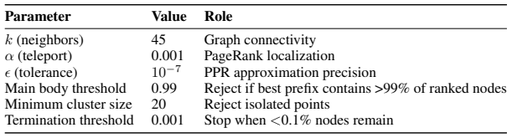
Table 4 : Clustering algorithm parameters.
원문 · CC BY 4.0 · Andrew Gordon, Garrett Baker, George Wang, William Snell, Stan van Wingerden, Daniel Murfet · Towards Spectroscopy: Susceptibility Clusters in Language Models · 원문 그림 인용 · 원본 PDF 17쪽에서 그림 영역을 추출했습니다.Pythia-14M에서 확인된 군집과 한계
저자들은 Pythia-14M에서 conductance 기반 방법으로 510개의 군집을 보고합니다. 군집의 예로는 문장 시작 대문자, 수학 변수, HTML 태그 같은 구조가 제시됩니다. 군집 라벨은 LLM으로 생성되었고 수동 검토를 거쳤다고 보고되며, 임의 샘플 30개 중 대부분이 90% 이상 같은 주제를 가진다는 평가도 있습니다. 다만 이 평가는 논문이 제시한 샘플에 대한 것이며, 군집 의미가 모두 정확하다는 독립적 검증은 아닙니다.
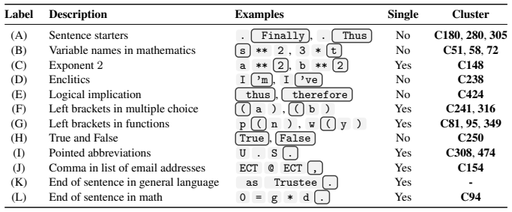
Table 1 :A selection of clustersfrom Figure 1. The clusters span natural language (A, D, E), mathematics (B, C, H, G, L), and code-like syntax (J). In the fourth column we show whether the cluster has a single sharedytoken. For a complete list of clusters see Section I.1.
원문 · CC BY 4.0 · Andrew Gordon, Garrett Baker, George Wang, William Snell, Stan van Wingerden, Daniel Murfet · Towards Spectroscopy: Susceptibility Clusters in Language Models · 원문 그림 인용 · 원본 PDF 3쪽에서 그림 영역을 추출했습니다.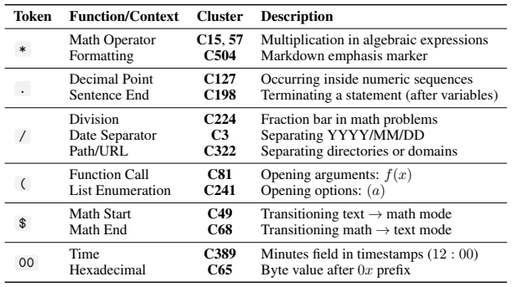
Table 2 :Context sensitivity. Identical y tokens are separated into distinct clusters based on their functional role. For example, the model maps the token * to disjoint regions of susceptibility space depending on whether it is used as a mathematical operator (multiplication) or a formatting marker (markdown italics), indicating distinct computational mechanisms.
원문 · CC BY 4.0 · Andrew Gordon, Garrett Baker, George Wang, William Snell, Stan van Wingerden, Daniel Murfet · Towards Spectroscopy: Susceptibility Clusters in Language Models · 원문 그림 인용 · 원본 PDF 7쪽에서 그림 영역을 추출했습니다.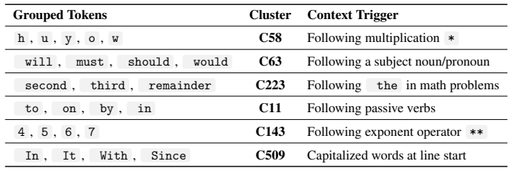
Table 3 :Abstraction over token identity.Distinct y tokens are grouped into single clusters when they share a functional role. For instance, the model treats disparate variable names ( h , u , y ) as computationally equivalent in the context of multiplication (C58). This indicates that the susceptibility vector captures the abstract category (e.g., “variable” or “exponent”) rather than just the token.
원문 · CC BY 4.0 · Andrew Gordon, Garrett Baker, George Wang, William Snell, Stan van Wingerden, Daniel Murfet · Towards Spectroscopy: Susceptibility Clusters in Language Models · 원문 그림 인용 · 원본 PDF 8쪽에서 그림 영역을 추출했습니다.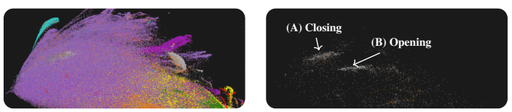
Figure 2 :Double quote token clusters.Left:Full low-dimensional representation of susceptibility vectors computed from Pythia-14M, with points colored by pattern type.Right:Filtered view showing only tokens which, when decoded, contain double quotes (e.g. " , ." ). (A) Tokens containing double quotes as closing a quotation (C69,C182,C372,C469). (B) Tokens containing double quotes as opening a quotation (C168,C174).
원문 · CC BY 4.0 · Andrew Gordon, Garrett Baker, George Wang, William Snell, Stan van Wingerden, Daniel Murfet · Towards Spectroscopy: Susceptibility Clusters in Language Models · 원문 그림 인용 · 원본 PDF 8쪽에서 그림 영역을 추출했습니다.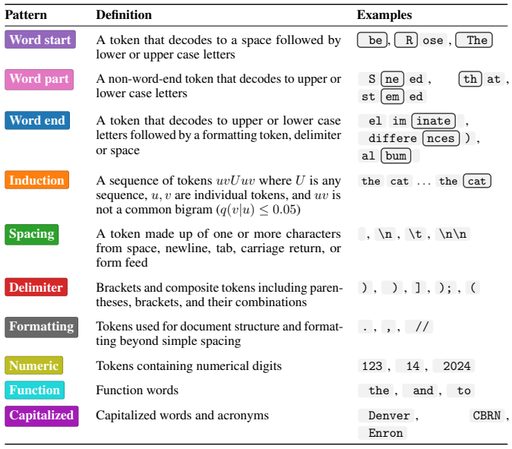
Table 6 : Token pattern categories and their definitions. Throughout the text we apply the indicated colors to tokens that follow a particular pattern. Boxed tokens indicate the pattern being illustrated.
원문 · CC BY 4.0 · Andrew Gordon, Garrett Baker, George Wang, William Snell, Stan van Wingerden, Daniel Murfet · Towards Spectroscopy: Susceptibility Clusters in Language Models · 원문 그림 인용 · 원본 PDF 23쪽에서 그림 영역을 추출했습니다.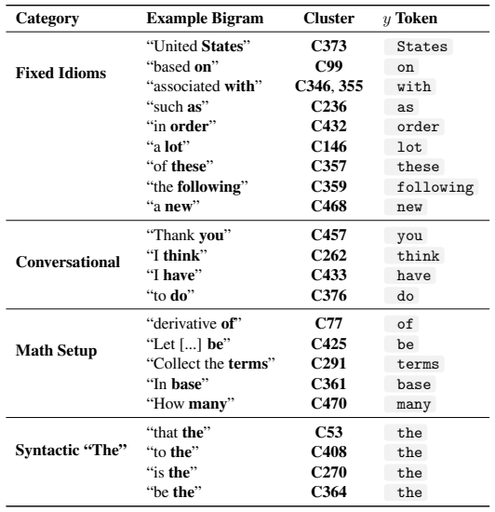
Table 8 :Bigrams and fixed phrases.A significant minority of discovered clusters correspond to rigid bigrams and idiomatic phrases where the continuation is highly deterministic. This suggests the model processes common multi-token sequences (like “United States” or “based on”) as atomic units.
원문 · CC BY 4.0 · Andrew Gordon, Garrett Baker, George Wang, William Snell, Stan van Wingerden, Daniel Murfet · Towards Spectroscopy: Susceptibility Clusters in Language Models · 원문 그림 인용 · 원본 PDF 54쪽에서 그림 영역을 추출했습니다.SAE 특징과의 비교
저자들은 Pythia-70M의 layer 2–4 잔차 흐름 SAE 특징과 군집을 비교합니다. 특징의 활성 빈도가 0.8 이상이면 일치로 정의하며, 510개 군집 중 259개(50.8%)가 일치한다고 보고합니다. 저자들은 이 일치율이 두 방법이 유사한 구조를 복구한다는 교차 방법 일관성을 지지한다고 해석하지만, 희소 특징과 단일 할당 군집 사이의 일대일 대응을 입증하지는 않는다고 명시합니다. 또한 비교 대상이 Pythia-14M이 아니라 Pythia-70M의 SAE라는 점도 한계로 남습니다.
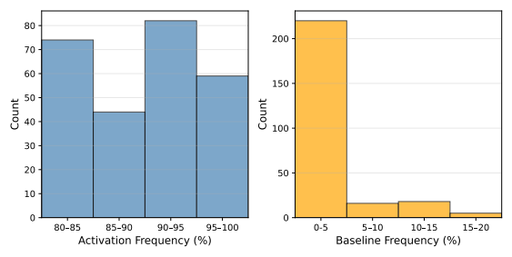
Figure 7 :Distribution of activation and baseline frequencies for matched SAE features.Left: Activation frequencies for 259 matched features.Right: Baseline frequencies for the same features when measured across random clusters, demonstrating specificity with most baselines below 5%. Matched features are defined as those with activation frequency≥80%.
원문 · CC BY 4.0 · Andrew Gordon, Garrett Baker, George Wang, William Snell, Stan van Wingerden, Daniel Murfet · Towards Spectroscopy: Susceptibility Clusters in Language Models · 원문 그림 인용 · 원본 PDF 27쪽에서 그림 영역을 추출했습니다.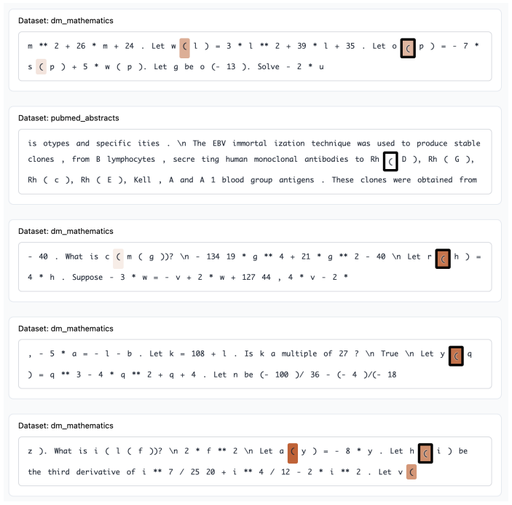
Figure 8 :Matching SAE for cluster C95. Shown are five contexts from across dm_mathematics andpubmed_abstracts appearing inC95, with the outlined token being y. We show the activation of SAE feature 834 from layer 3 of Pythia-70M, which is strongly activated on these y tokens. The activation ranges from 0.0 (white) to 6.33 (orange). The label for this cluster is: opening parenthesis ( after function names in dm_mathematics algebra problems. The activation frequency of this feature on this cluster is 93.3% and baseline frequency 4.3%.
원문 · CC BY 4.0 · Andrew Gordon, Garrett Baker, George Wang, William Snell, Stan van Wingerden, Daniel Murfet · Towards Spectroscopy: Susceptibility Clusters in Language Models · 원문 그림 인용 · 원본 PDF 28쪽에서 그림 영역을 추출했습니다.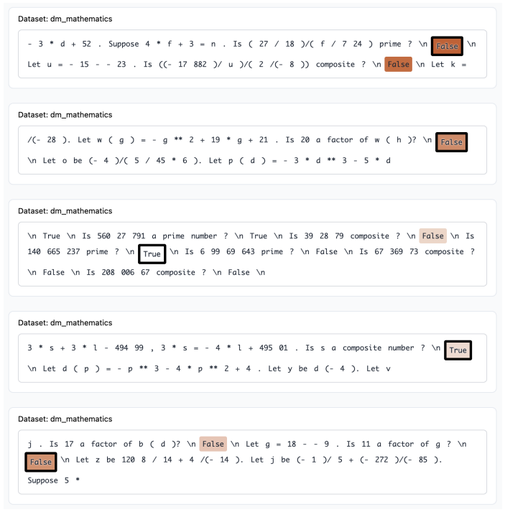
Figure 9 :Matching SAE for cluster C250. Shown are five contexts from across dm_mathematics appearing inC250, with the outlined token being y. We show the activation of SAE feature 16089 from layer 4 of Pythia-70M, which is strongly activated on these y tokens. The activation ranges from 0.0 (white) to 5.95 (orange). The label for this cluster is: True / False boolean answers after newlines indm_mathematics math problems. The activation frequency of this feature on this cluster is 90% and baseline frequency 0.2%.
원문 · CC BY 4.0 · Andrew Gordon, Garrett Baker, George Wang, William Snell, Stan van Wingerden, Daniel Murfet · Towards Spectroscopy: Susceptibility Clusters in Language Models · 원문 그림 인용 · 원본 PDF 29쪽에서 그림 영역을 추출했습니다.더 큰 Pythia 모델에서의 전도도
Pythia-14M 군집을 31M부터 1.4B까지 더 큰 모델의 susceptibility 거리 그래프에서 측정하면, 전도도가 1보다 유의하게 낮게 나타난다고 보고됩니다. 무작위 정점 집합의 전도도는 약 1입니다. 이 결과는 Pythia-14M의 군집 구조가 큰 모델의 susceptibility 기하에서도 일부 유지된다는 근거로 제시됩니다. 다만 더 큰 모델에서 군집 수는 241–358개로 줄어들었고, 이는 고차원 샘플링과 거리 측정의 어려움 등 여러 원인으로 설명됩니다. 이 결과는 Pythia-14M 군집 집합이 큰 모델에서 같은 방식으로 재발견되었다는 뜻이 아니라, 전도도 측정에 한정된 관찰입니다.
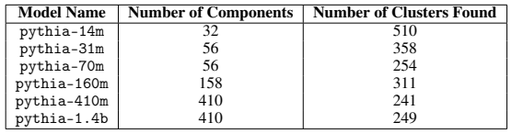
Table 7 : Pythia models from 14M-1.4B parameters and the results of clustering.
원문 · CC BY 4.0 · Andrew Gordon, Garrett Baker, George Wang, William Snell, Stan van Wingerden, Daniel Murfet · Towards Spectroscopy: Susceptibility Clusters in Language Models · 원문 그림 인용 · 원본 PDF 24쪽에서 그림 영역을 추출했습니다.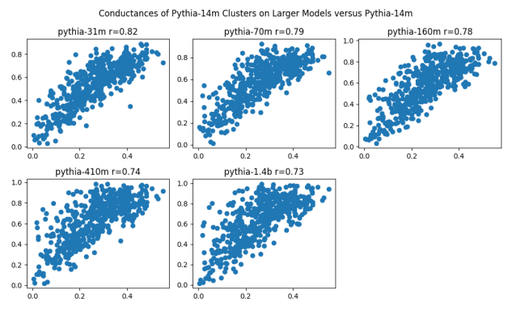
Figure 5 :Conductance of Pythia-14M clusters in larger models.Each point represents one of the 510 clusters, with its conductance measured on the susceptibility distance graph of a larger Pythia model (y-axis) versus Pythia-14M (x-axis). Clusters with low conductance in both models correspond to patterns that persist across scale.
원문 · CC BY 4.0 · Andrew Gordon, Garrett Baker, George Wang, William Snell, Stan van Wingerden, Daniel Murfet · Towards Spectroscopy: Susceptibility Clusters in Language Models · 원문 그림 인용 · 원본 PDF 24쪽에서 그림 영역을 추출했습니다.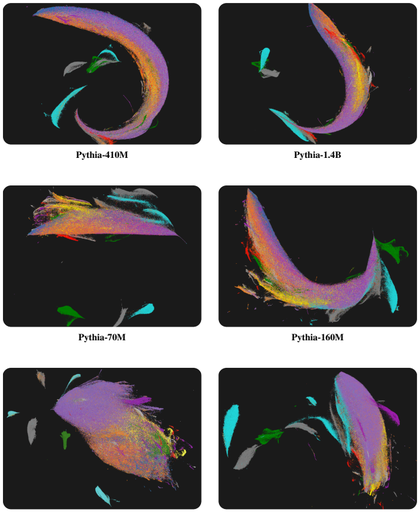
Figure 6 :UMAP visualizations of susceptibility vectors across the Pythia family.Each panel shows the low-dimensional representation of susceptibility vectors for the same set of token sequences, computed from models ranging from 14M to 1.4B parameters. Points are colored by token pattern type. The overall structure – including the separation of spacing tokens, the clustering of similar patterns, and the broad organization into regions – persists across model scales, though the precise geometry varies.
원문 · CC BY 4.0 · Andrew Gordon, Garrett Baker, George Wang, William Snell, Stan van Wingerden, Daniel Murfet · Towards Spectroscopy: Susceptibility Clusters in Language Models · 원문 그림 인용 · 원본 PDF 25쪽에서 그림 영역을 추출했습니다.한계와 남은 질문
연구는 Pythia 계열과 Pile 데이터에 한정되며, 군집화 결과는 k와 전도도 임계값 같은 설정에 의존합니다. 저자들은 결과가 합리적인 변화에 대해 견고하다고 보고하지만, 다른 설정에서는 경계가 달라질 수 있습니다. 또한 susceptibility 분석이 프런티어 규모로 확장되었다는 증거는 아직 없습니다. Gaussian 사후분포 기반 susceptibility는 군집 수와 구성요소 간 상관 측면에서 Gibbs 사후분포 방식보다 열등하다고 보고되며, 이는 사후분포 구조가 결과에 기여함을 보여주는 근거로 제시됩니다.
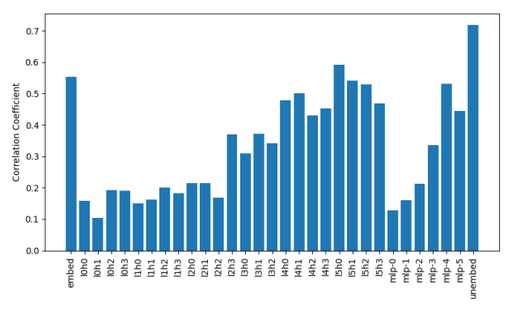
Figure 10 :Component-wise correlation between susceptibility types.Pearson correlation between Gaussian posterior and usual susceptibilities, computed separately for each of the 32 components.
원문 · CC BY 4.0 · Andrew Gordon, Garrett Baker, George Wang, William Snell, Stan van Wingerden, Daniel Murfet · Towards Spectroscopy: Susceptibility Clusters in Language Models · 원문 그림 인용 · 원본 PDF 31쪽에서 그림 영역을 추출했습니다.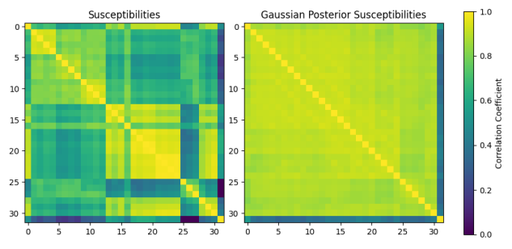
Figure 11 :Inter-component correlation structure.Correlation matrices for usual susceptibilities (left) and Gaussian posterior susceptibilities (right) across the 32 components. The higher off- diagonal correlations on the right indicate that Gaussian posterior susceptibilities are less sensitive to differences between components.
원문 · CC BY 4.0 · Andrew Gordon, Garrett Baker, George Wang, William Snell, Stan van Wingerden, Daniel Murfet · Towards Spectroscopy: Susceptibility Clusters in Language Models · 원문 그림 인용 · 원본 PDF 32쪽에서 그림 영역을 추출했습니다.논문 정보
- 저자
- Andrew Gordon, Garrett Baker, George Wang, William Snell, Stan van Wingerden, Daniel Murfet
- 학회·저널
- arXiv · 프리프린트
- 최초 공개일
- 2026년 1월 19일
- 등록일
- 2026년 10월 30일
- 수정일
- 2026년 1월 19일
- 버전
- v1
- arXiv
- 2601.12703
- 분류
- cs.LG
- 원문 이용 조건
- CC BY 4.0
- 제공 범위
- 논문 정보, 해설, 허용된 원문 그림
AI 해설은 논문 원문과 별개의 설명이며 오류가 있을 수 있습니다. 원문과 그림은 각 출처의 이용 조건과 따로 표시된 권리를 따릅니다.
초록
Spectroscopy infers the internal structure of physical systems by measuring their response to perturbations. We apply this principle to neural networks: perturbing the data distribution by upweighting a token $y$ in context $x$, we measure the model's response via susceptibilities $χ_{xy}$, which are covariances between component-level observables and the perturbation computed over a localized Gibbs posterior via stochastic gradient Langevin dynamics (SGLD). Theoretically, we show that susceptibilities decompose as a sum over modes of the data distribution, explaining why tokens that follow their contexts "for similar reasons" cluster together in susceptibility space. Empirically, we apply this methodology to Pythia-14M, developing a conductance-based clustering algorithm that identifies 510 interpretable clusters ranging from grammatical patterns to code structure to mathematical notation. Comparing to sparse autoencoders, 50% of our clusters match SAE features, validating that both methods recover similar structure.
원문 인용
Andrew Gordon, Garrett Baker, George Wang, William Snell, Stan van Wingerden, Daniel Murfet (2026). Towards Spectroscopy: Susceptibility Clusters in Language Models. arXiv:2601.12703v1. https://arxiv.org/abs/2601.12703v1
BibTeX
@misc{gordon2026towards,
  title = {{Towards Spectroscopy: Susceptibility Clusters in Language Models}},
  author = {Andrew Gordon and Garrett Baker and George Wang and William Snell and Stan van Wingerden and Daniel Murfet},
  year = {2026},
  eprint = {2601.12703},
  archivePrefix = {arXiv},
  url = {https://arxiv.org/abs/2601.12703v1}
}